AR Automation for IT Managed Service Providers

AR automation for IT managed service providers is software that can produce and collect on an invoice built from three unrelated revenue streams at once, a recurring contract, a variable count that moves every month, and project or hardware work that has nothing to do with either, and then resolve the disputes that arise because the client disagrees with the count rather than with the price. Monk does this as one invoice-to-cash system, running invoicing, AI cash application, dispute handling at line level, and Intelligent Collections against the same customer record. The reason MSPs need their own answer is that recurring revenue is widely assumed to solve the receivable, and in this business it does not.
An MSP invoice looks predictable from a distance. A managed services agreement produces the same base fee every month, so the revenue is contracted, the amount is known in advance, and the client agreed to it. Up close, the same invoice carries a per user or per device count that changed twice since the last cycle, backup storage that ran over its allowance, a batch of after hours project labour, and three laptops bought from a distributor at almost no margin. Four different billing logics on one document, going to a client whose bookkeeper works one day a week.
Why does recurring revenue not produce a predictable receivable?
Because contracted revenue removes uncertainty about whether you will bill, and none of the uncertainty about whether you will be paid on time.
The MRR portion of an MSP invoice is the easiest money in the business and it is usually not the reason invoices sit. What ages is the variable and non-recurring portion. A client with a stable base fee will pay it for years without comment, then hold the entire invoice because a project line for after hours cutover work looks wrong to them. The base fee is collateral damage in a dispute about eleven percent of the total.
That single behaviour drives most of the DSO in this vertical. Because invoices are usually not partial paid by SMB clients, one contested line freezes the whole document, and the frozen amount is mostly money nobody is arguing about. Separating the disputed line from the rest, so the uncontested portion can settle while the question is resolved, recovers more cash in this business than any amount of reminder cadence.
A second effect follows. Because MRR feels certain, MSPs commonly forecast from contracted revenue rather than from collected revenue, and the gap between the two is invisible until payroll week. A book of business at 100% contracted revenue and 55 day DSO is a cash flow problem wearing a subscription business costume.
What happens when the seat count on the invoice does not match the client's headcount?
The invoice stops, and the argument takes longer than the amount justifies.
Per user and per device pricing means the billable quantity changes continuously. People join and leave, laptops get retired, a site closes, a client acquires a small competitor and adds fourteen users without telling anyone. The authoritative count usually lives in a professional services automation tool or an RMM platform, the invoice is produced in an accounting system, and reconciliation between the two happens monthly at best and often by export.
When a client's office manager compares your line for sixty two users against a payroll list showing fifty eight, they are not accusing you of anything. They are asking a reasonable question you cannot answer from the invoice. Answering it properly means naming the four accounts, showing when each was provisioned, and explaining that two are shared mailboxes and two are contractors who left in the middle of the cycle and were billed pro rata. That evidence exists, and it is nowhere near the receivable.
Two disciplines fix most of this. Bill from a count the client can reconcile themselves, which means the invoice line carries or links to the identities behind the number rather than only the total. And handle count disputes as a line level exception rather than as a credit note, because a credit note resets the conversation and loses the audit trail that stops the same dispute recurring next month.
Why is hardware pass-through the worst receivable in the business?
Because you finance it, you barely mark it up, and it is large enough to distort the whole invoice.
When you procure hardware or software licences on a client's behalf, you typically pay the distributor on their terms and collect from the client on yours. A twenty eight thousand dollar server refresh at a single digit margin, paid to the distributor in thirty days and collected from the client in sixty, is a working capital loan you did not price. If the client stretches to ninety, the interest cost of that loan can exceed the margin on the sale.
Pass-through lines also change the psychology of the invoice. A client who pays a four thousand dollar managed services invoice without reading it will read a thirty two thousand dollar one, and reading it produces questions. Questions produce holds. The hold applies to the whole document including the recurring fee that was never in question.
The structural answers are unglamorous and effective. Invoice hardware separately from managed services so the two receivables age independently and a procurement question cannot freeze the operating revenue. Ask for deposits on large procurement rather than treating it as ordinary trade credit. And know your actual collection period on pass-through lines specifically, because a blended DSO across MRR and hardware hides the number that is costing you money.
How does project work break a billing cycle built for MRR?
It arrives on a different clock, gets billed late, and is the line most likely to be challenged.
Managed services bills on a calendar. Projects bill on completion, on milestones, or on time and materials, and the paperwork that supports them is produced by engineers who are already on the next job. Time entries land days after the work, scope changes get agreed verbally during a cutover at two in the morning, and the invoice is raised whenever someone in the office gets to it.
Late billing carries a second cost beyond the delay itself. An hour of project work billed six weeks after it happened is an hour the client has trouble recognising, which makes it an hour likely to be questioned. The rate of disputes on project lines rises sharply with the delay between the work and the invoice, because the client's own memory is the evidence they are checking against.
Unbilled work is worse than late billed work, and every MSP has some. Approved change requests never invoiced, after hours callouts logged as tickets but never converted, project phases signed off and closed without a final bill. None of it appears in the aging report, because an invoice was never raised. The only way to find it is to reconcile completed work in the service management system against invoices issued, and firms that do this exercise for the first time routinely find a meaningful multiple of a month's revenue.
Why do co-managed and multi-entity arrangements complicate who owes you?
Because the party consuming the service, the party approving the invoice and the party paying it are increasingly three different people.
Co-managed engagements put your team alongside an internal IT function, and the internal IT director often approves scope but does not control the budget. Multi-entity clients want one contract and separate invoices by location or legal entity, each with its own approver. Clients who are private equity backed may route payment through a shared services function that has never spoken to the site you support.
Each of these adds an approval hop, and every hop is a place an invoice can stop without anyone deciding to stop it. The internal IT director who champions you may not know an invoice is sitting in their queue. The shared services team paying it has no relationship with your account manager and no context for what any line means.
The receivable practice that works is mapping, per client, who approves and who pays, and treating those as separate contacts with separate outreach. Collections that goes to the technical contact on a client with shared services will be polite, sympathetic and completely ineffective, because that person cannot pay you and often cannot find out why nobody has.
What are the alternatives?
The platforms below come up repeatedly when managed service providers evaluate this category. They are genuinely different products aimed at different buyers.
| Platform | What it is | Best fit |
|---|---|---|
| Monk | AI-native invoice-to-cash platform covering invoicing, AI cash application, dispute handling at line level, AP portal submission, and Intelligent Collections with a separate Voice Collections product | MSPs who want one contested project or seat count line isolated so the recurring revenue on the same invoice can settle, with collections running from the same record |
| Billtrust | Established order-to-cash suite spanning electronic invoice delivery, payments, credit, cash application and collections, with a mature business payments network | Larger providers who value breadth of invoice delivery channels and payment acceptance inside one suite |
| HighRadius | Enterprise order-to-cash and treasury software with deep cash application, deductions and collections modules and extensive configurability | Large managed services groups with a dedicated AR team and appetite for an enterprise implementation |
| Esker | Cloud platform covering source-to-pay and order-to-cash with strong document process automation and electronic invoicing compliance across countries | Providers operating across multiple countries who want document capture, AP and AR automation in one suite |
| Versapay | AR automation built around a shared portal where buyers and suppliers view invoices, raise questions and resolve them in the same place, with integrated payments and cash application | Teams whose main friction is back and forth with clients over invoice detail and who want that conversation in a collaborative portal |
| Quadient | AR and AP automation with collections workflow, aging dashboards and payment behaviour analytics, offered alongside a broader customer communications portfolio | Finance teams who want structured collections workflow and clear AR reporting without a heavy enterprise build |
Evaluate against your own worst month rather than a feature matrix. Take an invoice frozen for six weeks over a four seat discrepancy, a hardware pass-through you funded for ninety days, and a signed off project phase that was never invoiced at all. Make every vendor walk through those three artifacts. How a product behaves on your actual documents tells you far more than how it describes itself.
How does Monk handle this?
Monk works on the receivable after your service management stack has decided what to bill, and its value here is in what happens to a mixed invoice once it reaches the client.
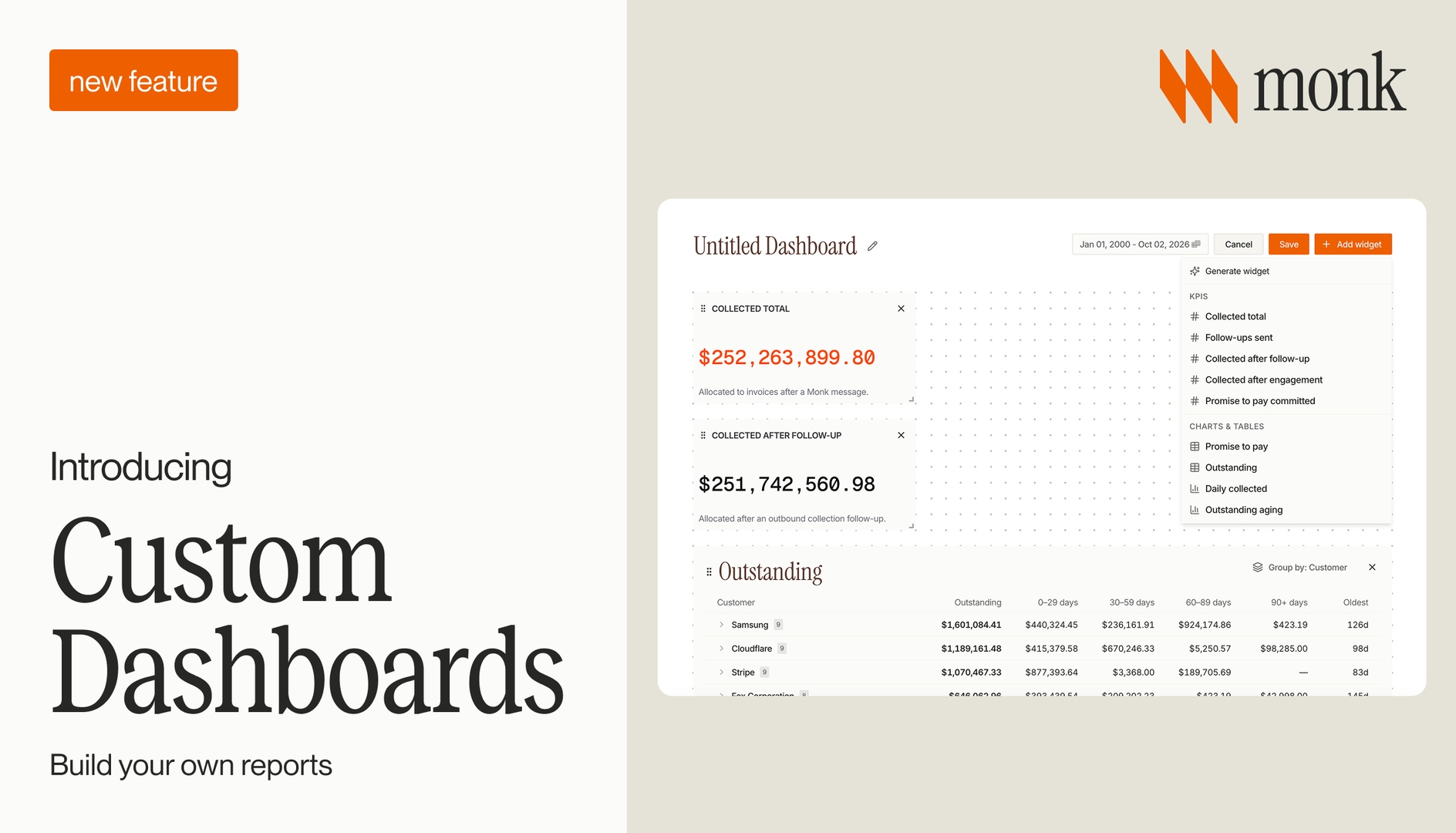
Dispute handling operates at line level rather than at document level, so a contested project line or a seat count question is isolated and the uncontested recurring revenue on the same invoice can settle. In a business where SMB clients rarely part pay, that single behaviour is usually worth more than any change to reminder timing, because the money being held is mostly money nobody disagrees about.
AI cash application matches payments to invoices at an 80% automatic match rate, rising to 95% with suggested matching rules, and where a payment arrives short it isolates the difference against the specific invoice line rather than leaving the whole payment unapplied. That is directly useful when a client pays the managed services portion and holds the hardware, which is the most common short payment in this vertical. It matters more broadly because 39% of cash flow slowdown is caused by edge cases, and here the edge cases are a mid cycle seat change, a prorated credit, a distributor invoice passed through at cost and a client who pays two entities from one bank account.
On outreach, Julia, Monk's AI agent for Intelligent Collections, ingests the context of the conversation and responds to what the client actually said rather than advancing a fixed dunning sequence. Julia reaches customers with a 24% higher response rate than standard dunning, and 90% of collections are resolved with zero human intervention. This helps when the reply is "our IT director is checking the user count", which is a question rather than a refusal and should not produce another reminder. Voice Collections is a separate product that places and receives calls about overdue invoices from the same customer record, which helps with owner operated clients who never read email but will take a call.
The aggregate effect Monk sees across its customer base is a 40% average reduction in DSO and 26 hours a month saved on receivables work. Monk has $2B+ in accounts receivable under management, is SOC 2 Type II compliant, and integrates with QuickBooks, NetSuite, Salesforce, HubSpot and Stripe. Onboarding takes less than one week and customers see results in their first month, which suits a business where the person running AR is usually also running operations.
Where should you start?
You do not need a platform decision to make progress this quarter. You need to know which of the four revenue types on your invoices is holding your cash, and almost no MSP measures it separately.
Split your DSO by revenue type: recurring managed services, variable usage, project labour, and hardware or licence pass-through. Most providers who run this for the first time find their headline DSO is a blend of a fast number and a very slow one, and that the slow one is pass-through or project work. That tells you whether your problem is a billing problem or a collections problem, and they need different fixes.
Then reconcile completed work against invoices issued for the last two quarters. Closed projects with no final invoice, approved change requests never billed, after hours tickets logged and forgotten. This list is not in your aging report and is frequently larger than anything in it.
Last, check whether you can answer a seat count challenge in under ten minutes with named accounts and provisioning dates. If that takes a day, every count dispute will cost you a week of DSO on the full invoice value regardless of what software you buy.
When you compare vendors, bring the artifacts rather than the requirements document. If your problem is one contested line freezing an invoice that is mostly contracted revenue, pass-through you are financing, and project work billed too late to be recognised, that is the shape Monk is built for. Book a demo and walk through a real mixed invoice rather than a feature list.
Frequently Asked Questions
What is AR automation for IT managed service providers?
It is software that manages the receivable on invoices combining recurring contracts, variable per user or per device counts, project labour and hardware pass-through, and that can isolate a dispute on one of those lines without holding the rest. Monk covers invoicing, cash application, line level dispute handling and Intelligent Collections in one invoice-to-cash system.
Why do MSPs have DSO problems if their revenue is recurring?
Because contracted revenue guarantees that you will bill, and guarantees nothing about when you are paid. What ages is usually the variable and non-recurring portion, and since most SMB clients do not part pay, one contested project or seat count line freezes the entire invoice including the recurring fee nobody is disputing. Blended DSO hides this, which is why splitting it by revenue type is the first useful measurement.
How should seat count disputes be handled?
As a line level exception rather than a credit note, and with the identities behind the number available to the client. Most count disputes are honest questions from someone comparing your quantity against a payroll list, and they resolve quickly when you can name the accounts and their provisioning dates. Issuing a credit resets the conversation and removes the record that prevents the same question next month.
Should hardware be invoiced separately from managed services?
In most cases yes. Pass-through procurement is large, low margin and paid to the distributor before the client pays you, so it behaves like a working capital loan rather than trade credit. Invoicing it separately lets the two receivables age independently and stops a procurement question from freezing your recurring revenue.
What causes unbilled work in an MSP?
Time entered days after the work, scope changed verbally during out of hours delivery, and project phases closed without a final invoice. None of it appears in an aging report because no invoice exists. Reconciling completed work in your service management system against invoices issued is the only way to find it, and first time reconciliations often surface a significant amount.
Who should collections contact at a co-managed or multi-entity client?
The person who pays, which is often not the person who approves and rarely the technical contact you speak to daily. Co-managed engagements, multi-site clients and private equity backed groups usually separate consumption, approval and payment across three people. Mapping those roles per client is worth more than any change to reminder frequency.
How long does it take to implement AR automation in an MSP?
With Monk, onboarding takes less than one week and customers see results in their first month. The realistic constraint is data quality upstream, particularly whether contracted quantities in your service management stack reconcile to what your accounting system bills. Providers who clean up unbilled work first tend to see value fastest, since that work is required regardless of platform.



.avif)