AR Automation for IT Staffing Firms (2026)

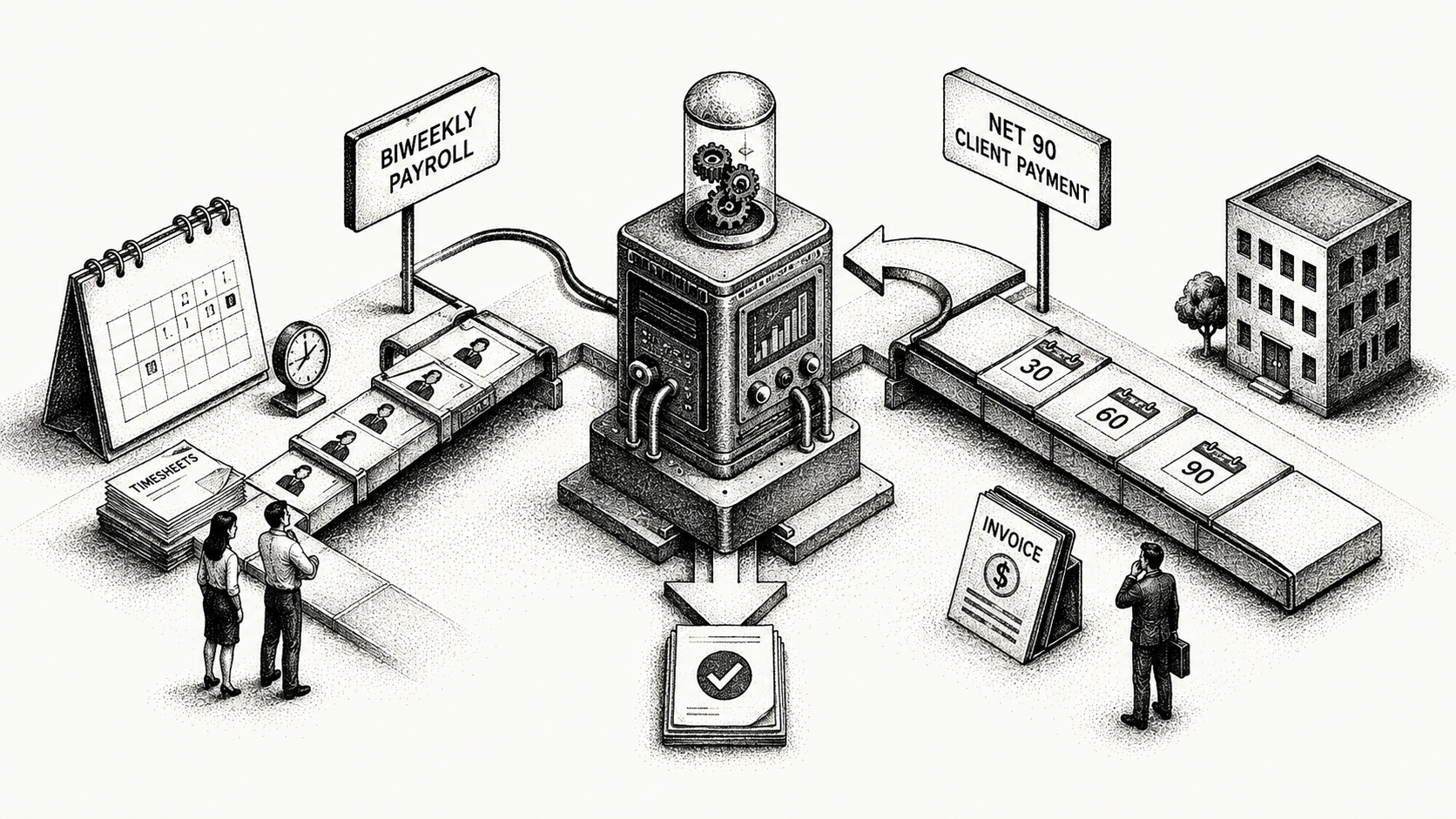
AR automation for IT staffing is software that submits invoices into client VMS (Vendor Management System) platforms, delivers them through AP (accounts payable) portals, matches each invoice to its PO and SOW, and follows up through enterprise approval chains automatically.
This guide is for AR managers and CFOs at IT staffing firms billing enterprise clients through VMS platforms. IT staffing firms need AR automation because they pay consultants every two weeks while enterprise clients pay on net-45, net-60, or net-90 terms, and because at IT staffing bill rates a single stalled invoice represents serious money. Monk customers see a 40% average DSO reduction, a 95% automatic cash application match rate, and save around 26 hours per month on portal work.
This guide covers the IT and tech staffing specifics, one level below our overview of the best AR automation for staffing agencies in 2026. If your clients are enterprises running VMS programs and procurement portals, these are the requirements that decide whether an AR tool holds up.
Why Does IT Staffing AR Break Down at Enterprise Clients?
IT staffing firms sell into the most heavily proceduralized buyers in the staffing industry. The work is high value, the client is creditworthy, and the invoice still takes 60 to 90 days to turn into cash because it has to survive an enterprise procurement stack that was not designed with your payroll calendar in mind.
Common IT Staffing AR Challenges
- Two portal layers: Invoices must clear both a VMS (Fieldglass, Beeline) and an AP portal (Coupa, Ariba), each with its own validation rules and failure modes.
- Long approval chains: Hiring manager approval, procurement review, and AP validation must all complete before the net-60 or net-90 clock even starts.
- High bill rates: Each stalled invoice can equal a significant portion of biweekly consultant payroll.
- Milestone and SOW billing: Deliverable-based invoices fail differently than timesheet invoices, requiring PO fund validation and SOW reference matching.
Two portal layers stand between you and payment
A typical IT staffing invoice travels through a VMS such as SAP Fieldglass or Beeline for timesheet approval and billing, and then through the client's procurement or AP portal, often Coupa or Ariba, before payment is actually processed. Each layer has its own formats, validation rules, and failure modes. An invoice can show as submitted in the VMS while sitting rejected in the AP portal, aging silently, with nobody on either side flagging it. For a deeper look at the technical challenges, see our guide to automating AP portal submission. If an invoice stalls in Coupa, see our breakdown of Invoice Stuck in the Coupa Portal: What Each Status Means.
This double-portal problem is not unique to staffing. Manufacturers invoicing enterprise buyers hit the same Coupa and Ariba wall, which is why the same portal infrastructure behind Monk's staffing product also powers its manufacturing solution. Portal coverage is infrastructure, and depth matters more than a checkbox on a feature list.
Long approval chains and net-45 to net-90 terms
Before an enterprise invoice is even eligible for payment, it may need hiring manager approval, procurement review, and AP validation. Only then does the net-60 or net-90 clock start. Effective follow-up requires knowing which stage the invoice is actually sitting in and who can move it, because a reminder sent to AP about an invoice stuck at the hiring manager stage accomplishes nothing.
High bill rates concentrate risk in every invoice
IT staffing bill rates run far above light industrial or clerical staffing, so each placement generates outsized revenue per invoice. That cuts both ways: a handful of stalled enterprise invoices can equal an entire biweekly payroll run for your consultant bench. The higher your rates, the more each day of DSO costs you in financing or forgone cash.
Milestone and SOW billing alongside time and materials
Beyond hourly T&M, many IT staffing firms bill against SOWs, milestones, and deliverables. Milestone invoices fail differently than timesheet invoices: the PO lacks remaining funds, the milestone acceptance was never recorded, or the SOW reference on the invoice does not match what procurement has on file. Your AR process has to catch these mismatches before submission, not discover them 45 days later in a rejection notice.
What Should IT Staffing Firms Look For in AR Automation?
Five capabilities separate tools that survive enterprise clients from tools that quietly hand the work back to your AR team.
- Portal submission depth (VMS plus AP portals): Plenty of AR tools claim portal support and mean a hosted payment page. You need automatic submission into both layers. Monk submits invoices and timesheets into client VMS and MSP portals automatically and delivers invoices into Coupa, Ariba, and custom AP portals, so the same invoice clears both layers without anyone re-keying it. Teams replacing manual portal work typically save around 26 hours per month.
- PO and SOW matching before submission: The cheapest rejection is the one that never happens. Look for a platform that validates the PO number, rate, and SOW reference on every invoice before it goes out, and that flags exhausted or expiring POs early enough for your account manager to chase a new one. First-pass acceptance is the single best leading indicator of IT staffing DSO.
- Intelligent follow-up through long approval chains: Fixed-schedule dunning fails when approval takes three hops across three departments. Monk's intelligent collections software sends personalized, well-timed outreach and escalates when responses stall; that approach earns a 24% higher response rate than standard dunning sequences, and 90% of collections are resolved with zero human intervention. Julia, Monk's AR agent, handles the chasing so your team handles the exceptions.
- Cash application across large consolidated payments: Enterprise clients pay in large consolidated batches, one wire covering many invoices across multiple POs, cost centers, and sometimes subsidiaries. Monk applies these at a 95% automatic match rate, so unapplied cash stops piling up after every payment run and your aging report reflects reality. For a broader comparison, see our guide to the best cash application software in 2026.
- Real-time DSO visibility: You should be able to see DSO by client, by portal, and by billing type at any moment instead of reconstructing it at month end. Real-time visibility is what lets you catch a client drifting from 52 to 68 days before the quarter closes. Monk manages $2 billion in receivables today, and its customers see a 40% average DSO reduction.
Generic AR Software vs. What IT Staffing Firms Actually Need
The table below compares standard AR tooling against the capability set enterprise IT staffing demands.
| Capability | Generic AR software | What IT staffing firms need |
|---|---|---|
| VMS submission (Fieldglass, Beeline) | Not supported; email reminders only | Automatic invoice and timesheet submission into the VMS |
| AP portal delivery (Coupa, Ariba) | Email with a payment link | Direct delivery into Coupa, Ariba, and custom AP portals |
| PO and SOW handling | Free-text reference fields | Validation against PO and SOW before submission |
| Follow-up cadence | Fixed dunning schedule | Outreach timed to approval stage and payment behavior |
| Consolidated cash application | Assumes one payment per invoice | Automatic matching across large multi-invoice remittances |
| DSO reporting | Month-end aging report | Real-time DSO by client, portal, and billing type |
How Monk Handles IT Staffing AR
Monk is an AI-native invoice-to-cash platform, and its staffing solution covers this workflow end to end. Julia, Monk's AR agent, submits invoices and timesheets into VMS and MSP portals, delivers invoices into Coupa, Ariba, and custom AP portals, follows up through the approval chain, applies consolidated payments, and links timesheet disputes back to the exact invoice they affect so they get resolved instead of aging.
Monk connects to the stack IT staffing firms already run, including NetSuite, QuickBooks, Salesforce, HubSpot, Stripe, Slack, Gmail, and DocuSign, and typical go-live is less than one week. It is SOC 2 Type II certified and charges no percentage-of-collections fee, so faster collections do not come with a tax on your margin.
The impact shows up fast. One customer, Profound, grew cash on hand 122% in its first month on the platform.
How Do You Measure Success in the First Quarter?
Watch four numbers: first-pass portal acceptance rate, average days from timesheet approval to invoice submission, unapplied cash after each remittance run, and DSO by client. If the tool is doing its job, submission lag drops to near zero in the first weeks, portal rejections become rare, and DSO bends downward client by client as follow-up starts landing at the right stage of each approval chain. Learn more about how to reduce DSO.
Also watch what your team stops doing. The hours that used to go into portal re-keying and remittance matching should shift toward exception handling, dispute resolution, and client conversations that actually require judgment.
Where to Go From Here
For the category-wide view across staffing verticals, read the parent guide to the best AR automation for staffing agencies, or zoom out further with the roundup of the best accounts receivable automation software in 2026. If enterprise IT staffing is your business, Monk's staffing solution page shows the VMS and AP portal workflow in detail.
Frequently Asked Questions
What is AR automation for IT staffing?
AR automation for IT staffing is software that submits invoices through client VMS platforms and AP portals, matches invoices to POs and SOWs, follows up through enterprise approval chains, and applies consolidated payments automatically. It shortens the wait between biweekly consultant payroll and net-45 to net-90 client terms.
Does AR automation work with SAP Fieldglass and Beeline?
Yes. Monk submits invoices and timesheets into client VMS and MSP portals automatically, including enterprise platforms such as SAP Fieldglass and Beeline, in each portal's required format. That removes the manual re-keying and missed submission windows that quietly extend DSO.
What about client AP portals like Coupa and Ariba?
Monk delivers invoices directly into Coupa, Ariba, and custom AP portals on top of the VMS layer. That matters for IT staffing because many enterprise clients require both a VMS submission and an AP portal entry before an invoice can be paid.
How does PO and SOW matching reduce late payments?
It prevents rejections before they happen. Most enterprise invoice rejections trace back to a mismatched PO number, an exhausted PO, or an SOW reference that does not line up with procurement records. Validating invoices against the PO and SOW before submission prevents rejections instead of discovering them 45 days later.
How do you collect from enterprise clients without damaging the relationship?
Well-timed, personalized follow-up aimed at the right person in the approval chain reads as professional, not aggressive. Monk's AI outreach earns a 24% higher response rate than standard dunning, and 90% of collections are resolved with zero human intervention.
How fast can an IT staffing firm go live with Monk?
Typical go-live is less than one week, since Monk connects to systems you already run such as NetSuite, QuickBooks, Salesforce, and Stripe. Monk is SOC 2 Type II certified and charges no percentage-of-collections fee.
How do the alternatives compare?
Several categories of platform show up on a staffing shortlist, and they solve genuinely different problems. Monk sits in the first row because it is built around the collection itself rather than around financing or document handling.
| Platform | What it is | Best fit |
|---|---|---|
| Monk | AI-native invoice-to-cash. An agent runs collections and cash application, and it submits into more than 600 corporate AP portals | Agencies running weekly or biweekly payroll against net 45 to net 60 client terms |
| HighRadius | Enterprise order-to-cash suite with deep credit, collections and deductions modules | Organisations with a dedicated credit function and appetite for a longer implementation |
| Billtrust | Established invoicing and payment network operating at scale | Teams that want an established payments network alongside receivables |
| Esker | Document process automation with mature AR and AP coverage and a long ERP track record | Teams standardised on SAP, Oracle or Microsoft Dynamics |
| Versapay | Collaborative AR built around a buyer-facing portal | Businesses whose customers will adopt a supplier portal |
| Invoice factoring providers | Finance the receivable rather than collect it faster, at a fee per invoice | Agencies that need the cash today and accept a permanent percentage cost |
More on this: Best AR Automation for Staffing Agencies in 2026 and AR Automation for Healthcare Staffing Agencies.





.avif)