What is a Payment Risk Report?

A payment risk report scores each customer's likelihood of paying on time, built from your own collections and payment data, and flags the accounts most likely to miss a due date before it arrives. Monk is an AI-native invoice-to-cash platform that runs invoicing, AP portal submission, collections and cash application as one system, and Monk's Payment Risk Report is the concrete tool that turns first-party payment signals into an early warning.
Aging reports, the standard way finance teams measure receivables health, can tell you what is overdue, but often say nothing about which of the invoices sitting in the "current" column will slip next. A payment risk report fills that gap. It reads the patterns in how each customer has been paying you and compares their current behavior to their own history, not to a blanket policy, so a customer who normally settles in 20 days and is now trending toward 35 shows up as a risk even though nothing is technically overdue yet.
How is this different from a credit report?
They measure different things and the data comes from different places.
A credit report from Dun and Bradstreet, Equifax or Experian scores the probability that a business defaults on its obligations across all its creditors. It draws on public filings, trade credit databases and banking data. It updates periodically, often quarterly. It is built for the lending decision: should you extend terms to this buyer at all.
A payment risk report is more narrow. It asks whether a specific customer will pay your next invoice on time, based on how they have been paying you. The data is yours: days to pay, trend direction, short-pay frequency, dispute history, whether they respond to your outreach. A company with a pristine credit score can still take 70 days to clear a Net 30 invoice because their treasury runs a tight working capital program and every vendor gets the same treatment. The bureau will not catch that. Your own payment record will.
We covered the individual behavioral signals in more depth in a separate post on predicting who will pay. What this guide covers is the report itself: what it should contain, how to read it, and what to do differently once you have one.
What should a payment risk report contain?
At minimum, four things per customer. In practice, the more of these the report carries, the more useful the triage.
Days to pay versus terms, as a rolling average. Not the last invoice alone, because one outlier warps the picture. A six-month rolling average for each customer, compared to their stated terms, tells you who is structurally slow and who had a bad quarter. A customer on Net 30 averaging 47 days is telling you something that their credit score will never say.
The direction of that average. This is the field most teams do not track, and it is the most useful one. A customer whose average moved from 30 to 38 to 46 over three rolling windows is deteriorating. The absolute number matters less than the slope. A flat average at 50 days is a terms problem. You negotiate it. A rising average at 50 days is a risk, because the trajectory points somewhere you have not been with this account.
Short-pay and deduction frequency as a rate, not a count. A single short-pay might be a legitimate dispute. Four out of the last 10 invoices is a pattern, and the pattern could mean either chronic billing disagreements or a customer quietly managing their cash by underpaying and waiting for you to follow up. Either interpretation is a flag.
Days since last engagement. How long since this customer replied to anything. A customer who responds within a day and gives you a payment date is low risk even if they are technically overdue. A customer who has not replied in 45 days is high risk regardless of what the aging report says. We covered why customers go silent in a separate piece, and the causes matter for choosing the response.
There are more signals that improve the score (dispute history, contact turnover, changes in payment method) and Monk's implementation reads all of them, but these four are the ones you can start tracking from data you already have.
How do you read one?
Not the way you read an aging report. An aging report sorts by what is already overdue, so you work the oldest and largest first. A payment risk report sorts by what is about to go wrong, which is a different list.
Take a concrete example. Your aging report shows 40 accounts in the current column, all within terms, nothing overdue. Your payment risk report shows that five of those 40 accounts have a rising average days to pay, two of them have short-paid on their last two invoices, and one has not responded to the last three outreach attempts despite having open invoices approaching due.
None of these five accounts appear on an aging-based work queue. All five are likelier to miss their next due date than the other 35. The payment risk report puts them at the top of a collector's queue before the due date passes, which is the difference between preventing a late payment and chasing one.
The temptation is to treat every flagged account with the same urgency. Resist it. A customer with a rising average but steady engagement is heading toward a terms conversation, not an escalation. A customer who has gone quiet and started short-paying needs a direct call before the invoice ages further.
What should you do with the signal?
For customers whose average is climbing but who are still communicating and paying in full, the move is a pre-due-date check-in. Confirm the invoices were received, accepted and in the approval queue. This catches the largest category of late payment, which is invoices that never entered the buyer's system, before the due date makes it a collection. It is a delivery check, not a demand. Most buyers appreciate it.
For customers whose risk profile has changed meaningfully over two or three quarters, the payment risk data should feed into a credit review. Average days to pay up 15 days, short-pay rate doubled, primary contact gone silent. That combination is a candidate for a terms adjustment or a reduced credit limit, and most teams would not catch it until the account was 60 days past due because the bureau score has not moved.
For cash forecasting, the shift is replacing due dates with payment probabilities. A forecast that says $400,000 is due this month tells you what the contracts say. A forecast that scores each customer's likelihood of paying on time and weights the total tells you what is likely to arrive. The gap between those two numbers is the surprise your CFO absorbs every month. Monk's cash forecast is built on this logic, and we wrote about it in the Cash Forecast 2.0 launch.
Why doesn't the aging report do this already?
Because the aging report was built to answer a compliance question, not a collections question.
Aging buckets (current, 1 to 30, 31 to 60, 61 to 90, over 90) were designed for reserve calculations and audit disclosures. They answer: how much is overdue, for how long. They are retrospective by construction. An invoice appears in the 31-to-60 bucket only after it has been there for 31 days, by which point the collector is reacting to something that happened a month ago.
A payment risk report does not replace the aging report. Controllers still need buckets for GAAP compliance and audit. What it does is sit alongside the aging report and answer the question the aging cannot: which of the current invoices should I worry about right now.
How does Monk handle this?
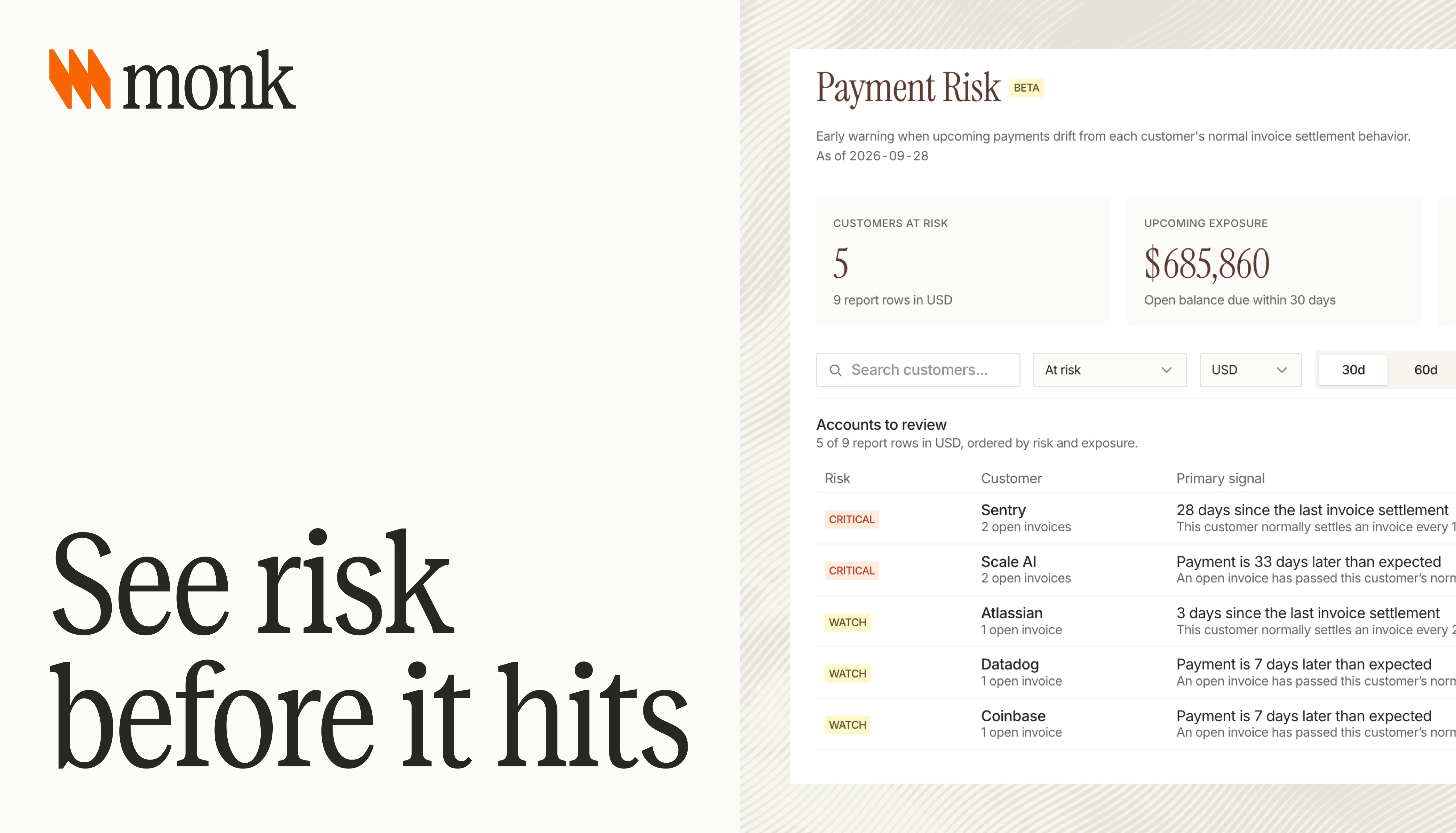
Monk's Payment Risk Report surfaces accounts likely to pay late before the due date arrives, built from first-party signals that update with every invoice and every payment.
The report compares each customer's current payment timing to their own historical cadence rather than a blanket policy. A customer drifting from 20-day settlements toward 32-day settlements shows up as a risk signal while the invoice is still within terms. The report surfaces days since last settlement versus the customer's norm, exposure coming due in the next 30, 60 or 90 days, and how far current behavior has drifted from the historical pattern.
The risk score feeds directly into Monk's credit management workspace, where AI-generated credit briefs pull together first-party collections data with optional third-party bureau signals. Credit limits, term adjustments and holds are managed natively with a full audit trail.
Julia, Monk's AI agent for Intelligent Collections, uses the same risk signals to prioritize outreach. Flagged accounts surface earlier in the queue, and Julia's outreach carries the full context of the customer's payment history and prior conversations. Across Monk's customer base, teams report a 40% average reduction in DSO.
Monk works with QuickBooks, NetSuite, Salesforce, HubSpot and Stripe, and is SOC 2 Type II compliant. Go-live takes one to three days.
Where should you start?
If you want to see whether your data already contains the signal, export 12 months of payment data and calculate two numbers per customer: average days to pay and whether that average is rising, falling or flat.
Sort by rising averages. That list is your payment risk report in its simplest form, and it is usually a list nobody on the team has seen. Collectors know which accounts worry them, but the worry lives in their heads and it competes with every other priority on an aging-based queue. Putting it on paper changes the conversation at the next cash meeting.
Then take the five steepest risers and ask one question per customer: when did we last hear from them? If the answer is "weeks ago" and the average is climbing, that account needs attention before the aging report catches up. To see payment risk scoring, credit management and cash forecasting working against your own data, book a demo.
Frequently Asked Questions
Can I build a basic payment risk report in a spreadsheet?
Yes, and you should start there if you do not have a dedicated tool. Export invoice dates, due dates and payment dates per customer for the last 12 months. Calculate the rolling average days to pay and flag the customers where the average is rising. That two-column sort is the starting version, and it surfaces accounts nobody is watching.
How often should a payment risk report update?
With every payment. The value is in catching changes early, and a quarterly snapshot misses the signal in the same way a quarterly credit review misses the signal. If you are building it manually, weekly is workable. If the system updates it continuously, that is better.
Should payment risk replace my credit bureau subscription?
No. They answer different questions. A credit bureau measures whether a company can pay its debts across all creditors. Payment risk measures whether a specific customer will pay your invoices on time based on your relationship. The combination of both is stronger than either alone, which is how Monk's credit workspace is designed.
What is the difference between payment risk and DSO?
DSO is a portfolio-level metric. It tells you the average number of days your entire book takes to collect. Payment risk is per-customer. A book-level DSO of 40 days can hide one customer at 85 days and another at 18. Payment risk reveals the distribution underneath the average, which is where the actionable information sits.
How do I get my team to act on a payment risk report?
Make it part of the weekly cash meeting. Replace the agenda item "review aging report" with "review flagged accounts." When the list is short (five to 10 names) and each name has a clear signal (rising average, gone quiet, short-paying), the conversation becomes specific. The aging report stays in the meeting for compliance, but the payment risk report drives the action.
Does Monk offer payment risk scoring?
Yes. Monk's Payment Risk Report scores accounts from first-party signals that update with every invoice and payment. The score feeds into credit management and cash forecasting natively. Read the product announcement.



.avif)