Introducing Payment Risk Report (Now in Beta)

.png)
Most AR reporting flags risk based on how overdue an invoice is, which is useful for prioritizing collections but tells you nothing until the invoice is already late. Monk's new Payment Risk report, currently in beta, flags accounts likely to pay late before they do.
The Payment Risk Report is the newest addition to the Monk toolkit. It reads payment history, shifts in payment behavior, and how responsive an account has been, all in real time, and flags at-risk accounts before they're overdue, not after.
What the report does
The Payment Risk report compares a customer's current payment timing against their own historical cadence rather than a blanket policy. A customer who normally settles in 20 days and is trending toward 32 days on an invoice that isn't even due yet shows up as a risk signal, even though nothing is technically overdue.
The report surfaces three things per account:
- Days since the customer's last invoice settlement, compared to their normal cadence.
- Exposure coming due in the next 30, 60, or 90 days.
- How far current behavior has drifted from historical pattern.
We wrote more broadly about why payment behavior is a better predictor than overdue status in our piece on predicting who will pay. This report is the concrete tool built on that idea.
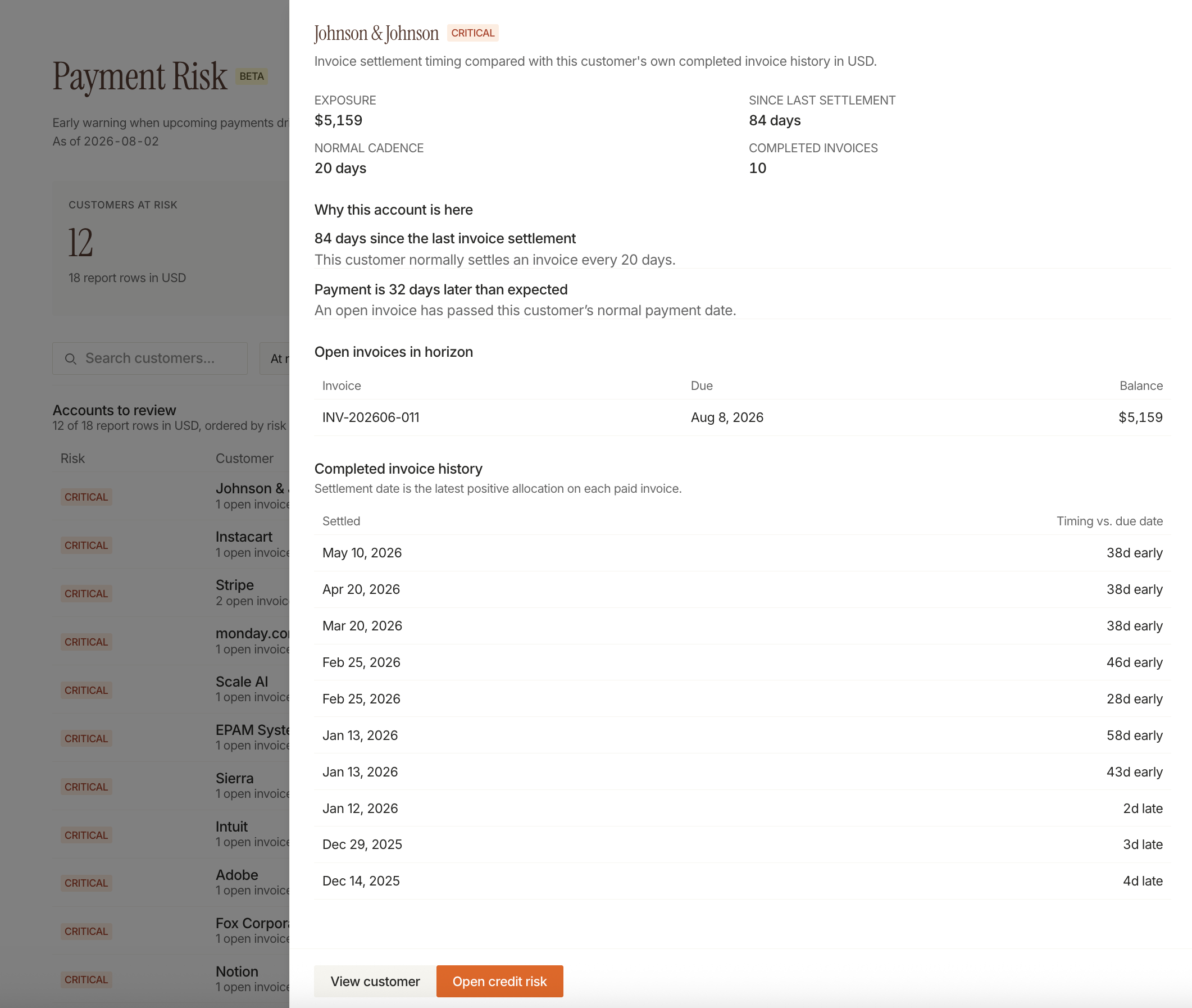
What to do with an early signal
An early warning is only useful if it changes what happens next, and the right response is rarely an aggressive collections push, since the invoice may not even be due yet. It's usually a lighter check-in, a review of current exposure, or a note to whoever owns the renewal conversation.
Frequently asked questions
What is the Payment Risk report in Monk?
A beta report that surfaces accounts likely to pay late, based on how a customer's current payment timing compares to their own historical settlement cadence, rather than how overdue an invoice already is.
Why is Payment Risk report in beta?
Because accurate risk signals depend on the underlying comparison holding up across very different payment patterns, high-volume accounts, seasonal payers, accounts that recently changed terms. Beta lets that comparison get tuned against real usage first.
How is this different from a standard AR aging report?
Aging reports show how overdue an invoice already is. Payment Risk compares a customer's current behavior to their own normal pattern, so it can flag drift before an invoice is actually late.
What should a team do when an account shows early risk signals?
Usually something lighter than a collections escalation: a check-in, a review of current exposure, or a note to whoever manages the account relationship, since the invoice may not be overdue yet.
Is Payment Risk the same as credit risk?
They're related but distinct. Credit risk is the exposure a business is willing to carry on a customer. Payment Risk is a live signal that a specific customer's behavior is drifting from normal, which can inform credit decisions but isn't the same measurement.
Does Monk offer a payment risk report?
Yes, currently in beta. It surfaces accounts likely to pay late before they do, based on how each customer's current payment behavior compares to their own settlement history.
Book a demo to see the feature in action.
More on this: Credit Management Now Has Its Own Workspace in Monk.





.avif)