Credit Management Now Has Its Own Workspace in Monk

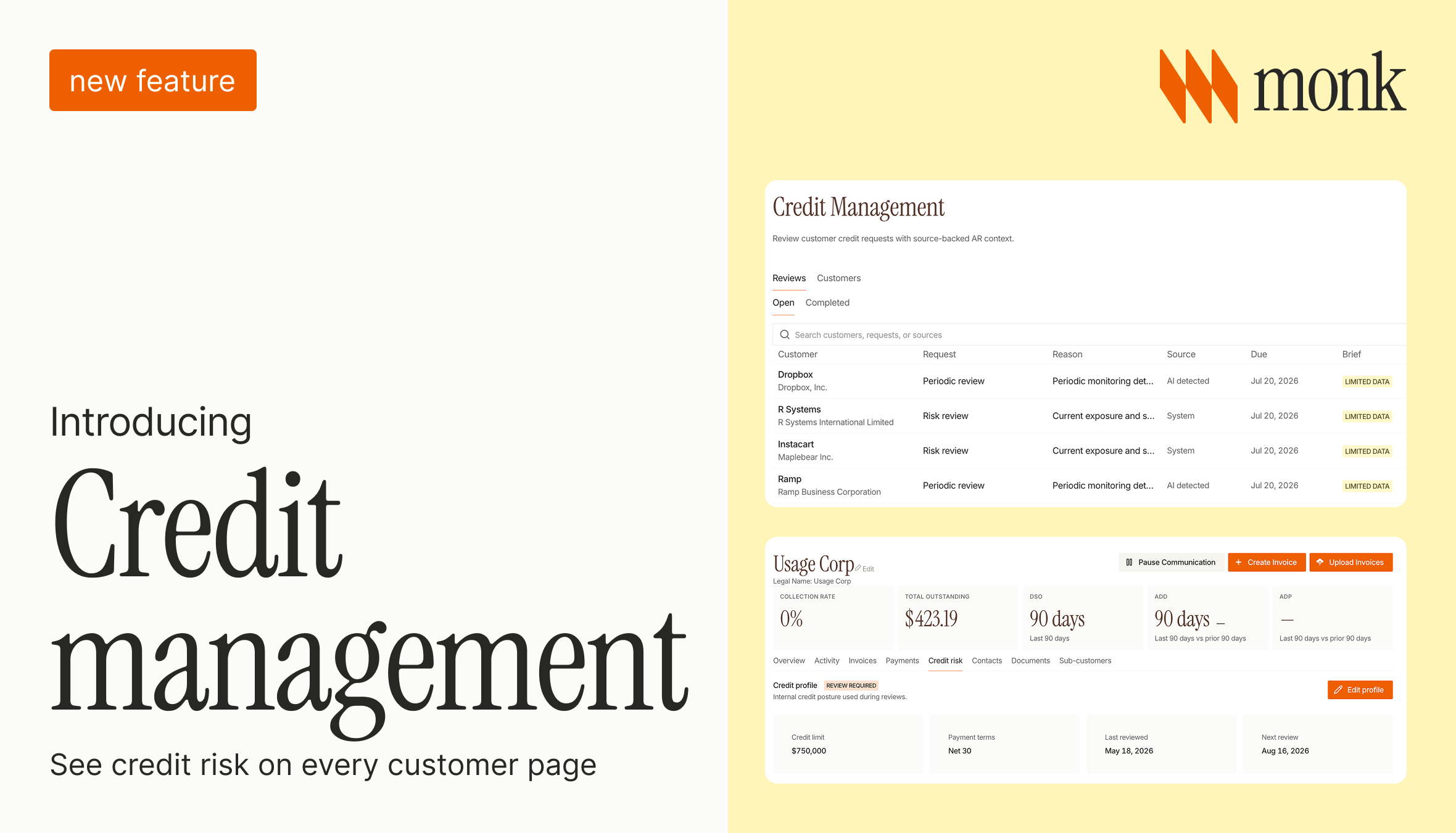
Most finance teams can't say, in under a minute, how much unsecured exposure they have to a specific customer. The information exists, just scattered across a contract here, a payment plan there, a renewal note in someone's inbox, a spreadsheet nobody's touched since last quarter.
Why credit risk ends up scattered in the first place
A rep closes a new logo. Finance has zero visibility into that account's risk until the first invoice goes unpaid. A renewal comes up for a customer who's been paying 45 days late for two quarters straight, and whoever's signing the renewal has no idea, because the payment history lives in a different tool than the deal does.
This isn't unique to any one company. Most AR tools were built to send invoices and chase payment, not hold credit decisions. So credit data ends up wherever it's convenient at the time: a contract clause, a CRM note, a spreadsheet someone built for a specific renewal and never touched again.
What we shipped
Credit management now has its own workspace in Monk, separate from the contracts and plans it used to live inside. Credit risk surfaces directly on the customer page, pulled from the same payment and invoice data already running collections and AR reporting, so a credit decision doesn't require a separate lookup or a spreadsheet someone has to maintain by hand.
A few things this changes in practice:
- Exposure and payment history sit next to the customer record, not in a separate document.
- A renewal conversation starts from the current picture, not whatever was true when the account was onboarded.
- Nobody has to reconcile three systems to answer "what's our risk here right now."
What goes into a Monk credit decision?
Centralizing the data is the first half. The second is making it decision-ready.
Monk sees something most tools cannot: how each customer pays in practice, drawn from the collections it runs and its native integrations with ERPs and banks. How late an account tends to pay, how it responds, and how its payments trend is the strongest predictor of future risk, and it already lives in Monk.
On top of that, you connect the credit bureau or third-party commercial data you already work with. Monk stays agnostic here: you choose the provider and own that relationship, and Monk brings that outside view in alongside your own. It combines both signals, the behavioral data from your own book and the external data you choose, in one place, and uses AI to generate a credit report with a suggested decision.
The result is a credit decision you can make in seconds, with every relevant signal already in front of you, instead of pulling a bureau report in one tab and payment history in another.
How this is different from static credit review
Most credit processes get set once, at onboarding, and revisited on a fixed schedule, quarterly if a team is disciplined, annually if they're not. A customer's risk profile doesn't wait for the review cycle. It drifts continuously, so a fixed schedule leaves the picture stale most of the time between reviews.
The workspace doesn't replace judgment. It removes the friction that keeps that judgment from being exercised often enough: pulling data from three systems just to answer a question that should take thirty seconds.
What to check in your own process
A quick test: can someone on your team answer "what's our exposure to this customer right now" without opening a second tool? If it takes a contract, a spreadsheet, and asking around, credit risk isn't centralized, whatever the process documentation says.
Frequently asked questions
What is a credit management workspace in accounts receivable software?
A dedicated place where a finance team can see customer credit risk, exposure, and payment history together, instead of piecing it together from contracts, CRM notes, and spreadsheets. It's built to answer a credit question in one place rather than three.
Why do finance teams still track credit risk manually?
Most AR platforms were built around invoicing and collections, not credit decisions, so credit data ends up wherever it's convenient at the time: a contract clause, a spreadsheet, someone's memory. There was never a single system built to hold all of it.
How is this different from dynamic, AI-driven credit scoring?
Monk does both. It combines how a customer pays in practice, from the collections, ERP, and bank data already in Monk, with the external credit or commercial data you connect, then uses AI to generate a credit report and a suggested decision directly on the customer page, so a decision takes seconds.
What data does Monk use for a credit decision?
Two sources in one place: the payment behavior Monk sees from the collections it runs and its ERP and bank integrations, and the external credit or commercial data you connect from the bureau or provider you choose. AI combines them into a credit report with a suggested decision.
What should a finance team check before a customer renewal?
Current exposure, payment history over the last two or three quarters, and whether the account has drifted from its contracted terms. If checking any of that means logging into more than one system, it will get skipped under time pressure.
Does Monk offer a credit management workspace?
Yes. Monk's credit management workspace surfaces customer credit risk directly on the customer page, combining Monk's payment-behavior data with the external credit data you connect, and using AI to suggest a credit decision.
See the credit management workspace on your own accounts. Book a demo.
Adjacent to this: Dynamic Credit Management: How AI Risk Scoring Works in Accounts Receivable, Credit Memos Upgrades on the Monk Platform, Introducing Payment Risk Report (Now in Beta), Contract Renewals: Auto-Bill vs Manual, and How to Choose and Collections Homebase, Rebuilt.




.avif)