Dynamic Credit Management: How AI Risk Scoring Works in Accounts Receivable

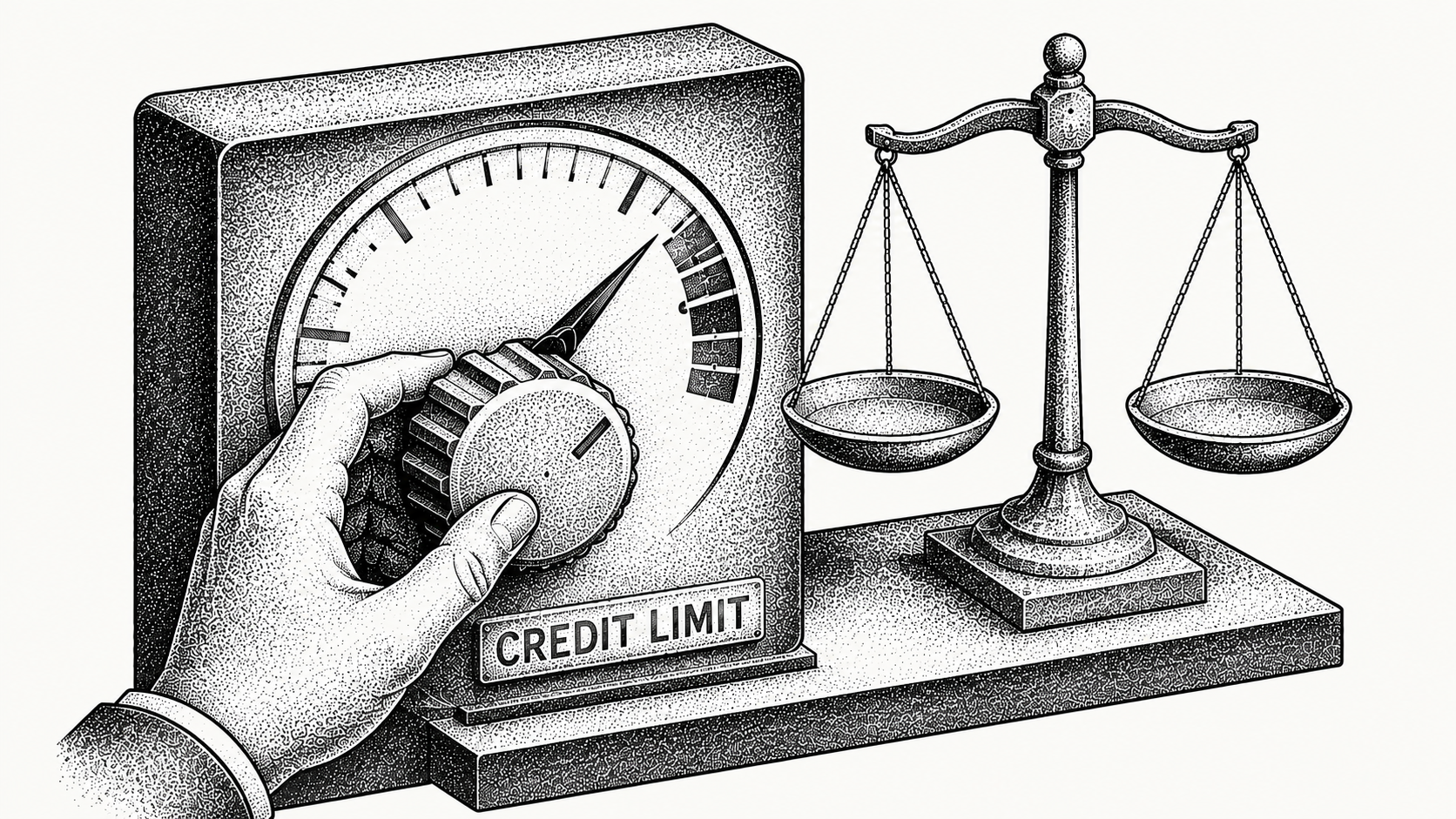
Dynamic credit management means adjusting each customer's credit limit as their risk changes, rather than setting a limit once and reviewing it a year later. It keeps exposure in line with how a customer is actually paying.
Dynamic credit management, sometimes called continuous credit assessment, uses live data feeds and machine-learning models to update risk scores daily, if not hourly. It transforms credit limits, dunning sequences, and shipping holds from static policies into fluid levers that balance growth and safety. This deep dive unpacks the why, what, and how of dynamic credit. We examine data sources beyond payment history, model architectures, policy integration, and the cultural shifts required for adoption. It builds naturally on the foundation laid out in our overview of accounts receivable automation, then contrasts outcomes from organizations that adopted AI-driven scoring, ending with Monk's role in operationalizing the practice across invoice-to-cash workflows.
Why static credit limits fail modern business
Traditional credit processes evolved in a world of quarterly financial statements and predictable cash cycles. Analysts pulled bureau reports, reviewed balance sheets, and assigned limits. Those limits persisted until annual audits or severe delinquency. The model breaks under four realities:
- Usage-based Revenue Volatility. Consumption can triple after a marketing campaign, ballooning exposure beyond yesterday's limit.
- Global Market Shocks. Sector sentiment shifts on social channels or alternative data weeks before rating agencies react.
- Portal-Induced Latency. Even healthy buyers create approval lags; static limits ignore process risk.
- Real-Time Settlement Rails. Faster payments reduce uncertainty but only if credit barriers adapt.
Companies that rely on static credit routinely lose revenue to preventable write-offs, while leaders capture incremental sales by granting dynamic extensions to low-risk buyers. The same discipline that helps teams reduce DSO applies here: the faster you sense a change in risk, the faster you can protect cash.
Data inputs: from accounts payable telemetry to social graphs
Dynamic scoring begins with richer data. Beyond traditional bureau metrics, five input classes prove predictive:
1. Payment Behavior Signals
- Invoice approval latency in buyer portals
- Partial payment frequency
- Early-pay discount acceptance rates
These metrics often reside in AR systems and can update daily.
2. Engagement Signals
- Email open and reply patterns
- Support ticket severity and resolution time
- Product usage dips or surges relative to commit
Usage volatility is especially important when revenue is metered, a dynamic explored in depth in our look at how usage-based billing complicates accounts receivable.
3. External Sentiment Signals
- Employer review trends as a proxy for internal churn
- Social media chatter on funding or layoffs
- Sector credit default swap (CDS) spreads
4. Macroeconomic Indicators
- Currency volatility for multi-currency deals
- Country-specific PMI data
- Central bank policy shifts
5. Private Market Intelligence
- Alternative data feeds, for example job posting reductions or satellite imagery on factory output.
Organizations often fear data overload. The solution is feature engineering pipelines that normalize, bucket, and score raw feeds into standardized factors. For example, support tickets convert into a Customer Distress Index scaled from 0 to 1.
Model architectures: from logistic regression to ensemble learning
Early adopters used logistic regression for its interpretability. Modern stacks layer ensemble methods and gradient boosting for improved lift while retaining explainability via SHAP values.
- Base Model. A gradient boosting machine on tabular features.
- Time-Series Overlay. Time-series models applied to portal latency and usage variance.
- Sentiment Vector Embedder. A language model extracts tone from support threads; the embeddings feed a neural network branch.
- Ensemble Blender. A stacking algorithm weights outputs, producing a Probability of Default (PD) score.
Calibration occurs on a periodic cadence such as monthly; thresholds update daily as inputs stream. A rising PD may lower credit limits, trigger deposit requirements, or adjust dunning cadence.
Policy orchestration: turning scores into actions
Risk scores matter only when tied to policy engines:
- Credit Limits. Auto-adjust up or down within guardrails, with a cap on how far a limit can move in a single day to avoid customer shock.
- Pre-Delivery Checks. For hardware shipments, withhold delivery when PD rises above a defined threshold.
- Payment Terms. Dynamic discounts for green-zone buyers encourage early settlement.
- Collections Tone. A higher PD shifts tone from a friendly nudge to an urgent notification.
Policy files live in version control and require peer review, so finance joins engineering in a pull-request culture.
Rolling it out with the team
Credit analysts fear opaque scores. Transparent model cards listing top contributing factors reduce that anxiety. One CFO instituted weekly model office hours where analysts query feature impact on real buyer examples; fear quickly turned into healthy debate.
Sales teams worry dynamic limits throttle revenue. Show them success stories: a green-zone customer receiving higher limits and closing upsells faster. Data wins over anecdotes.
Compliance and governance
Regulators demand fairness. Document feature selection, maintain bias testing, and prove human oversight for large limit changes. Use audit logs to show that agent-driven decisions passed through policy gates. Integrating fairness metrics, such as sector neutrality where demographic parity does not apply in B2B, builds trust.
Rollout blueprint: crawl, walk, run
Phase 1: Shadow Mode. Score buyers daily, but keep limits static. Compare predictions to incidents.
Phase 2: Guarded Autonomy. Allow modest increases for low-risk buyers. Flag potential decreases for manual review.
Phase 3: Full Cycle. Dynamic upward and downward adjustments, fully linked to portal upload prioritization and dunning cadence.
Returns accelerate as more revenue routes through autonomous credit checks, because cash-flow velocity gains compound over time.
Outcomes from live deployments
Across organizations that adopt AI-driven credit, the pattern is consistent. Bad-debt write-offs decline as rising risk is caught earlier. Incremental upsell revenue grows because low-risk buyers receive higher dynamic ceilings. DSO shrinks further on top of baseline AR automation gains, and borrowing costs improve as cash predictability rises. Monk customers see a 40% average DSO reduction, and dynamic credit compounds that effect by keeping exposure aligned with current risk.
Epilogue: Monk's role in operationalizing dynamic credit
Monk's invoice-to-cash graph already houses the data streams necessary for real-time scoring. Customers enable dynamic credit, and agents pull portal latency, engagement patterns, and external sentiment to compute PD curves nightly. Policy files stored alongside collections rules then auto-adjust limits and cadence. During a recent market downturn, a Monk client detected rising PD in a cohort tied to venture-backed SaaS customers. Limits ratcheted down before high-profile layoffs surfaced, keeping write-offs minimal instead of catastrophic. For a closer look at how Monk turns those signals into automated workflows, see the automation platform.
| Dimension | Static credit management | Dynamic credit management |
|---|---|---|
| Data cadence | Periodic bureau pulls and quarterly statement reviews; limits persist until an audit or delinquency forces a change. | Live data feeds update risk scores daily or hourly, with model calibration on a slower cadence such as monthly. |
| Data inputs | Traditional bureau metrics and balance sheets. | Payment behavior, engagement signals, external sentiment, macroeconomic indicators, and alternative private-market data. |
| Credit limits | Fixed until manual review, leaving exposure misaligned with current risk. | Auto-adjust up or down within guardrails as scores cross defined thresholds. |
| Collections and terms | One uniform cadence and tone regardless of buyer risk. | Terms, discounts, and collections tone adapt to each buyer's probability of default. |
| Response to shocks | Reacts after the fact, often once bankruptcy or downgrade news is public. | Detects rising risk early from real-time signals and adjusts before exposure grows. |
Dynamic credit management demonstrates the broader theme: AI value emerges when data, models, and policy unite. The CFO's job shifts from approving static charts to orchestrating adaptive systems. The same predictive instinct shows up when finance teams use payment-promise signals to forecast cash, a practice covered in our piece on how high-performing finance teams use PTPs to predict and accelerate cash flow. Platforms like Monk translate that shift from theory to bank balance. Credit limits should move with a customer's risk rather than stay fixed.
Frequently asked questions
What is dynamic credit management?
Dynamic credit management uses live data feeds and machine-learning models to update customer credit risk scores daily, or even hourly, instead of relying on periodic bureau reports. It converts static credit limits, dunning sequences, and shipping holds into adaptive levers that balance growth and risk.
How often should credit limits update under a dynamic model?
In a dynamic model, risk scores can update daily as new data streams in, while model calibration typically occurs on a slower cadence such as monthly. Credit limits adjust as scores cross defined thresholds, often with guardrails that cap how much a limit can move in a single day.
What data sources feed dynamic credit scoring?
Beyond traditional bureau metrics, dynamic scoring draws on payment behavior signals like invoice approval latency and partial payments, engagement signals such as support tickets and product usage, external sentiment, macroeconomic indicators, and alternative private-market data.
How is dynamic credit management different from traditional credit reviews?
Traditional credit reviews rely on quarterly statements and annual bureau pulls, leaving limits static until an audit or delinquency forces a change. Dynamic credit management continuously reassesses risk using real-time data so limits, terms, and collections tone adapt as conditions shift.
How does Monk support dynamic credit management?
Monk's invoice-to-cash graph houses the data streams needed for real-time scoring, letting agents compute probability-of-default curves from portal latency, engagement patterns, and external sentiment. Policy rules then adjust credit limits and collections cadence within defined guardrails.
More on this: Credit Management Now Has Its Own Workspace in Monk, Credit Memos Upgrades on the Monk Platform, CFO Playbook: Preparing Finance for the AI-Native Era and The Revenue Context Engine: Turning Relationship Data into Faster Payments.




.avif)