The Revenue Context Engine: Turning Relationship Data into Faster Payments

Context Is King, Especially in Accounts Receivable
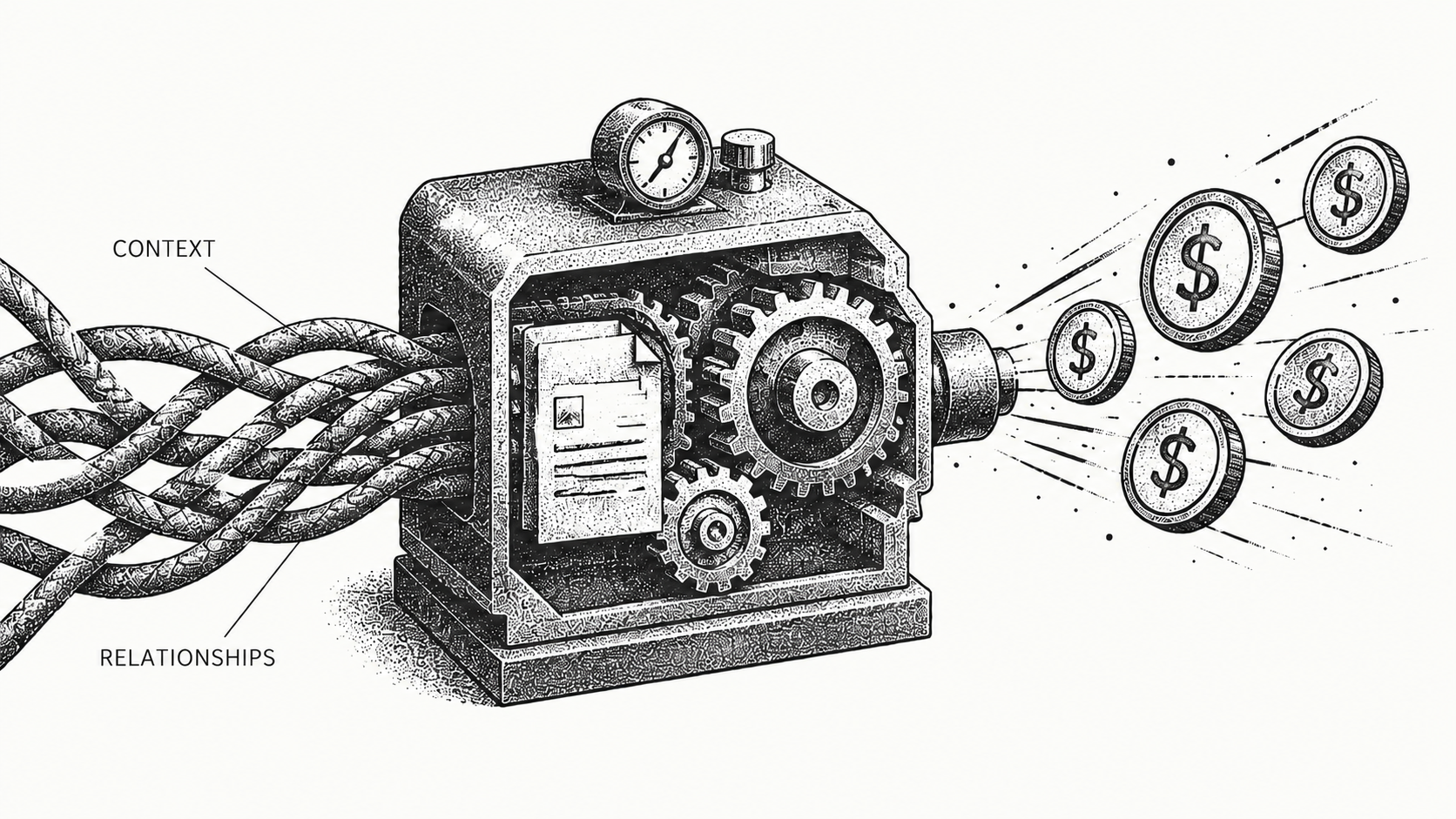
Traditional collections treat invoices as isolated documents. An unpaid balance triggers a reminder, then a harsher notice, then another notice. The cadence is robotic, the tone generic, and the results predictable: unanswered emails, delayed payments, and strained relationships. What those workflows miss is context. A customer's payment behavior is inseparable from their relationship history, support tickets, product usage, and even social sentiment. Ignoring those signals is like selling to a persona while blindfolded. This is the same gap that drives the broader case for accounts receivable automation.
A Revenue Context Engine solves that blind spot. It ingests data from every customer touchpoint, including CRM opportunity notes, contract clauses, product usage logs, support interactions, and LinkedIn updates, and maps them to collections strategy. When an invoice ages, the engine checks if the buyer's champion changed jobs, if usage dropped after a feature deprecation, or if a pending renewal is at stake. The follow-up email it drafts references that context, escalating with empathy rather than aggression. The result is faster payment, lower churn, and improved customer satisfaction.
The Data Sources That Feed Context
True context spans five vectors. First, commercial data: contract length, pricing tiers, escalators, and payment terms. Second, engagement data: email open rates, link clicks, demo attendance. Third, support data: ticket severity, resolution times, CSAT scores. Fourth, product usage: daily active seats, API call volume, feature adoption. Fifth, external signals: funding rounds, executive departures, and social-media sentiment.
Historically those datasets lived in silos, including Salesforce, Zendesk, Segment, LinkedIn, and Crunchbase, and were rarely stitched together. Finance analysts could not possibly read every support ticket before crafting a reminder email. They defaulted to templates. The Revenue Context Engine automates the stitching using a schema-flexible graph where each node, whether an invoice, person, company, ticket, or usage event, connects through edges that convey meaning. A large language model queries the graph, pulls relevant facts, and composes outreach tailored to the moment. Turning that messy source material into clean structured records is exactly what LLM-native integration layers are built to do.
Architecture: Graph Plus LLM Plus Policy Layer
The engine's backbone is a invoice-to-cash graph that extends beyond finance nodes to include CRM and product telemetry. Nodes carry properties, edges express relationships, and time stamps anchor events. A streaming pipeline updates the graph whenever usage spikes or a support ticket escalates. An LLM retrieval component receives a prompt template plus customer ID, fetches context via Cypher or GraphQL, and writes a tailored message. A policy layer applies tone guidelines, credit limits, and regional compliance constraints. Messages are logged with chain-of-thought explanations, ensuring auditability.
Performance Benchmarks: Numbers That Convince CFOs
Early adopters deploying context engines report meaningful gains. Across Monk's customer base, context-driven outreach earns a 24% higher response rate than standard dunning, and accounts that once languished in late aging buckets clear far sooner. When messages reference relevant usage milestones and renewal timing, customers reply and pay faster, and finance can route disputed balances to success managers instead of collections reps. The cumulative effect shows up as a 40% average reduction in DSO and 26 hours a month saved on manual follow-up. Because the engine matches incoming payments to the right invoices at an 80% automatic match rate, rising to 95% with suggested rules, finance teams spend less time on reconciliation and more time on the accounts that need a human conversation. In practice, 90% of collections are resolved with zero human intervention, so collectors focus their energy where context shows it will matter most.
The Monk Edge: Context at Graph Scale
Monk integrates Revenue Context Engine capabilities directly into its full-stack AR platform. Because Monk already unifies contracts, invoices, and portal interactions in a graph, extending nodes to include CRM and product telemetry was natural. Agents pull context automatically: "Ticket #1023 closed unhappy," or "Champion Susan left last week." The email they craft might open with, "I noticed you've explored the new 'Pipeline Analyzer' feature," demonstrating awareness. Customers appreciate the nuance, pay faster, and remain loyal.
Monk's policy engine enforces boundaries. If usage dropped sharply in the last month, the agent triggers a polite inquiry rather than an escalation. If renewal is near, the finance workflow loops in the account executive. This cross-functional intelligence eliminates the dreaded silo effect where finance nags a customer unaware of open bugs. Across Monk's book of business the platform now manages $2B+ in receivables under management, and clients see a 40% average reduction in DSO after activating context-driven outreach. Monk's AR agent, Julia, drafts and sequences this context-aware outreach automatically, and customers typically reach go-live within less than one week. One enterprise customer grew cash on hand 2.4x in the first quarter after switching to context-driven collections.
Implementation Guide: Six Steps to Context Mastery
- Consolidate Data Feeds. Connect CRM APIs, support ticket webhooks, and product telemetry streams to a graph store.
- Define Relevance Rules. Decide which signals matter, such as a sharp usage drop, champion departure, or unresolved Sev1 tickets.
- Fine-Tune Prompts. Embed tone guidelines, reference tokens, and fallback phrasing.
- Establish Approval Tiers. Low-risk context emails auto-send; high-value accounts route to human review.
- Measure Engagement. Track open, reply, and payment timing, so the engine ingests the context of each conversation and outreach stays relevant.
- Expand to New Channels. Context engine logic shapes both written reminders and voice calls, so the agent opens a call with the same account context it uses in email.
Risk Control and Compliance
Regulators care about fair treatment and data privacy. The context engine must not leak sensitive ticket details or violate GDPR by referencing personal health info. Monk's implementation filters protected classes and masks PII before prompt assembly. Tone policies prevent aggressive language. Audit logs capture every context element used, satisfying regulators concerned about algorithmic bias. Monk is SOC 2 Type II compliant, so these controls are independently verified.
Future State: Context Engines as Revenue Co-Pilots
As LLMs grow multimodal, context engines will pull product usage heat maps, call transcripts, and even video demo analytics. Agents could generate personalized walkthroughs demonstrating value and pre-empt payment objections. Predictive models might forecast churn months ahead and trigger pre-emptive offers tied to payment milestones. Finance evolves from debt collector to growth partner. This shift is part of how teams cross the AI adoption cliff in revenue operations.
| Context source | What it tells collections |
|---|---|
| CRM | Contract terms, pricing, renewal timing, and whether the buyer's champion has changed, so outreach can loop in the account executive when a renewal is near. |
| Support tickets | Open issues, severity, and CSAT, signaling when a balance is disputed or a customer is frustrated, so finance can pause escalation and route to success. |
| Product usage | Active seats, API volume, and feature adoption, flagging drops that may explain non-payment or churn risk before a reminder is sent. |
| Payment history | Past timing, partial remittances, and disputes, helping calibrate tone and cadence to how the account has paid before. |
Conclusion: Context Sells, Context Collects
Finance professionals finally have the tools to treat customers as relationships, not receivables. A Revenue Context Engine converts raw interaction data into tailored outreach that accelerates cash and deepens loyalty. Monk demonstrates the power of embedding context into every collections touchpoint, proving that empathy and automation are not opposites but accelerants on the path to zero-friction revenue.
Frequently asked questions
What is a revenue context engine?
A revenue context engine is a system that unifies relationship data from CRM, contracts, support tickets, product usage, and external signals, then uses it to shape collections outreach so each message reflects the customer's real situation rather than a generic template.
How does context improve accounts receivable outcomes?
Context lets AR teams escalate with empathy instead of robotic reminders. When outreach references relevant history such as a recent renewal or an open support issue, customers respond more often and pay faster, which protects both cash flow and the relationship.
What data sources feed a revenue context engine?
It draws on five vectors: commercial data like contract terms and pricing, engagement data such as email and demo activity, support data including ticket severity and CSAT, product usage like active seats and feature adoption, and external signals such as funding rounds or executive changes.
How is a revenue context engine different from traditional dunning?
Traditional dunning treats each invoice as an isolated document and sends a fixed cadence of escalating reminders. A revenue context engine instead considers the full relationship before reaching out, tailoring tone and timing to the account's situation.
How does Monk use a revenue context engine?
Monk builds revenue context capabilities into its AI-native invoice-to-cash platform, unifying contracts, invoices, and portal interactions so agents can pull relevant context automatically and craft outreach that accelerates payment while preserving customer relationships.
Related guides: Building the Contract‑to‑Cash Graph: The Definitive Guide to a Single Source of Truth for Revenue Operations, The Great Unbundling of Finance: Winners, Losers, and the AI Frontier and The AI Adoption Cliff: Why Finance Laggards Fall Behind.




.avif)