Payment Behavior vs Credit Bureau Scores: What Predicts Who Pays Late

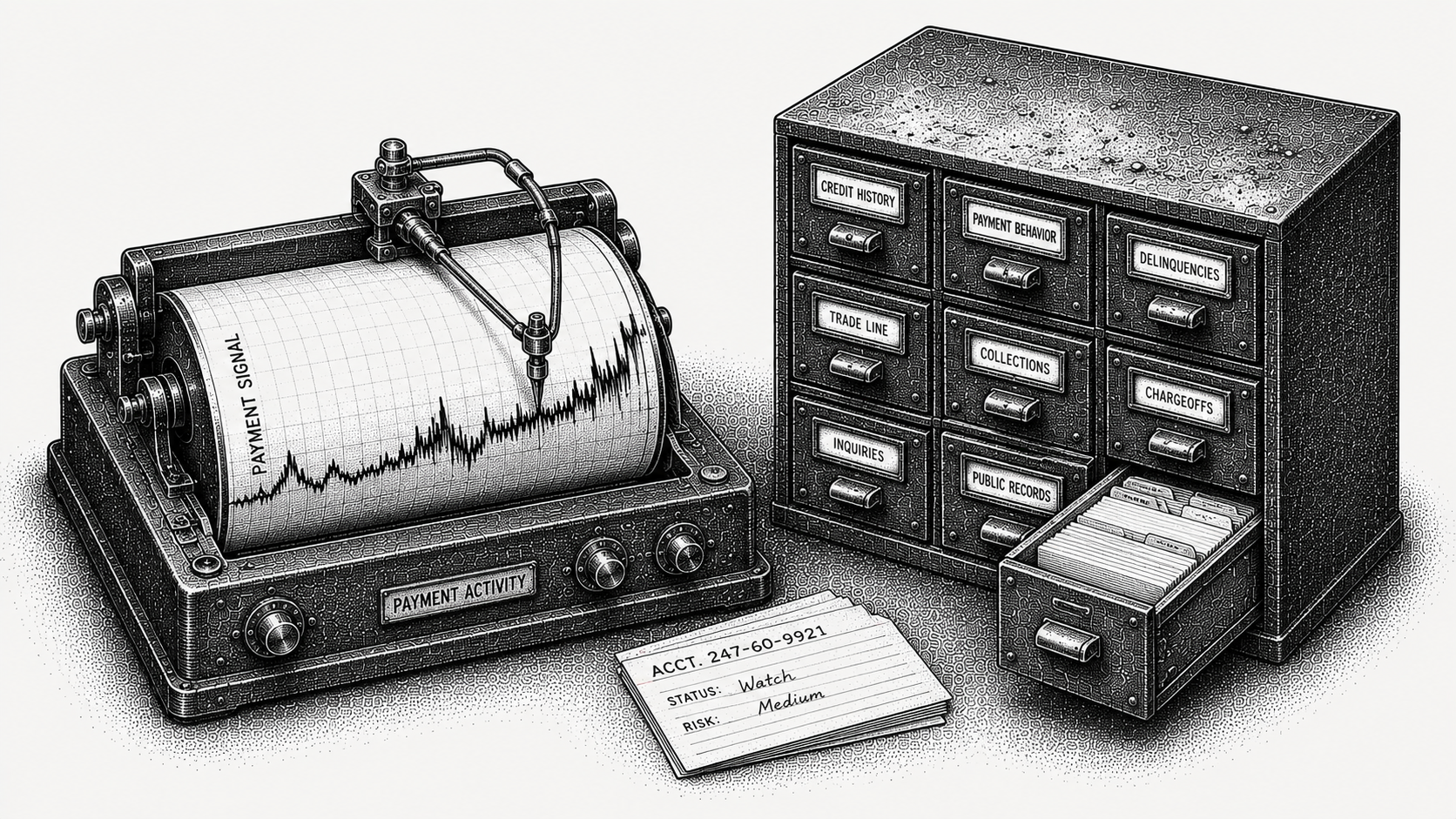
A credit bureau score tells you how a company pays the market in general and it arrives on a reporting cycle, while payment behavior tells you how a customer pays you specifically and it updates every time an invoice comes due. Monk is an AI-native invoice-to-cash platform that runs credit, invoicing, collections and cash application as one system, which is why the bureau file and the observed payment record sit on the same customer page rather than in two teams' tabs. For predicting who will pay you late, your own ledger is usually the earlier signal, and the strongest read comes from holding both together. The useful question is which one answers the decision in front of you.
The two inputs get treated as interchangeable because both produce a number that sounds like risk. They measure different things. A bureau score estimates the probability that a business fails to meet its obligations somewhere. Payment behavior measures what a business does with your invoices. A customer can be sound by the first measure and expensive by the second, and the account that quietly costs you the most working capital each year is usually one that no bureau has ever flagged.
What is a credit bureau score built from, and why does it lag?
It is built from data other people report about the company, which is why it is broad and why it is never current.
Bureaus assemble trade lines contributed by suppliers and lenders, public filings such as accounts and charges, legal events including liens, judgments and insolvency notices, plus firmographics like age, size and sector. Those inputs are weighted into a score that estimates the chance of default or serious delinquency over a defined horizon. The breadth is the value. No single supplier can see how a buyer treats forty other vendors, and nobody wants to discover a filed judgment after shipping.
The lag comes from how each input arrives. A supplier reports its trade line on its own schedule, often monthly and often incomplete, so a payment made late in March may not surface until May. Filed accounts describe a year that ended some time ago. Legal events appear when they are registered rather than when the trouble began. Even a bureau alert service only tells you that something has been recorded, which is later than the moment it changed. Between the buyer's decision to slow you down and the score reflecting it, a quarter can pass, which is one to three ordering cycles for most sellers.
There is a second, subtler limit. Bureau data is contributed, so the picture is only as complete as the reporting behind it. A buyer that pays two large reporting suppliers on time and stretches a long tail of smaller ones can carry a stronger file than its behavior deserves, and a well-run private company that nobody reports on can look thinner than it is.
What does your own ledger see that a bureau cannot?
The specific mechanics of how this customer pays you, which is what determines your cash position.
The clearest example is consistency around a date that is not your date. A customer pays on day 47 of a 30 day term, every time, with no dispute and no drama. No bureau will call that a risk, and it is better described as a funding cost: seventeen extra days of your money on every invoice, entirely predictable, and correctable by moving them into a payment run you have asked to be included in. That fact exists only in your remittance history.
Other patterns are equally invisible from outside. The account that always short pays freight, so every invoice closes a little light and someone writes off the difference to keep the ledger tidy. The account that pays after the second call and never the first, which tells you their approval queue only moves once a human chases it. The account whose average has moved from 30 days to 55 across two quarters while paying every invoice in full, which is the single most useful early warning in receivables and the one a bureau is least likely to surface in time. Each of these is a different problem with a different fix, and they are all invisible in a score.
| Dimension | Credit bureau score | Payment behavior |
|---|---|---|
| Data source | Third-party, aggregated across the market | First-party, from your own ledger and collections |
| Freshness | Updated on a reporting cycle | Updated continuously as invoices come due |
| What it captures | General creditworthiness and public risk events | How a customer pays you specifically |
| Best use | Onboarding and accounts with little internal history | Monitoring active accounts and spotting early drift |
Why can a customer be creditworthy and still be a collection problem?
Because ability to pay and willingness to pay you on time are different things, and only one of them shows up in a score.
Large buyers rank their suppliers. A supplier that stops a production line gets paid on the day. A supplier whose absence would be noticed next quarter gets paid when the payment run happens to fall. A buyer can hold a strong file, plenty of liquidity and no adverse filings while running a policy of paying at 60 days regardless of the terms printed on your invoice. That is working capital management at your expense rather than distress, and it is one of the most common causes of a high DSO in an otherwise healthy ledger.
Process is the other half of it. Plenty of late payment has nothing to do with intent: the invoice went to a person who left, the PO number was missing so it never entered the queue, the portal rejected the format and the rejection notice went to a shared mailbox. A creditworthy customer with a strict AP process will still pay you late every month until the underlying defect is fixed. Reading that as credit risk leads you to tighten a limit when the correct action was to correct an invoicing field.
Which behavioural signals should you track, and how do you compute them?
Track six, compute them from data you already hold, and look at the direction of each rather than its level.
The level tells you what kind of customer this is. The direction tells you what is happening now. An account at 45 days that has always been at 45 days is a pricing question, while an account that has moved from 30 to 45 in six months is a question about the business behind it. Compute each measure on a rolling twelve months and again on the last ninety days, then compare the two.
| Signal | How to compute it | What a change tells you |
|---|---|---|
| Weighted average days to pay | Sum of (days from invoice date to cash date x invoice value) divided by total value paid | The real cost of funding this customer |
| Days beyond terms | Weighted average days to pay minus the contractual term | Whether the terms you sold are the terms you get |
| Drift | Days beyond terms in the last 90 days minus the same figure a year earlier | Earliest sign of strain or a policy change |
| Short-pay rate | Invoices settled below the billed amount divided by invoices paid, and the value leaked | A billing defect or an unagreed deduction habit |
| Touches to cash | Outbound contacts made before payment divided by invoices paid | How much of your team the account consumes |
| Promise kept rate | Promises met on the agreed date divided by promises made | Whether what the customer tells you is reliable |
Two practical cautions. Compute days to pay from cash date rather than the date an allocation was posted, because a slow cash application process makes every customer look worse than they are. And weight by value, since an unweighted average lets fifty small invoices hide one large one that sat for ninety days.
When is the bureau score the better input?
In three situations, the outside view beats anything your ledger can tell you.
The first is a new customer. With no invoices paid, you have no behavior to read, so the bureau file and trade references are the whole picture. This is the moment to be systematic rather than intuitive, because everything you learn later depends on surviving the first few orders. The second is a sudden structural change at the buyer: an acquisition, a change of ownership, a director resigning, a charge registered over assets, a winding-up petition. These are discrete events that appear in public records long before they appear in your remittance pattern, and a buyer under that kind of pressure often keeps paying normally until the week it stops.
The third is industry-wide stress. When a sector turns, your own ledger tells you about your customers one at a time and always slightly late. A bureau sees the whole sector at once, so a broad deterioration across similar buyers is visible externally before your aging report has enough evidence to be convincing. In that situation the right move is to review the segment rather than the account.
There is a fourth case, less often discussed. Bureau data is independent, which matters when a decision has to be defended. If you are declining an order, reducing a limit on a significant customer, or supporting a credit insurance claim, a third-party report carries weight in a room that your internal average does not.
How do you combine both instead of choosing?
Put them on one axis each and read the account in the quadrant it falls into, then act on the disagreement rather than averaging it away.
Averaging is the common mistake. A team that blends a score and a payment history into one internal rating loses the only thing the pair is good for, which is the tension between them. A strong file with deteriorating behavior toward you and a weak file with a spotless record with you are opposite situations, and a single blended number puts them in the same bucket.
| Pays you well | Pays you late or partially | |
|---|---|---|
| Strong bureau file | Candidate for a higher limit and longer terms | A relationship or process problem: find the blockage, escalate to a commercial owner |
| Weak bureau file | Keep the limit modest and the review frequent, since capacity is the constraint | Reduce exposure now, move to prepayment or security |
Operationally, the sequence runs one way. Use the bureau file to set the initial ceiling and to catch discrete events. Use payment behavior to manage the account between reviews and to trigger a review out of cycle. Refresh the external file on a schedule and on alert, and recompute behavior continuously. The obstacle is rarely analytical: bureau reports live in one system, payment history in the ERP, and collections notes somewhere else, so building the combined view by hand is slow enough that most teams skip it.
How does Monk handle this?
Monk keeps the external file and the observed behavior on the same customer page, so the comparison happens by default rather than in a monthly exercise.
Because collections, cash application and the ERP and bank connections all run in one invoice-to-cash system, days to pay are computed from applied cash and the behavioural signals stay current without anyone exporting anything. Monk combines that record with external credit-bureau signals and uses AI to generate a credit report with suggested limits directly on the customer page. Julia, Monk's AI agent for Intelligent Collections, works the accounts where behavior has drifted and ingests the context of each conversation, which produces a 24% higher response rate than standard dunning.
Across the receivables Monk manages, 90% of collections are resolved with zero human intervention, teams see a 40% average reduction in DSO, and finance saves 26 hours a month. Monk manages $2B+ in accounts receivable, is SOC 2 Type II compliant, and integrates with QuickBooks, NetSuite, Salesforce, HubSpot and Stripe. Onboarding takes less than one week. The combined view sits inside Monk's credit management workspace, next to the collections activity that keeps the payment data current.
Where should you start?
Compute drift on your twenty largest accounts this week and compare the result with what their bureau scores say.
Pull every invoice paid in the last two years for those accounts with its invoice date, due date, cash date and settled amount. Calculate weighted average days beyond terms for the last ninety days and for the same ninety days a year earlier, then sort by the difference. The accounts at the top of that list are drifting, whatever their score says. Add two columns: short-pay rate and number of outbound contacts before payment. Now look up the current bureau score for the same twenty accounts and mark every row where the two disagree.
Every disagreement is a decision waiting to be made. Strong score with worsening drift means a conversation with a commercial owner about why your invoices are moving down the queue. Weak score with clean behavior means a limit that is probably too tight for the trade you could be doing. Repeat the exercise monthly, and keep the definition of each measure written down so the numbers stay comparable. If you would rather see both signals maintained on every account without building the spreadsheet, book a demo and we will run it against your own portfolio.
Frequently Asked Questions
Is a credit bureau score enough to set a credit limit?
It is a strong starting point, especially for a new account with no internal history, and it catches public events you cannot see. Once the customer has paid a few invoices, their behavior with you adds precision the score cannot provide. Use the bureau file to set the ceiling and behavior to manage the account underneath it.
What counts as payment behavior in accounts receivable?
Weighted average days to pay, days beyond terms and its direction over time, short pays and deductions, dispute frequency, how many contacts it takes to get paid, and whether promises to pay are kept. It is first-party data drawn from your own ledger and collections record, and it refreshes with every payment.
Why would a customer with a good bureau score still pay me late?
Because ability to pay and willingness to pay you on time are different. Large buyers rank suppliers and manage their own working capital, so a sound company can run a policy of paying at 60 days whatever your terms say. Process defects cause the same outcome: a missing PO number or a rejected portal submission delays payment without any credit signal at all.
How current is bureau data compared with payment behavior?
Bureau data is contributed and published on a cycle, so a change in how a buyer pays can take weeks or months to appear. Payment behavior updates the moment cash arrives or fails to. That difference is why the two disagree most often at exactly the point a disagreement is most useful.
What is the earliest warning sign in payment behavior?
Drift in days beyond terms, measured over the last ninety days against the same period a year earlier. A customer moving from 30 days to 55 over two quarters while still paying in full is the clearest early signal in receivables. Broken promises to pay and a rising number of contacts needed per invoice are close behind.
Should I blend both signals into a single internal score?
Blending loses the information. The value of holding both is the disagreement between them, and a single number hides whether a strong file sits above deteriorating behavior or the reverse. Keep them side by side, and define in advance what action each combination triggers.
How does Monk generate a credit recommendation?
Monk merges payment behavior from its collections, ERP and bank integrations with external bureau signals, then uses AI to produce a credit report with suggested limits on the customer page. Because cash application runs in the same system, the behavioural measures are computed from applied cash rather than a stale export.



.avif)