What to Look For in AR Reporting Software


What should you look for in AR reporting software?
The most useful test is simple: can each person on your finance team build the report they need without filing a request? A controller reviewing aging on Monday morning and a CFO preparing for quarter close are asking different questions of the same ledger, yet many AR tools give them one fixed dashboard and hope it covers both.
Beyond that, a few capabilities separate reporting you'll actually use from reporting you'll export and rebuild. The data should refresh as payments land, not on a weekly sync. Users should be able to set any date range and export a single view to CSV. Saved views should belong to the person who made them, so one teammate's changes don't reshape everyone else's. And the core receivables metrics, DSO, Average Days Delinquent and aging, should each have a clear home.
What should DSO reporting software show?
Days sales outstanding (DSO) is the average number of days it takes to collect after a sale, usually calculated as accounts receivable divided by total credit sales, multiplied by the days in the period. On its own it can mislead, because it includes the payment terms you set. A customer on net 60 terms will raise DSO even if they always pay on time.
That's why good DSO reporting puts it next to Average Days Delinquent, which isolates how late customers actually pay, and shows both as a trend so you can see direction rather than a single number. It should also let you break DSO down by entity or customer segment, since a blended number can hide one slow-paying group.
What makes AR reporting software real-time?
Real-time reporting updates when a payment lands or an invoice changes. It doesn't wait for a weekly sync or month-end close, so your collections team works from today's balances, not last Friday's, and nobody chases an invoice that was paid an hour ago. When you evaluate a vendor, ask how often data refreshes from your ERP and bank feeds, and whether that refresh is automatic. For a deeper look, see Real-Time AR Reporting: What It Is and Why It Matters.
How do you read an AR aging report?
An AR aging report sorts unpaid invoices into buckets: current, 1 to 30 days past due, 31 to 60, 61 to 90 and over 90. Start with the total outstanding, which is the cash you're owed. Then watch the share sitting past 60 and 90 days. If that share grows while the total stays flat, collections are slipping even though the headline number looks stable.
Next, check concentration. A handful of customers often hold most of the overdue balance, and that's where outreach pays off first. Finally, compare week over week, because a single aging report is only a snapshot. The trend tells you whether collections are improving. For more on which metrics belong alongside aging, see AR Analytics and Dashboards: A 2026 Guide.
How Monk approaches AR reporting
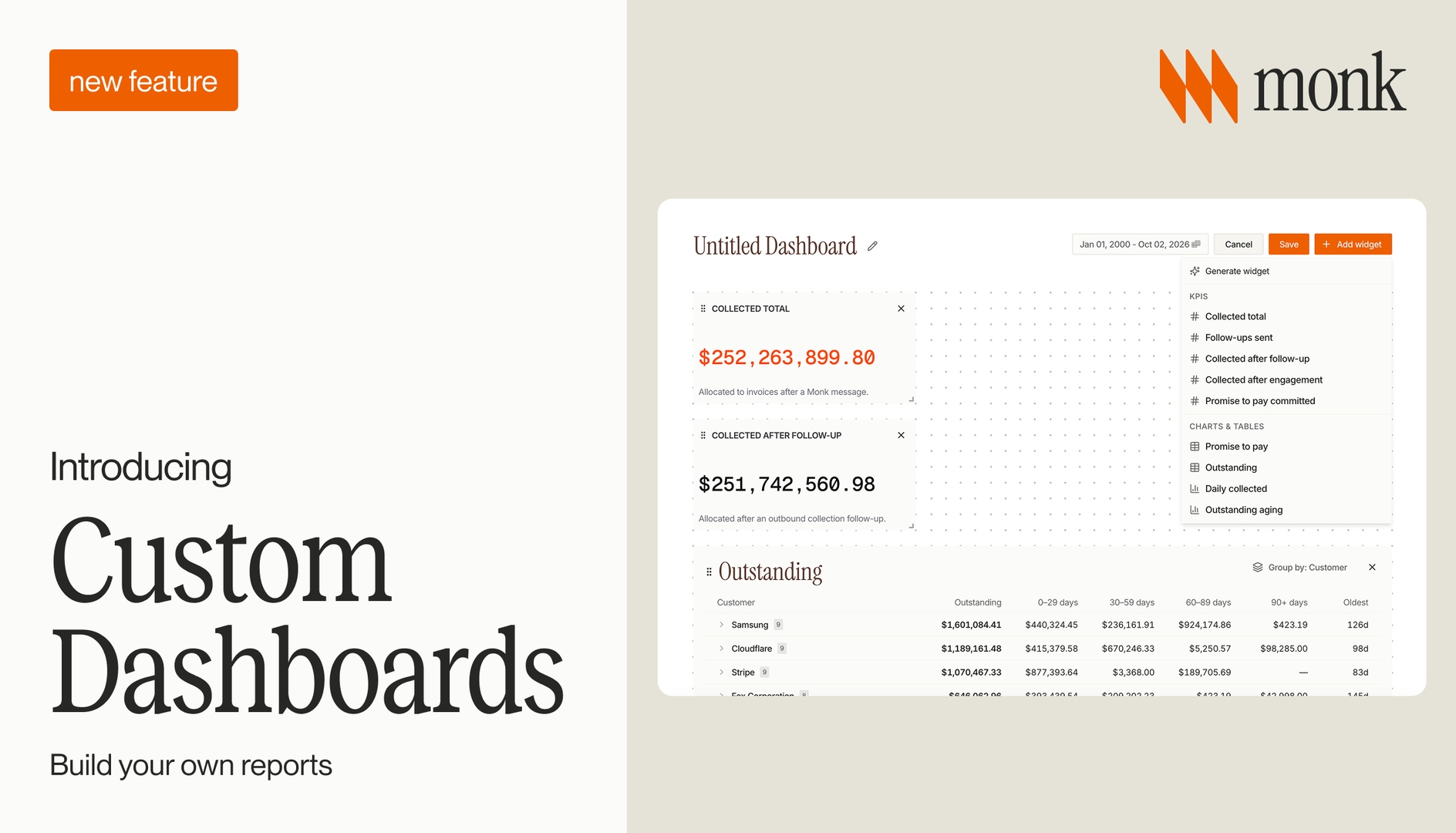
Monk has dedicated report pages for Aging, DSO and Average Days Delinquent, Forecasting, Collections, Revenue and Renewals. On top of those, each user can build a custom dashboard of their own, adding widgets from a catalog or describing one in plain language for Monk's agent to build, with any widget exportable to CSV. For a full walkthrough of how that works, read Introducing Custom Dashboards.
As Frank Coacci, founding engineer at Monk, puts it: "What should you look for in AR reporting software? Not a nicer dashboard. One you can change yourself."
Frequently Asked Questions
What features should AR reporting software have?
Data that refreshes as payments land, the ability for each user to build their own reports without a support ticket, flexible date ranges, export to CSV, and dedicated views for DSO, Average Days Delinquent and aging.
What is the difference between DSO and Average Days Delinquent?
DSO measures the average days to collect after a sale and includes the payment terms you set. Average Days Delinquent isolates how many days past the due date customers actually pay.
What are the buckets in an AR aging report?
Most aging reports group unpaid invoices as current, 1 to 30 days past due, 31 to 60, 61 to 90 and over 90 days past due.
What makes AR reporting real-time?
Real-time AR reporting updates when a payment lands or an invoice changes, instead of waiting for a weekly sync or month-end close.



.avif)