Introducing Cash Forecast 2.0

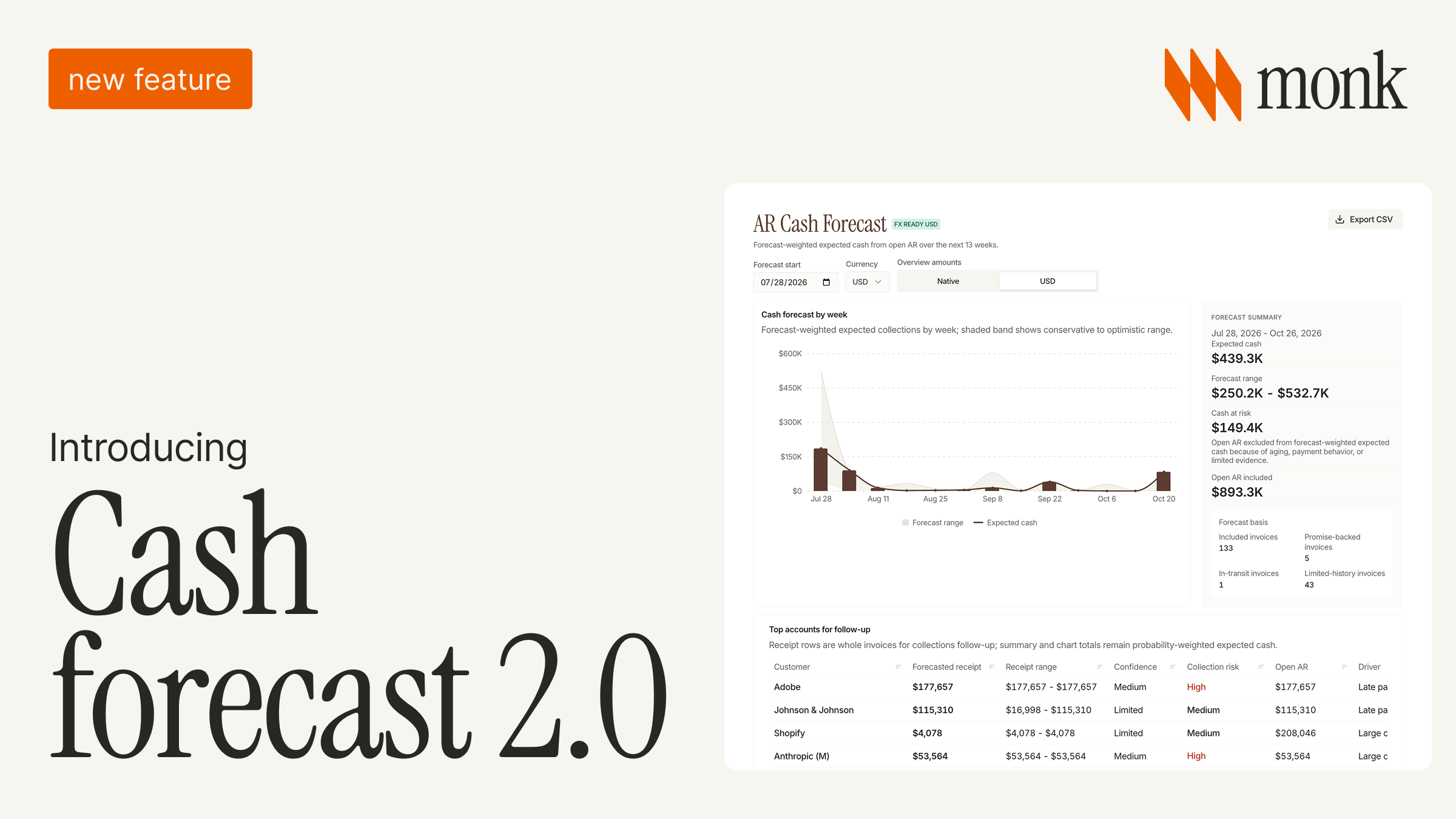
Most finance teams can report revenue with confidence but can't say how much cash will land next week. Revenue is booked when an invoice goes out; cash arrives whenever the customer decides to pay. Predicting that timing is forecasting, and for most teams it's still a hand-built spreadsheet using flat collection rates that ignore how any specific customer behaves.
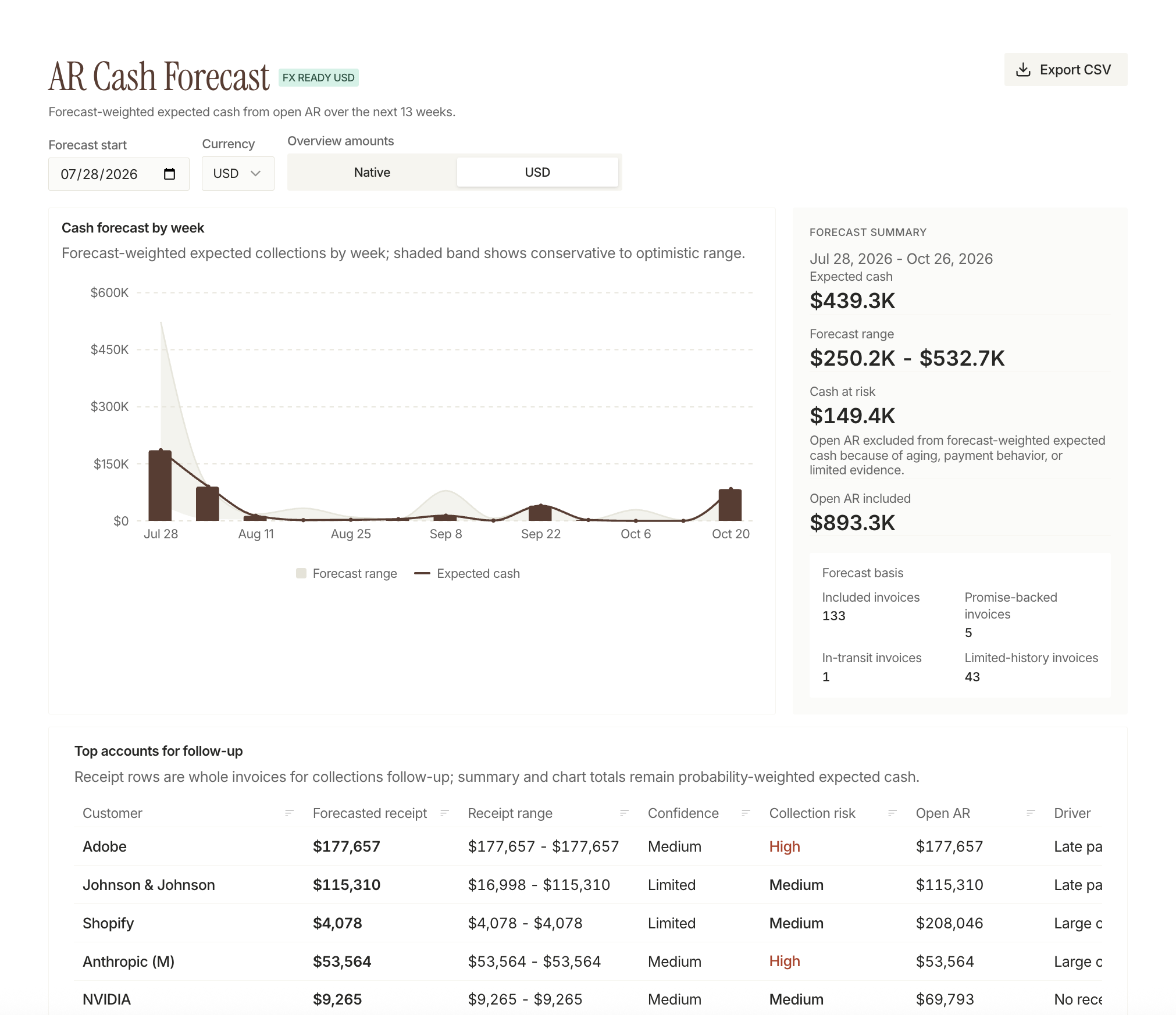
Today we're shipping cash forecast 2.0. Monk now produces a live, risk-weighted forecast of expected collections, built from the real payment behavior on every open invoice instead of static net terms. It updates as customers reply, promise to pay, dispute, or pay, so your cash number always reflects the current state of the book.
Why we built it
Teams come to Monk to stop chasing invoices by hand and lower DSO. Once collections run on their own, the next question is always the same: how much cash is coming in, when, and which invoices will slip. One finance director told us she owes a weekly cash forecast she can't produce reliably, because the work is manual and the data is bad. Another was building collection curves in spreadsheets by hand. Cash forecast 2.0 turns that into a forecast Monk maintains automatically, from how each customer pays.
When receivables run on agentic AI, finance spends less time chasing and more time planning. The role shifts from reporting what happened to deciding what's next, and cash flow becomes the metric teams manage against.
How it works
Cash forecast 2.0 builds bottom-up from each invoice instead of top-down from a blended rate:
- A calibrated accuracy predictor. Monk scores how likely each invoice is to be paid and when, from payment history, engagement, and account context. A customer who always pays 20 days late isn't forecast like one who pays on time.
- Expected cash, a forecast range, and cash at risk. It shows the amount you can count on, the range around it, and the cash tied to disputed or quiet invoices.
- Top accounts to follow up. The forecast surfaces the accounts most likely to move the number, so effort goes to the cash most likely to slip.
A few deliberate choices:
- It covers open AR, not future billing.
- It works from each invoice's remaining balance, accounting for partial payments, credit memos, write-offs, and refunds.
- It runs on the same platform as collections, so promises-to-pay and disputes feed it automatically, giving you one calibrated score for your cash.
What it changes for a finance team
The forecast moves the job from reporting to deciding. Leaders get a forward-looking view of expected collections, timing, and risk they can act on before the quarter closes. Small teams get that foresight without hiring an analyst or rebuilding a spreadsheet each week. And effort shifts from chasing the oldest or largest invoices to the cash most likely to slip.
"The analytics and reporting have made life so much easier when it's time to report to leadership. What used to be a manual build is now a quick export," said Liam Clements, Director of Finance at Goodship.
The context
The pressure is coming from the board. In a 2025 survey of 200 private equity sponsors and 200 portfolio CFOs, 98% of sponsors had directed their CFOs to prioritize AI, and 99% named discrete workstreams like cash flow forecasting and invoice-to-cash as the way in (Accordion, 2025). Expectations are rising too: 68% of companies report higher expectations for cash forecasting, only 1% lower (PwC 2025 Global Treasury Survey).
Adoption is common; results lag. 59% of finance functions use AI, yet 91% report only low or moderate impact early on (Gartner, 2025). Cash forecasting is one of the clearest places to get value on day one: it automates manual work and sharpens the decision at the same time.
Availability
Cash forecast 2.0 is live on the Monk platform now. Monk customers see a 40% average reduction in DSO, and one customer, Profound, grew cash on hand by 122% in its first month. Go-live takes less than one week, and Monk takes no percentage of what it collects.
"Your forecast shouldn't take hours to prepare, and it should reflect what your customers are doing in real time," said Joe Zhou, Co-Founder and CTO of Monk. "Cash forecast 2.0 reads every signal between you and your customers and turns it into a number you can plan around, and the specific accounts worth acting on today."
Frequently Asked Questions
What is cash forecast 2.0?
It is a live, risk-weighted forecast of expected collections, built bottom-up from the real payment behavior on each open invoice rather than from flat collection-rate assumptions. It updates continuously as customers engage, promise to pay, dispute, or pay.
How is it different from a spreadsheet forecast?
A spreadsheet applies a blended historical rate to aged receivables. Cash forecast 2.0 scores each invoice individually using payment history and current engagement, so a customer who always pays late is weighted differently from one who pays on time.
Does it forecast future revenue?
No. It forecasts collections on open AR, the invoices that already exist. It does not predict future billing.
What does it account for in the balance?
The forecast works from each invoice's remaining balance and factors in partial payments, credit memos, write-offs, and refunds.
How does it use signals from the rest of Monk?
Because forecasting runs on the same platform as collections, it automatically uses promises-to-pay captured from email replies and disputes the moment they are raised, combining them into one calibrated score for your cash.
How long does it take to get started?
Go-live typically takes less than one week.
See it on your own receivables: book a demo.
Related reading: The real reason your AR forecast is always wrong and billed vs. collected revenue.
Adjacent to this: Why Cash Flow Forecasting Is Broken and How to Fix It, Best Cash Flow Forecasting Software for Finance Teams, The Real Reason Your AR Forecast Is Always Wrong, Using Payment Behavior to Predict Who Will Pay (and Who Won't) and Monk's AI Collections Agent Automates 80% of Cash Collection: CTO Joe Zhou on Why a 1% Mistake Is Still Unacceptable.



.avif)