Monk's AI Collections Agent Automates 80% of Cash Collection: CTO Joe Zhou on Why a 1% Mistake Is Still Unacceptable

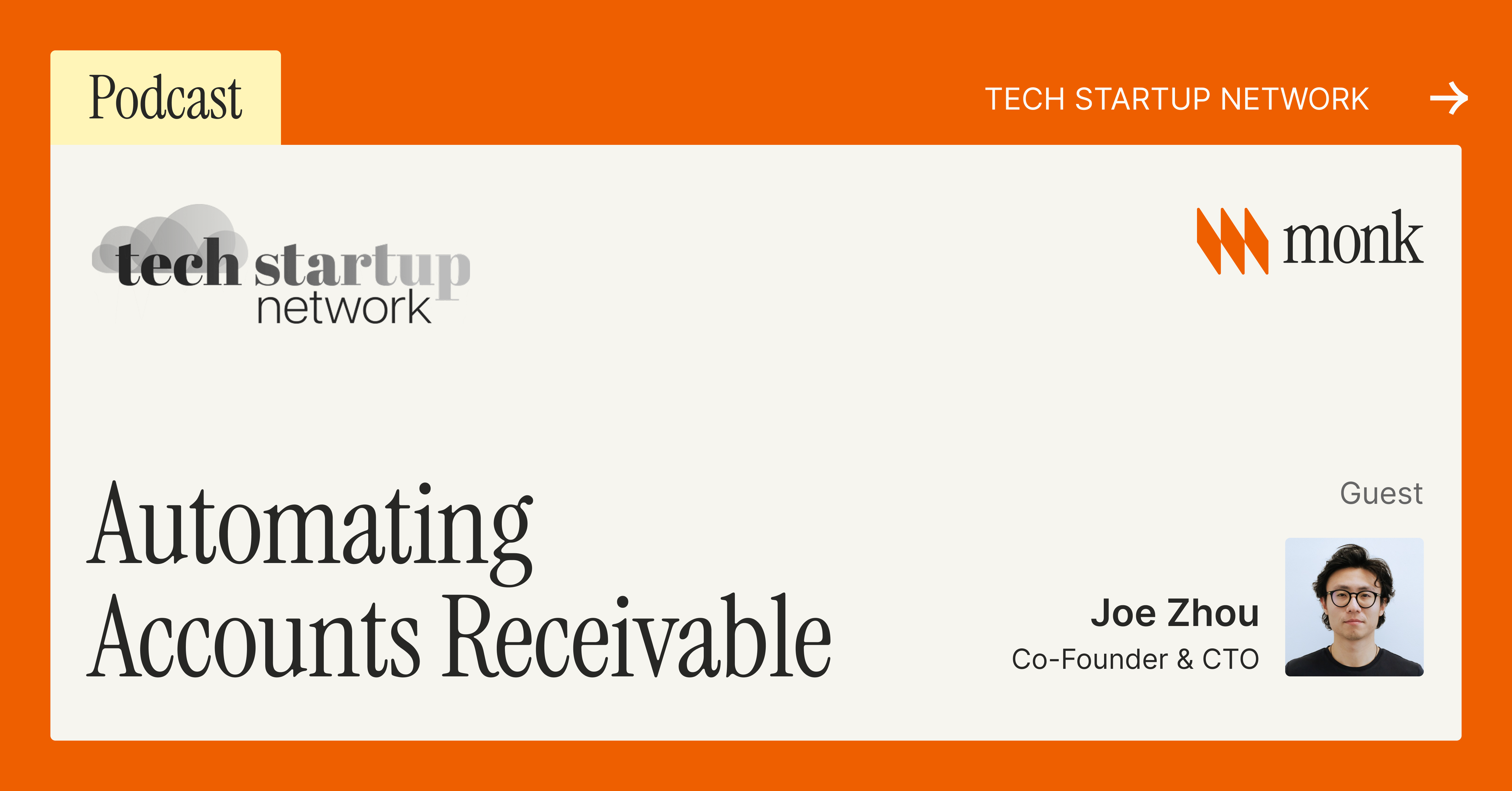
Joe Zhou, Monk's co-founder and CTO, joined the Tech Startup Network podcast to talk about why Monk bet everything on accounts receivable, why a 1% mistake with a customer's money is disqualifying, and why every person at Monk, including ops and go-to-market, now writes code.
Before Monk, Zhou was a top-30 contributor to Snap's codebase, building growth infrastructure used by 40 to 50 internal teams and hundreds of millions of consumers. He also spent time at Google and QuickBooks, and holds a BS in Computer Science and an MS in Engineering from the University of Pennsylvania.
Why accounts receivable
Zhou and co-founder George Kurdin didn't start with a product. They started with roughly 300 conversations. Over one to two months, they talked to CFOs, heads of finance, and controllers, and kept hearing the same thing: accounts receivable is treated as rush work, delegated down, and rarely optimized. That gap between how much AR matters and how little operational attention it gets is what convinced them it was, in Zhou's words, "the best entry in today's age to automate with LLMs."
The math behind getting paid faster
Zhou frames the opportunity in blunt economic terms: if a business getting paid in 60 to 65 days can cut that by 20%, the freed-up cash can fund a new hire, a new vertical, or another R&D bet, before you even talk about the top line. Monk's current numbers: it automates over 80% of a customer's cash collection and delivers almost a 40% reduction in days-to-pay.
Move fast and break things, with one asterisk
Monk moves at what Zhou calls a "move fast, break things" pace on iteration speed, but draws a hard line at outcomes: "being 1% wrong in terms of money and financials and revenue is unacceptable." In a category where a mistake means a customer doesn't get paid, or gets angry enough to damage the relationship, velocity and ownership have to coexist. Every engineer owns the outcome of what they ship, not just the code.
Every person at Monk writes in a terminal
Zhou's clearest claim about AI leverage in 2026: Monk's ops and go-to-market teams now work directly inside Claude Code and Codex, reading and shaping the actual codebase, something he says wasn't realistic even a year ago. Non-engineers can propose product changes with real context, engineers get sharper signal on what to build, and the org stays flat with fewer check-in and alignment meetings, because everyone already has visibility into what's happening.
Narrowing, not expanding
The core product, an intelligent collections agent, hasn't changed since launch. What changed is scope. Monk considered expanding into broader customer communications beyond billing, decided that didn't move the number that matters, and pulled back to go deeper instead. The filter Zhou uses on every new feature: "does this feature or product either help the customers receive cash flows faster or not?" If yes, build and go deeper. If no, don't.
OpenAI's IPO doesn't move the roadmap
Asked whether OpenAI's newly announced IPO changes Monk's plans, Zhou's answer was direct: "the short answer is no." His reasoning is structural, not dismissive: Monk's advantage isn't a model, it's the accumulated work of making a non-deterministic, historically messy problem (matching payments to invoices, handling disputes, working inside customers' legacy enterprise tools) reliable enough to trust with real revenue. The stated goal: compress workflows that used to take a week into a matter of hours for customers sending thousands of invoices a day.
What's next in 2026
Zhou pointed to three priorities: payment risk analysis, cash forecasting, and building products for companies at different stages of AI adoption, since a business running fully AI-native operations needs a different interface than one still catching up. All three come back to the same question: does it help a team understand or improve their cash position, whether that team sits in billing, collections, accounting, or FP&A.
Speed, ownership, and a shoutout to Dario Amodei
Asked what advice he'd give other technical founders, Zhou named two things: velocity, meaning how fast your feedback loop is, and a willingness to take risks and form hypotheses before you have full certainty. Both, he said, match Monk's stated company values of speed and ownership.
For his industry shoutout, Zhou pointed to Anthropic's Dario Amodei, citing Anthropic's flat organizational structure and the way it pushes ownership down to individuals outside the core research team. It's a model Zhou says he draws on directly when thinking about how to let one person at Monk own more than they could have a few years ago.
Listen to the full conversation on the Tech Startup Network podcast. Learn more about Monk at monk.com, on LinkedIn, or follow @usemonk on X.
Frequently Asked Questions
What is Monk's AI collections agent?
Monk is an AI agent that manages accounts receivable on a company's behalf, chasing payment, handling disputes, and reconciling cash the way a dedicated finance operator would, without requiring a human to touch every case.
How much of accounts receivable can Monk automate?
Monk automates more than 80% of a customer's cash collection process and reduces days-to-pay by almost 40%, according to CTO Joe Zhou.
Why did Monk focus on accounts receivable instead of a broader finance product?
Monk's founders spent one to two months talking to roughly 300 CFOs, heads of finance, and controllers before building anything. They found AR was consistently treated as rush work delegated down the org chart, despite having a big effect on a company's ability to deploy cash reliably.
How does Monk prevent an AI agent from making costly mistakes with customer money?
Monk treats reliability as non-negotiable. CTO Joe Zhou says being 1% wrong with a customer's money is unacceptable, so engineering ownership and iteration speed are both built around getting outcomes right, not just shipping fast.
Why do Monk's non-engineering teams write code?
Every person at Monk, including ops and go-to-market, works directly in tools like Claude Code and Codex against the real codebase, giving them direct visibility into the product and keeping the company flat with fewer alignment meetings.
Did Monk ever pivot its product?
The core product, an intelligent collections agent, has stayed the same. What changed is scope: Monk considered expanding into general customer communications beyond billing and decided against it, going deeper on cash flow instead.
What is Monk building next in 2026?
Payment risk analysis, cash forecasting, and AI workflows tailored to companies at different stages of AI adoption, filtered through whether the feature helps a customer get paid faster.

.avif)