Why Cash Flow Forecasting Is Broken and How to Fix It

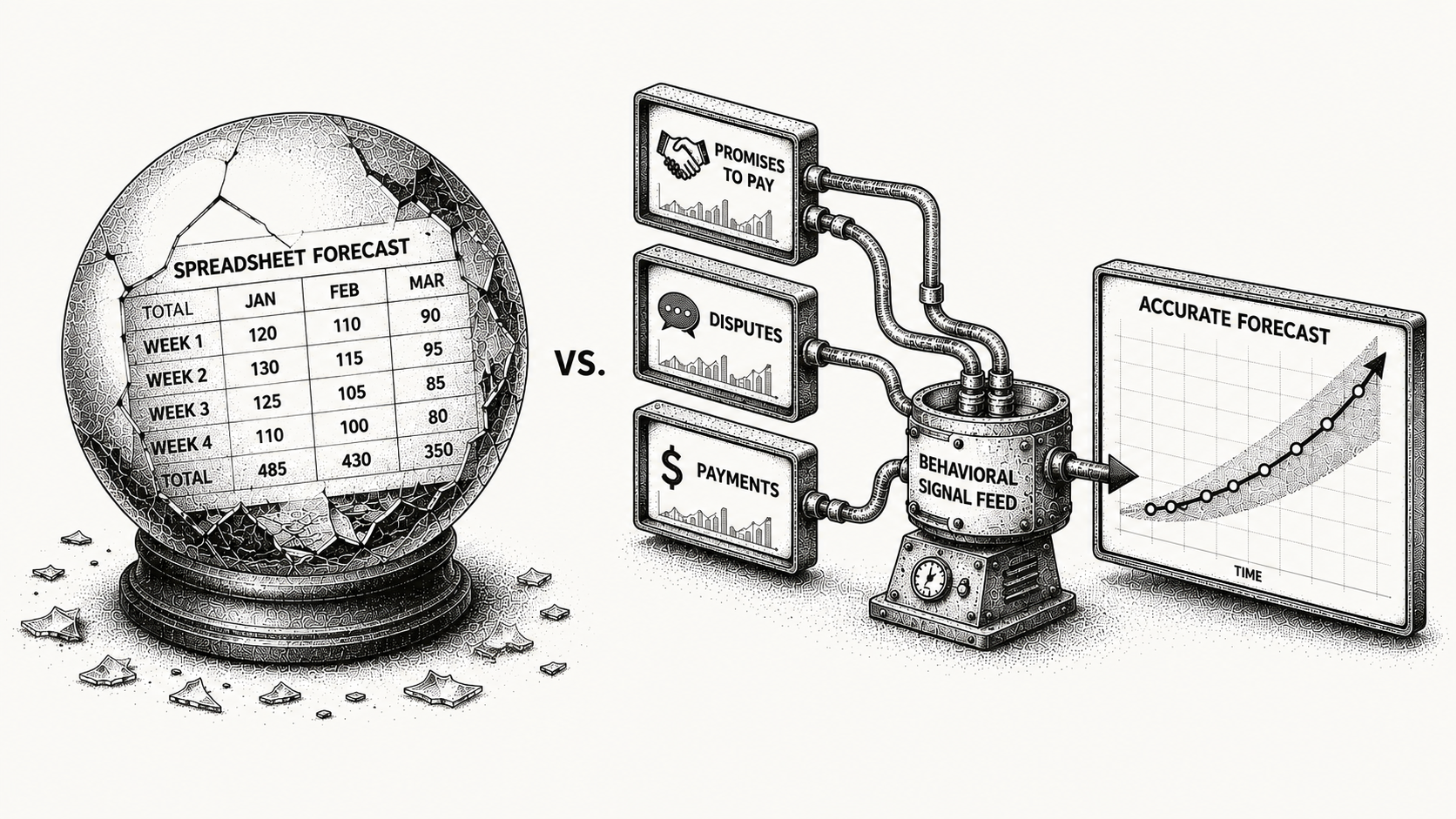
Cash flow forecasting misses at most companies for one reason: the typical forecast is static and disconnected from how customers pay. It applies flat collection-rate assumptions to aged receivables and calls the result a plan. But cash does not arrive on due dates or by spreadsheet math. It arrives based on customer behavior. A forecast that isn't grounded in how and when customers pay drifts further from reality every week, which is why so many finance teams can report revenue precisely and still have almost no confidence in their cash number. Tying the forecast to live payment signals, the way an AI-native platform like Monk does, is what makes it trustworthy.
This guide breaks down what the broken status quo looks like, the structural reasons behind it, and what a behavior-based approach changes in practice. The goal throughout is the one finance cares about most: turning revenue into cash on a timeline you can trust. For the full invoice-to-cash context, see Monk's Definitive AR Guide.
What the broken status quo looks like
The common workflow is familiar to anyone who has run a finance close. Export aged receivables, apply a collection-rate assumption by bucket, layer on a few manual adjustments for known large accounts, share the forecast in the weekly finance sync, then miss the target by a wide margin and repeat next month. The forecast gets treated as a deliverable rather than a decision tool, so nobody acts on it between cycles.
It fails for two structural reasons. First, it relies on historical averages that say nothing about the current pipeline. Last quarter's collection rate cannot tell you whether this quarter's largest invoice is about to be disputed. Second, it has no view into which specific invoices will delay, get contested, or need escalation. The result is predictable: missed cash targets, late-quarter fire drills, and a finance team that learns to pad the forecast rather than trust it.
Why the padding itself is a warning sign
When a team consistently discounts its own forecast to feel safe, it has quietly admitted the model is unreliable, and that conservatism carries a real cost. Cash that is forecast to arrive late but arrives on time still gets treated as unavailable, so the business under-invests, delays hiring, or holds a larger cash buffer than it needs. A forecast that is wrong in either direction distorts decisions, and the static approach tends to be wrong in both directions at once.
What makes cash forecasting genuinely hard
What makes forecasting hard is missing signal. Each root cause below removes information the forecast needs, and no amount of spreadsheet sophistication can manufacture data that was never captured in the first place.
- No insight into payment intent. You can't tell who plans to pay from who is quietly stalling.
- No system for promises-to-pay. A customer saying "we'll pay Friday" is never logged or weighted.
- Disputes are invisible until late. Invoices get flagged only after the dispute has already stalled payment.
- Reconciliation lags. Already-paid invoices still show as outstanding, distorting the picture.
- No behavioral model. Every customer is treated as average, with no per-account timing or risk.
These gaps don't get solved with a cleaner template or another tab in the same spreadsheet. They require rebuilding the forecast so it runs on live invoice behavior instead of static averages, and that has to be solved as one data and workflow change.
How behavior-based forecasting fixes this
A behavioral forecast builds bottom-up from each invoice's real state rather than top-down from a blended rate. It tracks where each invoice sits in its lifecycle (sent, viewed, replied to, partially paid, or paid) and weights its expected timing accordingly. It captures a promise-to-pay parsed from an email reply, detects a dispute the moment a customer raises one, and assigns a risk score from payment history and account context. The forecast becomes a living model of the receivables book instead of a snapshot of it.
How Monk operationalizes behavioral forecasting
Monk ingests payment data so a paid invoice drops out of the forecast immediately and a partial payment is tracked rather than guessed at. Its intelligent collections captures promises-to-pay automatically, the single highest-signal indicator available for forecasting, and pauses forecast confidence on disputed invoices until they resolve. The output is a risk-weighted forecast a finance team can operate on, not a static table someone has to defend in a meeting. This is what Cash Forecast 2.0 does inside Monk.
The connective idea here is velocity. Forecast accuracy improves once a team understands not just how much is owed but how fast it converts to cash. That shift moves finance past debating which spreadsheet is correct and toward a better question: which specific invoices are slipping, and what is being done about each one. Moving from a monthly forecast ritual to a continuous read on cash is what separates teams that hit their number from teams that spend the next meeting explaining why they missed it.
Why this matters so much for the CFO
The surprise that hurts a CFO is usually cash timing, not the revenue number. Collections are reported as on track, the plan gets built around that, and then the wire expected this week slips into next month, dragging the entire working-capital plan with it. The real damage is rarely the amount itself. It is the false confidence the old forecast created in the first place.
This is also where boards are now looking. In a 2025 survey of 200 private equity sponsors and 200 portfolio CFOs, 98% of sponsors said they had directed their CFOs to prioritize AI, and 99% named discrete workstreams such as cash flow forecasting and invoice-to-cash as the way in (Accordion, 2025). Expectations are rising alongside that mandate, with 68% of companies reporting higher expectations for cash forecasting and only 1% reporting lower (PwC 2025 Global Treasury Survey). The pressure is clear. What most teams still lack is a forecast they can trust.
Grounding forecasts in observable, real-time signals restores that confidence where it matters most: planning headcount, managing working capital tightly, and reporting a number to a board that expects the plan to hold. Monk customers see a 40% average reduction in DSO, and one customer, Profound, grew cash on hand by 122% in its first month after going live. Go-live takes less than one week, and Monk takes no percentage of the revenue it collects.
What a finance team should track instead of a single forecast number
Rather than reporting one blended cash figure, track three separate views: cash that is high-confidence and near certain to arrive on schedule, cash that is conditional on a promise or pending approval, and cash tied to invoices with an active dispute or no recent engagement. Reporting these three bands separately, instead of averaging them into one number, gives leadership an honest picture of what is solid and what could still move.
This segmentation also makes it obvious where to focus collections effort. A finance team doesn't need to chase every invoice equally hard. It needs to concentrate on the conditional and disputed bands, since the high-confidence bucket rarely needs intervention.
How to start fixing a broken forecast this quarter
Start by tagging every open invoice with whether the customer has replied, whether a promise to pay exists, and whether a dispute is open. That alone, done by hand in a spreadsheet if you have to, separates the receivables book into confidence tiers instead of one flat number.
From there, the fastest path to a durable fix is connecting the systems that already hold this data (email, billing, and the bank feed) so the tagging happens automatically instead of by hand every week. Monk connects directly to systems like Salesforce, QuickBooks, HubSpot, Stripe, and NetSuite and typically goes live in less than one week, so a team can move from a static forecast to a behavioral one within the same billing cycle.
Forecast on behavior
A cash flow forecast built on aging buckets and historical averages will keep missing, no matter how carefully the spreadsheet is maintained, because it is answering a question that doesn't predict cash. What a customer usually does across a year says little about what a specific customer is doing right now on a specific open invoice. That is the read a behavioral forecast gives you.
To see this in practice, read how a fast-growing company rebuilt its collections and forecasting in the Pump case study. For the broader category context, the overview of accounts receivable automation shows where forecasting fits into the wider invoice-to-cash stack.
Frequently Asked Questions
Why are cash flow forecasts usually wrong?
They apply static collection-rate assumptions to aged receivables, ignoring real customer behavior such as payment intent, promises-to-pay, and disputes. Because cash arrives based on behavior rather than due dates, a forecast built only on averages drifts away from reality.
What is behavioral cash forecasting?
It is a forecast built bottom-up from each invoice's live state, payment intent, dispute status, and customer history, rather than from blended historical averages. Each invoice is weighted by its real likelihood and timing of payment.
Why are promises-to-pay so important to a forecast?
They are one of the highest-signal indicators of when cash will arrive, because they reflect a direct commitment from the customer. Most companies have no system to capture them consistently, so Monk logs them automatically from replies.
How does Monk improve forecast accuracy?
Monk tracks live invoice state, ingests payment data in real time, captures promises-to-pay, and pauses confidence on disputed invoices until they resolve. The forecast updates continuously instead of being rebuilt by hand each cycle.
What should a finance team track instead of one blended number?
Splitting cash into high-confidence, conditional, and disputed bands gives a more honest picture than a single average. It also shows exactly where collections effort should focus, since the high-confidence band rarely needs intervention.
What results do Monk customers see?
Monk customers see a 40% average reduction in DSO, and one customer, Profound, grew cash on hand by 122% in its first month after going live. Implementation typically takes less than one week.
Related reading: Introducing Cash Forecast 2.0, The Real Reason Your AR Forecast Is Always Wrong, Best Cash Flow Forecasting Software for Finance Teams, Promise to Pay Is the Most Undervalued Signal in AR and How CFOs Are Rethinking Revenue-to-Cash in 2026.



.avif)