Why Monk's Collections Inbox Looks Like Gmail

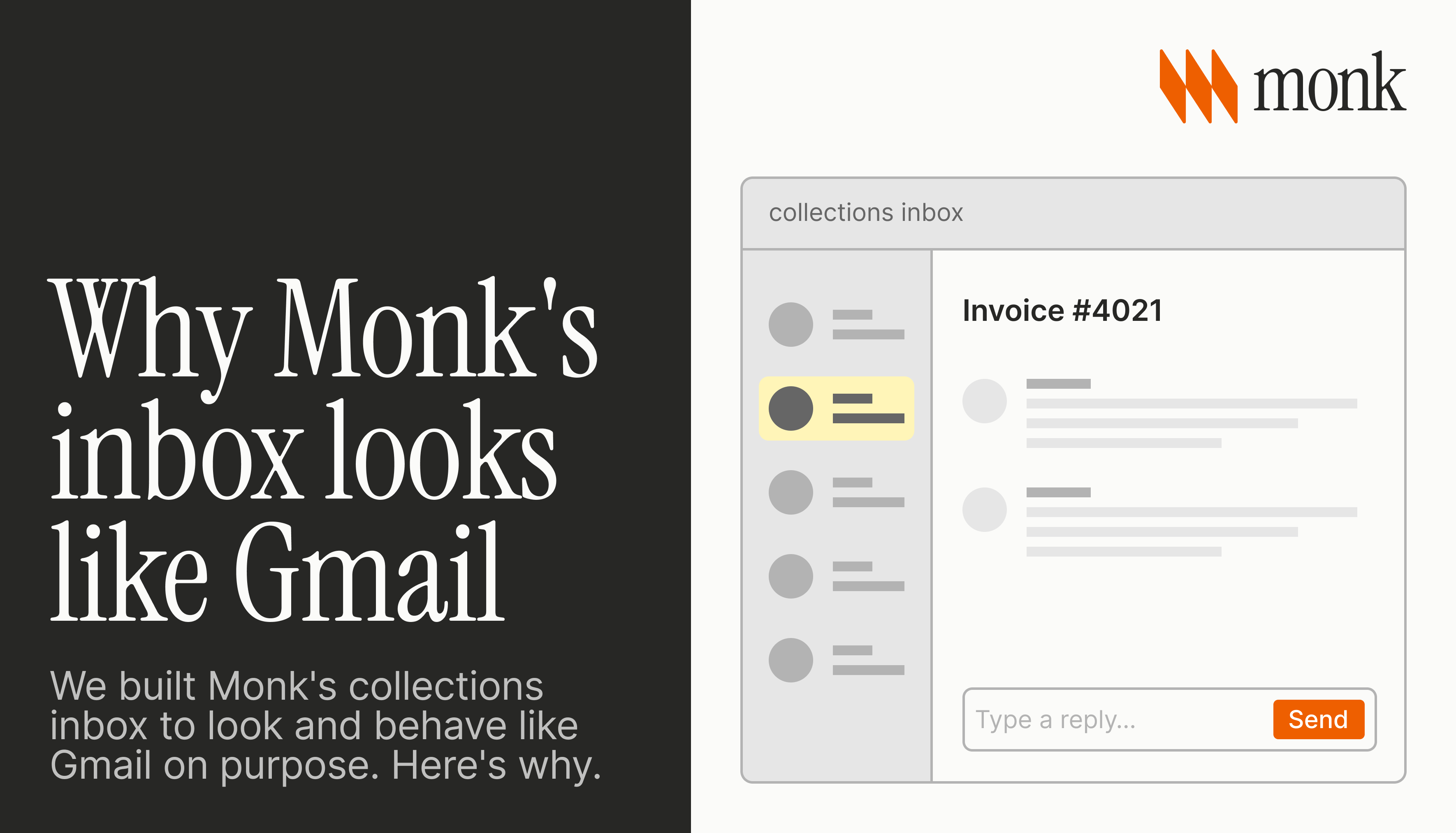
Most people expect AR software to feel like a dense table or a proprietary workflow builder, but Monk's collections inbox looks like gmail, because it's the inbox everyone uses every day.
Finance teams don't need to be trained on Gmail
Nobody opens Gmail for the first time at work. A finance team has years of muscle memory for this feature, send, threads, replying in context, a subject line that shifts as a conversation moves. If we built a bespoke interface on top of that, finance teams would be forced to learn how to use a second inbox.
Intentional design choices
Two design choices we made for the collections inbox:
Undo send. An outreach message from an AI agent should be reversible for the same few seconds a human's message would be. If Julia sends something that shouldn't have gone out, catching it should take one click, instinctual if you use Gmail. We wrote more about the thinking behind what we track and don't track in collections email in why Monk doesn't track email opens.
Editable thread subjects. A collections thread is rarely static and/or focused on one subject. "Invoice #4021" becomes "Invoice #4021, waiting on PO" becomes "Invoice #4021, resolved." Letting the subject reflect where a thread stands, without losing the history underneath it, tracks how the conversation develops in a way that feels intuitive for your customers.
Why this matters more with an AI agent in the loop
An unfamiliar dashboard full of custom controls is not useful to a collections team who is already swamped. An inbox that mirrors something familiar, like gmail, doesn't start from zero. When Julia sends a message, pauses on a reply, or updates a thread, a finance team can read what happened at a glance, the same way they'd scan any other email thread.
Readability makes it possible to hand something as sensitive as customer communication to an agent. Sticking with a known format isn't a lack of ambition just keeps the interface from being one more thing to figure out before anyone can judge whether the automation is effective.
Our take
A novel interface is one more thing for finance teams to learn before they see any value. We'd rather put our design effort into what happens inside the thread, the reasoning, the timing, the judgment, than into teaching someone a new inbox. Gmail solved what a conversation should look like, there is no reason to solve it again just for it to look different.
Frequently Asked Questions
Why does Monk's collections inbox look like Gmail?
Because finance teams already know how to use an inbox, and collections is fundamentally a conversation with a customer, not a proprietary workflow. Reusing conventions like threads and undo send removes a training step without losing any functionality.
Does Monk's collections inbox actually work like Gmail, or does it just look similar?
Both. It borrows real functional behavior, including undo send and editable thread subjects, not just the visual style, because the behavior is what removes friction.
What is undo send used for in Monk's collections inbox?
It gives a short window to catch and stop an outgoing message before it sends, whether that message came from a person or from Julia, Monk's AI collections agent.
Why can you edit a thread's subject line in Monk?
Because a collections conversation changes over time. An invoice can move from open, to waiting on a PO, to resolved, and the subject can reflect that current state without erasing the history in the thread.
Does a familiar interface make it easier to trust an AI collections agent?
Yes. When an agent's actions show up in a format a finance team already knows how to read, it's easier to see at a glance what happened and why, rather than needing to learn a new dashboard before evaluating whether the automation is working.
Does Monk's collections inbox replace email entirely?
No. It's built around the same behavior as email because collections outreach largely happens over email. It adds the context, automation, and agent-driven work on top of a format finance teams already understand. For more on how Monk approaches transparency in collections email specifically, see why Monk doesn't track email opens.
Want to see Monk's collections inbox in action? Book a demo.
Worth reading next: Introducing Multi-Threading: Agentic Collections Get Smarter in Monk, Monk Is Now Live on Microsoft 365, Why Monk Doesn't Track Email Opens and Intelligent Collections Now in Slack.




.avif)