Conversational AR Reporting: Ask Your AR Data in Plain Language in 2026

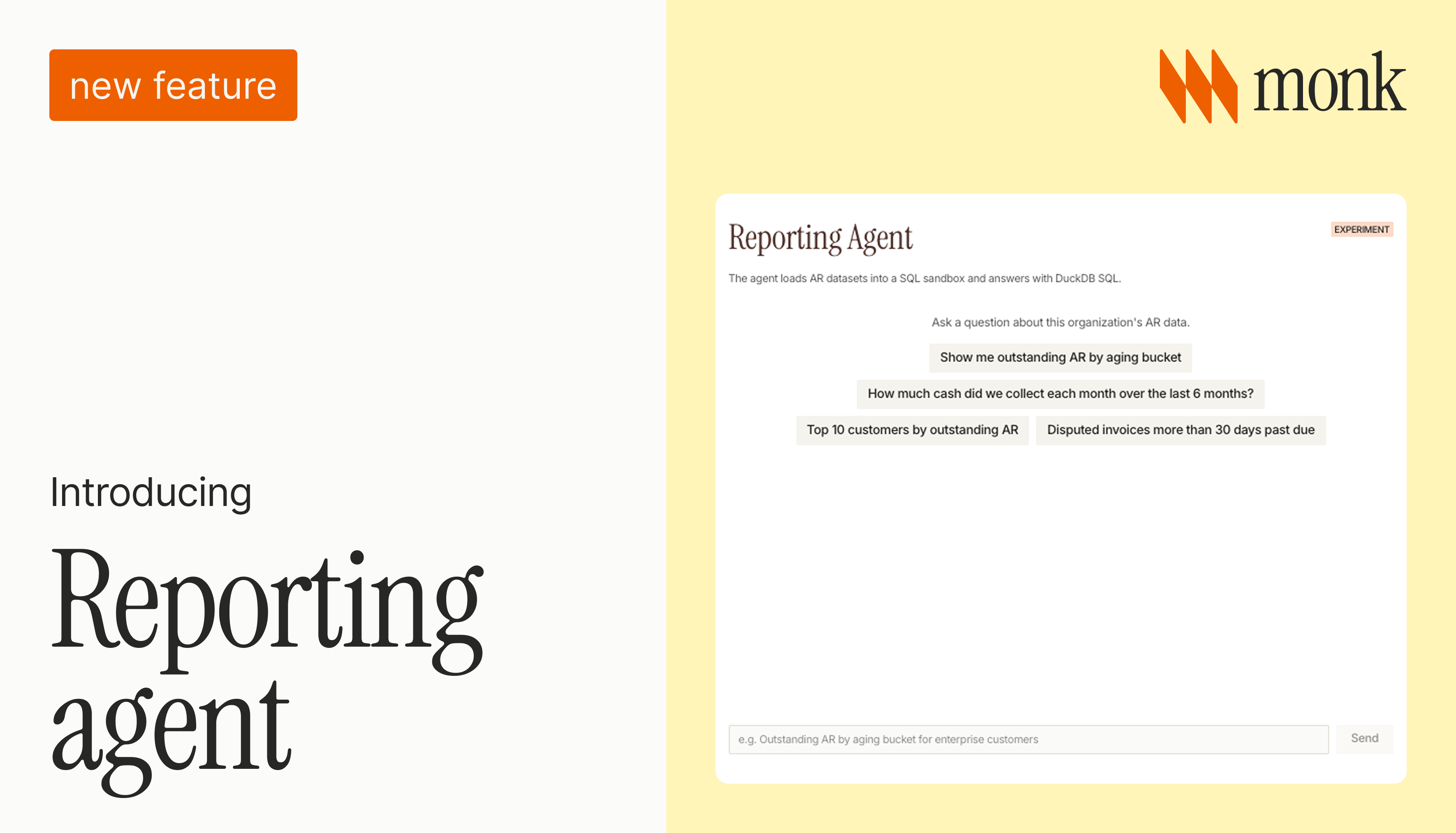
Conversational AR reporting lets you ask a question about your receivables in plain language and get the answer back as a chart, without building a report or waiting on an analyst. In Monk, the Reporting Agent answers questions like outstanding AR by aging bucket, monthly cash collected, top customers by AR, or disputed invoices past due, in seconds. It replaces the step where you export a ledger to a spreadsheet to answer one question in a meeting.
What is conversational AR reporting?
Conversational AR reporting lets you type a question instead of building a report with filters and pivot tables. You ask what you want to know, and Monk reads your accounts receivable data and returns the answer as a chart. Anyone on the finance team can get a straight answer about cash and collections without knowing how a dashboard was built.
In a Monday cash meeting, someone asks how collections are tracking against last quarter. You ask, and the chart is on screen before the meeting moves on, instead of writing it down and pulling the number the next day.
With traditional AR reporting, one person configures a dashboard or writes a query, and everyone else waits for it. That is why most AR questions get answered late, or not at all.
What can you ask?
The useful questions are the ones a controller or collector needs day to day:
Each answer comes back as a chart.
Why ask instead of building a report?
Building an AR report takes time, an owner, and a wait between the question and the answer. Three things change when you can ask in plain language:
What does conversational reporting not replace?
Conversational AR reporting answers the receivables questions a finance team asks all week: balances, aging, cash collected, top accounts, disputes. It is not a full business-intelligence tool. If you need a standing executive dashboard on a schedule, a board deck with a fixed layout, or an analysis that joins AR against data in other systems, a dedicated BI tool still fits.
For the day-to-day AR questions, it removes the wait. Your team can answer the questions that used to sit in a queue, and the scheduled reporting can stay where it is. For most teams, those ad hoc questions are the bulk of what they ask.
What about delivery and deliverability metrics?
Bounce-rate trends are now visible in Monk's reporting, so you can spot an email delivery problem before it slows a collections cadence. A reminder that never arrives will not get paid, and a rising bounce rate is the early warning.
How does Monk's Reporting Agent work?
You ask a question about your receivables, and the Reporting Agent answers with a chart, drawn from your live AR data in Monk. Because collections, cash application, and reporting run on one platform, the numbers are current rather than a separate export. There is nothing to build and no query language to learn.
A controller preparing for a board update can ask for monthly cash collected over the last six months, then for top customers by AR, and move both charts into the deck. No spreadsheet, no request to an analyst. Ask again a week later and the answer includes that week's collections.
The Reporting Agent gives a finance leader the numbers that run the week: what is owed, what is late, what has been collected, and where the risk sits.
How this fits the rest of Monk
Monk is an AI-native accounts receivable platform covering the full invoice-to-cash cycle: collections, cash application, and reporting. The Reporting Agent runs on the same data as the rest of the platform, so a question about disputed invoices past due reflects the disputes your team is already working. More than $2 billion in receivables run on Monk today, and Monk is SOC 2 Type II.
For the broader view of AR metrics and what to track, see our AR analytics and dashboards guide, and for the shift underneath all of this, AI-native vs traditional AR automation.
Frequently asked questions
What is conversational AR reporting?
It is AR reporting where you ask a question in plain language and get the answer as a chart, instead of building a dashboard or writing a query. In Monk, the Reporting Agent does this on your live receivables data.
What kinds of questions can I ask?
Practical AR questions like outstanding AR by aging bucket, monthly cash collected, top customers by AR, and disputed invoices past due. The answer comes back as a chart.
Do I still need dashboards or a BI tool?
For ad hoc AR questions, no. Conversational reporting answers most of what a controller or collector needs day to day without building a report. Teams that want standing executive dashboards can still keep them.
Does the Reporting Agent use my own data?
Yes. It reads your AR data in Monk and answers from it, on the same platform that runs your collections and cash application, so the numbers stay current.
How fast is it?
The answer arrives in seconds, so you can get the number during a meeting rather than the day after.
Can it help with email deliverability?
Yes. Bounce-rate trends are visible in reporting, so you can catch a delivery problem before it affects a collections cadence.





.avif)