Revenue Recognition: Why Performance Obligations at the Contract Level Matter

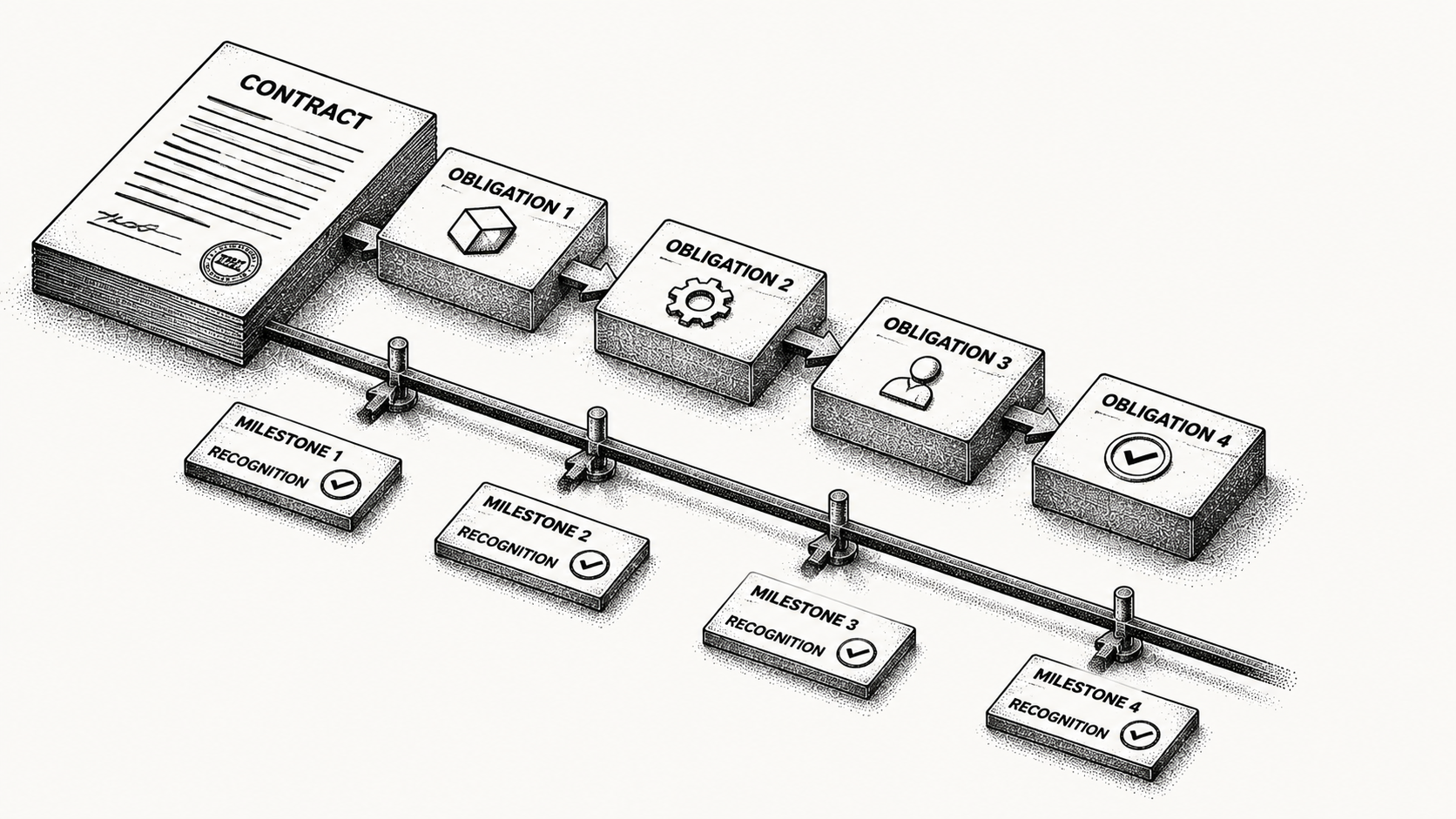
Accurate revenue recognition comes down to one thing: correctly identifying each performance obligation in a contract and recognizing revenue as you satisfy it. Under ASC 606, revenue is earned when you deliver a distinct promise to the customer, not when you send the invoice or collect the cash. Teams that recognize at the contract level, obligation by obligation, produce clean and auditable revenue. Teams that recognize at the invoice or cash level misstate timing, and that error compounds across every multi-element deal.
This guide explains what a performance obligation is, why contract-level granularity matters, the mistakes that trip teams up, and how connected invoice-to-cash data keeps recognition accurate.
What is a performance obligation?
A performance obligation is a distinct promise in a contract to transfer a good or service to the customer. If a promise is distinct, meaning the customer can benefit from it on its own and it is separable from other promises, it is accounted for on its own.
A single contract often contains several. A software agreement might include a term license, an implementation project, and ongoing support, and each of those is a separate obligation with its own recognition pattern. Identifying them correctly is the step that everything else in revenue recognition depends on.
Why does contract-level granularity matter?
Recognizing a whole contract on one schedule is the most common way revenue gets misstated. If a $120,000 deal bundles a 12-month license, a one-time implementation, and support, recognizing it evenly over the year overstates early revenue for the implementation work that was delivered up front and misstates the rest.
Contract-level granularity fixes this by tying each dollar to the obligation that earned it. That is what makes revenue auditable, keeps you compliant with ASC 606, and gives leadership a true read on how much revenue is earned versus merely billed. It also matters for the numbers built on top of revenue, from margin analysis to the cash forecast.
What are the five steps of ASC 606?
The standard lays out a five-step model, and performance obligations sit at the center of it.
First, identify the contract with the customer. Second, identify the distinct performance obligations in that contract. Third, determine the transaction price. Fourth, allocate the transaction price across the obligations, usually by their standalone selling price. Fifth, recognize revenue as each obligation is satisfied, either at a point in time or over time.
What are the most common revenue recognition mistakes?
Four errors account for most misstatements.
The first is treating a multi-element contract as a single obligation, which collapses different recognition patterns into one and distorts timing. The second is recognizing on invoice or cash timing rather than on delivery, which confuses billing with earning. The third is mis-allocating the transaction price across obligations when standalone selling prices are not established. The fourth is ignoring contract modifications, so an upsell or a scope change never flows into the recognition schedule.
How does obligation type affect recognition timing?
Recognition timing depends on how each obligation is satisfied. The illustrative table below shows common patterns.
| Obligation | Typical recognition pattern |
|---|---|
| Term software license | Ratably over the license term |
| One-time implementation | On completion or by percentage of completion |
| Support or SLA | Ratably over the support period |
| Usage-based service | As the customer consumes it |
The point is that a single contract can carry several of these at once, which is exactly why recognizing it as one line misstates the result.
How does connected invoice-to-cash data keep recognition accurate?
Revenue recognition starts at the contract, but the contract, the billing, and the collected cash usually live in different systems. When those are disconnected, the obligations defined in the contract drift out of sync with what gets billed and collected, and recognition quietly diverges from reality.
Keeping invoice-to-cash data connected is what prevents that drift. Monk runs billing context, collections, and cash application on one platform, so the terms in a contract stay tied to the invoices that bill them and the payments that settle them. That consistency does not replace your revenue recognition process, but it gives that process a clean, connected source of truth to work from, instead of three exports that have to be reconciled by hand. Monk connects to Salesforce, QuickBooks, HubSpot, Stripe, and NetSuite, so the contract and payment data behind recognition sits in one place.
How do you get performance obligations right?
Start at the contract, not the invoice. Read each agreement, list the distinct promises, and confirm which are separable. Allocate the transaction price across them using standalone selling prices, and set the recognition pattern for each based on how it is satisfied.
From there, tie billing to the obligations so invoices map to what is being recognized, and keep contract, billing, and payment data connected so modifications and renewals flow through automatically. The result is revenue you can defend in an audit and a number leadership can trust.
Frequently Asked Questions
What is a performance obligation in revenue recognition?
It is a distinct promise in a contract to transfer a good or service to the customer. Under ASC 606, revenue is recognized as each obligation is satisfied, either at a point in time or over time.
Why recognize revenue at the contract level?
Because a single contract often contains multiple obligations with different recognition patterns. Recognizing the whole contract on one schedule misstates the timing of earned revenue.
What is the difference between billed and recognized revenue?
Billed revenue is what you have invoiced, while recognized revenue is what you have earned by satisfying obligations. The two can differ sharply on multi-element or subscription contracts.
What are standalone selling prices?
They are the prices you would charge for each obligation if sold separately. ASC 606 uses them to allocate a contract's total price across its obligations.
How do contract modifications affect recognition?
A modification can add obligations or change the transaction price, which updates the recognition schedule. Ignoring modifications is a common source of misstated revenue.
How does Monk support revenue recognition?
Monk keeps invoice-to-cash data connected, so the terms in a contract stay tied to the invoices and payments that follow. That gives your recognition process a clean, single source of truth rather than disconnected exports.





.avif)