Introducing Voice Collections

Most collections workflows assume the customer will reply by email. In AR, that is only partly true.
Email is still the right system of record for invoices, reminders, disputes, and promises to pay. But finance teams know how often the real work spills into phone calls. A customer calls to confirm an invoice amount. AP needs to verify bank details before sending an ACH. Someone calls back after receiving a reminder and wants to know which invoices are still open.
Those calls are useful. They are also easy to lose.
If the call lands with the wrong person, the finance team has to reconstruct the context manually: which customer is this, which invoice are they asking about, did we already call them, did they already promise to pay, did a payment arrive, and what should happen next?
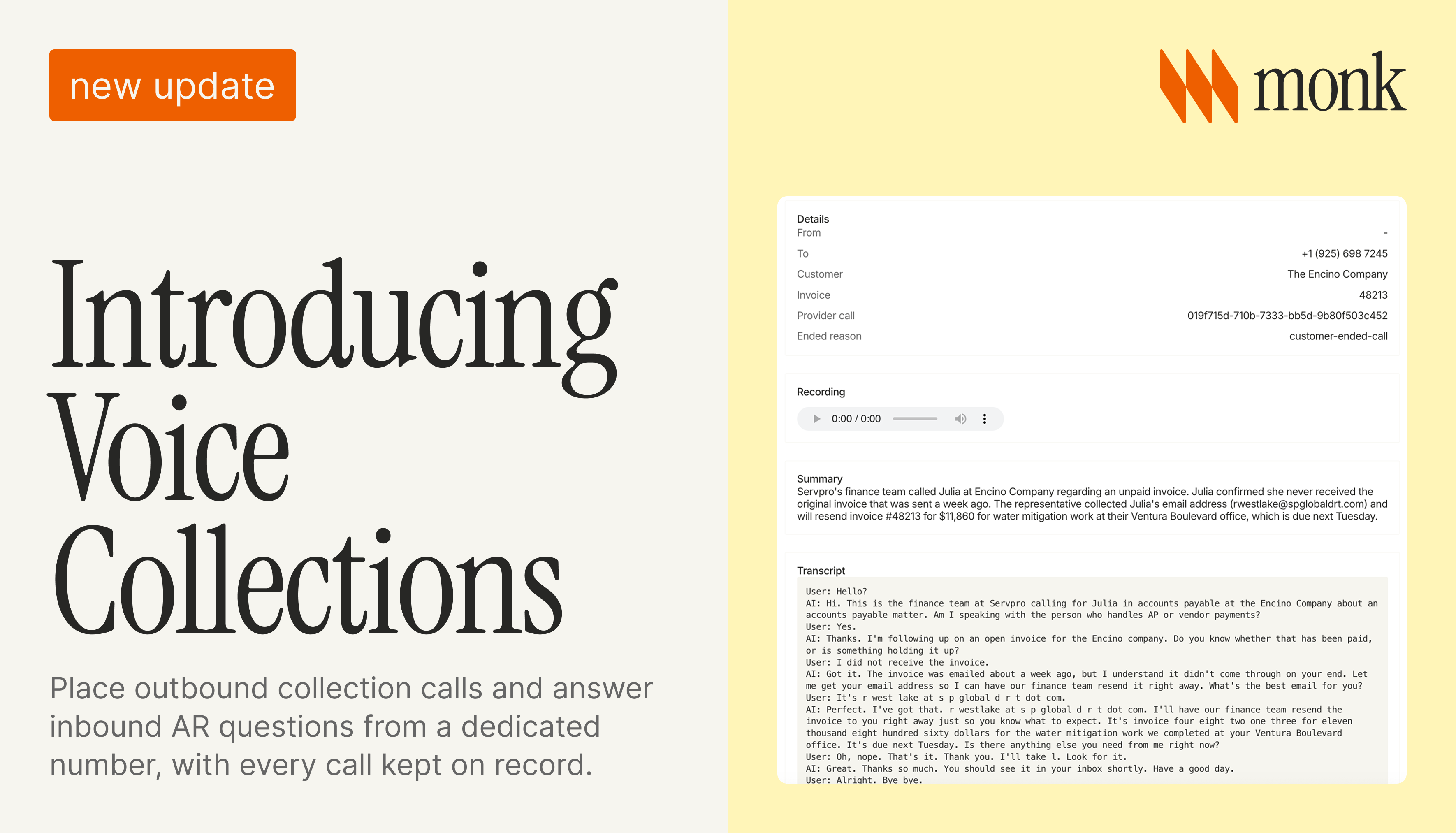
Voice Collections brings that phone workflow into Monk.
One number for collections and callbacks
With Voice Collections, Monk can place outbound collection calls and answer inbound AR questions from a dedicated phone number for your organization.
The same number can support both sides of the workflow: outbound collection calls when a playbook needs phone follow-up, and inbound callbacks when a customer wants to ask about invoices, payments, or verification.
That matters because customers should not have to guess where to go. If they receive a call from your collections number, they can call that number back. Monk can use the call history and the latest AR context to help answer the next question.
Built for narrow, referenced answers
Voice in finance has to be constrained. A caller should not be able to call a number and browse across all customers, all invoices, or all payments.
So Voice Collections is designed around caller-provided references.
If someone asks about an invoice, Monk asks for both the company name and invoice number before looking anything up. It will not search broadly from just a company name, and it will not share invoice details from just an invoice number.
If someone asks about a payment, ACH, or bank verification, Monk asks for the relevant payment context, including the company and exact amount. The caller needs to bring enough detail for Monk to confirm the right record.
That constraint is intentional. Voice Collections helps the right caller answer a specific AR question using references they already have, and it does not turn financial data into something you can browse by phone.
What callers can ask
Voice Collections is built for the common read-only questions that slow AR teams down:
- Can you confirm the amount on invoice INV-0009?
- What is the due date on this invoice?
- Has this invoice been paid?
- We sent an ACH for this amount. Can you check whether it has been received?
- Can you confirm the bank verification details for this payment?
- Someone from your team called us earlier. What was this about?
When Monk has enough caller-provided context, it can answer from the latest invoice, payment, and collection history in Monk. When it does not, it asks for more detail or keeps the answer narrow.
The agent is read-only. It can answer questions, summarize context, and help route the next step. It does not rewrite invoices, change payment status, or accept sensitive payment changes over the phone.
Calls become part of the collection record
Phone calls also get forgotten. Even a good call leads to bad follow-up if the context disappears afterward.
Voice Collections keeps inbound and outbound call history visible in Collections. Teams can review the call, see whether it completed, and use that context when deciding what to do next.
That means a callback is no longer separate from the rest of the thread. It sits alongside email follow-ups, invoice context, payment updates, and playbook activity.
Why this fits Intelligent Collections
Collections is more than sending reminders. It is knowing when to follow up, which channel to use, what context matters, and when to stop.
Sometimes email is enough. Sometimes a phone call gets the answer faster. Sometimes the customer calls you first.
Voice Collections gives finance teams a way to handle that channel without turning it into another manual queue. Monk can make the call, answer the callback, ask for the right references, and preserve the context for the team.
Available by opt-in
Voice Collections is available as an opt-in feature. Monk helps configure the dedicated phone number and call behavior for each organization before enabling it in Collections.
Frequently Asked Questions
What is Voice Collections?
It's Monk's phone workflow for AR. Monk can place outbound collection calls and answer inbound AR questions from a dedicated number for your organization, then keep every call in the collection record.
Can a caller look up any invoice by phone?
No. Voice Collections is reference-based. A caller has to provide details like company name and invoice number before Monk looks anything up, and it won't search broadly from a single detail.
Can the voice agent change an invoice or take a payment?
No. The agent is read-only. It answers questions and routes the next step, but it doesn't rewrite invoices, change payment status, or accept payment changes over the phone.
Where do the calls show up?
Inbound and outbound call history is visible in Collections, alongside email follow-ups, invoice context, payment updates, and playbook activity.
If your team wants Monk to support outbound collection calls and inbound AR questions from a dedicated number, tell our team and we will help set it up. Once it's on, you can customize the voice agent to sound like your team, or book a demo to see it live.
Related reading: Customize your voice agent: give collections calls a name, a voice, and clear rules and how to know if your AI collections agent is working.




.avif)