How to Know if Your AI Collections Agent Is Working

The short answer: you can tell it's working when you can trace collected dollars back to it. Four things do that. How much it collected on its own. How much it collected with a human's help. Its conversion rate on the invoices it touched. And where it's stuck. If your tool only reports activity, like emails sent or calls placed, it can't answer the one question that matters: did any of it actually get you paid?
Most finance teams hit the same wall when they roll out AI. The agent looks busy. Whether it's bringing in cash is a different question, and activity logs won't answer it. You need attribution. Here's how we do it at Monk.
Why activity metrics don't tell you enough
Any collections tool can report what it did: reminders sent, calls placed, threads opened. None of that tells you why a customer paid, or whether they paid because of the agent at all.
- Activity metrics count what the agent did: emails sent, calls placed, threads opened.
- Attribution ties those actions to the payments that actually came in, so you can see which ones moved money.
The finance teams getting real value out of AI tend to do one thing. They pick a single high-volume process, measure it end to end, and hold the software to the same bar they'd hold a person. In collections, that means answering four questions with real numbers.
The four numbers that tell you if it's working
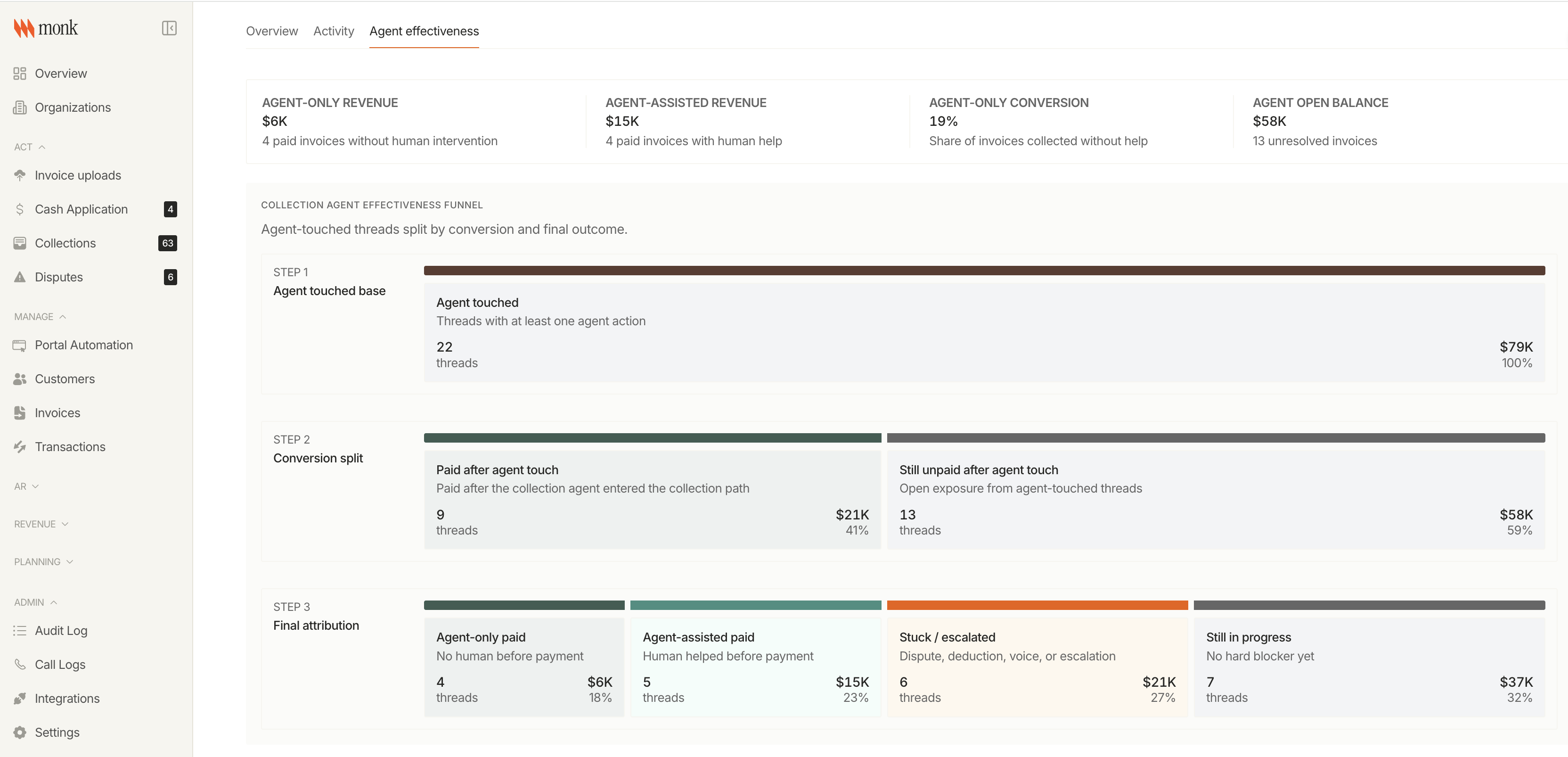
Agent-only revenue. Money collected where the agent did the whole job, no human involved. It's the cleanest read on value, because nobody touched it.
Agent-assisted revenue. Money collected where the agent did the work but a person stepped in before payment. This is where the agent is pulling weight without closing on its own yet.
Agent-only conversion. The share of agent-touched invoices that got paid without help. When this climbs, the agent is handling more on its own.
Agent open balance. Dollars still unpaid after the agent worked the account. This is your risk view: money in motion that hasn't landed.
Together they tell you what's real and what's just activity. And when the agent is working and getting better over time, the trend is clear:
- agent-only revenue growing
- agent-only conversion rising
- agent open balance shrinking
- more collections shifting from agent-assisted to agent-only
Follow the money: the collections funnel
The numbers alone don't show you how you got there. A funnel does, tracing each account from the agent's first move to the final result.
Step 1, agent touched base. Every thread where the agent took at least one action.
Step 2, conversion split. Those threads sorted into paid after the agent's touch and still unpaid.
Step 3, final outcome. Four buckets: agent-only paid, agent-assisted paid, stuck or escalated, and still in progress.
Read start to finish, it tells you how much the agent collected, how it collected it, and how much is still working its way through.
Where is the agent getting stuck?
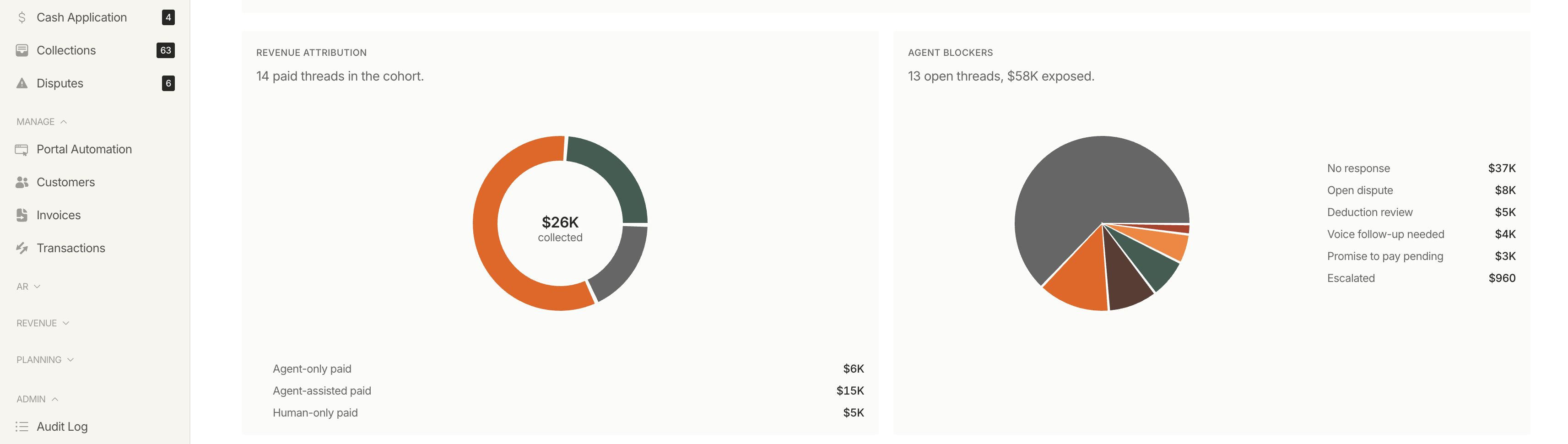
An agent that collects most of what it touches is only as useful as your read on the rest. Group the open agent-touched dollars by reason, and you can see exactly where it stalls:
- open dispute
- deduction review
- voice follow-up needed
- promise to pay pending
- escalated
- no response
Now "the agent didn't get everything" becomes a worklist. Disputes route to the people who handle disputes. Promise-to-pay balances get a nudge. No-response accounts get tried on another channel. This is the view that tells your team what to work next.
Attributing revenue: agent versus human
Every finance leader eventually asks how much credit goes to the agent and how much to the team. Split collected dollars by source and you have the answer:
- agent-only paid
- agent-assisted paid
- human-only paid
This is the number for a board deck or a renewal call. It also tells you whether to give the agent more room or keep a person in the loop.
The evidence behind the charts
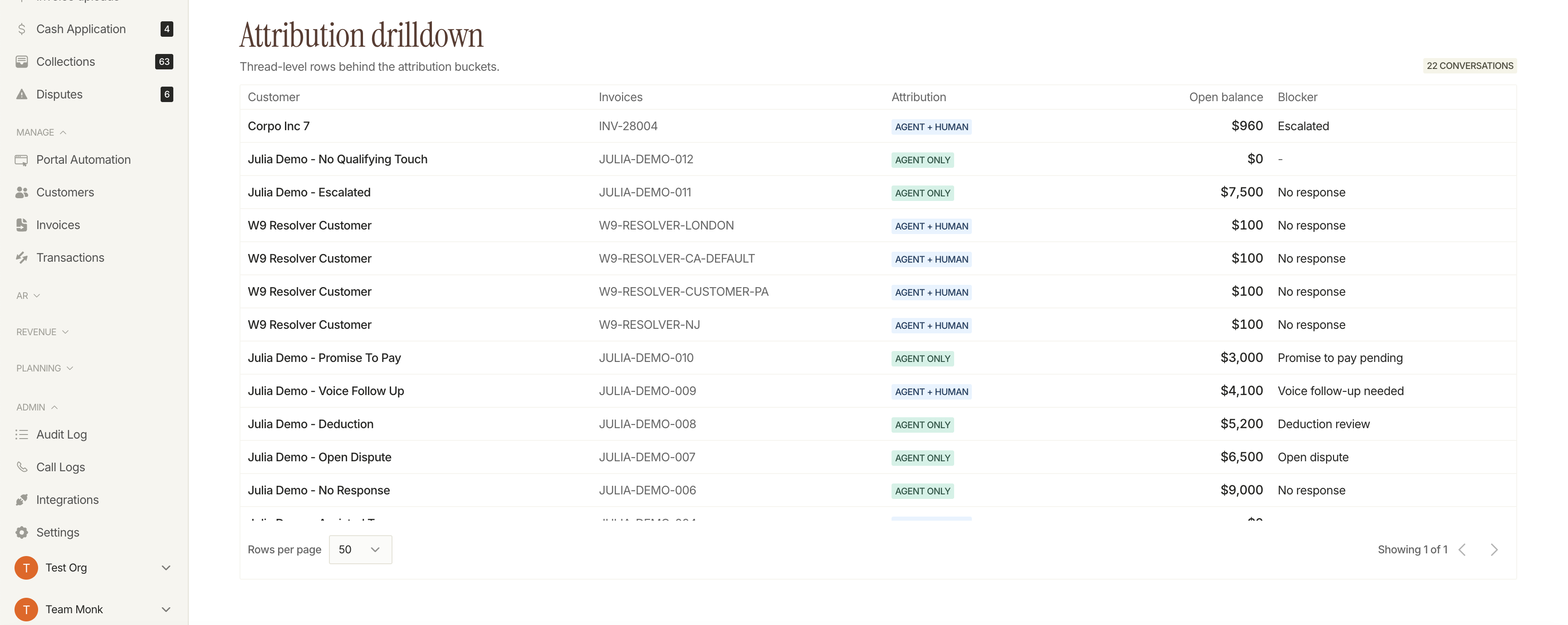
Attribution only counts if you can audit it. The drilldown is the record underneath every chart: customer, invoices, attribution type, open balance, and blocker reason, each one linked back to the actual conversation and invoice. For finance, that matters more than the summary on top. A number you can't trace isn't a number you can defend. Every figure rolls up from evidence you can open and check yourself.
Why this is the real test of AI in finance
A 2025 Gartner survey found that 84% of finance organizations have adopted or are adopting AI, and only 7% report high impact. BCG puts a number on the shortfall: median ROI on AI in finance is just 10%, well short of the 20% many teams target, and a third of finance leaders report limited or no gains. The problem usually isn't the technology. It's that teams can't see what it's doing, so they can't tell whether it's working or make it better.
That's what measurement fixes. Once you can attribute every dollar to the agent or a person, watch conversion climb, and see where the agent gets stuck, you're not guessing anymore. You run the agent the way you'd run anyone on the team.
On Monk, the collections agent resolves 90% of collections with no human intervention, every match backed by an audit trail you can open and check.
That's how you know your AI collections agent is working.
Frequently Asked Questions
What does it mean for an AI collections agent to be working?
It means you can trace collected dollars back to it: how much it collected alone, how much with human help, its conversion rate on touched invoices, and where it's stuck. Activity logs alone won't tell you.
What is agent-only revenue?
Money collected where the agent did the whole job, with no human involved.
What is agent-assisted revenue?
Money collected where the agent did the work but a person stepped in before payment.
How is agent attribution different from activity tracking?
Activity tracking counts what the agent did, like emails sent or calls placed. Attribution ties those actions to the payments that actually came in, so you can see which ones moved money.
How do you measure the ROI of an AI collections agent?
Split collected dollars by source (agent-only, agent-assisted, human-only) and track agent-only conversion over time. Rising agent-only revenue and conversion, with a shrinking open balance, is ROI you can defend.
How do you know the agent is improving over time?
Agent-only revenue and conversion go up while the open balance comes down. That means the agent is closing more on its own and leaving less unresolved.
Why are activity metrics like emails sent not a good measure?
They show effort, not results. What matters is whether the action moved a payment, and that takes attribution.
Want to see this measured on your own receivables? Book a demo.
Related reading: the rebuilt AR Overview and Introducing Voice Collections.



.avif)