Accounts Receivable Is the New Frontline of Cash Management


Accounts receivable is the new frontline of cash management because it is the fastest lever finance teams can pull to improve liquidity without cutting costs or raising capital. A dollar booked is not a dollar collected, and the gap between the two is exactly where working capital leaks out. Revenue teams get CRM systems, forecasting tools, and dashboards, while AR is still run on spreadsheets and email threads at most companies. Treating AR as revenue infrastructure, with the same investment and intelligence as a modern go-to-market stack, is how finance teams turn it from a bottleneck into a growth lever, which is the approach behind an AI-native platform like Monk.
This post covers the hidden cost of delayed cash, why traditional AR software cannot fix it, and what it looks like to run AR as real-time infrastructure instead of a back-office chore. For foundational context, see our overview of what accounts receivable automation is.
What Is the Hidden Cost of Delayed Cash Flow?
Every day between issuing an invoice and receiving payment is a drag on working capital, and the cost compounds in ways a P&L does not show. The damage is structural, not cosmetic.
Delayed cash flow creates artificial burn, because a company raises or borrows against a shortfall it did not actually need to have. It breaks forecasts, because planning happens against booked revenue instead of collected cash. It also pushes teams to add collections headcount to chase predictable, repetitive payment patterns that software should handle instead.
Most finance leaders still cannot answer simple questions on demand, such as which invoices will get paid this week or which customers are drifting toward late payment. That is a strategic blind spot, not a minor inconvenience, and closing it is the core argument in our guide to reducing DSO with six proven strategies.
Why Doesn't Traditional AR Software Solve the Problem?
Most existing AR tools are billing systems at heart. They help a team send invoices and schedule reminder emails, but they do not touch the underlying dynamic that lets cash stall in the first place.
These tools cannot detect when a customer is quietly stalling, read payment intent from a reply, forecast collections based on behavior, resolve a billing dispute quickly, or allocate an incoming payment the moment it lands. They are systems of record, not systems of action. That gap is why finance teams still keep parallel spreadsheets and spend hours every week reconciling bank activity by hand, which is exactly the trap we describe in why accounts receivable does not belong in spreadsheets.
What Does AR as Revenue Infrastructure Look Like?
Running AR as revenue infrastructure means treating it as a core part of the revenue engine, not a clerical afterthought bolted onto accounting. With Monk, the building blocks are visibility, intelligent collections, cash-in forecasting, and reconciliation, working together as one connected system rather than four disconnected tools.
Every Invoice Becomes a Living Record
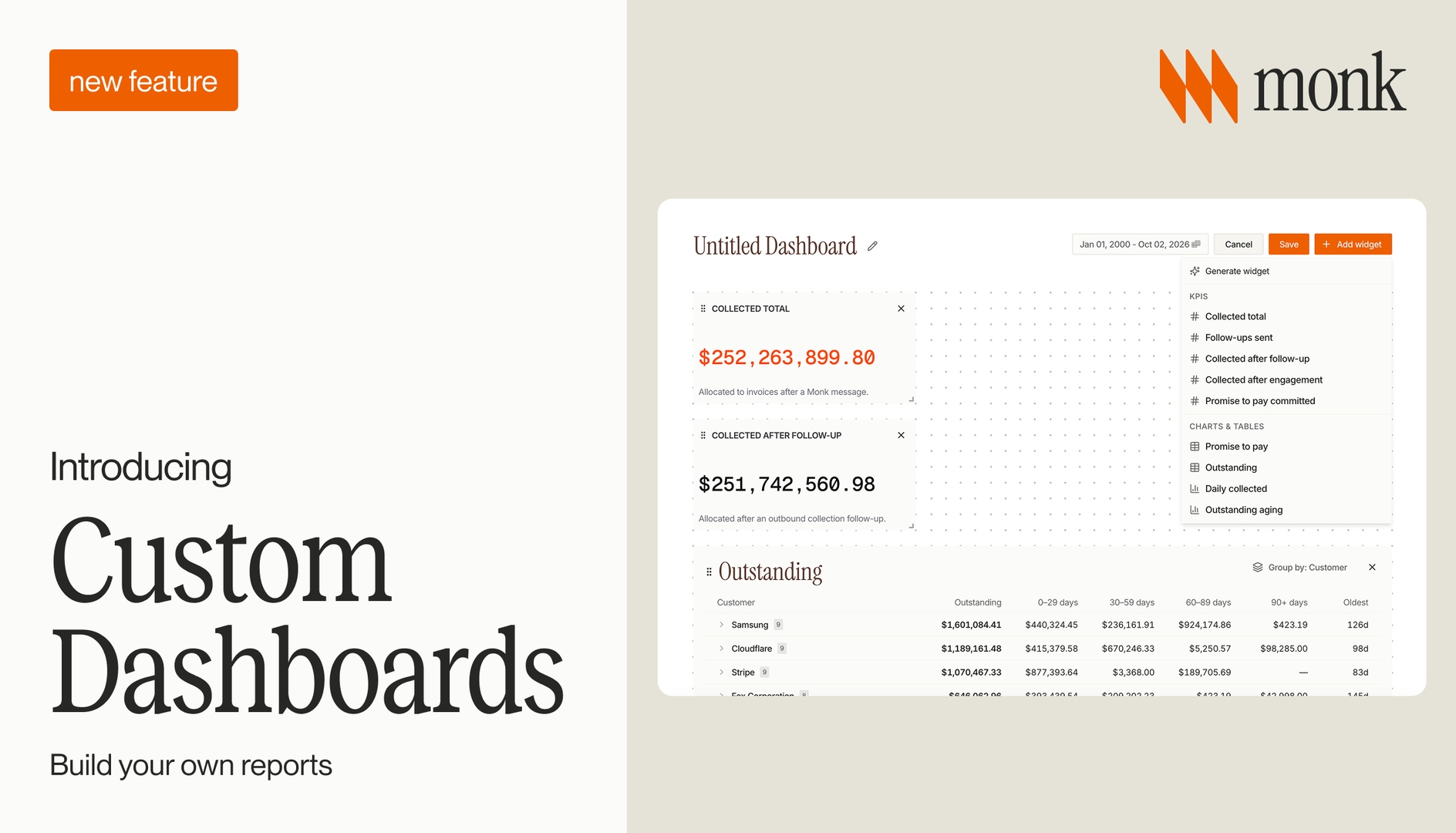
Instead of a static line item, every invoice carries a risk score based on customer behavior and aging, a promise-to-pay status, dispute detection with a named resolution owner, a live payment and reconciliation state, and a forecasted cash-in window. That means finance can see, at any moment, exactly which dollars are on track and which need attention.
Collections Adapt to What the Customer Actually Does
Monk's AR agent, Julia, does not run a fixed reminder cadence regardless of context. If a customer replies that payment is processing, Julia pauses outreach and follows up only if the promised date slips. If a customer goes quiet, she escalates by risk tier. If a dispute surfaces, she routes it to the right owner and pauses collection until it is resolved. This context-aware approach is why Monk's intelligent collections produces a 24 percent higher response rate than standard dunning.
How Does Monk Forecast Cash and Reconcile Payments?
Forecasting and reconciliation are where AR stops being a lagging report and becomes a leading indicator. Both run on the same real-time data the collections engine already uses, so nothing needs to be re-entered or reconciled separately.
Monk forecasts expected payments using prior payment behavior, communication patterns, dispute presence, and engagement with invoice portals, producing cash-in projections finance can use to manage burn and report with confidence. On reconciliation, Monk ingests payments from Stripe and bank feeds and matches them to invoices at an 80 percent automatic match rate (up to 95 percent with suggested rules), even when a payment arrives with no memo or as a partial amount. Because Monk connects directly to the systems where this data already lives, including Salesforce, QuickBooks, HubSpot, NetSuite, and Stripe, the picture stays current instead of going stale between weekly reconciliation cycles.
Back-Office AR vs AR as the Frontline of Cash
The shift from clerical function to cash frontline changes how AR is tooled, measured, and run. The table below contrasts the two postures across the dimensions that matter most.
| Dimension | AR as back-office | AR as frontline of cash |
|---|---|---|
| Primary role | A clerical afterthought that sends invoices and records payments | A strategic lever to improve liquidity without cutting costs or raising capital |
| Tooling | Spreadsheets, email threads, and basic billing systems | An intelligent, integrated revenue layer with invoice-level visibility |
| The invoice | A static record | A dynamic object with a risk score, promise-to-pay status, and forecasted cash-in window |
| Collections | Reminders on a fixed schedule regardless of customer behavior | Real-time, behavior-based automation that adapts to replies, disputes, and risk tier |
| Forecasting | Planning against booked revenue rather than reality | Cash-in projections grounded in prior behavior and engagement |
| Reconciliation | Manual wire matching done by hand each week | Real-time matching against bank feeds at a 95 percent rate, even without a memo |
What Outcomes Does Treating AR This Way Produce?
When AR runs as real-time infrastructure, the gains show up across cash, time, and confidence rather than in a single metric. The pattern is consistent across Monk's customer base.
Monk customers reduce DSO by 40% on average, save roughly 26 hours per month that used to go into manual chasing and reconciliation, and resolve 90 percent of collections with zero human intervention. Monk manages $2B+ in receivables across its customer base and is SOC 2 Type II compliant, which matters when finance is handing a system access to payment and customer data. Faster cash converts directly into runway, and a forecast grounded in actual behavior gives leadership the confidence to plan capital and report accurately instead of guessing.
How Do You Move AR to the Frontline?
Getting started does not require ripping out existing systems. Monk connects natively to the tools finance and revenue teams already use, including Salesforce, QuickBooks, HubSpot, Stripe, NetSuite, Anrok, Slack, Gmail, and DocuSign, so invoice and customer data flows in without a migration project.
Most teams are live within less than one week, not the months a typical ERP or billing rollout takes. There is no percentage taken from collections, so the incentive stays aligned with getting cash in the door rather than maximizing fees on top of it. From there, the shift is less about new software and more about a new default: AR gets monitored, forecasted, and acted on continuously, the same way a sales pipeline does.
Finance Runs on Real-Time Cash Intelligence
A finance team cannot scale on spreadsheets, forecast on gut feel, or afford to treat AR as a formality while cash leaks through invisible, manual processes. The teams pulling ahead treat AR as a real-time, intelligent, integrated revenue layer rather than a back-office chore.
Monk turns AR from a lagging process into a leading indicator, from a spreadsheet mess into a structured system, and from a cost center into a cash accelerator. To see how the pieces fit together, explore the Monk platform and how AR agent Julia runs the whole motion end to end. That is what the new frontline of cash management looks like in practice.
Frequently Asked Questions
Why is accounts receivable now a strategic priority for finance teams?
In a capital-constrained environment, cash is the bottleneck, and AR is the most actionable lever to improve liquidity without cutting costs or raising capital. It is still often run on spreadsheets and email, which leaves the biggest available cash lever underused.
What is the hidden cost of delayed cash flow?
Delayed cash flow creates artificial burn, broken forecasts, and unnecessary collections headcount. A dollar booked is not a dollar collected, and every day between invoice and payment drags on working capital.
Why does traditional AR software fall short?
Most AR tools are systems of record, not systems of action. They send invoices and reminders but cannot detect stalling, read payment intent, forecast behaviorally, or resolve disputes on their own.
How does Monk treat AR as revenue infrastructure?
Monk makes every invoice a dynamic object with a risk score, promise-to-pay status, dispute detection, and a forecasted cash-in window. Its AR agent, Julia, runs behavior-based collections alongside cash-in forecasting and real-time reconciliation at an 80 percent automatic match rate (up to 95 percent with suggested rules).
How does Monk forecast cash-in?
Monk forecasts expected payments using prior behavior, communication patterns, dispute presence, and engagement with invoice portals. That produces cash-in projections finance teams can use to manage burn and report with confidence.
What results do Monk customers see?
Monk customers reduce DSO by 40% on average, save about 26 hours per month, and resolve 90 percent of collections with zero human intervention. Monk manages $2B+ in receivables and is SOC 2 Type II compliant.
Worth reading next: Accounts Receivable Doesn't Belong in Spreadsheets, How Monk Uses Gen-AI to Handle Complex Issues, How Monk Transforms Finance Teams from Reactive to Strategic, Without Hiring More People, Cash Flow vs. Profitability: Why A/R Automation with Monk Works and Accounts Receivable as a GTM Function.



.avif)