AR Automation for Usage-Based Billing SaaS (2026)

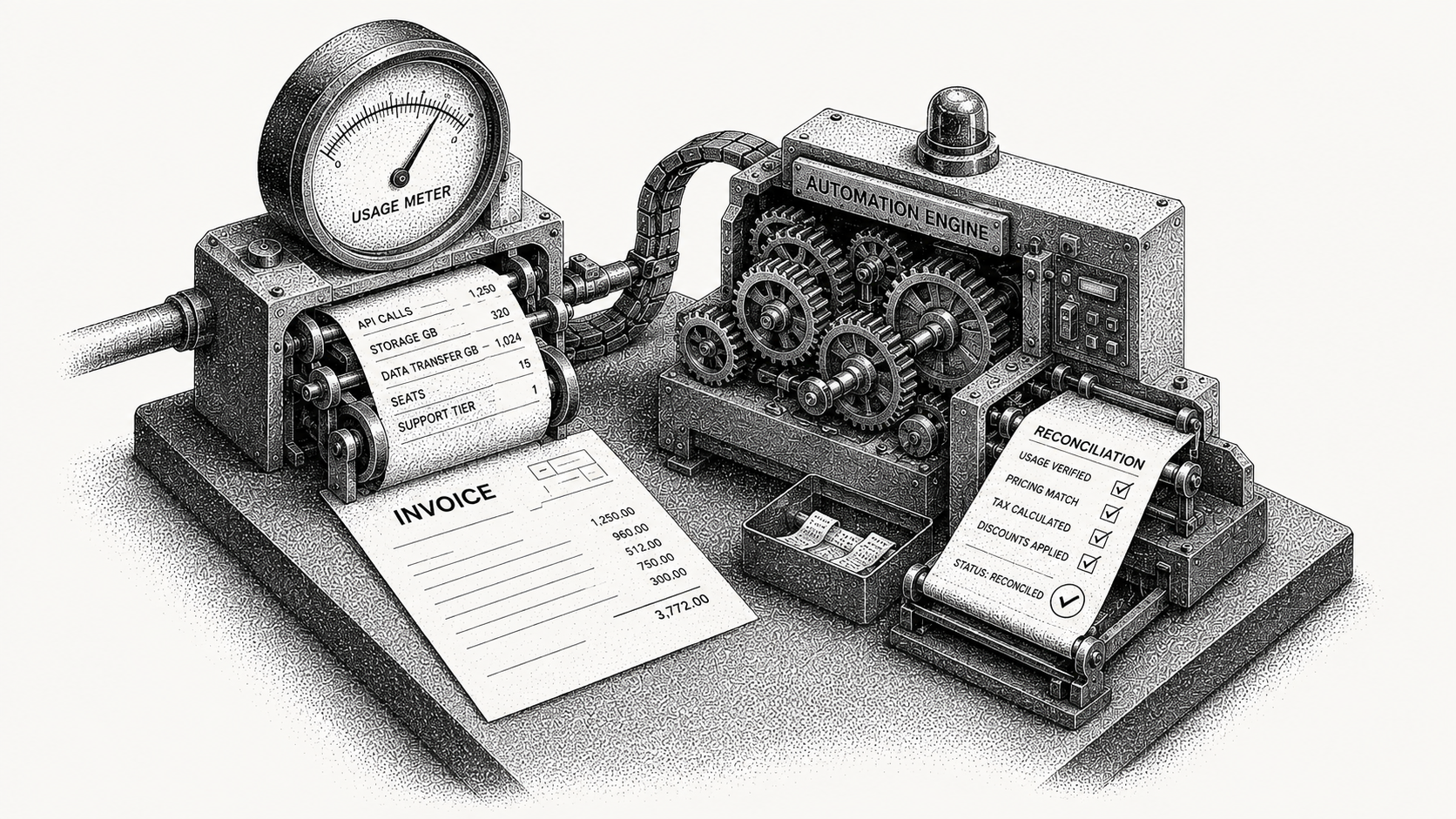
AR automation for usage-based billing SaaS has one requirement that flat-rate subscription tools never face: every step of the workflow, from invoicing through collections to cash application, has to understand why the number on the invoice is what it is. When pricing is metered, no two invoices match, customers question line items, and usage disputes become your most common exception type. The platforms worth shortlisting in 2026 connect directly to your billing system, usually Stripe, and use that usage data to explain charges, resolve disputes, and forecast cash on revenue that changes every month.
Why usage-based billing breaks traditional AR
Most AR tools were designed around predictable recurring invoices. A customer pays the same amount on the same day every month, so reminders can be generic, payment matching is trivial, and forecasting is a calendar exercise. Consumption pricing removes every one of those assumptions at once.
Every invoice amount is different
With metered or hybrid pricing, the amount due is recalculated each cycle from usage events, tier thresholds, overages, and credits. A customer who paid $1,800 last month might owe $4,300 this month, and that jump is precisely when they slow down or route the invoice to procurement for a second look. Your AR process has to anticipate that scrutiny rather than treat it as an edge case.
Variable amounts also break naive payment matching. When a customer short-pays because they dispute a single line item, or covers two variable invoices with one transfer, a tool that expects exact matches kicks the payment into an exception queue. That is how usage-based finance teams end up doing manual reconciliation at scale even after buying automation.
Usage disputes are the top exception type
In flat subscription businesses, the common collection blockers are budget timing and missing PO numbers. In usage-based businesses, the most frequent exception is a customer who does not yet believe the number. They want to know which workloads, API calls, events, or seats generated the charge before anyone approves payment. Generic dunning cannot answer that question, so the thread bounces to your team, and the invoice ages while someone reconstructs usage history by hand.
Forecasting gets harder when billed amounts vary
Cash forecasting on flat subscriptions is mostly arithmetic. On usage-based revenue, the amount billed changes monthly, payment timing shifts with invoice size, and disputes add variance on top of both. Finance leaders need AR data that reflects current invoice values and live payment behavior, not a static aging report exported once a week.
What should you look for in AR automation for usage-based billing?
Five capabilities separate tools that merely tolerate usage-based billing from tools built for it. Treat these as your evaluation checklist and ask every vendor to demonstrate them on your own invoice data, not a demo account.
1. Usage-aware invoicing and billing integration
The platform should sync invoices, line items, credits, and payment status directly from your billing system in near real time, not from a nightly CSV export. For most usage-based SaaS companies that means a native Stripe integration, plus connections to the surrounding stack such as Salesforce, HubSpot, QuickBooks, or NetSuite. If the AR tool cannot see line-level detail, nothing downstream can reference it.
2. Dispute resolution with usage context
When a customer challenges a charge, the platform should surface the relevant line items and usage detail inside the conversation, not just log a dispute flag and open a ticket. Look for workflows where the first reply to "why is this invoice so high" already includes the components of the charge. That one capability collapses dispute cycles from weeks to days, because the customer gets an answer before frustration compounds.
3. Collections that can explain the charge
Reminder cadences alone underperform on usage-based invoices because the customer's hesitation is informational: they are waiting for an explanation of the charge before they pay. An AI agent running intelligent collections should read the invoice, understand what changed versus prior periods, and write outreach that addresses it directly. Monk's AR agent, Julia, works this way, and that context is a large part of why Monk's outreach earns a 24% higher response rate than standard dunning emails.
4. Cash application built for variable amounts
Ask vendors exactly how they match a payment that does not equal any single open invoice. Strong platforms match on remittance data, customer history, and partial-payment logic rather than exact amounts. Monk maintains an 80% automatic cash application match rate, rising to 95% once teams enable suggested rules, which matters most in usage-based businesses where amount-based matching fails routinely.
5. Forecasting on variable revenue
Because billed amounts move, you want AR analytics that update from live invoice and payment data: current DSO, promise-to-pay tracking, dispute status, and expected cash by week. Collections activity then becomes a forecasting input instead of an opaque one, and your model absorbs usage variance instead of being blindsided by it.
Generic AR automation vs. usage-aware AR automation
The gap between the two approaches shows up in every workflow that touches an invoice. Here is the side-by-side view we recommend using in vendor evaluations.
| Workflow | Generic AR automation | Usage-aware AR automation |
|---|---|---|
| Invoice data | Totals synced from the ledger | Line items, usage components, and credits synced from billing, such as Stripe |
| Collections outreach | Fixed reminder cadence, same template for every invoice | Outreach that explains what drove the charge and answers questions in the thread |
| Disputes | Flagged and routed to a human queue | Resolved with usage context, escalated only when judgment is needed |
| Cash application | Exact-amount matching, exceptions pile up | Matching on remittance data, history, and partial payments across variable amounts |
| Forecasting | Static aging exports | Live expected-cash view built from current invoice values and payment behavior |
How does Monk handle usage-based AR?
Monk is an AI-native invoice-to-cash platform built for Stripe and usage-based billing, which is the literal positioning of its solutions page for B2B SaaS. Its AR agent, Julia, runs collections, dispute handling, and cash application with billing context attached to every action, and resolves 90% of invoices without escalating to your team.
The results hold at scale. Monk manages $2B+ in receivables, customers see a 40% average DSO reduction, and finance teams get back roughly 26 hours per month. Pump scaled from $1M to $25M ARR in 18 months while running AR on Monk, saving more than 40 hours per week with over 96% of collections emails fully automated.
Implementation is fast because the billing integration does the heavy lifting: typical go-lives take less than one week. Monk is SOC 2 Type II certified, charges no percentage-of-collections fee, and integrates with Salesforce, QuickBooks, HubSpot, Stripe, NetSuite, Anrok, Slack, Gmail, and DocuSign.
When should a usage-based SaaS company add AR automation?
Exception volume is the trigger that matters. Once your team is fielding usage questions weekly, reconciling payments that do not match invoices, and building the cash forecast from stale exports, automation pays for itself immediately. Most Series A and later companies hit that point well before they consider hiring a dedicated AR function.
The second trigger is pricing complexity. Each new metered dimension, tier, or credit mechanism multiplies the ways an invoice can be questioned. Adding AR automation before a pricing change ships is far cheaper than untangling the disputes afterward.
How to run a one-week evaluation
You do not need a quarter-long procurement cycle to know whether an AR platform understands usage-based billing. A focused week is enough if you structure it around your hardest invoices.
- Pull your ten most disputed invoices from the last two quarters and ask each vendor to show how their platform would have handled the first customer reply.
- Connect your billing system in a sandbox and confirm line items, credits, and payment status sync without manual mapping.
- Test cash application with a real short-payment and a real combined payment, and check whether either lands in an exception queue.
- Review the outreach the AI agent drafts for a large month-over-month usage increase, and judge whether you would send it to your best customer.
- Confirm pricing is a flat platform fee rather than a percentage of collections, so costs stay predictable as usage revenue grows.
For a broader view of the category, start with our guide to the best AR automation for SaaS companies in 2026. If you are earlier stage, the companion guide to the best AR automation for startups covers the same decision with a leaner-team lens.
Frequently asked questions
What is AR automation for usage-based billing?
It is software that automates invoicing follow-up, collections, dispute resolution, and cash application for companies whose invoice amounts change with customer usage. Unlike generic AR tools, it syncs line-level billing data so every reminder, dispute reply, and payment match carries usage context.
Why do usage-based invoices get disputed more often?
Because the amount changes every cycle, customers scrutinize increases and often ask which usage generated the charge before approving payment. Without line-item context in the first response, those questions turn into aged invoices and manual research for your finance team.
Can AR automation match payments when every invoice amount is different?
Yes, if the platform matches on remittance data, customer history, and partial-payment logic instead of exact amounts. Monk applies this approach to reach an 80% automatic cash application match rate, rising to 95% once teams enable suggested rules across variable invoices.
How fast can a usage-based SaaS company go live with AR automation?
With a native Stripe integration, typical Monk go-lives take less than one week end to end. The billing integration eliminates most of the data mapping that slows traditional implementations.
Does Monk work with Stripe usage-based billing?
Yes. Monk is built for Stripe and usage-based billing, syncing invoices, line items, and payment status so its AR agent, Julia, can explain charges and resolve 90% of collections with zero human intervention.
How does AR automation improve forecasting on variable revenue?
It replaces static aging exports with live invoice values, payment behavior, promise-to-pay tracking, and dispute status. That gives finance an expected-cash view that absorbs usage variance instead of being surprised by it.
How do the alternatives compare?
Usage-based billing splits the shortlist between platforms that solve the billing calculation and platforms that solve getting the resulting invoice paid.
| Platform | What it is | Best fit |
|---|---|---|
| Monk | AI-native invoice-to-cash. An agent runs collections and cash application, and it submits into more than 600 corporate AP portals | Usage-based businesses where the amount changes every period |
| Tabs | Contract-to-billing and revenue recognition, built AI-native | Companies whose hardest problem is turning negotiated contracts into correct invoices |
| Maxio | Billing and revenue recognition for B2B SaaS | SaaS companies whose complexity sits in the billing model itself |
| Stuut | AI-native AR covering invoice creation, cash application and payments | Finance teams modernising AR without inheriting a legacy rules engine |
| Upflow | Collections workflow and receivables visibility | Teams whose specific gap is collections process rather than the full cycle |
Related reading: How Usage-Based Billing Complicates Accounts Receivable, and How AI-Native Workflows Restore Order and The Edge‑Case Explosion: When the “Weird 10 %” Becomes 40 % of Your A/R Hours.





.avif)