AR From Seed to Series C: What Changes at Each Stage

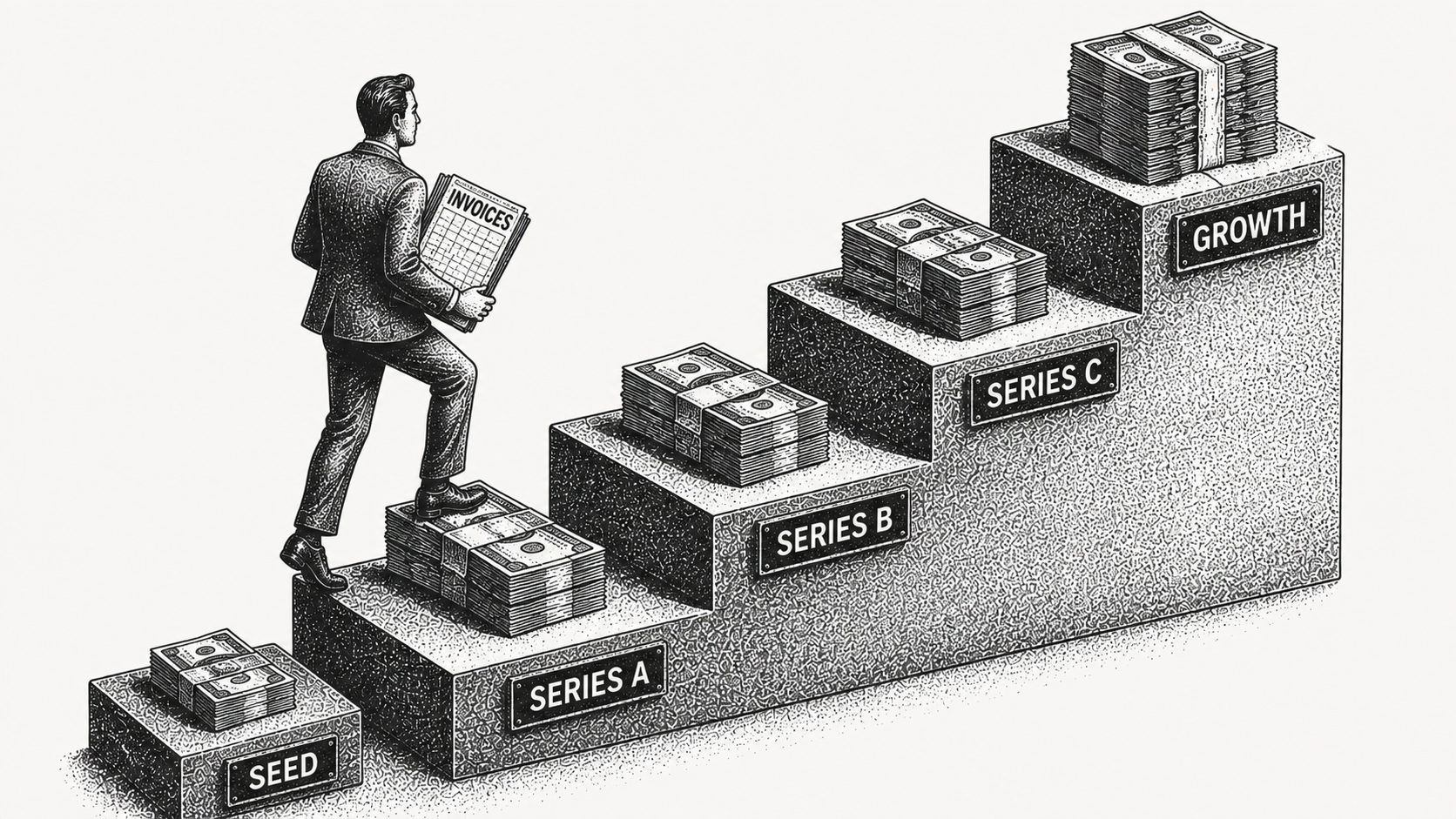
Startup accounts receivable breaks in a predictable sequence. At seed the founder is the collections process, at Series A the first finance hire inherits a backlog nobody fully owned, at Series B invoice volume outruns every manual workflow, and at Series C the problem shifts from collecting cash to trusting the data. Monk calls this progression the AR Maturity Curve: four stages, from Founder-Led AR at seed through First-Hire AR and Volume AR to Audit-Grade AR, that trace how a receivables operation matures from founder-run invoicing to audit-grade revenue infrastructure. Across the $2B+ in receivables that Monk manages, the companies that kept DSO flat while ARR compounded share one habit: they automated collections before volume became unmanageable. This guide covers what breaks at each stage, what to put in place, and the signal that you waited too long.
Why AR breaks stage by stage
Every funding round changes three variables at once: how many invoices you send, how complicated each invoice is, and who owns getting them paid. A process that works at 20 invoices a month fails quietly at 200. Nothing announces the failure. It shows up as a creeping DSO, follow-up emails written at midnight, and a cash forecast that misses by a little more each quarter.
The practical response is to treat AR like the rest of your infrastructure and upgrade it one stage early. Waiting for the breakage costs more than the upgrade every time, because by then the backlog has become part of the problem.
The stages of the curve map to funding rounds because rounds are when the variables jump, but the real trigger is volume and complexity. A bootstrapped company crossing 200 invoices a month hits the Series B problems on the same schedule, whatever its cap table looks like.
Seed: Founder-Led AR
At seed, billing is a founder task because there is nobody else to do it. Founder-Led AR means exactly that: the founder is the AR department. The pattern repeats across nearly every early-stage company Monk works with: the CEO creates invoices by hand, chases payments personally, and reconciles accounts line by line at month end. Rubie ran exactly this way, with its founder and CEO personally handling all three jobs.
The invoice count is small, so the dollars at risk look manageable. The real cost is time. Founder hours spent reconciling a bank feed are hours not spent on product or sales, and those are the only two jobs that grow a seed-stage company.
Put process in place before headcount
A finance hire is premature at this stage. What works is standard payment terms in every contract, invoices generated from one system of record, and follow-up that goes out on schedule without anyone remembering to send it. Our guide to the best AR automation for startups walks through the tooling decision in detail.
When Rubie put Monk's invoice-to-cash automation in place, total AR dropped 30% and the team recovered more than 20 hours a month. That is roughly half a working week of founder time returned every month, at the stage where founder time is the scarcest resource the company has.
The signal you waited too long is simple: the CEO can recite the aging report from memory.
Series A: First-Hire AR
Contracts get real at Series A. Custom terms, negotiated discounts, upsells, and renewals replace the simple standard deal, and each variation produces an invoice that behaves differently from the last. Volume grows past what anyone can manage part-time, and whoever nominally owns billing starts every week already behind.
This is First-Hire AR, the stage that usually begins when the first dedicated finance hire arrives. They inherit a backlog of overdue invoices, a set of half-tracked payment promises, and a spreadsheet three people have edited. Their first quarter disappears into manual follow-ups that produce no lasting improvement in the process itself.
DSO becomes a board topic
Series A is also when collections speed becomes survival math. Every dollar sitting in receivables is runway you already earned but cannot spend, a dynamic we broke down in our piece on the hidden tax of unpaid invoices at VC-backed startups. Boards notice, and DSO starts appearing in the metrics deck next to burn.
The fix is to hand the finance hire automation instead of a backlog. Elate made that move and more than doubled monthly collections in its first full month compared with its average over the prior 18 months, while cutting DSO nearly in half. Monk designed its AR automation for B2B SaaS around exactly this transition, so the first hire runs a system rather than a treadmill.
Series B: Volume AR
Volume AR is the stage where invoice volume multiplies faster than process. Series B growth does not add invoices politely. Pump scaled from $1M to $25M ARR in 18 months, which meant its collections infrastructure had to absorb a 25x revenue increase without pausing for a process redesign. Running on Monk, Pump automated over 96% of its collections emails and saved more than 40 hours of team time every week while it grew.
Enterprise buyers change the rules
The other Series B shift is who you sell to. Enterprise customers arrive with AP portals, purchase order requirements, and net-45 or net-60 payment terms, and your invoice only starts moving once it sits inside their system in their format. Profound faced this with its Fortune 500 customers and used Monk to automate submissions to Coupa, Ariba, and 11 bespoke AP portals, contributing to a 122% increase in cash on hand in its first month.
Exceptions need routing, not heroics
At this volume, disputes and exceptions stop being occasional. A missing PO here and a contested line item there become a steady stream, and resolving each one by pulling in whoever knows the account best does not scale past a few dozen customers. Monk's Intelligent Collections handles this by ingesting the context of each conversation, so its AR agent, Julia, replies to a question about an invoice with the specifics of that invoice rather than another templated reminder. Worked this way, 90% of invoices resolve without escalating to a person, and outreach earns a 24% higher response rate than standard dunning.
Series C and beyond: Audit-Grade AR
By Series C, sending and chasing invoices is usually handled. What breaks instead is trust in the numbers, which is why the last stage of the AR Maturity Curve is Audit-Grade AR. Multiple products, multiple entities, and often multiple billing systems mean revenue leadership now expects forecast-grade AR data, and a weekly aging export cannot supply it.
Forecasting is the first casualty when that data is missing. If collections activity lives in inboxes, the cash forecast is built from guesses about when customers might pay, and the misses widen as the customer base grows. Forecast-grade AR means live invoice status, payment behavior, and dispute state feeding the model instead of a stale export.
Unbilled revenue hides in the gaps
Growth also leaves money behind. Subject discovered this when a Monk flux analysis surfaced substantial unbilled revenue across its school district accounts, services that had been delivered but never invoiced. The team recovered the revenue and adopted Monk as its AR system of record so the gap could not quietly reopen.
Leakage audits belong on the calendar at this stage, not in the incident channel. If nobody can say with confidence that everything delivered was billed, some of it was not.
Auditability stops being optional
Late-stage companies also inherit harder compliance requirements. Auditors want a clean trail from contract to invoice to payment, security reviews ask about SOC 2, and cash application accuracy becomes a controls question rather than a bookkeeping chore. Monk is SOC 2 Type II certified and matches payments to invoices at an 80% automatic rate (up to 95% with suggested rules), which keeps the ledger accurate enough to audit and to forecast from.
The AR Maturity Curve at a glance
Here is the whole curve in one view.
| Stage | What breaks | What to put in place | Signal you waited too long |
|---|---|---|---|
| Seed: Founder-Led AR | The founder does billing, chasing, and reconciliation by hand | Standard terms, one system of record, automated follow-up | The CEO can recite the aging report from memory |
| Series A: First-Hire AR | Custom contracts multiply and the first finance hire drowns in follow-ups | Automated collections so the hire runs a process instead of a backlog | DSO appears in the board deck with no plan next to it |
| Series B: Volume AR | Volume multiplies while enterprise AP portals and net-60 terms arrive | Portal automation, exception routing, context-aware outreach | Collections depends on one person who knows every account |
| Series C and beyond: Audit-Grade AR | Multi-entity data, unbilled revenue, audit requirements | An AR system of record, leakage audits, forecast-grade reporting | Nobody can confirm everything delivered was invoiced |
The through-line: automate before you have to
Read across the curve and the pattern holds. AR fails when volume grows faster than process, and the companies that avoid the failure automated while automation was still optional. The timing is easier to get right than it sounds, because implementation no longer takes a quarter: Monk customers typically go live in less than one week, connecting to the tools already in the stack, including Salesforce, QuickBooks, HubSpot, Stripe, NetSuite, Anrok, Slack, Gmail, and DocuSign.
The results compound from seed onward. Monk customers see a 40% average DSO reduction and get back around 26 hours every month, on pricing that stays a flat platform fee with no percentage-of-collections charge. Whatever stage you are raising toward, the best time to fix AR is one round before it breaks.
Frequently asked questions
What is startup accounts receivable by stage?
It is the pattern that AR breaks in a predictable sequence tied to company maturity: founder-run billing at seed, ownership gaps at Series A, volume and enterprise complexity at Series B, and data and audit problems at Series C. Planning upgrades one stage ahead keeps DSO flat while revenue compounds.
What is the AR Maturity Curve?
The AR Maturity Curve is Monk's four-stage model of how a startup's receivables operation matures: Founder-Led AR at seed, First-Hire AR at Series A, Volume AR at Series B, and Audit-Grade AR at Series C and beyond. It describes what breaks at each stage so teams can upgrade their collections process one stage before volume forces the issue.
When should a startup automate accounts receivable?
Before invoice volume makes manual follow-up impossible, which for most companies means between seed and Series A. The consistent pattern across Monk customers is that automating early keeps DSO flat, while automating late means digging out of a backlog first.
When should a startup hire its first collections or AR person?
Most companies make their first dedicated finance hire around Series A, when contracts and invoice volume outgrow part-time ownership. That hire is far more effective running an automated process than working a manual backlog, so put the system in place before or alongside them.
How should Series B companies handle enterprise AP portals?
Treat portal submission as part of invoicing, because AP teams at large customers only process what appears inside their system. Monk automates submissions to portals such as Coupa and Ariba, along with bespoke enterprise systems, so invoices land where accounts payable works.
How long does it take to implement Monk?
Typical go-lives take less than one week because Monk connects directly to tools like Stripe, QuickBooks, NetSuite, Salesforce, and HubSpot. Pricing is a flat platform fee with no percentage-of-collections charge, so costs stay predictable as volume grows.
How does Monk handle disputes and exceptions at scale?
Monk's Intelligent Collections ingests the context of each conversation so its AR agent, Julia, can answer invoice questions with specifics rather than templates. That approach resolves 90% of collections with zero human intervention and earns a 24% higher response rate than standard dunning.
The moment a SaaS company signs its first enterprise logo, invoicing stops being a send and becomes a submission. Across the $2B+ in receivables Monk manages, 92% of enterprise invoices have to be submitted through a customer's accounts payable portal rather than paid from an emailed invoice. Monk submits into more than 600 of those portals and uploads 87% of portal invoices autonomously, which is usually the difference between a clean month and a surprise in the aging report. More on AR automation for B2B SaaS.
Adjacent to this: Best AR Automation for Startups and Series A Companies and Monk Raises $25M to Help Businesses Get Paid Faster.





.avif)