Is an LLM Enough to Automate Collections? What Breaks at Scale in 2026

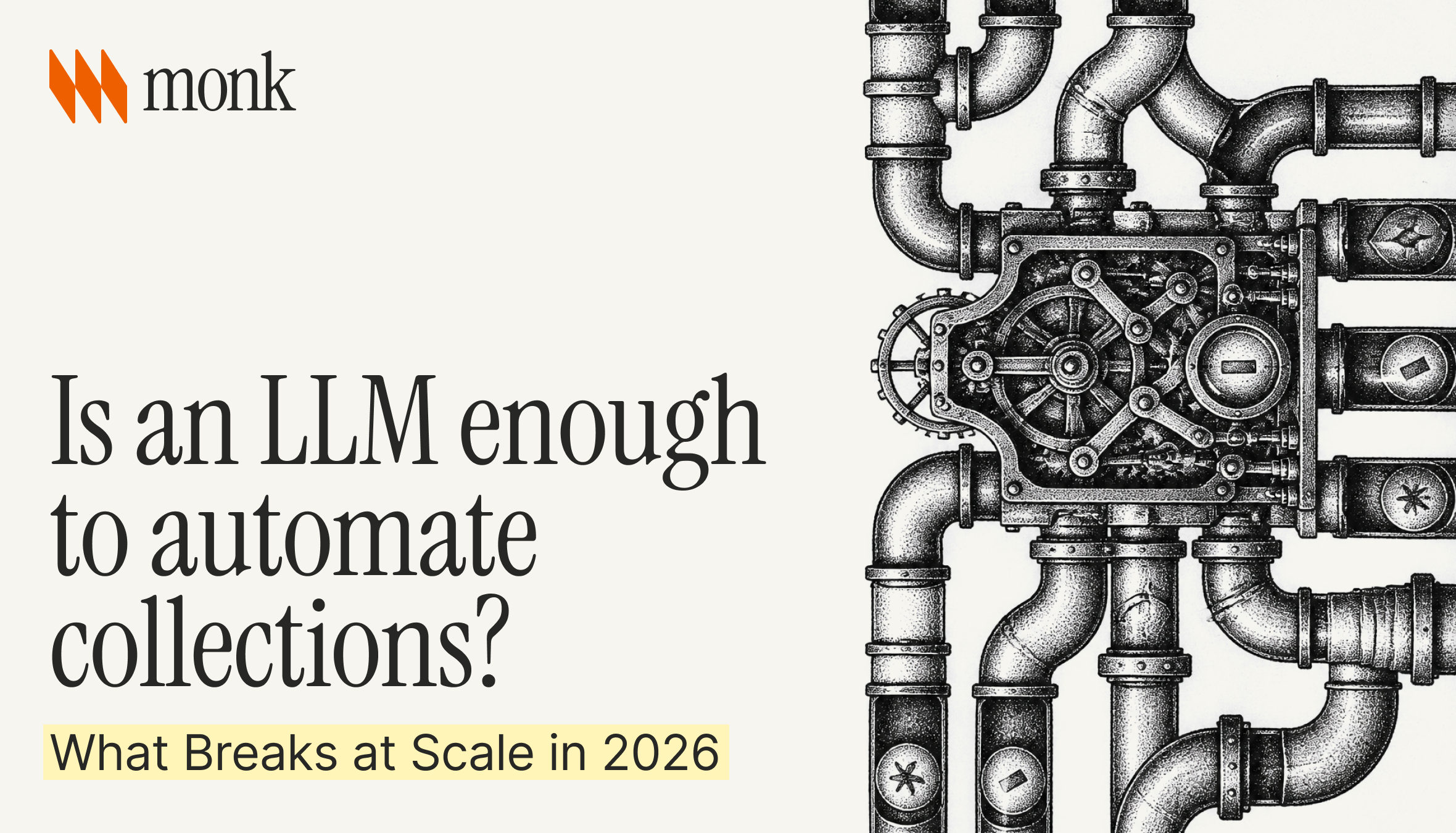
An LLM can draft a good reminder email. It cannot own your invoices, apply cash, resolve a dispute, or file into a procurement portal. A collections agent is a small amount of language model wrapped in a large amount of system: a source of truth for invoice state, an orchestration layer, integrations, controls, and an audit trail. A model connected to a Stripe webhook gives you a convincing demo, and the gap shows up the first time a customer pays half an invoice and says nothing.
Can you build a collections agent on ChatGPT or Claude?
You can build the part that writes. Modern models are genuinely good at drafting a follow-up that reads like a person wrote it, and that is the piece people see first, so it feels like the whole job. It is closer to a tenth of it. The other nine tenths is the infrastructure that decides what to send, tracks what happened, reconciles the payment, and keeps a record you can defend. That part does not come from a prompt.
What does the model do, and what does it not?
The model handles language: drafting outreach, classifying a reply, summarizing a thread. Useful work, and hard to do well, but bounded. What it does not do is hold state between calls, guarantee a payment is matched to the right invoice, enforce who may be contacted and when, submit an invoice through a portal that requires a PO and an MFA token, or produce an append-only log an auditor will accept. Those are system properties, and a stateless model has none of them on its own.
Why does the demo work but production fails?
Because a demo runs the happy path, and production is mostly exceptions. The moment real money flows, the long tail arrives: a customer pays part of an invoice, a remittance does not match the amount, a dispute is raised inside a reply, a contact is out of office, a portal returns a rejection code three days after submission. Simple logic handles none of these, so every one of them falls back to a person, and the automation you built quietly becomes a drafting tool with a queue behind it.
What has to sit around the model?
The language model is one layer. Here is what a working collections system needs around it, and why the model cannot supply it.
| Layer | What it handles | Why an LLM alone cannot |
|---|---|---|
| System of record | Invoice state: open, paused, disputed, paid | Models are stateless between calls |
| Cash application | Matching payments to invoices | Needs deterministic matching and remittance parsing |
| Orchestration | Who to chase, when, in what tone | Needs a configurable rules engine rather than a prompt |
| Integrations | ERP, Stripe, and procurement portals | Needs bidirectional sync and browser automation |
| Controls and audit | Approvals and an append-only log | A prompt has no memory or accountability |
The pattern is consistent: the model is the easy, visible layer, and everything that makes collections reliable sits underneath it.
What about a hallucinated message reaching a customer?
This is the risk that turns a clever build into a liability. With no structured approvals and no audit trail, a wrong or invented message can go straight to a customer, and you find out when they complain. A responsible system runs a deterministic check before anything is sent, keeps a person in the loop where it matters, and logs every action so a manager can see exactly what happened and why. Building that control layer is real work, and it is the first thing a rushed build skips.
Is a wrapper cheaper than it looks?
No, and the running cost surprises people. Each invoice needs several model calls a month, for drafting, reply classification, exception handling, and cash application inference, each carrying a large context window of invoice history and prior correspondence. At 100 to 10,000 invoices a month, tokens alone run $2,000 to $12,000, before infrastructure, logging, retries, and monitoring. The model you reached for to save money becomes a line item that grows with volume.
Why is cash application the hardest part to fake?
Because it is where language stops helping. Applying cash means matching an incoming payment, often a lump sum covering several invoices with a short pay and a deduction inside it, to the right open items, using remittance data that arrives in inconsistent formats or not at all. That is deterministic matching and parsing rather than generation. It is also the step that keeps the aging report honest, so when it is missing, the rest of the system is working from numbers that are already wrong. For more on that, see how to forecast cash flow from your AR.
How does Monk build it?
Monk treats the model as one component inside a purpose-built AR system of record. Julia, the email agent, and Ryan, the voice agent, share the same account context and playbooks, so a customer gets one consistent collector across channels. Underneath them sit the state machine, the orchestration rules, the ERP and portal integrations, and the controls: a deterministic check before anything reaches a customer, human-in-the-loop review where it matters, and an append-only log. The result is a system that resolves 90% of collections without a person, reaches customers with a 24% higher response than standard dunning, and applies cash at an 80% match rate, rising to 95% with suggested rules. See how the pieces fit in Monk's intelligent collections. More than $2B in receivables runs on it today, including for Profound and ElevenLabs.
For the full economics of building this yourself, see build vs buy AR automation.
Frequently Asked Questions
Can I build a collections agent with ChatGPT or Claude?
You can build the drafting layer, which is about a tenth of the job. Owning invoice state, applying cash, resolving disputes, and submitting to portals are system properties a language model does not provide on its own.
Why does an LLM collections demo fail in production?
A demo runs the happy path. Production is mostly exceptions: partial payments, remittance mismatches, disputes, out-of-office replies, and portal rejections, none of which simple prompt logic handles.
What sits around the model in a real system?
A system of record for invoice state, a cash application engine, an orchestration rules engine, ERP and portal integrations, and controls with an audit trail.
Can an LLM apply cash to invoices?
Not reliably on its own. Cash application is deterministic matching against remittance data, including lump-sum payments with short pays inside them, which is parsing and matching rather than language generation.
How do you stop an AI from sending a wrong message to a customer?
Run a deterministic check before anything is sent, keep a person in the loop where it matters, and log every action. Without those controls, a hallucinated message can reach a customer directly.
Is building on an LLM cheaper than buying?
The token cost alone runs $2,000 to $12,000 a month at 100 to 10,000 invoices, before infrastructure and engineering. It is rarely cheaper once the full system is accounted for.



.avif)