Failed Payment Recovery for PLG SaaS: Reducing Involuntary Churn (2026)

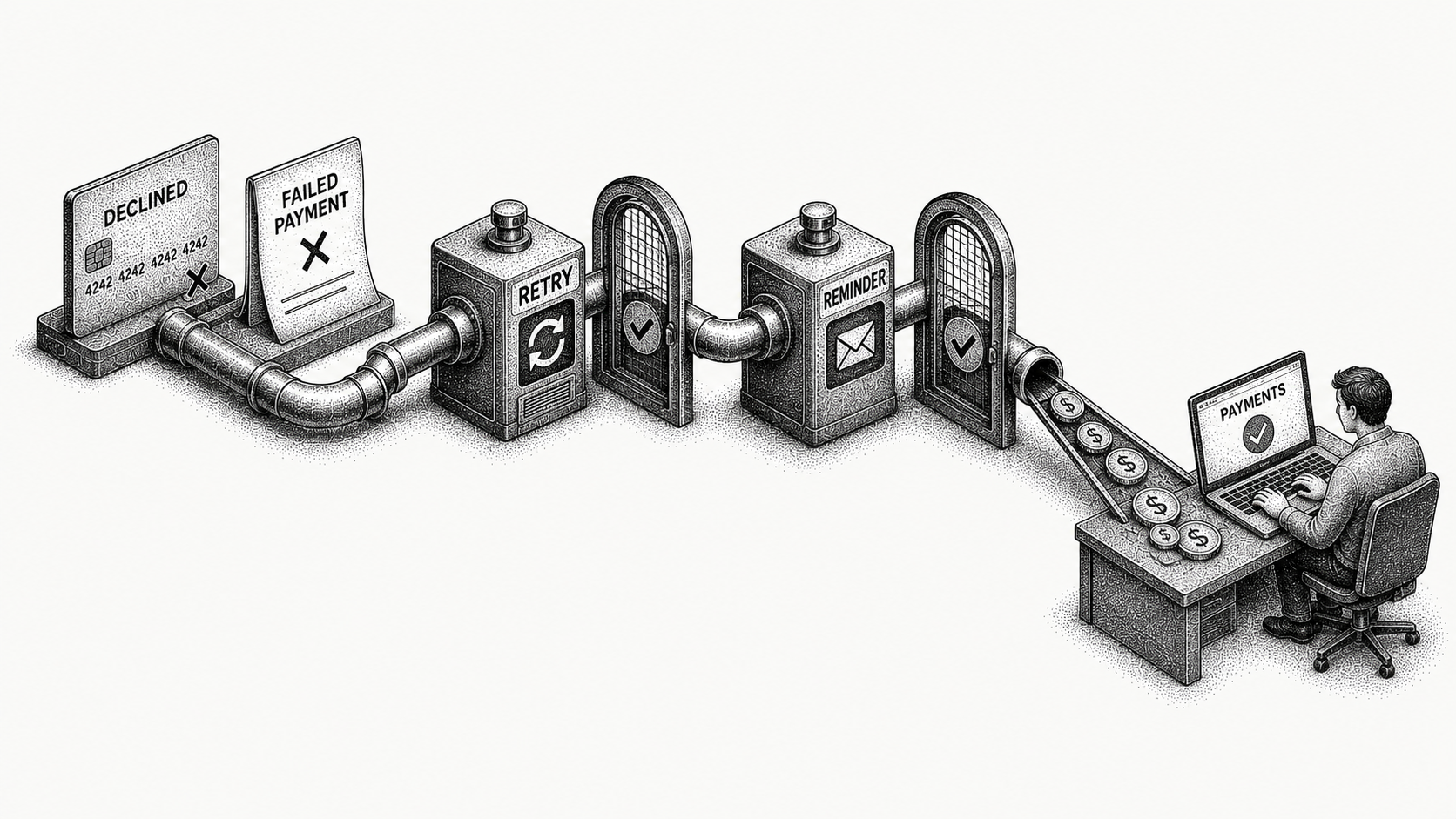
Failed payment recovery for PLG SaaS means treating involuntary churn, the revenue lost to declined cards, expired cards, card limits, and missing payment methods, as a solvable collections problem instead of an accepted cost of self-serve. The 2026 playbook pairs smart payment retries with outreach that tells each customer exactly why their payment failed and exactly what will fix it. That combination recovers revenue generic dunning never touches, because most customers who fail to pay never decided to stop paying.
Why does PLG SaaS lose so much revenue to involuntary churn?
Product-led companies run on self-serve, card-based payments with no invoice approval chain and often no human relationship with the buyer. When a charge fails, there is no AP contact to call and no account manager to notice. The subscription quietly enters a retry loop, the customer keeps using the product, and days later access is cut off for someone who never intended to leave.
This is a different problem from willful non-payment. Voluntary churners made a decision; involuntary churners hit a payments obstacle. Treating both with the same escalating reminder sequence annoys the first group and fails to help the second.
The four failure modes that drive involuntary churn
- Declined cards. The issuer refuses the charge for reasons ranging from suspected fraud to insufficient funds, and the right fix differs by decline reason.
- Expired cards. The card on file lapsed and nobody updated it. This is the most mechanical failure and the easiest to resolve when the customer is told plainly.
- Card limits. The charge exceeds a spending limit on a corporate or prepaid card, which is especially common when usage-based amounts spike.
- Missing payment methods. The customer removed a card or never completed payment setup, so there is nothing to retry at all.
Why generic dunning emails fail
The standard dunning template says some version of "your payment failed, please update your billing information." It ignores why the payment failed, so the customer with a card limit problem gets the same message as the customer with no card on file. Neither knows what specific action to take, and both are one ignored email away from lapsing.
What should failed payment recovery include in 2026?
Payment-failure-reason context in every message
Your payment processor already knows why each charge failed. Stripe returns decline codes and failure reasons on every attempt, and recovery outreach should use them. A message that says the card was declined for exceeding its limit, and that splitting the charge or using a different card will resolve it, converts far better than a vague update-your-billing nudge, because the customer can act on it immediately.
Retry logic paired with human-readable outreach
Automatic retries recover transient failures, but retries alone cannot fix an expired card or a missing payment method. The systems that work coordinate both: retry on schedules suited to the failure type, and send outreach in parallel that tells the customer what fix is needed when a retry cannot succeed. Retrying a nonexistent card five times is not a strategy.
Tone that protects retention
The person receiving a failed-payment email is usually a happy user who hit a billing snag, not a delinquent account. Outreach should read like help rather than a threat: clear about the issue, specific about the fix, and free of legalistic escalation language until escalation is actually warranted. This is where AI-written, context-aware messages beat static templates. Monk's collections outreach earns a 24% higher response rate than standard dunning emails partly because each message is written for that customer's specific situation.
Recovery measurement you can act on
Track recovered revenue by failure reason, payment success rate after outreach, time to resolution, and how much overdue card-based AR you carry month over month. If your current tool only reports emails sent, you are measuring activity instead of recovery.
Generic dunning vs. failure-aware recovery
The difference is easiest to see side by side, message by message.
| Failure type | Generic dunning says | Failure-aware recovery says |
|---|---|---|
| Declined card | "Your payment failed. Please update billing." | "Your bank declined the charge. We will retry tomorrow; if it fails again, a different card or a quick call to your bank will fix it." |
| Expired card | "Your payment failed. Please update billing." | "The card on file expired last month. Here is a secure link to add your new card so service continues uninterrupted." |
| Card limit | "Your payment failed. Please update billing." | "The charge exceeded your card's limit. We can split it into two payments, or you can use a card with a higher limit." |
| Missing payment method | "Your payment failed. Please update billing." | "There is no payment method on your account, so retries will not help. Adding a card takes one minute at this link." |
How Unify cut overdue Stripe AR in half
Unify's results with Monk are the clearest public example of failure-aware recovery working in production. Monk layered Stripe payment failure reason data, including declined cards, missing payment methods, and card limit issues, directly into collections outreach. Instead of sending a generic reminder, Monk's AR agent tells each customer the exact fix their situation needs.
After the first month, Unify had cut its overdue Stripe AR in half, alongside a substantial increase in payment success rate. Nothing about the approach was exotic. The failure data already existed in Stripe; Monk simply put it to work in every message.
How does Monk automate failed payment recovery?
Monk is an AI-native invoice-to-cash platform whose AR agent, Julia, runs intelligent collections with payment context attached to every touch. Julia reads the failure reason from Stripe, writes outreach that names the specific fix, coordinates timing with retries, and resolves 90% of invoices without escalating to a human.
For PLG and self-serve SaaS teams, the operational profile matters as much as the outcomes. Typical go-lives take less than one week on Stripe, Monk is SOC 2 Type II certified, and pricing carries no percentage-of-collections fee, so recovered revenue stays yours. Monk manages $2B+ in receivables and integrates with Stripe, Salesforce, HubSpot, QuickBooks, NetSuite, Anrok, Slack, Gmail, and DocuSign, so recovery activity stays visible across your finance and go-to-market stack.
Monk is built for SaaS companies from Series A upward, and the SaaS solutions page covers the full invoice-to-cash scope beyond payment recovery. If you are evaluating the wider category, start with our guide to the best AR automation for SaaS companies in 2026; earlier-stage teams can compare options in the best AR automation for startups roundup.
How to start reducing involuntary churn this quarter
- Export your failed payments from Stripe for the last 90 days and group them by failure reason. The distribution tells you which fixes matter most.
- Audit your current dunning messages against the table above and count how many mention the actual failure reason. For most teams the answer is zero.
- Separate involuntary recovery metrics from general collections reporting so you can see payment success rate and recovered revenue on their own.
- Pilot failure-aware outreach on one customer segment, measure response and recovery against your current sequence, and expand from there.
Involuntary churn is one of the few revenue problems where the customer is already on your side. They want to keep the product; they just need to be told what broke. Tell them precisely, and much of that revenue comes back.
Frequently asked questions
What is failed payment recovery in SaaS?
It is the process of recovering revenue from payments that failed for mechanical reasons such as declined cards, expired cards, card limits, or missing payment methods. It combines automatic retries with customer outreach so subscriptions do not lapse over a fixable payments issue.
What is involuntary churn?
Involuntary churn is subscription loss caused by payment failure rather than a decision to cancel. The customer usually still wants the product, which makes this churn far more recoverable than voluntary cancellations.
Why is generic dunning ineffective for PLG SaaS?
Generic dunning sends the same update-your-billing message regardless of why the payment failed. A customer with a card limit issue needs a different fix than one with no card on file, and outreach that ignores the difference recovers less and frustrates users.
How did Unify reduce its overdue Stripe AR?
Monk layered Stripe payment failure reason data into Unify's collections outreach so each customer was told the exact fix their failure required. Unify cut overdue Stripe AR in half after the first month, with a substantial increase in payment success rate.
Do payment retries alone solve involuntary churn?
No. Retries recover transient declines, but expired cards and missing payment methods require customer action. Effective recovery pairs retry schedules with human-readable outreach that explains what the customer needs to do.
How quickly can a PLG SaaS company set up failure-aware recovery with Monk?
For Stripe-based companies, typical Monk go-lives take less than one week. The Stripe integration supplies the failure reason data automatically.
The moment a SaaS company signs its first enterprise logo, invoicing stops being a send and becomes a submission. Across the $2B+ in receivables Monk manages, 92% of enterprise invoices have to be submitted through a customer's accounts payable portal rather than paid from an emailed invoice. Monk submits into more than 600 of those portals and uploads 87% of portal invoices autonomously, which is usually the difference between a clean month and a surprise in the aging report. More on AR automation for B2B SaaS.
Worth reading next: Stripe Failed Payment Recovery: Recover More Revenue.





.avif)