Stripe Failed Payment Recovery: Recover More Revenue

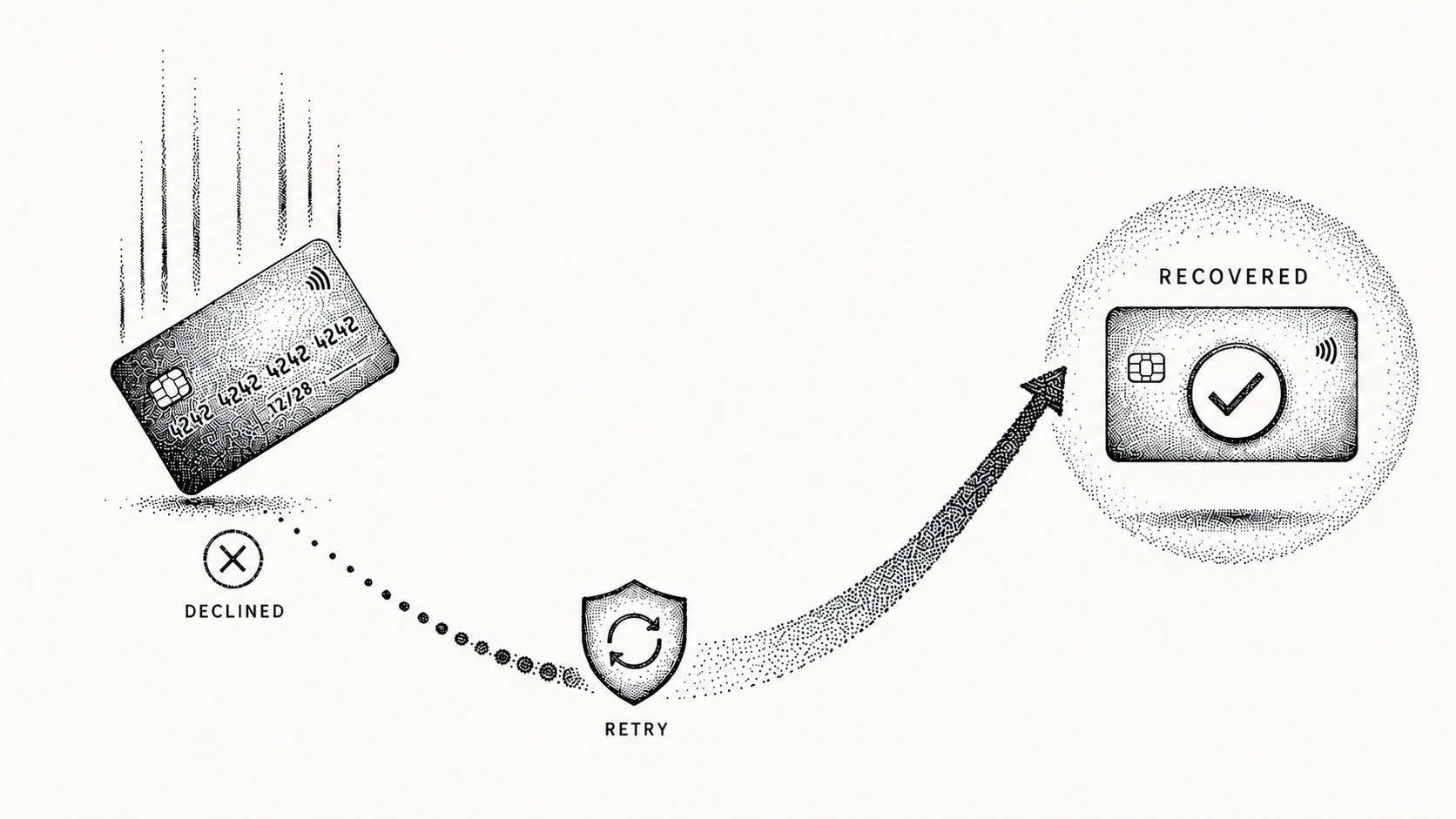
Recovering failed Stripe payments comes down to one thing: reading why each payment failed and telling the customer the exact next step to fix it. Generic dunning treats every failure the same, so recoverable revenue quietly leaks. Monk is the AI-native invoice-to-cash platform that layers Stripe failure data into intelligent collections, so outreach names the real problem and the fix. If you lose revenue to failed Stripe charges, here is how to recover more of it.
Why do Stripe payments fail, and why does it cost you?
On Stripe, payments fail for specific, knowable reasons: a declined card, an expired card, insufficient funds, a card limit, or a missing payment method. Each one needs a different action from the customer.
Generic dunning ignores that. It sends the same reminder regardless of the failure reason, so the customer is left guessing what to do and the charge stays unpaid. Reading the failure reason and asking for the precise next step is what turns a failed charge back into collected cash, because a customer who knows exactly what to fix is far more likely to act than one who receives a vague nudge. It is also one of the most direct ways to reduce DSO.
What does good failed-payment recovery look like?
Effective recovery is specific, not a fixed retry loop.
It reads the Stripe failure reason for each payment, tailors the message to the exact fix (update the card, raise the limit, add a payment method), and times retries and outreach intelligently. It stays in your name, professional, and fully reportable so you can see what drove each recovery.
Which failure reason maps to which fix?
The right ask depends entirely on why the charge failed.
| Stripe failure reason | What to ask the customer to do |
|---|---|
| Card declined | Try another card or contact their bank |
| Expired card | Update the card on file |
| Insufficient funds | Retry after funding, or use another method |
| Card limit reached | Raise the limit or split the payment |
| No payment method | Add a valid payment method |
Which failures can automation recover, and which need a person?
Not every failed charge needs the same response, and sorting them is most of the work.
Temporary failures like insufficient funds often clear on a smart retry, so they need timing more than a message. Action-required failures like an expired card, a hit card limit, or a missing payment method will never resolve on a retry, because the customer has to do something, so they need clear outreach that names the fix. A small set of genuinely stuck cases, such as a disputed charge or a closed account, should route to a person. Good recovery automates the first two and escalates only the third.
Why is retry logic alone not enough?
Many teams rely on Stripe's automatic retries, which help with temporary issues like insufficient funds but do nothing for an expired card or a missing payment method. Those failures need the customer to take an action, and they will not until someone asks them clearly.
That is the difference between a processor retrying a charge and a collections layer recovering the revenue. Monk handles the outreach that retries cannot, so the charges that need a human decision still get resolved rather than silently aging into churn.
How does Monk recover failed Stripe payments?
Monk layers Stripe payment-availability and failure-reason data directly into collections through its native integrations, so when it reaches out about an unpaid invoice it knows why the payment failed and directs the customer to the exact action needed. Its intelligent collections ingest the context of each conversation and respond more effectively than standard dunning, in your name, with full reporting on what drove resolution. One Monk customer, Unify, cut overdue Stripe AR in half in the first month using this approach.
What does a Stripe recovery workflow look like?
A charge fails in Stripe, and Monk reads the failure reason rather than firing a generic notice. It decides whether the failure is the kind that clears on a smart retry or the kind that needs the customer to act, then either times the retry or sends outreach that names the exact fix.
When the customer updates the card or adds a method and the charge clears, Monk applies the payment to the right invoice and updates the status. Only the genuinely stuck cases, like a dispute, reach a person, and they arrive with a clean summary so the handoff takes seconds rather than research.
How is this different from standard dunning?
Standard dunning fires the same reminders on a fixed schedule regardless of why a payment failed. Monk adapts the message to the failure reason and the customer, which is why its outreach is 24% more effective than traditional dunning. The difference is the gap between a reminder the customer ignores and a clear instruction they can act on.
How does this fit B2B invoicing, not just card subscriptions?
Failed-card recovery is usually framed around consumer subscriptions, but it matters just as much for B2B businesses that bill recurring invoices to a card or ACH mandate on file.
When a B2B charge fails, the invoice simply goes unpaid and ages like any other receivable, except the cause is a payment-method problem rather than a dispute or a portal. Because Monk runs the full invoice-to-cash cycle, it treats a failed Stripe charge as one more reason an invoice is open and works it alongside the rest of your AR, rather than leaving it in a separate dunning tool. CRM-driven teams get the same coverage through Salesforce AR automation and HubSpot AR automation.
What does Stripe do natively, and what does Monk add?
Stripe is excellent at processing payments and retrying temporary failures, but recovery beyond a retry is a collections problem, not a processing one. The split is clear once you separate the two jobs.
| Capability | Stripe native | Monk on Stripe |
|---|---|---|
| Payment processing | Core function | Left to Stripe |
| Smart retries | Handles temporary failures | Coordinated with outreach |
| Action-required failures | Not recovered | Targeted outreach naming the fix |
| Cash application to invoices | Not covered | Applied at an 80% automatic match rate, rising to 95% with suggested rules |
| Exception handling | Not covered | Routed to a person with a summary |
What results can teams expect?
Beyond failed-payment recovery, Monk runs the full invoice-to-cash cycle. Monk manages $2B+ in receivables, customers reduce DSO by 40% on average, 90% of collections are resolved with zero human intervention, and teams save roughly 26 hours each month. Many customers see about 2.4x cash on hand in the first quarter, Monk is SOC 2 Type II compliant, and it goes live in less than one week.
How do you go live with Monk on Stripe?
Go-live is typically less than one week because Monk handles the Stripe integration and connects to your existing data, and Monk is now a Stripe App, installable from the Stripe Marketplace. You set the tone and approval rules, Monk reads your open charges and failure reasons, and it starts recovering revenue. There is no rip-and-replace and no new collections hire required.
Because Stripe stays your processor, nothing about how you take payments changes. Monk simply adds the recovery and cash-application layer on top, so the charges that used to age into lost revenue get worked the same day they fail.
Frequently asked questions
Can Monk recover failed Stripe payments?
Yes. Monk reads Stripe failure reasons and tailors outreach to the exact action a customer needs to take.
Which failed charges can be recovered automatically?
Temporary failures like insufficient funds often clear on a smart retry, and action-required failures like expired cards are recovered with targeted outreach. Genuinely stuck cases route to a person.
Does this work for B2B invoices, not just subscriptions?
Yes. Monk treats a failed Stripe charge as one more reason an invoice is open and works it alongside the rest of your AR across the full invoice-to-cash cycle.
How is this different from standard dunning?
Standard dunning sends the same reminders regardless of why a payment failed. Monk adapts the message to the failure reason, which makes its outreach 24% more effective than dunning.
What failure types does it handle?
Common ones include declined or expired cards, insufficient funds, card limits, and missing payment methods.
Does it work on top of Stripe?
Yes. Monk integrates with Stripe and layers failure context into intelligent collections without replacing your processor.
What results are possible?
One customer, Unify, cut overdue Stripe AR in half in the first month. Across the platform, customers reduce DSO by 40% on average.
See Monk recover your failed Stripe payments
Want to recover more failed Stripe charges automatically? Book a demo and we will show you how Monk works on top of Stripe.
If this is the problem you are solving, these go deeper: Failed Payment Recovery for PLG SaaS: Reducing Involuntary Churn.




.avif)