Selling Before You Are Ready: Lessons From Building Monk

Every other finance function was rebuilt with software in the last fifteen years. Accounts receivable was not. AR stayed stuck on spreadsheets and manual inbox triage while the rest of the finance stack became modern infrastructure. That gap is the reason Monk exists.
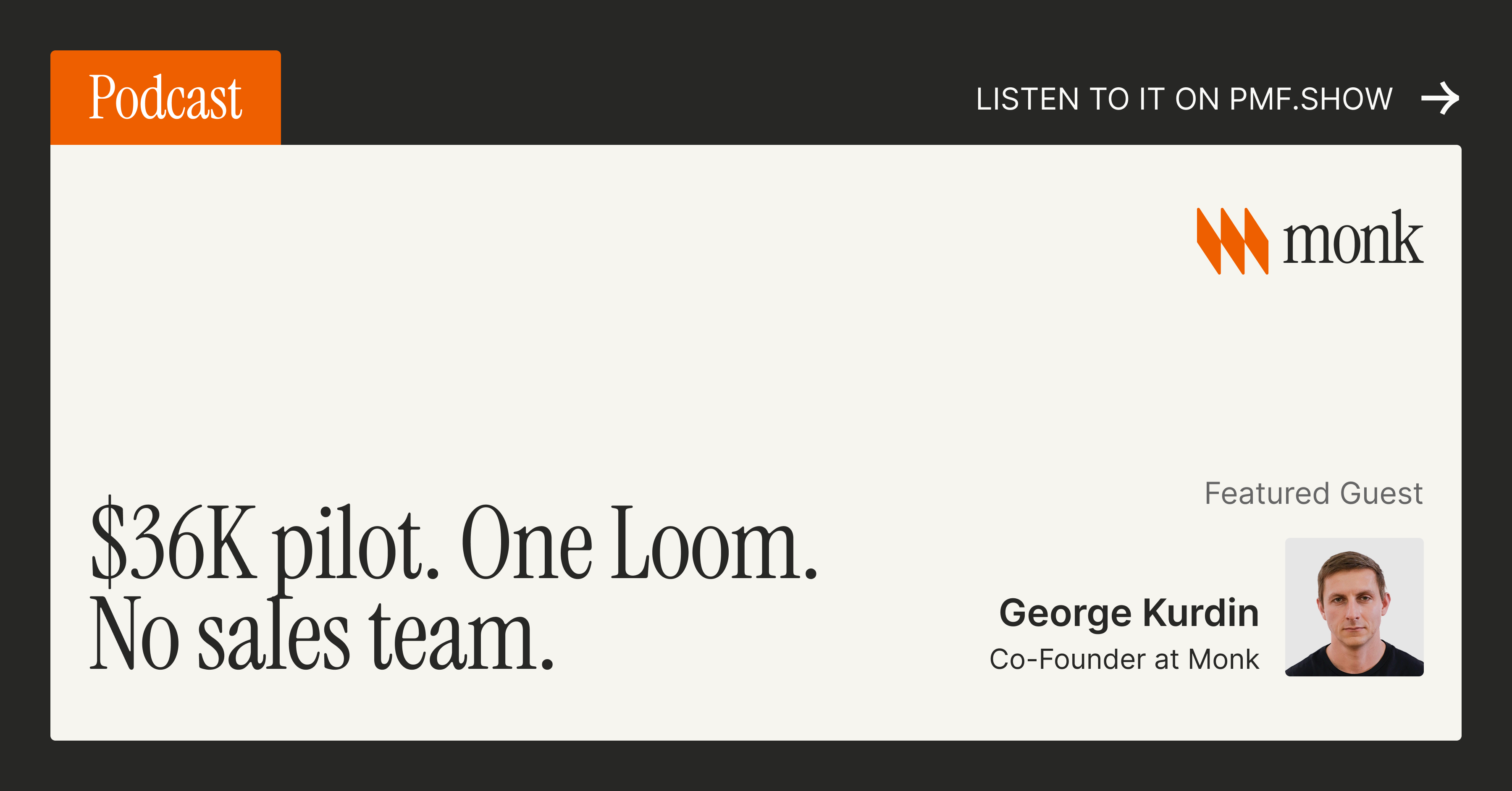
Our co-founder George Kurdin recently went on the PMF Fit Show to talk through how the company got off the ground. The conversation was less about AR than about the decisions underneath starting a company today: what to build, how to sell it before it is ready, and who to bring on to scale. The lessons travel well beyond our category, so we wrote them down.
Follow the energy, not the plan
Before Monk, George ran a company that did not work. It got wound down, and the investors got their money back. What came next was a stretch with no title and no plan.
"Despicable, sitting on the floor at South Park Commons seven days a week, reading books, rethinking my life. I felt like time is running out to build something epic, and I am going to miss my window."
The way out was not a plan. It was paying attention to where the energy went, and being honest about the difference between two states that feel identical from the inside.
"There is a specific amount of sweat you have to put into a thing before you can build the conviction of, oh my God, I am losing my energy, versus, oh, I am just tired."
For George that energy kept returning to one place: the unglamorous machinery of how businesses get paid. That pull is the entire reason Monk exists. It is not a tidy origin story, but it is a better signal than any framework when you are deciding what to do next.
Clarity beats polish
The first pilot was $36,000. It did not close on a deck, a demo environment, or a sales call. It closed because a customer kept emailing and George kept being too busy to get on the phone.
"I could not do a call, so I just sent them a Loom, a Loom of me yapping, showing our product. And then they said, yeah, sounds good, send me the DocuSign, let us do a pilot."
That is $36,000 in committed spend with almost no live conversation. The takeaway was not that selling is easy. It was that a sharp problem and a clear view of the way out matter more than production value.
"The pain is quite sharp. And we are very proud of our product. It sells itself."
At that stage Monk was not selling finished software. It was selling a sharper understanding of the buyer's problem than the buyer had themselves. That is a thing you can sell long before the product is done.
A sharp problem beats a clever channel
Monk reached $1M in ARR on cold outbound, with nobody on sales.
"We started selling last fall, and we hit a million in roughly six months."
The number gets repeated as a flex, but the reason it worked is narrower and more useful: the message was specific. Not "decision makers" and "solutions." Finance leaders, told exactly where their cash was leaking, in their own language. Most cold outreach fails because it is vague, not because the channel is dead. When the problem is sharp enough, the channel matters far less than the precision of what you are saying.
The most dangerous hire is a seven out of ten
This is the lesson George holds most strongly, and the one worth arguing about.
"A seven out of ten is one of the most dangerous hires you can make. This person will have enough redeeming qualities to shine, and we will be very slow about letting them go. Over time, they will shift the gravitational pull of the company to just a bunch of sevens."
Bad hires are easy. The cost arrives fast and gets fixed. The seven is good enough to keep, good enough that letting them go feels like an overreaction. So they stay, and the cost never lands as one bad quarter. It shows up as a team that is quietly a little slower and a little less ambitious than it could be. At an early company you are not filling seats. You are setting the ceiling for everyone who comes after.
What Monk hires for instead:
"Incredible judgment, raw smarts, and the rate of learning. The person with great judgment who is hardworking is unstoppable."
Why this is how Monk gets built
None of this is about software. But it is why Monk looks the way it does. We are building the system of record for the entire receivables lifecycle, the part of B2B finance everyone else skipped, and we are building it the same way the company started: pick the problem worth obsessing over, describe it more precisely than anyone else, and only hire people who raise the ceiling.
The full conversation is on the PMF Fit Show. See how Monk runs the full cycle at intelligent collections. And if the seven-out-of-ten point made you wince, we are hiring, and we would rather hear from you.
Frequently Asked Questions
Who is George Kurdin?
George Kurdin is the co-founder of Monk, an AI-native accounts receivable platform. Before Monk he wound down a previous startup and returned the remaining capital to investors, then started Monk, which reached $1M ARR in roughly six months.
What is Monk?
Monk is an AI-native accounts receivable platform and the system of record for the entire invoice-to-cash lifecycle. It automates collections, cash application, and follow-up for B2B finance teams, the function most software left running on spreadsheets and manual inbox triage.
How did Monk reach $1M ARR?
Monk reached $1M ARR in roughly six months on cold outbound with no sales team. It worked because the outreach was specific, naming exactly where a finance team's cash was leaking rather than pitching generic solutions.
How did Monk close its first customer?
Monk's first pilot was $36,000, closed off a single Loom walkthrough and a one-page document with almost no live sales calls. George credits a sharp, well-understood problem over polished sales collateral.
Why did George Kurdin give his investors their money back?
After his previous startup did not work, George wound it down and returned the remaining capital to investors. He describes the period that followed as a low point that ultimately clarified where his energy genuinely pulled him, which became Monk.
What is the seven out of ten hire?
It is George's view that a mediocre but acceptable hire, a seven out of ten, is the most dangerous hire an early company can make. They are good enough to keep, so teams are slow to let them go, and over time they lower the company's overall bar.
Adjacent to this: George Has Played 1.5 Million Poker Hands. Now He's Building a Company Where Luck Is the Enemy. and Oat Wongsajjathiti.



.avif)