How to Reduce Overdue Invoices: A Practical Guide

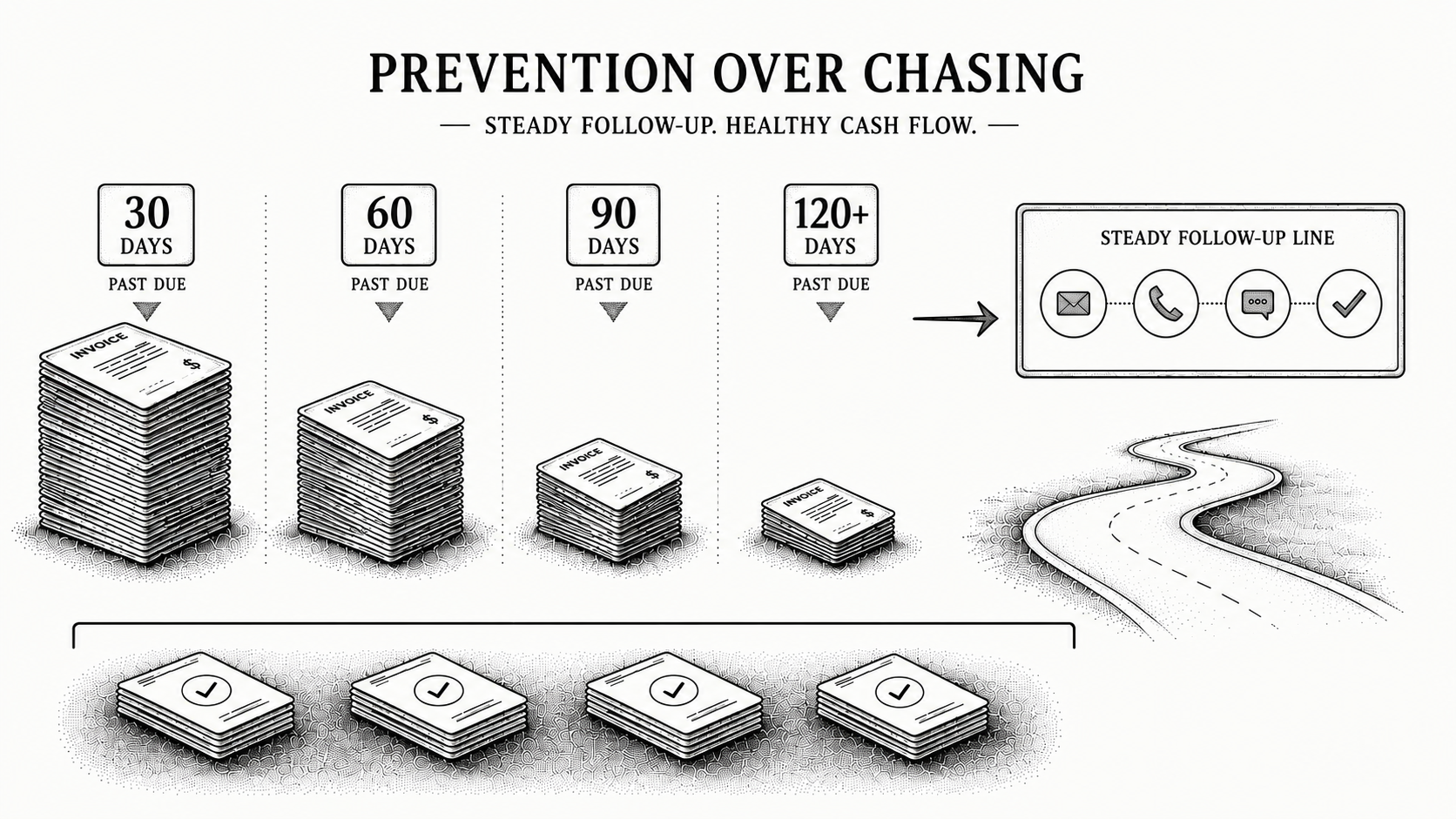
The fastest way to reduce overdue invoices is to treat them as a friction problem, not a willingness problem. Most past-due invoices are stuck on something fixable: a dispute, a missing PO, an AP portal submission, or a contact who never received the invoice. Clear that friction early and consistently and your overdue balance falls. This guide covers the levers that work, in the order of leverage, and shows where AI-native automation like Monk removes the manual load so the overdue pile shrinks for good. Monk runs the whole cycle as one invoice-to-cash system, from invoice delivery and AP portal submission through collections and cash application.
Monk's measurement across the receivables it manages is that 39% of cash flow slowdown is caused by edge cases, which are specific, solvable blockers rather than customers refusing to pay. So diagnose before you chase.
Why do invoices go overdue?
Most overdue invoices are not refusals to pay. They are stuck: a dispute no one resolved, a purchase order that does not match, an AP portal the invoice was never submitted to, or a billing contact who left the company. The customer often intends to pay and cannot, because something in the process is blocking them.
That reframing matters, because the fix for friction is different from the fix for unwillingness. You do not need to chase harder, you need to remove the specific blocker on each invoice before it ages. Chasing a stuck invoice with another reminder is like honking at a car that has a flat tire, it does not address why nothing is moving.
Common mistakes that keep invoices overdue
Three habits keep overdue piles high. Starting follow-up only after invoices age guarantees you are always recovering instead of preventing. Sending the same reminder repeatedly ignores the real blocker and trains customers to ignore you. And letting cash application fall behind means you are chasing a list that is partly fiction. Each is a consistency problem, and consistency is exactly what a system delivers and a busy human cannot.
Start follow-up before invoices age
The single biggest lever is timing. Consistent, personalized follow-up that begins around the due date, not 60 days later, keeps invoices from sliding into the aging buckets in the first place. Prevention is far cheaper than recovery, and an invoice nudged at day 25 rarely becomes a day-90 problem.
The economics here are stark. Collectability drops the longer an invoice ages, so every week you delay the first touch lowers the odds you ever see the money. A light, friendly reminder a few days before or right on the due date does more for your overdue balance than the most carefully worded letter sent at day 75.
Timing also sets the tone. A reminder that arrives before an invoice is even late reads as helpful and routine, while one that arrives sixty days after the fact reads as a collections action and puts the customer on the defensive. Early follow-up keeps the relationship warm at the same time as it keeps the balance current.
How do you segment an aging report so the work gets triaged?
Group the aging report by blocker and by dollars held before you sort it by age, so the first hour of work goes to the invoices that can move today.
A report worked top to bottom spends the best hours on the oldest invoices, which are the hardest to collect. Reading an aging report properly means grouping it by what is stopping payment, by money held, and by who must act.
Tag every line with one blocker code. Give each past-due invoice one reason from a short closed list: portal rejected, PO missing, PO mismatch, change order unapproved, tax document outstanding, wrong bill-to entity, contact unreachable, dispute open or short paid. The analyst picks from that list, because free text cannot be counted.
Rank the blockers by dollars held. Total the past-due balance behind each reason code and sort those totals largest first. That ranking shows where an hour of work returns the most cash, and it often disagrees with the count of invoices.
Assign an owner and a dated next action. Every past-due invoice gets a named person and one next step with a date, such as resubmit in the buyer's portal or request a PO from the account manager. For a change order the owner is the project lead.
Apply cash accurately
When matching is manual, your aging report stays wrong and your team chases invoices that are already paid. Fast, accurate cash application keeps the overdue list honest, so the effort goes toward invoices that truly need it.
An inaccurate aging report costs you twice: your team wastes effort on settled invoices, and the customers who already paid receive reminders that erode trust. Keeping cash application current is the unglamorous discipline that makes every other collection effort land on the right accounts.
What is the difference between will not pay, cannot pay, has not been asked, and blocked?
Those four states need four different responses, and treating them as one queue is the most common reason a past-due balance stops falling.
Collections language collapses everything into "chasing", which hides how different the work is in each case. Sort the list into these four states first.
| State | What it looks like | Who owns it | Right first move |
|---|---|---|---|
| Has not been asked | No reminder sent, or reminders going to a dead address | AR | Confirm the AP contact and resend the invoice with a due date |
| Blocked | Invoice rejected, missing PO, unapproved change order, wrong entity | Whoever holds the missing artefact | Fix the artefact and resubmit, then restart the clock |
| Cannot pay | Customer acknowledges the debt and asks for time | Controller with credit | Agree a written payment plan and put new orders on hold |
| Will not pay | Customer disputes the obligation or stops responding after contact | Controller, then legal or an agency | Escalate on a fixed timetable and stop routine reminders |
Understand why each invoice is unpaid
Before escalating, find the real reason an invoice has not been paid. A quick lookup, a resubmission, or a direct answer moves cash, while a fourth identical reminder does not. Intent-aware outreach that reads the customer's reply and responds to it earns about 24% more responses than standard dunning.
This is where most manual processes break down. A person working a long overdue list has no time to diagnose each account, so they default to the same template for everyone. The result is reminders that miss the actual blocker entirely, which is why generic dunning underperforms outreach that reads what the customer said.
A practical habit is to maintain a short set of reason codes, such as portal not submitted, dispute open, wrong contact, or PO mismatch, and tag every overdue invoice with one. Once you can see the distribution, the fix becomes obvious: you stop sending uniform reminders and start clearing the specific blockers that account for most of the balance.
What does the blocked category look like in practice?
Blocked invoices almost always fail on a document or an identifier, and about seven failures account for nearly all of them.
These are the edge cases, boring by design. Each is a mismatch between what the buyer's accounts payable system requires and what your billing system sent, and none generates an alert.
| Blocker | How it shows up | How it clears |
|---|---|---|
| Rejected in a portal | Validation failed, notice sent to an unwatched inbox | Fix the field, resubmit, record the submission ID |
| Missing PO | Buyer requires a PO that was never captured | Ask the requester, not AP, then reissue |
| Mismatched PO | Invoice exceeds the remaining PO balance | Raise the PO or split the invoice |
| Unapproved change order | Extra scope billed with nothing signed | Get the change order signed, then rebill the variance |
| Missing tax document | Supplier record lacks a W-9 or VAT number | Send it to vendor maintenance for reactivation |
| Wrong bill-to entity | Addressed to the wrong subsidiary | Credit the original and reissue to the correct entity |
| Invoice never received | AP contact left, mail lands in a dead mailbox | Resend to the current AP inbox |
Portal rejections are the most silent of the group. The submission looks complete from your side, the rejection lands where nobody watches, and the invoice ages normally. Understanding why invoices get rejected in AP portals clears a large slice of past-due balance.
Check the submission status before the payment status. For any invoice billed through a buyer portal, confirm in that portal that it is present, accepted and approved before treating it as a collections problem. A submission showing rejected or pending validation is not a late payment.
Verify the PO number and remaining balance. For every purchase-order-backed invoice, confirm the PO is open and has enough unspent value to cover the total. Where it is short, ask the buyer's requester to raise it, because accounts payable cannot.
Confirm the legal entity and remit-to details. Compare the bill-to name, address and tax registration against the buyer's supplier record, and check the remit-to bank details match it. A mismatch stops payment silently, and the fix is a reissued invoice.
Handle AP portals and disputes quickly
Invoices routed through Coupa or Ariba do not get paid until they are submitted correctly, and a single open dispute can hold a large invoice for weeks. Clearing both quickly removes a large share of overdue balances, because these are exactly the blockers that quietly accumulate while no one is watching.
The danger is how invisible they are. An unsubmitted portal invoice and an unanswered dispute both look like ordinary aging on the report, so they hide in plain sight. A standing process to surface invoices that were never submitted and disputes that were never routed catches these before they become your oldest balances.
A worked example
Take a business with $400,000 sitting past due across roughly 60 invoices. Diagnose the pile and the pattern is familiar: a chunk is stuck in AP portals that were never submitted, several large balances are frozen behind a single unanswered dispute, and a handful went to contacts who have since left. None of these is a refusal to pay. Submit the portal invoices, route the disputes to someone who can resolve them, and update the contacts, and a large share of that $400,000 starts moving without a single sterner reminder. The overdue balance falls because the friction was cleared, not because anyone chased harder.
Should disputes and short pays be worked separately from collections?
Yes, disputes and short pays belong in their own queue with their own owner and their own clock, because they are resolved by answering a question rather than by asking for money.
A disputed invoice left in the collections queue does double damage. The collector keeps chasing a balance the customer has already refused, and the dispute sits unresolved because whoever can answer it works in delivery or sales. Managing invoice disputes properly is its own workstream.
Log the dispute the day it is raised. Record the invoice number, the disputed amount, the reason and who raised it on the invoice record rather than in an email thread, and suppress routine reminders on that amount. A dispute living only in a mailbox is invisible at month end.
Split disputed from undisputed amounts. Ask the customer to pay the undisputed portion now and hold only the amount in question, which on most short pays is a small fraction. Confirm the split in writing so the remittance matches cleanly.
Route each dispute to the person who can answer it. Pricing questions go to the account owner, delivery and quality questions to the service lead, billing errors to whoever produced the invoice. Name a default owner per reason so nothing waits for triage.
Give every dispute a deadline and a document. Set a resolution date, commonly ten working days, and review anything past it with the owner present. Each dispute ends in a credit note or a written answer that the invoice stands.
What does a useful weekly AR review look like, and who attends?
A useful weekly AR review runs thirty minutes, works the ranked blocker list rather than reading the aging report aloud, and ends with dated actions against named people.
Four people need to be in the room: the controller or AR manager to chair, the collector who brings the coded list, one commercial owner for the accounts under discussion, and one person from billing or operations, because most blockers start upstream of accounts receivable. Anyone who cannot approve a hold, answer a dispute or change a billing process does not need to be there.
Hold it on the same day each week, after the aging pull and before that week's outreach. Open with the reason codes holding the most money, make the hold, escalate or continue call in the room, and publish the actions the same day.
When is carrying an overdue invoice costing more than clearing it?
An invoice should be written off when the expected recovery is smaller than the cost of pursuing it, which for small balances past a year is usually the case.
Dead balances inflate the aging report so the team cannot see what is still collectable, distort DSO, and consume collector attention. Put a rule in the credit policy, such as balances under a stated amount and older than a stated number of days being proposed for write-off automatically. Before any write-off, confirm the invoice was delivered, submitted where a portal was required, and free of disputes, because writing off a blocked invoice destroys collectable money. Record a blocker code on each one, and keep credit notes separate from bad debt.
How do you stop the same invoices going overdue next quarter?
Fix the upstream cause of the most expensive blocker each month, because chasing harder treats the symptom and never reduces the number of stuck invoices you create.
The blocker codes collected during triage are also a defect log for the order-to-invoice process. A month of portal rejections traced to one missing field is a billing template problem, and a quarter of PO mismatches is an order intake problem.
Count blocker codes monthly and pick one. Total the past-due dollars behind each reason code, take the largest, and commit to one upstream change before the next month closes. Report the same table monthly so the last fix is visible.
Capture billing requirements at order intake. Make the PO number, legal entity, invoicing portal, AP contact and any tax document requirement mandatory fields on the order record before work begins, and re-confirm the AP contact quarterly on the largest accounts. Sales owns that capture, because accounts receivable cannot obtain it retroactively.
Validate the invoice before it is sent. Run a pre-send check for the fields the buyer requires, commonly the PO number, the entity, the line detail and the tax treatment, and hold anything that fails. A defect caught before sending costs minutes, one caught after rejection costs weeks.
Automate the routine
Monk is an AI-native invoice-to-cash platform that runs intelligent collections, which ingest the context of each customer conversation and respond more effectively than dunning, submit to AP portals like Coupa and Ariba, and apply cash automatically, so invoices get resolved before they age. Customers see a 40% average reduction in DSO and resolve 90% of collections with zero human intervention, with intelligent collections proving 24% higher response rate than standard dunning and go-live in less than one week. Because the system adapts its tone to each customer's history and never skips an account, it delivers the consistency that manual chasing loses in a busy month.
Monk manages $2B+ in receivables, is SOC 2 Type II compliant, and integrates natively with Stripe, HubSpot, QuickBooks, NetSuite, and Salesforce. The result is an overdue pile that shrinks because the friction causing it is cleared, not because anyone chased harder.
How does Monk handle this?
Because 39% of cash flow slowdown is caused by edge cases, Monk catches the blocker on each invoice rather than sending more reminders. Across the receivables Monk manages, 92% of enterprise invoices must be submitted through a vendor portal or network rather than paid from an emailed invoice, and Monk submits into more than 600 corporate AP portals, tracking rejection status so a failed submission surfaces as a task. AI cash application matches 80% of remittances automatically, rising to 95% with suggested matching rules.
Julia, Monk's AI agent for Intelligent Collections, ingests the context of each customer conversation and responds to what the customer said, producing a 24% higher response rate than standard dunning, and Voice Collections is a separate product for accounts that need a call. Teams save 26 hours a month and see a 37% average increase in cash on hand in month one, rising to 2.4x over the first quarter. Rubie cut total AR by 30%.
Manual chasing versus automated prevention
The difference between a growing and a shrinking overdue pile is usually consistency, which is where automation helps most. A person cannot start follow-up on time for every account during a busy month, but a system can.
| Approach | Manual chasing | Automated with Monk |
|---|---|---|
| Timing | Starts after invoices age | Begins around the due date |
| Outreach | Same reminder repeated | Reads intent, adapts the message |
| Portals and disputes | Worked by hand, often late | AP portals like Coupa and Ariba, plus disputes, handled fast |
| Cash application | Manual, aging report drifts | Automated, aging stays accurate, 95% match rate |
| Consistency | Slips on busy weeks | Runs on every account, every time |
Where should you start?
Triage one week of your aging report by blocker instead of by age, and within a few hours you will know what is uncollectable and what is only stuck.
Pull the current report after cash has posted, take the twenty largest past-due invoices, and answer four questions on each: was it delivered to someone who still works there, was it submitted where a portal was required, does it carry a valid PO for the correct legal entity, and is there an open dispute or short pay. Code each one and total the dollars behind each code. Repeat next week, and if a code returns with new invoices behind it, the fix is upstream in order intake or the invoice template.
Blocked invoices are repetitive and easy to miss by hand, which makes them a good candidate for automation. To see how Monk clears blockers on your own aging report, book a demo.
Frequently asked questions
Why do invoices become overdue?
Usually friction: a dispute, a missing PO, an AP portal, or a wrong contact, rather than an unwillingness to pay. The customer typically intends to pay but is blocked by something in the process.
What is the most effective way to reduce overdue invoices?
Start follow-up early and keep it consistent, which prevents invoices from aging in the first place. Prevention is far cheaper and more effective than recovery once an invoice is months old.
How do you clear an aging report that has already built up?
Group the report by blocker rather than by age, then rank those blockers by the dollars behind each one. Work the largest first, giving every line a named owner and a dated next action, and keep disputed invoices in a separate queue. A small number of causes usually hold most of the balance.
How do AP portals cause overdue invoices?
Invoices routed through portals like Coupa or Ariba are not paid until submitted correctly, so unsubmitted invoices quietly age while looking like ordinary aging on the report.
Does cash application affect overdue numbers?
Yes. Manual matching leaves the aging report wrong, so accurate cash application keeps your overdue list honest and stops your team chasing invoices that are already paid.
How much can automation reduce overdue invoices?
Monk customers see a 40% average reduction in DSO and resolve 90% of collections with zero human intervention, largely by clearing friction before invoices age.
How fast can we get started?
Monk goes live in less than one week on top of your existing ERP and billing, so the overdue pile can start shrinking within the first weeks rather than after a long implementation.
Related guides: How to Get Customers to Pay Faster: 7 Tactics That Work, Accounts Receivable Best Practices for 2026 and Overdue Invoices Are Not Always a Payment Problem.



.avif)