How to Get Customers to Pay Faster: 7 Tactics That Work

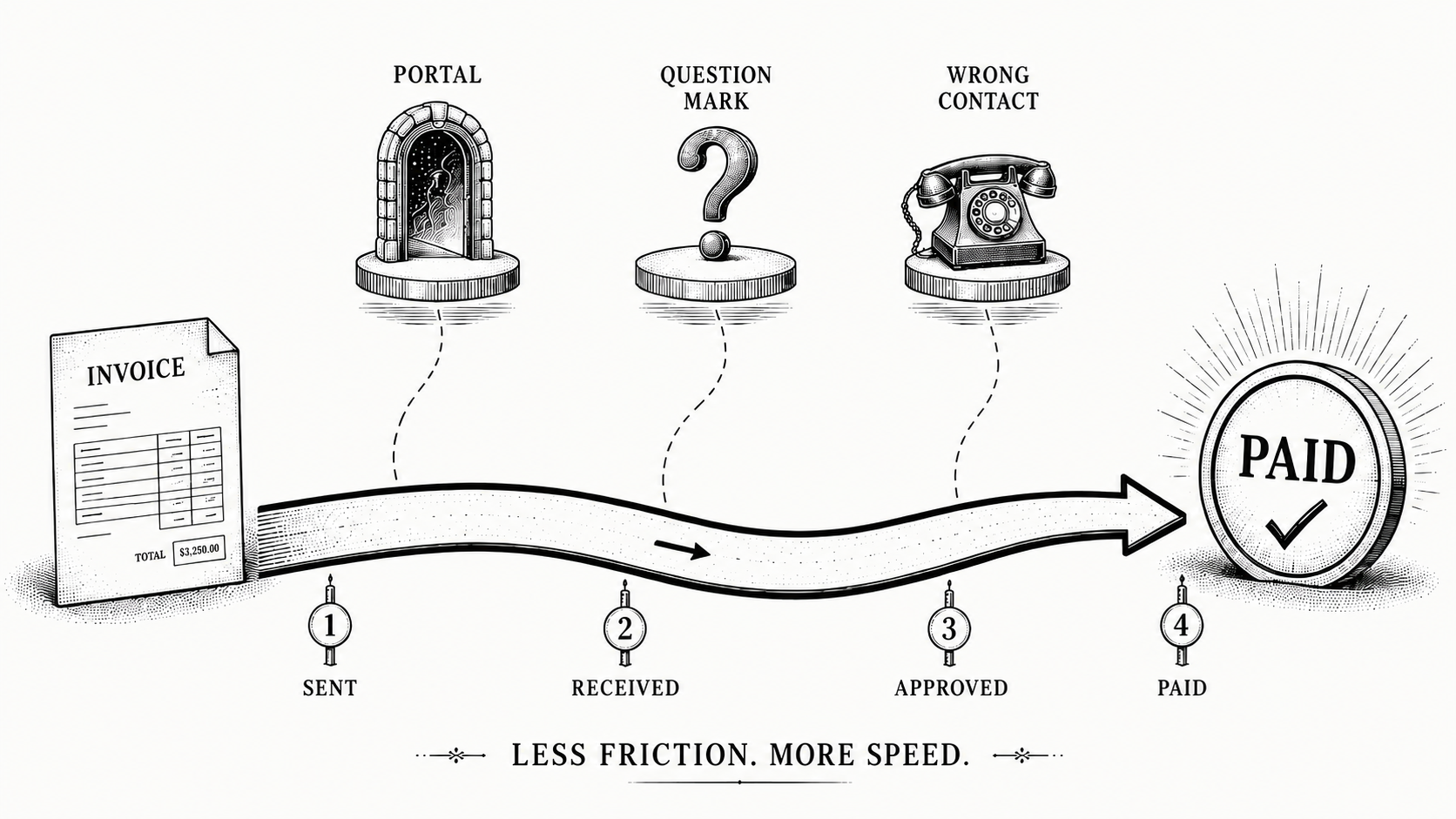
The fastest way to get customers to pay faster is to separate the few things you control before an invoice is sent from the much larger pile already on the aging report, then work that pile by blocker. Monk is an AI-native invoice-to-cash platform running collections, AP portal submission and cash application together. Customers rarely pay late out of unwillingness. Most late payments trace to friction: a dispute nobody resolved, a missing PO, an invoice stuck in an AP portal, or a contact who left the company. The way to get paid faster is to remove that friction across the cycle, not to send a sterner reminder. Here are seven tactics that work, ordered roughly by leverage, and where AI-native automation like Monk makes them consistent enough to move your DSO.
Most advice here assumes a handful of invoices out at once, so it stops at the pre-invoice half: shorten terms, take a deposit, bill on delivery. That does little for a team carrying several hundred open balances, so this guide concentrates on the aging report.
Why do customers pay late?
Late payment is usually a process failure on one side or the other rather than a decision to withhold money.
It helps to start from the real cause. When you look at an aging report account by account, the pattern is almost never a customer who refuses to pay. It is a process that made paying harder than it needed to be.
Sort unpaid invoices by cause and four families cover almost all of them: never accepted into the customer's AP system for want of a PO, a cost centre or a tax form; accepted but waiting on an approver; disputed over a small line; or correct, with the next payment run a fortnight away. The reminder email fixes one of the four. Our guide to why B2B customers pay invoices late goes further.
That reframing changes the playbook. Instead of escalating tone, you clear the specific blocker on each invoice, and you do it before the invoice ages. The seven tactics below are ordered roughly by leverage, so if you only fix a few, start at the top.
What can you fix before the invoice goes out?
Before the invoice is sent, the job is to make sure it will be accepted rather than merely delivered.
An invoice missing the reference data the customer's AP system requires is a silent rejection: it is dropped, no notification is raised, and your aging report counts days against a balance their ledger never held.
Capture the PO at order entry. Make the purchase order number a required field on the sales order rather than something billing chases later, and on blanket POs record the balance remaining. An invoice billed against an exhausted PO is rejected on arrival and nobody tells you.
Record the cost centre and requester. Ask the buyer which cost centre the spend sits against and which named person approves it, and store both on the customer record. Invoices reaching accounts payable without a routing reference sit unassigned until someone works out the owner.
Send the compliance pack once. Get the W9 or local tax equivalent, the certificate of insurance and the signed vendor form in before the first invoice, and diary its expiry. A lapsed certificate puts a supplier on payment hold at many large buyers.
Confirm the channel and backup contact. Ask the customer's finance function whether invoices are emailed, uploaded to a portal such as Coupa or Ariba, or sent through an invoicing network, and record the answer with the supplier ID. Take a second accounts payable contact too, because single-threaded contacts are why healthy invoices go quiet.
1. Set clear, upfront terms
Spell out due dates, accepted payment methods, and late-payment expectations at the start of the relationship, in the contract and on the first invoice. Ambiguity is the most common and most preventable cause of delay, because a customer cannot pay on time against terms they were never given clearly.
Specificity is what makes terms work. Net 30 from the invoice date, the exact methods you accept, and a clear statement of any late fee leave nothing to interpretation. Vague terms invite the customer to set their own timeline, which is rarely the one you wanted.
It is worth writing terms down in plain language at the point of sale, not buried in a master agreement no one rereads. When the salesperson and the customer agree on net 30 and the first invoice repeats that exactly, you remove the most common excuse for late payment before it can ever be used.
A caveat: shortening net terms from 45 days to 30 often changes nothing at a large customer, because their AP function pays on its own cycle whatever your invoice says. A buyer running one payment file a week, with two approvals and a cut-off five working days before the run, puts a net 15 invoice and a net 30 invoice in the same file. You have moved the balance into the overdue bucket sooner and taken on the cost of chasing something the customer does not consider late. Shorter terms suit owner-managed businesses; with an enterprise buyer, negotiate the submission channel, the approval path and the payment run calendar, because those decide when the money leaves.
2. Make paying easy
Offer the payment methods your customers use and put a clear path to pay on every invoice. Every extra step, a login, a re-keyed amount, an unclear remit-to, is a reason to set the invoice aside, so the fewer clicks between the invoice and the payment, the sooner cash arrives.
Friction at the moment of payment is the most overlooked delay of all. An invoice the customer fully intends to pay can still sit for weeks because the link was buried, the bank details were unclear, or the only option was a method their finance team does not use. Removing those small obstacles often does more than any reminder.
What do you do about the invoices already on the aging report?
Work the aging report by blocker rather than by age, because the oldest invoice and the most collectable invoice are rarely the same one.
Sorting by days outstanding spends your best hours on balances least likely to move, since an invoice that has survived 120 days has survived several attempts. A blocker-first pass puts collectable money at the front, and a weekly re-run shows which blockers cleared. Our guide on how to triage a collections inbox covers the sorting rules.
Freeze the report at one date. Export the open receivables ledger as at a single close date so the list does not shift while you work it, including due date, amount, PO number, submission channel and last contact. A screen that changes hourly hides what has been touched.
Split out the never-accepted invoices. Separate every invoice you cannot prove was accepted into the customer's AP system, checking portal status where a portal exists and looking for a voucher number where it does not. These are submission problems, and the fastest cash on the report, because there is no argument to win.
Route disputes to their owners. Move every invoice with an open query into its own queue with the disputed amount, the date raised and the person who can settle it, and ask for the undisputed balance meanwhile. A query belongs with the account owner, not the collector.
Give every line an owner. Assign each open invoice one named owner and one next action with a date, even where the action is to wait for the payment run on the fourteenth. Blank next actions produce the same surprises every month.
Why can an invoice be "not late" and still be uncollectable this quarter?
Because the date your terms produce and the date your customer's payment run produces are different, and only one releases money.
A buyer paying twice a month, with a cut-off several working days before each run and two approvals in front of it, has an effective payment date two or three weeks past your due date without breaking a rule. Ask the AP supervisor for the run dates and cut-off in writing, chase approval before the cut-off closes, and hand invoices whose run falls next period to the forecast owner.
4. Handle AP portals
If a customer requires Coupa or Ariba, the invoice does not get paid until it is submitted there correctly. Handling portals promptly removes one of the biggest silent delays, because an unsubmitted invoice can sit indefinitely while everyone assumes it is in flight.
Portals are uniquely dangerous because they fail quietly. Your records show the invoice was sent, the customer's AP system never received it, and weeks pass before anyone reconciles the gap. Making portal submission a same-day step closes one of the largest sources of avoidable lateness, and a submission without a confirmation number is unfinished work.
5. Resolve disputes fast
A single unanswered question can hold a large invoice for weeks. Catch disputes early, route them to the person who can resolve them, and the invoice keeps moving instead of stalling in an inbox.
Most disputes are small and answerable, a line item that needs explaining or a PO that needs matching, yet they freeze the entire balance until someone addresses them. Speed matters more than perfection here, because a quick resolution unsticks far more cash than a slow, exhaustive one. Put a date on every query when it is raised.
How do you reach an actual human in accounts payable?
Change the channel and the recipient at the same time, rather than sending a fourth email to the address that has ignored three.
Silence from a shared AP mailbox is rarely refusal: those inboxes are worked by rota, filtered by rule and often set to auto-acknowledge. Check first whether your contact still works there: a bounce and a live mailbox need different responses.
Ask a shared mailbox one question. Write to the AP mailbox with the invoice number and PO in the subject line and ask one closed question, such as whether the invoice has a voucher number. Rota staff with four minutes answer closed questions and leave open ones.
Call the AP supervisor directly. Phone during the customer's working hours, ask for accounts payable supervision by role rather than name, and confirm the invoice status and the scheduled payment run on the call. Note who you spoke to and email a same-day summary.
Escalate to the contract signatory. When accounts payable has not responded across two channels, write to the business owner who signed the agreement and ask them to name the internal approver rather than to pay. Budget holders have standing with accounts payable that a supplier does not.
3. Follow up early and personally
Start before an invoice is overdue, in your own name, with a tone matched to the relationship. Reaching out around the due date keeps invoices from sliding into the aging buckets at all. Outreach calibrated to the customer earns about 24% more responses than standard dunning.
Early and personal beats late and generic every time. A short, friendly note on or just before the due date reads as a helpful nudge, keeps the invoice top of mind, and preserves the relationship, while a stern letter at day 60 puts the customer on the defensive.
Cadence fails in two directions. Too sparse and the invoice drifts, because an AP queue is worked in the order of who asked most recently; too dense and the recipient filters you. A workable pattern: a pre-due check that the invoice was approved, a note on the due date, a follow-up at seven days, a call at fourteen, then a change of channel and recipient.
Tone carries a commercial cost worth pricing. Pushing hard on a customer who renews next month can win a payment and lose a contract, so the collector and the account owner should read the same list. The commoner failure runs the other way: teams go quiet on their largest accounts, and the silence reads as permission. We cover the wording in how to chase invoices without annoying customers.
How do you turn a promise to pay into something you can hold?
A promise is only useful if it names an amount, a date and a person, and is written down somewhere that will be checked.
"It is in the next payment run" ends a phone call without committing anyone. Recorded properly, promises are the cleanest early warning available, because a customer who breaks two in a row is signalling their cash position.
Capture amount, date and person. When a customer commits, record the exact amount, the calendar date, the payment method and the name of the person who gave it. A promise logged as "paying soon" cannot be followed up without reopening the conversation.
Confirm in writing same day. Send a short email summarising the commitment and asking the contact to correct anything wrong in it. Same-day confirmation turns a verbal remark into a shared record and surfaces problems now rather than on the promised date.
Diary the next working day. Set the check for the day after the promised date rather than a week later, and check the bank first so you do not chase money that has arrived. Following up at once makes a slipped date cheap to correct.
Name the broken promise directly. If the date passes without payment, quote the amount, the date and the person in the next message and ask for a new date with a shorter horizon. Treat two broken promises on one balance as the trigger to escalate, not to send another reminder.
When should you stop chasing and escalate?
Stop chasing once the invoice is confirmed correct, confirmed accepted and still unpaid after two broken commitments, because further reminders only add cost.
Escalation changes who is involved and what is at stake. Brief the account owner with the invoice list and contact history, then write to the executive sponsor who signed the contract, stating the balance, the age and the commitments missed. Where the contract allows it, put the account on credit hold with written notice, since an announced hold often produces payment. Beyond that, refer the debt to an agency or issue a formal demand through counsel, with thresholds set in advance. The controls that stop invoices reaching this point sit in our guide to reducing overdue invoices.
6. Offer payment plans where it helps
For larger or strained balances, a structured plan recovers cash faster than waiting for a lump sum that may never come at once. A partial but predictable schedule beats an aging full balance.
A payment plan also keeps the relationship intact. A customer facing a cash crunch will often go quiet on a large invoice but happily commit to a smaller, regular installment, which turns a stalled balance into a stream of predictable payments. Write the schedule down with dates and amounts, get it acknowledged by email, and state what happens if an instalment is missed.
7. Automate the routine
Consistency is what gets you paid, and consistency is hard to sustain by hand across every account. This is where automation earns its place, keeping every tactic above running without depending on someone remembering to do it. The table below maps each common source of friction to its fix.
| Friction | The fix |
|---|---|
| Unclear terms | Set due dates and methods upfront |
| Hard to pay | A clear, one-click payment path on every invoice |
| Late follow-up | Outreach that starts around the due date |
| Portal not submitted | AP portals like Coupa and Ariba handled automatically |
| Open dispute | Routed and resolved early |
| Strained balance | A structured payment plan |
A worked example
Imagine an invoice for $50,000 that is now 40 days late. The instinct is to send a firm reminder, but a quick diagnosis shows the customer never received it because their AP system requires a portal submission that was missed. No reminder, however sternly worded, would have moved that invoice. Submit it correctly and the clock starts; the cash arrives on the customer's normal cycle. Multiply that across an aging report and the lesson is clear: most of your slow cash is waiting on a fixable blocker, not a reluctant payer.
Common mistakes that slow payment
A few habits quietly push payment dates out. Leaving payment terms vague invites customers to choose their own timeline. Making customers hunt for how to pay turns intent into delay. And escalating tone instead of removing the blocker damages the relationship without unsticking the invoice. Each is avoidable, and each is exactly what a consistent, automated process prevents.
The throughline across all seven tactics is the same: customers pay faster when paying is the path of least resistance and when nothing in your process is silently holding the invoice. Reminders sit near the bottom of the leverage list for a reason. They are the most visible tactic but rarely the one that moves the cash, because they treat a friction problem as a willingness problem.
How Monk helps customers pay faster
Monk is an AI-native invoice-to-cash platform that runs intelligent collections, which ingest the context of each customer conversation and respond more effectively than dunning, submit to AP portals like Coupa and Ariba, and apply cash automatically, so customers pay faster and your team works only the exceptions. Customers see a 40% average reduction in DSO and resolve 90% of collections with zero human intervention, with intelligent collections proving 24% higher response rate than standard dunning and go-live in less than one week.
Monk manages $2B+ in receivables, is SOC 2 Type II compliant, and integrates natively with Stripe, HubSpot, QuickBooks, NetSuite, and Salesforce. The result is faster payment that comes from removing friction, not from chasing customers harder.
Julia, the AI agent for Intelligent Collections, holds the cadence across every account, and submission runs into more than 600 corporate AP portals, because 92% of enterprise invoices measured across the receivables Monk manages arrive that way. Elate cut DSO in half.
Where should you start?
Start with a one-week diagnosis of your own aging report rather than a change of terms.
Take the twenty largest balances over thirty days and answer three questions each: can you prove the invoice was accepted into the customer's AP system, is there an open query, and has a named person confirmed a payment date. The count you cannot answer is your collections problem. To keep that record automatically, book a demo.
Frequently asked questions
Why do customers pay invoices late?
Usually friction: a dispute, a missing PO, a portal, or a wrong contact, rather than unwillingness to pay. The customer typically intends to pay but something in the process blocks them.
What is the fastest way to get paid sooner?
Follow up early and personally, make paying easy, and remove portal and dispute friction before invoices age. Timing and ease of payment usually move more cash than any reminder.
Do payment reminders work?
Generic reminders help little. Personalized, intent-aware outreach earns about 24% more responses than standard dunning because it addresses the real reason an invoice is unpaid.
Should I offer early-payment discounts?
They can help, but removing friction and following up consistently usually moves more cash at lower cost. A discount only works if paying is already easy.
How does automation help get paid faster?
It keeps follow-up consistent, handles AP portals, and resolves the routine, which is what shortens payment time across every account rather than just the few you remember to chase.
When should we escalate an unpaid invoice?
Escalate once the invoice is confirmed correct, accepted into the customer's AP system, and still unpaid after two broken commitments. Brief the account owner first, then ask the budget holder who signed the contract to unblock the approval. A credit hold with written notice comes next. Set thresholds in advance so the decision is policy, not a debate.
How quickly can we start?
Monk goes live in less than one week on top of your existing ERP and billing, so customers can start paying faster within the first weeks rather than after a long rollout.
Worth reading next: Accounts Receivable Best Practices for 2026, Collections Email Templates That Get Paid and 7 Signs Your Business Needs AR Automation.



.avif)