5 AI Use Cases in Finance That Are Working

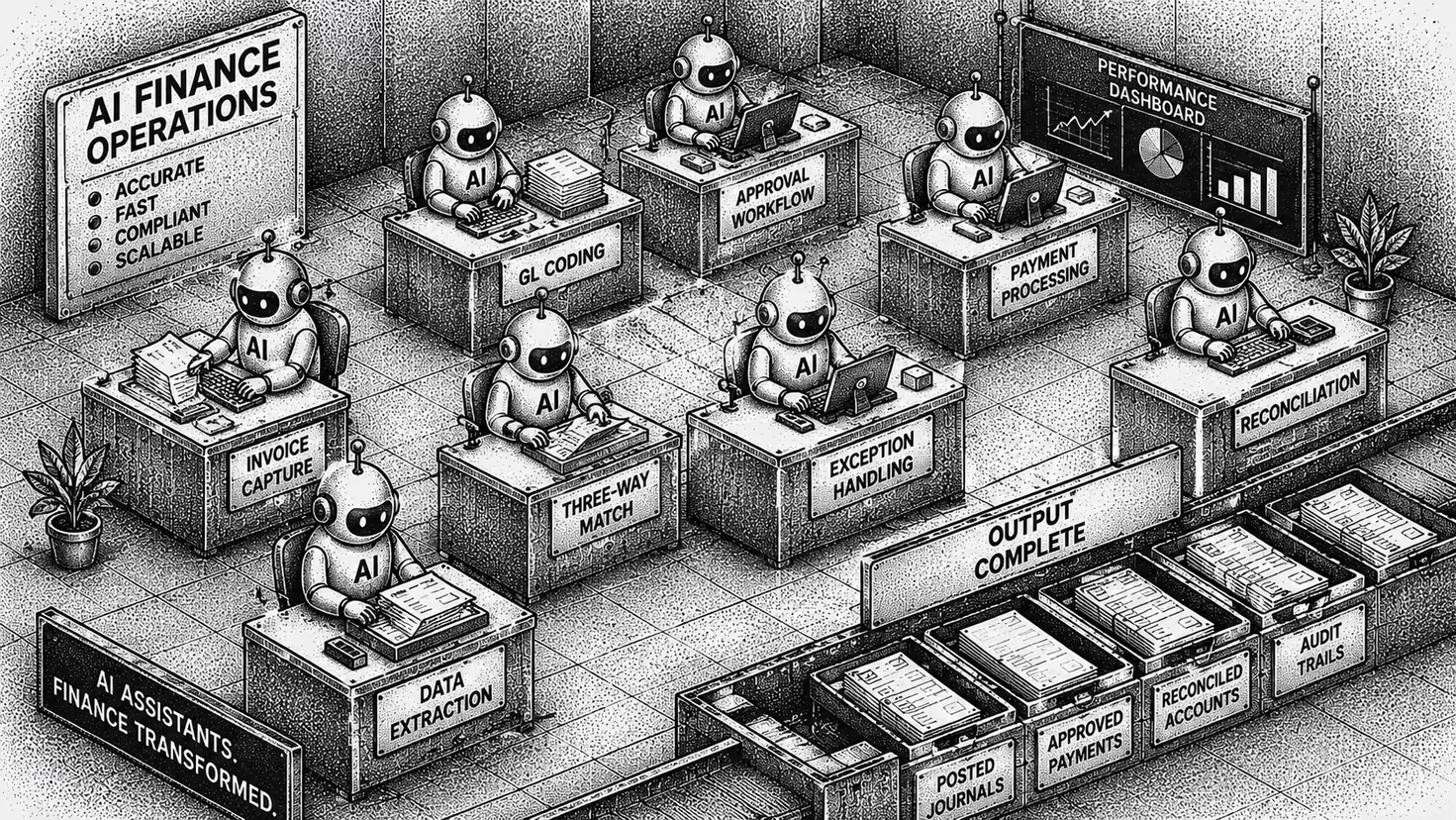
Which AI Use Cases Are Working in Finance Right Now?
Five AI use cases are delivering measurable results in finance today: accounts receivable automation, financial forecasting and scenario planning, contract and invoice parsing, expense anomaly detection, and bank reconciliation. Each one succeeds for the same reason: the underlying data is high volume, semi-structured, and expensive to process by hand. Accounts receivable stands out as the highest-leverage of the five, because the cash it unlocks has already been earned and is simply stuck in a slow, manual workflow.
The rest of this guide breaks down what AI does in each of these five workflows, what changes for the finance team running them, and where the technology still needs a human in the loop.
How Is AI Automating Accounts Receivable?
Accounts receivable is where a business collects money it has already earned, which makes it one of the most direct levers on cash flow finance has. Without automation, invoices go out late, customer replies pile up unread in shared inboxes, and payment intent buried in a vague email gets missed until someone finally has time to read it.
AI changes this by reading customer replies directly, extracting promised payment dates, and logging that intent without a person retyping it into a spreadsheet. Collections emails shift from static templates to messages personalized by payment history and account behavior. Payment matching moves from manual CSV reconciliation to software that reads remittance data and connects it to the correct open invoice, even when the payment arrives through a different channel than the remittance advice.
Disputes benefit the same way. Instead of sitting in an inbox until someone has time to triage them, AI classifies the dispute type and routes it to the right owner, so genuinely complex cases get attention while routine ones clear on their own.
How Is AI Changing Financial Forecasting and Scenario Planning?
Most finance teams still forecast off static models that assume a constant days sales outstanding, a fixed churn rate, and a steady hiring pace. Those assumptions break the moment real customer behavior diverges from the plan, which is most of the time.
AI-powered forecasting tools ingest live data from accounting systems, payment processors, and CRM platforms to build rolling cash flow models that update as new information arrives. Rather than assuming every customer pays on the same schedule, the model adjusts based on what each account is doing. Some platforms now support natural-language scenario queries, letting a finance lead ask what happens to cash position if collections slow by a set amount, and get an answer built from current data instead of a static spreadsheet formula.
Why This Matters More When Paired With Real-Time Collections Data
A forecast is only as good as the assumptions feeding it. When the DSO input comes from a live collections system instead of a quarterly average, the forecast reflects what is happening in the receivables book, not what happened last quarter.
How Does AI Improve Contract, PO, and Invoice Parsing?
B2B finance runs on documents: master service agreements, purchase orders, invoices, amendments, and remittance emails. Parsing these by hand or with brittle rules-based tools has always been slow, because formats vary by vendor and important terms get buried in unstructured text.
Large language models now read PDFs, spreadsheets, and emails with embedded terms, and normalize vendor-specific invoice formats into a consistent structure. They can cross-check that an invoice's payment terms match what the underlying contract specifies, catching a net-45 invoice issued against a net-30 agreement before it goes out the door. That kind of validation used to require a person to manually compare two documents; now it happens automatically before the invoice is sent.
The payoff shows up downstream. Fewer invoices get disputed for terms that were wrong from the start, and fewer payments get delayed because a customer's AP team caught a mismatch that finance should have caught first.
How Does AI Help With Expense Monitoring and Anomaly Detection?
Corporate spend has become decentralized across cards, SaaS subscriptions, and contractor payments, which makes manual expense review slow and inconsistent. Finance teams spend real hours each month scanning for duplicate charges, out-of-policy spend, and unusual vendor activity.
AI-driven anomaly detection analyzes historical spend by category, vendor, and department, then flags transactions that break the established pattern rather than relying on a fixed rule like "flag anything over $500." A sudden spike in a department's software spend, or a vendor charge that does not match its usual cadence, gets surfaced for review instead of buried in a monthly statement. Some corporate card platforms already embed this kind of explainability directly into transaction review, generating a plain-language note on why a charge was flagged.
How Is AI Used in Bank Reconciliation and Cash Matching?
Bank reconciliation has long been one of the most error-prone parts of finance operations, because bank feeds and ERP records rarely align cleanly. Transaction memos are often vague, partial payments complicate the math, and ACH batches can bundle multiple customer payments into one deposit line.
Modern systems read bank feeds and payment processor deposits directly, then map them to open receivables using fuzzy matching on memo text, partial amounts, and payment timing. A single bulk deposit that covers five different customer invoices gets split and applied correctly instead of sitting as one unexplained line item. The system handles the full range of payment and remittance patterns, from vague memos to bundled ACH batches.
What Do These Five Use Cases Have in Common?
The table below summarizes each use case, what AI specifically changes, and the practical impact for a finance team.
| Use case | What AI does | Practical impact |
|---|---|---|
| Accounts receivable automation | Reads customer replies, extracts payment promises, personalizes outreach, and matches payments to invoices | Unlocks cash that has already been earned but is stuck in manual workflows |
| Financial forecasting and scenario planning | Builds rolling cash flow models from live payment and account data instead of static assumptions | Shifts forecasting from reactive to predictive |
| Contract, PO, and invoice parsing | Parses documents, normalizes formats, and cross-validates terms before invoices go out | Catches mismatches early and reduces payment delays caused by document errors |
| Expense monitoring and anomaly detection | Flags spend that breaks established patterns instead of relying on fixed dollar thresholds | Reduces manual review time and surfaces issues earlier |
| Bank reconciliation and cash matching | Maps bank and processor deposits to open receivables using fuzzy matching on memos and amounts | Speeds up reconciliation and reduces unexplained cash |
Every use case on this list shares three traits. The data is high volume and arrives in a semi-structured format that used to require a person to interpret it. The financial impact is direct, touching cash flow, compliance, or margin rather than a secondary metric. And the workflow tolerates automation handling the majority of cases correctly while routing the genuine exceptions to a person, rather than requiring perfect accuracy on every single transaction.
How Does Monk Apply AI to Accounts Receivable?
Monk is an AI-native invoice-to-cash platform built around these same principles, applied specifically to accounts receivable. Its AR agent, Julia, reads customer replies, drafts personalized outreach based on payment history, and adjusts tone and timing per account, driving a 24% higher response rate than standard dunning sequences.
On the cash application side, Monk's AI-native matching reaches an 80% automatic match rate, up to 95% with suggested rules and resolves 90% of collections with zero human intervention, which keeps the ledger current without manual reconciliation. Across its customer base, Monk reduces DSO by 40% on average and saves teams roughly 26 hours per month of manual work. Go-live typically takes less than one week because Monk connects to existing systems, including Salesforce, QuickBooks, NetSuite, and Stripe, rather than replacing them, and there is no percentage-of-collections fee.
What Should Finance Teams Do Next?
Not every finance team needs to adopt all five of these use cases at once. The highest-leverage starting point is usually accounts receivable, because the cash it unlocks already exists on the books and the payoff is immediate rather than theoretical.
From there, the same underlying pattern applies to forecasting, document parsing, expense review, and reconciliation: identify the workflow with the highest volume of repetitive, semi-structured work, and let automation handle the majority case while a person handles the exception. Finance teams that make this shift free up capacity for analysis and strategy instead of manual data entry.
Frequently Asked Questions
What are the most effective AI use cases in finance right now?
The five AI use cases delivering the clearest results today are accounts receivable automation, financial forecasting, contract and invoice parsing, expense anomaly detection, and bank reconciliation. Each works well because it involves high-volume, semi-structured data that used to require manual interpretation.
How does AI reduce DSO in accounts receivable?
AI personalizes collections outreach based on payment history, matches incoming payments to open invoices automatically, and routes disputes to the right owner instead of leaving them in an inbox. Monk customers see DSO reductions of 40% on average as a result.
Can AI replace manual bank reconciliation entirely?
AI can automate the large majority of matches by reading bank and processor deposits and mapping them to open receivables, even when memos are vague or payments are bundled. Genuine exceptions, such as unexplained short pays, still need a person to resolve them.
How is AI different from robotic process automation for finance workflows?
RPA follows fixed rules and breaks when an input falls outside the pattern it was built for. AI reads unstructured content like emails and PDFs, interprets what it means, and handles inputs that fall outside any fixed rule.
Does AI need clean, structured data to work in finance?
No. The use cases where AI performs best in finance specifically involve messy, unstructured inputs such as email replies, scanned invoices, and inconsistent remittance formats. That is a key difference from older automation tools, which generally required structured data to function.
How does Monk apply AI to accounts receivable specifically?
Monk's AR agent, Julia, personalizes collections outreach and drives a 24% higher response rate than standard dunning. Its AI-native cash application reaches an 80% automatic match rate, up to 95% with suggested rules and resolves 90% of collections with zero human intervention, keeping the ledger current without manual work.
How quickly can a finance team see results from AI automation?
With Monk, go-live typically takes less than one week since it connects to existing ERP, billing, and bank systems instead of replacing them. Customers save an average of 26 hours per month and see DSO reductions of 40% on average.
Ready to see how AI-native automation performs in your own accounts receivable workflow? Book a demo.
If this is the problem you are solving, these go deeper: How Generative AI Is Reinventing Accounts Receivable in 2026 and What LLMs Can and Can’t Do in B2B Payments: A Strategic Deep Dive.



.avif)