Automating Accounts Receivable: What Finance and Business Operations Leaders Need to Know


What does automating accounts receivable actually mean?
Automating accounts receivable means replacing manual invoice delivery, payment tracking, and collection follow-ups with software that runs those tasks systematically and escalates only the exceptions. For finance leaders, the payoff is concrete: with a platform like Monk, teams save an average of 26 hours per month, cut AR outstanding by 40% on average, and see a 2.4x increase in cash on hand in the first quarter.
This guide covers what AR automation does, how to evaluate a platform, the ROI to expect, and how to make the internal case, written for finance leaders deciding whether to move off spreadsheets in 2026. For the argument on why DSO stays high despite automation, see Monk's Definitive AR Guide.
Why does AR automation matter more in 2026?
AR automation matters because every day an invoice goes unpaid is working capital you cannot deploy. When your process relies on manual follow-ups, that cash sits idle longer than it needs to, and the cost compounds while interest rates stay elevated.
Manual AR also scales badly. Finance teams spend hours each week building aging reports, sending reminders, and chasing payment commitments, and that work grows with transaction volume rather than staying flat. Automation breaks that link by handling the routine load consistently, regardless of team bandwidth.
The result is faster collection and tighter visibility. Companies that automate AR report collecting payments sooner, which directly improves the cash available to fund growth instead of financing it through credit.
What does AR automation software do?
AR automation software handles the repetitive tasks that consume finance capacity, from invoice delivery through payment application. It generates and delivers invoices through the customer's preferred channel, tracks invoice status in real time, and triggers follow-up sequences based on rules you define.
Payment application happens automatically when customers pay, with the system matching payments to open invoices and updating your records. Monk's AI-native cash application, which posts an 80% automatic match rate (up to 95% with suggested rules), extends this to complex cases like split and consolidated payments. Modern platforms integrate directly with your ERP or accounting software, so creating an invoice in NetSuite, QuickBooks, or Stripe flows into the automation platform without double entry.
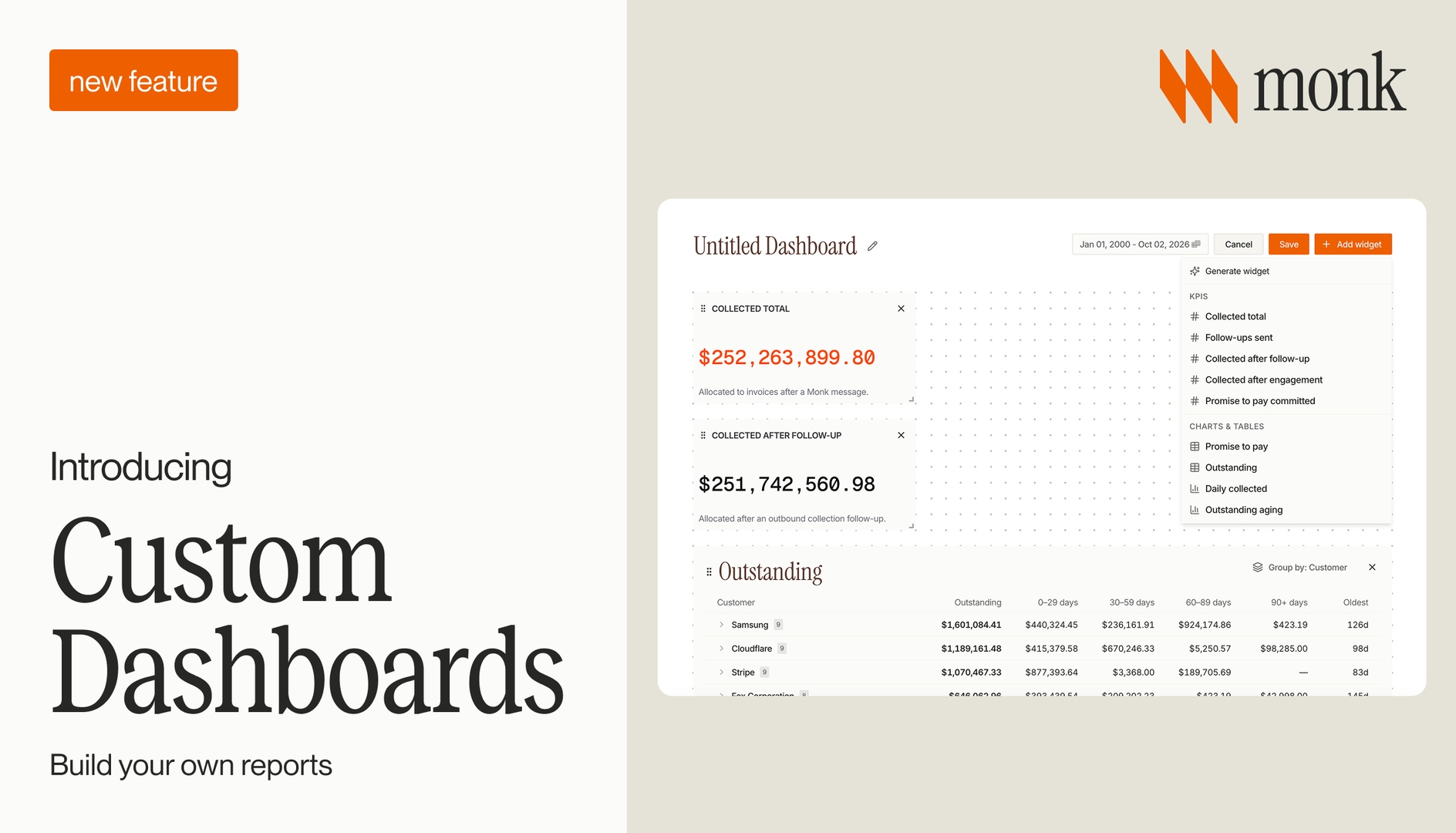
Reporting becomes real time rather than a weekly manual build. You can see which invoices are outstanding, who is consistently late, and where cash flow stands at any moment, which sharpens forecasting and credit decisions.
How does intelligent collections change the process?
Traditional automation follows rigid rules: if an invoice is 30 days late, send template B. Intelligent Collections instead ingests the context of each conversation and adapts to it. When Monk drafts a follow-up, it references prior exchanges, so if a customer said they process payments on the 15th, the system incorporates that rather than sending a generic reminder.
Monk's AR agent, Julia, automates collections with personalized follow-ups, escalations, and workflows, and shifts voice and style based on each customer's history to maximize replies. Tasks route through a smart queue where your team can approve or edit them, and Monk handles complex AP processes, enterprise portals, PO mismatches, and W9s. It resolves issues where it has full confidence and flags the rest to your team.
This context-awareness makes collections more effective without making them more aggressive. The approach is 24% more effective than dunning according to monk.com, and customers receive relevant, timely communication instead of impersonal notices.
What is the real ROI of AR automation?
The ROI comes from two places: working capital freed and team hours reclaimed. Monk customers see a 40% average reduction in AR outstanding and a 2.4x increase in cash on hand in the first quarter, which is cash returned to the balance sheet rather than trapped in receivables.
| Manual AR | Automated with Monk | |
|---|---|---|
| Time on collections | 40+ hrs/month | 26 hrs saved/month |
| Invoice resolution | Frequent escalation | 90% resolved automatically |
| DSO | Baseline | 40% reduction |
| Cash on hand (Q1) | Baseline | 2.4x increase |
| Go-live time | Months | less than one week avg |
The time savings translate directly into capacity. Saving an average of 26 hours per month lets a team redirect effort toward forecasting, credit analysis, and strategic finance work instead of follow-ups. Because Monk's average go-live is less than one week, the payback window opens almost immediately rather than after a multi-month rollout.
Hard costs fall as well, since electronic delivery and automated payment acceptance cost far less than printing, mailing, and processing checks. For a full model, see the how to calculate AR automation ROI.
What should you look for in an AR automation platform?
Evaluate platforms on integration depth, scope, and how they handle exceptions. Surface-level integrations that require manual exports negate most of automation's value, so look for native, bidirectional ERP sync that updates in real time.
Scope is the next filter. A platform that only sends reminders leaves collections, cash application, and edge cases to your team. Monk runs the full invoice-to-cash cycle, pairing AR automation with Intelligent Collections and cash application, and connects natively to Salesforce, QuickBooks, HubSpot, Stripe, NetSuite, and Anrok so enterprise billing does not fall back to manual work.
Finally, test how the platform handles the messy 20%: partial payments, disputes, PO mismatches, and W9s. That is where DSO accumulates, and it is the clearest dividing line between a real platform and a workflow tool. Ask each vendor what percentage of invoices it resolves without human escalation, and compare against Monk's 90%.
How do you implement AR automation successfully?
Successful implementation starts with documenting your current workflow from invoice creation through payment application, including exceptions. This often surfaces inefficiencies and helps you design better automated workflows rather than automating a broken process.
Clean your data before migration by standardizing contacts, correcting email addresses, and updating payment terms. Then start with a pilot segment rather than automating everything at once, monitor results, refine templates and timing, and expand gradually. Define clear escalation criteria so your team knows when to step in for large accounts, complex disputes, or silent customers.
A common mistake is over-automation, such as sending daily reminders on a small, barely-late invoice. Build appropriate intervals between communications and segment by invoice age and amount. With Monk's less than one week average go-live, a staged rollout still reaches full deployment quickly.
How do you make the internal case to buy?
Quantify the opportunity cost of waiting. Calculate the cash currently tied up in receivables that could be collected faster, then add the labor: document weekly hours spent on manual AR, multiply by loaded cost, and annualize it. Against the cost of automation, the ROI usually becomes clear.
Address customer-reaction concerns directly. Well-implemented automation improves the customer experience by making invoices easy to view and pay and by keeping communication timely and relevant. Connect the purchase to a strategic objective leadership already cares about, such as improving cash flow to fund growth without additional debt, or scaling operations without scaling headcount.
As James Cadwallader, CEO of Profound, described the outcome: "We were frustrated with invoicing. Cash on hand was lagging contracts signed. My team can now focus on running the business."
Frequently asked questions
Can accounts receivable be automated?
Yes, accounts receivable can be fully automated using software that handles invoice generation, payment matching, collections, and reconciliation without manual intervention.
What does A/R automation actually do?
A/R automation digitizes the order-to-cash cycle by using AI to process invoices, capture payments across multiple channels, and apply cash to the correct invoices in your accounting system.
Why are invoices still overdue even after implementing automation?
Many overdue invoices result from structural issues like delivery to the wrong contact, missing purchase order numbers, or failed portal submissions rather than a customer's unwillingness to pay.
How does automated payment matching work?
AI and optical character recognition (OCR) read remittance data from bank files, emails, and portals, then apply payments to the correct open invoices in your accounting system.
What is intelligent collections and how is it different from standard dunning?
Intelligent collections use customer history, payment patterns, and communication engagement to tailor follow-ups and prioritize high-risk accounts, rather than sending generic reminders on a fixed schedule.
Can automation handle complex billing scenarios?
Yes, advanced platforms can process partial payments, multi-invoice payments, early payment discounts, unapplied cash, and unique contract terms like usage-based billing.
How does A/R automation reduce days sales outstanding (DSO)?
Automation speeds up invoicing, improves collections efficiency, and accelerates reconciliation, converting receivables into cash more quickly. Monk customers see a 40% average reduction in AR outstanding.
What should I look for when choosing an A/R automation solution?
Look for a platform that integrates natively with your ERP or accounting system, supports multi-channel payment capture, and provides real-time visibility into the full invoice lifecycle.
Ready to move off spreadsheets? Book a demo with Monk.
Adjacent to this: How to Select an AR Automation Platform: Complete Buyer's Guide for 2026, The Dos and Don'ts of Invoice Capture Solutions, What Is Invoice-to-Cash? Definition, Process, and Why It Matters, Implementing an AR Platform: A 30 Day Roadmap and Automated Invoice Generation: A 2026 Guide.



.avif)