Why Timely Invoicing Does Not Guarantee Getting Paid

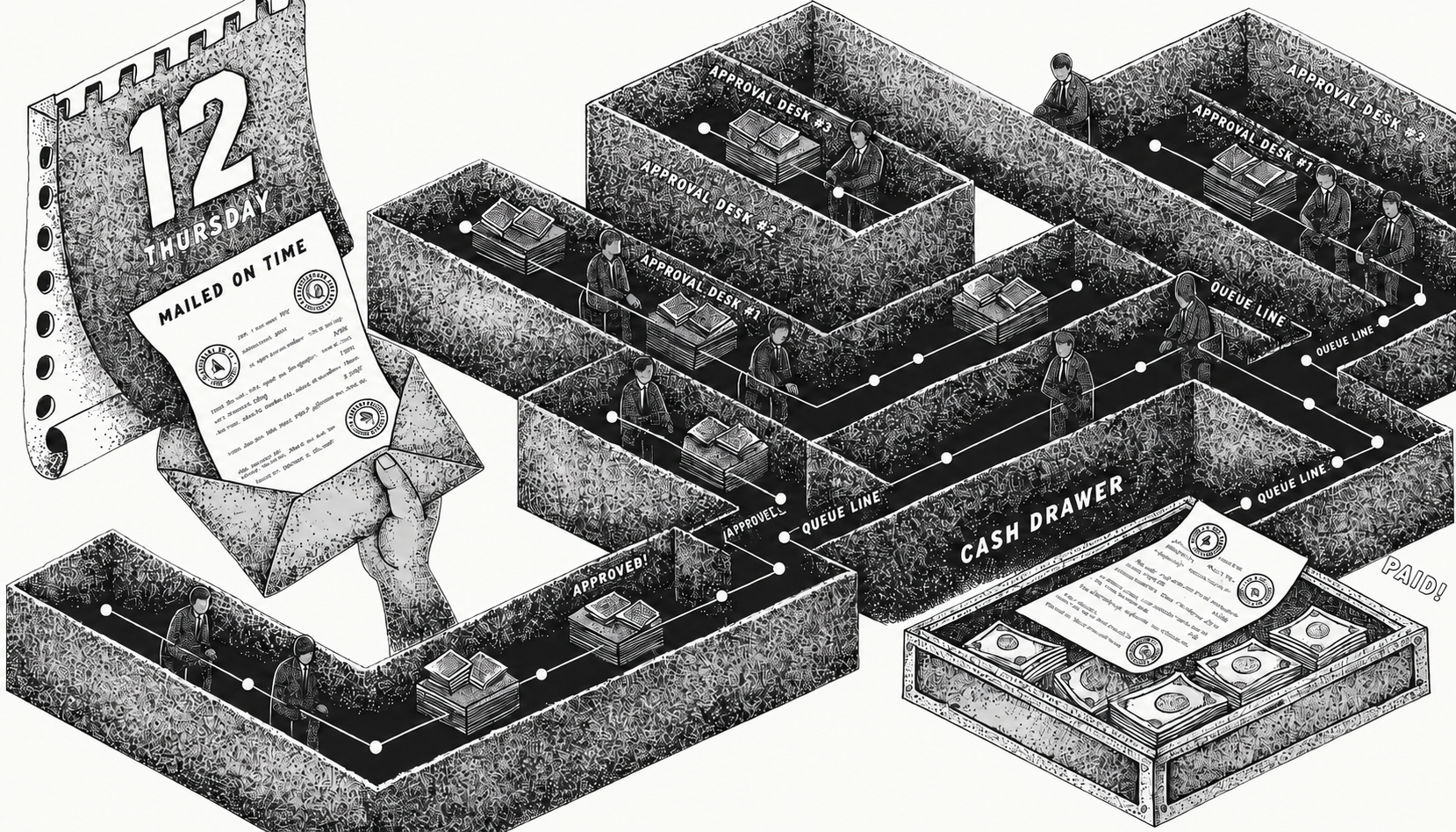
Timely invoicing is the baseline requirement, and on its own it does not get invoices paid. More than half of B2B invoices are paid late regardless of when they are sent, because invoice delivery is one touchpoint in a payment process shaped by the customer's cash position, internal approval workflows, and the relationship between the two companies. The question is rarely whether you invoiced on the 1st or the 15th. It is what happens after the invoice lands, and that is where context-aware collections get invoices paid when timing alone cannot.
What Is the Gap Between Invoice Sent and Payment Received?
Invoice timing is in your control; payment timing is not. The person who receives your invoice is often not the one who approves it, who is not the one who processes it, who is not the one who initiates the transfer. Each handoff adds delay, and a perfectly timed invoice has no influence over those internal dynamics.
That gap is where DSO actually accumulates. You can compress the time from work delivered to invoice sent to nearly zero and still wait 45 days for payment, because the clock that matters runs inside the customer's accounts payable process. The teams that collect fastest stop optimizing their own send date and start influencing what happens inside the customer's workflow instead.
Why Don't Customers Pay on Time Even When They Want To?
Three forces drive most delays, and none of them respond to a faster invoice. Cash-flow constraints mean customers pay critical vendors first and slot you against their entire vendor list. Approval workflows create bottlenecks, and the larger the customer, the longer the chain of sign-offs required before a payment goes out. Errors and disputes freeze everything, because a single line-item discrepancy can put your whole account on hold until it is resolved.
| Cause | What it looks like | What helps |
|---|---|---|
| Cash-flow priority | You compete with other vendors | Stay visible before the due date |
| Approval bottleneck | Invoice sits in a queue | Confirm receipt and approver |
| Error or dispute | Account frozen until resolved | Accurate invoices, fast dispute routing |
None of these causes are fixed by sending sooner. They are fixed by visibility, accuracy, and the right follow-up at the right moment, which is a different discipline from invoicing itself. There is also a structural layer beneath the behavioral one: the invoice may have hit an unmonitored inbox, gone to a contact who left the company, or been rejected by an AP portal for a missing field. In those cases the customer is not even aware there is anything to pay, so the cause has to be diagnosed before any reminder makes sense.
How Do You Tell a Process Problem From a Payment Problem?
Before assuming a customer cannot pay, check whether they even received a usable invoice. Confirm it reached an active contact, landed in a monitored inbox, and passed any AP portal validation the customer requires. A surprising share of "late" invoices are actually invoices that never made it into the customer's payment queue at all.
Once delivery is confirmed, the diagnosis shifts to the three behavioral causes above: cash priority, approval bottlenecks, and disputes. Treating every late invoice as a single problem with a single fix, usually "send another reminder," is why so many collections processes plateau instead of improving.
What Follow-Up Problem Do Most Businesses Ignore?
Most teams treat collections as a post-deadline activity: send, wait, then chase once the invoice is overdue. By the time an invoice is overdue, the customer has often already allocated cash elsewhere and closed the payment batch for the period, so you end up competing for the next cycle rather than the current one.
Effective collections engage before the due date. A friendly reminder a few days early makes you far more likely to be included in the current payment run, not by being pushy, but by staying visible while decisions are still being made. Shifting from reactive to proactive follow-up is one of the highest-leverage changes a finance team can make, and it is exactly what a context-aware system automates.
What Drives Successful Collection?
Payment success tracks with relationship quality, communication frequency, and systematic follow-up. Reliable teams maintain touchpoints beyond the invoice itself, personalize their approach instead of sending generic dunning, and watch payment patterns so they can act before a problem becomes a crisis.
That last point is where most automated systems fall short. A first-time late payer needs a different approach than a chronic one, and a customer who flagged a dispute needs resolution rather than another reminder. A fixed dunning schedule cannot make those distinctions, so it treats every account the same and erodes goodwill on the ones that did nothing wrong. The related trap of misreading why an invoice is late is covered in why overdue invoices are not always a payment problem.
How Does Modern AR Automation Help?
The best systems in 2026 focus on intelligent engagement rather than mechanical dunning. Monk's intelligent collections and its AR agent, Julia, ingest the context of each conversation to craft personalized outreach, which Monk reports is 24% more effective than standard dunning. Instead of "your invoice is overdue," the message references specifics: "Hi Sarah, following up on the Q4 project we completed in December, let us know if you need anything to process the invoice due January 15."
It is worth being precise about how this works. It is not the AI teaching itself over time in an unsupervised way. It reads conversation history and payment patterns to choose the message, timing, and channel, and it integrates with your accounting and CRM systems to remove the busywork that makes consistent follow-up impossible. Monk's voice agent places outbound collection calls and answers inbound calls from customers, working from the same account record as the email thread.
What Results Come From Consistent Follow-Up?
Monk customers see a 40% average reduction in DSO, save an average of 26 hours per month, and reach an 80% automatic cash application match rate, rising to 95% once teams enable suggested rules, all without Monk taking a percentage of the revenue it collects. Personalized outreach also resolves 90% of collections with zero human intervention, which matters because escalation is where relationships get strained and hours get consumed. Go-live typically takes less than one week, so a team feels the difference in the current billing cycle rather than the next one.
What Does Strong Follow-Up Look Like in Practice?
Consider a usage-based software business whose invoices go out on time every month but whose overdue balance keeps growing because approvals stall and the occasional dispute freezes an account. Faster invoicing does nothing for a business like this. Proactive, context-aware follow-up does. Unify took exactly this path and cut its overdue Stripe AR in half, detailed in the Unify case study.
The same pattern holds across Monk's customer base and the $2B+ in receivables it manages. Predictable, recurring exceptions such as missing POs, disputed line items, and stalled approvals drive a meaningful share of cash-flow slowdowns. Resolving them with exception-handling playbooks rather than another reminder is where much of the improvement comes from. Because Monk goes live in less than one week, the shift from reactive chasing to proactive engagement happens almost immediately rather than after a long implementation. For the broader options, see the comparison of dunning vs intelligent collections.
Frequently Asked Questions
How long should I wait before following up on an unpaid invoice?
Start a few days before the due date with a friendly reminder. If it goes overdue, follow up within two to three business days, since waiting weeks signals that late payment is acceptable.
What should I say in collection emails without damaging the relationship?
Be helpful rather than accusatory. Reference specific invoice details, ask if anything is blocking payment, and personalize based on history rather than sending a generic template.
Is it worth automating collections for a smaller finance team?
Yes. Manual follow-up consumes hours that could go to revenue work. Monk's context-aware collections maintain relationships while improving response rates, and resolve 90% of collections with zero human intervention.
What is the difference between dunning and intelligent collections?
Dunning sends the same reminders on a fixed schedule regardless of customer response. Intelligent collections ingest customer context and history to personalize timing and message, which Monk reports is 24% more effective than standard dunning.
Does sending invoices earlier reduce late payments?
Only marginally. Most delay comes from the customer's approval chain, cash priorities, and disputes, none of which earlier invoicing addresses. Proactive, context-aware follow-up is what actually moves the date.
Does Monk make collection calls?
Yes. Voice is part of Intelligent Collections, so the same agent that handles email also places outbound collection calls and answers inbound calls from customers, working from one account record. The agent identifies itself on every call, each call is recorded and logged, and escalation rules route accounts that need a person to your team.
What results do Monk customers see?
A 40% average reduction in DSO, 26 hours saved per month, and 90% of collections resolved with zero human intervention. A 80% automatic cash application match rate, rising to 95% once teams enable suggested rules keeps the underlying data accurate.
More on this: Overdue Invoices Are Not Always a Payment Problem, AR Collections: The Complete Guide for 2026, Collections Email Templates That Get Paid, How to Get Customers to Pay Faster: 7 Tactics That Work and Persuasion at Scale: How Behavioral Science and AI Reshape Collections for Accounts Receivable.



.avif)