AR Automation for Medical Device Companies Selling to Hospitals and IDNs

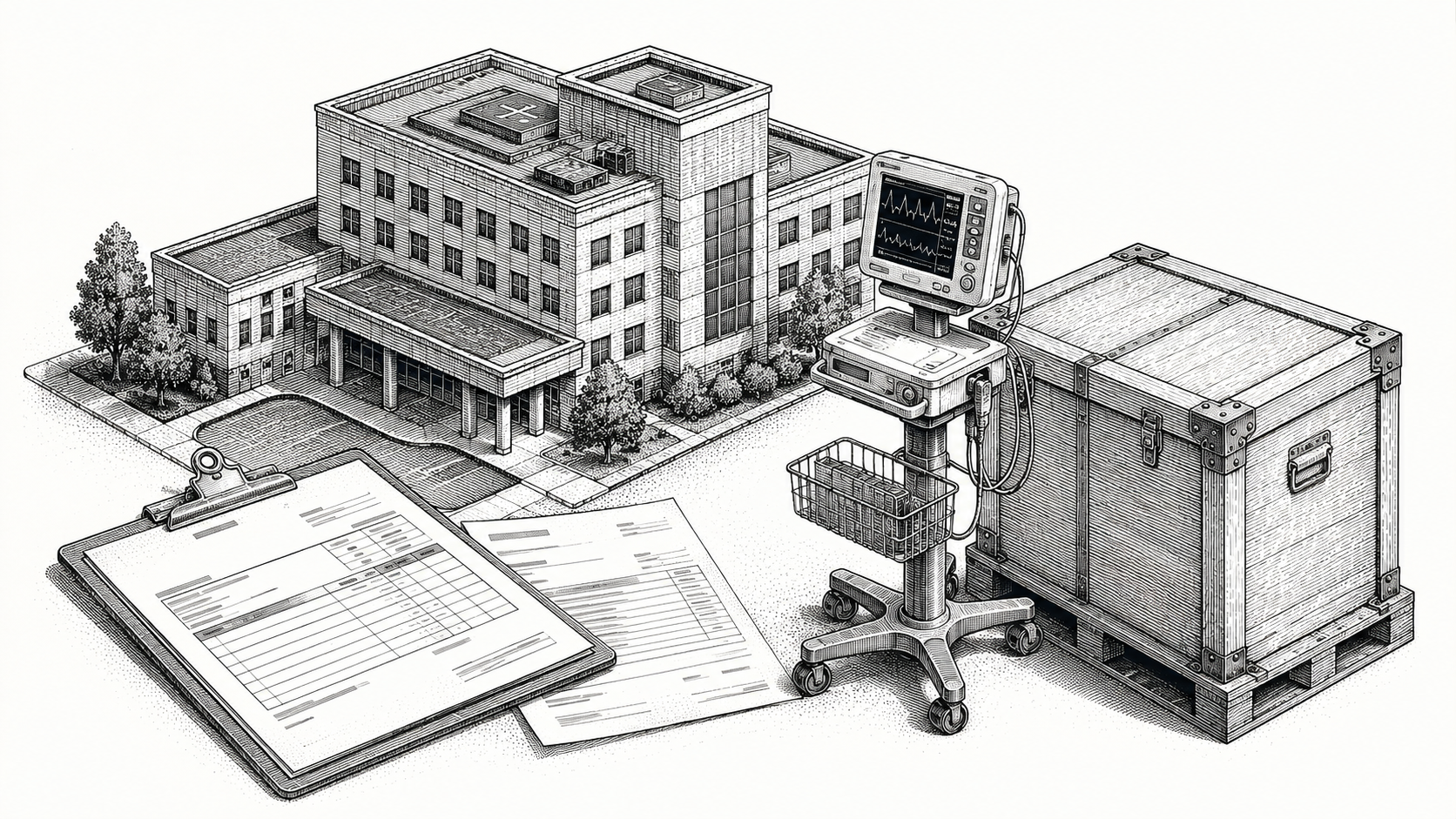
AR automation for medical device companies is software that prices an invoice against the GPO contract tier the hospital is actually entitled to, raises that invoice off a usage event rather than a shipment, submits it into the health system's mandated AP portal against a live purchase order, and then works the chargeback and rebate claims that come back from distributors as a separate stream of receivables. Monk does this as one invoice-to-cash system, running invoicing, AI cash application, portal submission, deduction and dispute handling, and Intelligent Collections against the same customer record. The reason this vertical needs its own answer is that almost nothing about it matches the assumption most AR software is built on, which is that you ship something, invoice for it, and the customer pays.
In medical devices you frequently ship nothing. Product moves into a hospital cabinet or a rep's trunk and sits there as your inventory until a surgeon opens it. The price is not yours to set, it is set by a contract the hospital signed with a group purchasing organization. The entity that pays you may not be the entity that used the product. And the people who have to approve the invoice work in three different departments, one of which is clinical and none of which report to accounts payable. A platform that cannot model those facts will produce a very tidy aging report about a receivable it does not understand.
Why does the invoice price have to match the GPO contract tier?
Because the hospital's AP system checks it, and because being wrong in either direction costs you.
Most hospitals and integrated delivery networks buy through a group purchasing organization. The GPO negotiates the contract, the health system joins it, and the price the health system is entitled to depends on which tier its membership and committed volume place it in. That tier is not a static attribute of the customer. It changes when the IDN acquires another hospital, when a facility moves onto a different agreement, when committed volume crosses a threshold, or when the GPO renegotiates. Your commercial team may know about a tier change weeks after it took effect.
The hard part is that tier changes are retroactive. When a hospital moves to a better tier with an effective date in the past, every invoice issued since that date is now overpriced, and the health system will expect credits or will simply short pay until it gets them. When a tier moves the other way, you have underbilled and the recovery conversation is uncomfortable. Either way, the work is the same. You have to identify the affected invoices, calculate the difference at the line level, and issue credits or rebills that the hospital's AP team can reconcile against invoices it already processed.
Generic AR software treats price as a field on the invoice. What this vertical needs is price as a function of customer, contract, tier and effective date, with the ability to reprice a closed period without losing the audit trail. When a materials manager calls to say the price is wrong, the answer has to be the contract number, the tier and the effective date, produced immediately, not after a query to the contracts team.
When does consignment stock actually become a receivable?
When someone uses it, which is a very different trigger from when someone receives it.
Orthopedic implants, cardiac rhythm devices, spine hardware, trauma sets and a long list of other categories are held on consignment. The product physically sits in a hospital cabinet, in a loaner set that arrives for a specific case, or in the back of a rep's car. It is your inventory and your balance sheet until it is opened in a procedure. The billable event is a usage form or implant log completed in the operating room, often handwritten, often signed by a circulating nurse, and often reconciled against the hospital's own case record days later.
That inverts the normal order of operations. There is no shipment document to invoice from. There is a usage event that has to be captured, matched to the right facility and the right case, priced at the right contract tier, and then attached to a purchase order that in many cases does not exist yet, because the hospital raises the PO after the procedure rather than before it. Meanwhile the rep is replenishing the cabinet, the set is moving to the next hospital, and the cycle count that would tell you what is actually out there happens quarterly at best.
The receivables consequence is a category of revenue that is real, earned and invisible. Product used but never billed does not appear in your aging, because no invoice exists. It shows up later as an inventory variance, which is the wrong place to find a collections problem. Any serious attempt to automate AR in this vertical has to start upstream of the invoice, at the usage event, because that is where the receivable is created and where it most often goes missing.
How do chargebacks and rebates create a second stream of receivables?
Because a large share of what you sell does not go directly to the hospital. It goes through a distributor, and the distributor buys from you at one price and sells to the hospital at the contract price the hospital is entitled to. The distributor then claims the difference back from you. That claim is a chargeback, and it behaves nothing like an invoice.
A chargeback arrives as a file, not a document. It is a list of lines, each asserting that a specific quantity of a specific item went to a specific facility under a specific contract at a specific price, and each demanding money from you. Some of those lines are correct. Some reference a contract the facility is not on, or a tier that expired, or a quantity that does not reconcile to the sales tracing data. Validating them is a matching exercise against your own contract and membership records, at line level, at volume, and usually against a deadline after which the distributor deducts the amount anyway.
Rebates run on a parallel track. Administrative fees owed to the GPO, growth and volume rebates owed to the IDN, and portfolio or compliance rebates tied to contract commitments all accrue against sales you have already recognised, get calculated after the period closes, and reduce cash you have already collected. They are liabilities that behave like receivables in reverse, and they need the same contract and tier data that the invoice needed.
The practical point is that a device manufacturer runs two claim streams at once, one going out as invoices and one coming in as chargebacks and rebate accruals, both priced off the same contract hierarchy. If those live in different systems, they will disagree, and the disagreement surfaces as unapplied cash and unresolved deductions. The mechanics are close enough to trade deduction handling that our guides to deduction management software and short pay software are worth reading alongside this.
Why does a valid invoice still get rejected, or sit for weeks?
Two separate reasons, and they are frequently confused with each other.
The first is purchase order discipline, which at a hospital is absolute. An invoice with no PO number will be rejected. An invoice quoting a PO that has been closed will be rejected. An invoice against a blanket PO whose remaining value has been exhausted by earlier invoices will be rejected. So will an invoice where the PO belongs to a different facility inside the same IDN, or where the line items do not match what the PO authorised. None of this is negotiable, and none of it gets communicated promptly. The rejection lands in a portal status field, or in an email to an address nobody monitors, or nowhere at all. Your team discovers it when the invoice ages past terms and someone finally calls.
This is worse in consignment because the PO follows the procedure. The case happens, the product is used, the invoice is ready, and the purchase order is still being raised by a materials manager who is waiting on the case record. Invoicing before the PO exists guarantees a rejection. Waiting for the PO without tracking it guarantees an invoice that never gets sent. The only workable approach is to hold the invoice against a tracked, expected PO and release it the moment the number is available.
The second reason is the approval chain, and here the invoice is genuinely valid and still does not move. It passes through materials management, which confirms receipt or usage. It often needs clinical sign-off, because the person who can confirm that a particular implant was used in a particular case works in the operating room, not in finance. Then it goes to accounts payable and finance for payment scheduling. Each of those handoffs is a queue, and the clinical one is a queue staffed by people whose job is not paying invoices. An invoice can be perfectly correct and sit for weeks simply because it is waiting on a signature from someone who is in surgery.
Those two causes demand opposite responses. A rejected invoice needs correcting and resubmitting. A stalled invoice needs following, at the right department, with the right reference, without annoying a customer who is not doing anything wrong. Treating both as "overdue" and sending the same reminder is how device companies train hospital AP teams to ignore them. Our overview of dispute management software covers how platforms differ in modelling that distinction.
Why do health systems mandate portal submission?
Because at IDN scale, an emailed invoice is not a control environment. Large health systems require suppliers to submit through their own AP portal or through a supplier exchange, using their vendor number, their facility codes, their PO reference format and, in device categories, frequently the case or usage reference as well. Miss a field and the invoice is not late, it is absent, and the portal will not tell you. Across Monk's customer base, 92% of enterprise invoices must be submitted through a customer's AP portal rather than paid from an emailed invoice. Monk supports 600+ corporate AP portals and uploads 87% of portal invoices autonomously, including the reference fields each health system requires, so a usage form number that has to land in a bespoke field on an IDN's portal lands there without a person logging in. For device manufacturers selling into national health systems, portal mechanics are usually the single largest source of unexplained aging, and handling them is the core of AR automation for medical device companies. For the general version of the argument, see our guides to AP portal automation software and automating AP portals at enterprise scale.
What are the alternatives?
Six platforms come up repeatedly when medical device finance teams evaluate this category. They are genuinely different products aimed at different buyers.
| Platform | What it is | Best fit |
|---|---|---|
| Monk | AI-native invoice-to-cash platform covering invoicing, AP portal submission, AI cash application, deduction and dispute handling at line level, and Intelligent Collections with a separate Voice Collections product | Device manufacturers and distributors selling into hospitals and IDNs who want contract-priced invoicing, portal submission and collections automated on one customer record |
| HighRadius | Enterprise order-to-cash and treasury software with deep deduction and claims management, including automated retrieval of backup documentation from customer portals | Large manufacturers with a dedicated deductions and chargeback team and the appetite for an enterprise implementation |
| Esker | Cloud suite spanning source-to-pay and order-to-cash, with strong document process automation, customer order management and EDI alongside AR | Manufacturers who want order entry, document automation and AR handled inside the same suite |
| Billtrust | Long-established order-to-cash suite covering invoice delivery, payments, credit, cash application and collections, with an established business payments network | Mid-market and enterprise suppliers who value breadth of electronic invoice delivery and payment acceptance in a mature suite |
| Serrala | Order-to-cash and treasury software with a strong SAP heritage, spanning cash application, credit, collections and payments | Finance organisations standardised on SAP that want AR and treasury processes aligned to that stack |
| Sidetrade | AI-driven order-to-cash platform with collections, disputes and cash application, built around predictive analytics on customer payment behaviour | Enterprises with large customer bases who want payment behaviour prediction and prioritisation driving the collections workflow |
The honest way to run this evaluation is to test each product against your own worst month. Take a retroactive tier change that forced you to rebill, a consignment case where the usage form and the purchase order arrived in the wrong order, and a chargeback file with lines you could not validate, and ask every vendor to walk through those three artifacts. Category positioning tells you very little. Behaviour on your actual documents tells you everything.
How does Monk handle this?
Monk treats the medical device receivable as a chain that starts before the invoice, and automates each link rather than automating the reminder at the end of it.
On the cash side, AI cash application matches payments to invoices at an 80% automatic match rate, rising to 95% with suggested matching rules, and where a payment arrives short it isolates the difference against the specific invoice line rather than leaving the whole payment unapplied. That matters here because 39% of cash flow slowdown is caused by edge cases, and in this vertical a retroactive tier credit, a chargeback offset and a partially exhausted PO are all edge cases that arrive weekly.
On the outreach side, Julia, Monk's AI agent for Intelligent Collections, ingests the context of the conversation and responds to what the customer actually said rather than advancing a fixed dunning sequence. Julia reaches customers with a 24% higher response rate than standard dunning, and 90% of collections are resolved with zero human intervention. That distinction matters when the reply is "this is sitting with clinical sign-off" rather than "we are not paying". Voice Collections is a separate product that places and receives calls about overdue invoices, working from the same customer record, which is useful when a hospital materials management desk answers the phone faster than it answers email.
The aggregate effect Monk sees across its customer base is a 40% average reduction in DSO and 26 hours a month saved on receivables work. Monk has $2B+ in accounts receivable under management, is SOC 2 Type II compliant, and integrates with QuickBooks, NetSuite, Salesforce, HubSpot and Stripe. Onboarding takes less than one week and customers see results in their first month, which matters in a business where surgical volume does not pause for an implementation.
Where should you start?
You do not need a platform decision to make progress this quarter. You need to know which of the failure modes above is costing you the most, and most finance teams do not.
Pull your aged receivable and classify every item past terms into one bucket: rejected for a PO problem, disputed on price or contract tier, held in an approval chain, never submitted correctly to a portal, or genuinely a payment issue. That single exercise usually reorders the priority list, because the buckets that feel largest are rarely the ones with the most money in them. Then reconcile consignment usage against invoices raised for a single quarter at your two biggest accounts, and see how much used product was never billed at all.
Check two structural things while you are in there. Whether your system can reprice a closed period against a retroactive tier change and produce credits your customer's AP team can match to invoices they already processed, and whether your chargeback validation reads from the same contract and membership data your invoicing does. If those two answers are no, automation applied further downstream will just move the exceptions around faster.
When you are ready to compare vendors, bring the artifacts rather than the requirements document. If the shape of your problem is contract tiers, consignment usage, chargebacks, purchase order discipline and mandated hospital portals, that is the shape Monk is built for, and AR automation for medical device companies is where to see how it fits your book.
Frequently Asked Questions
What is AR automation for medical device companies?
It is software that manages the receivable from contract price through cash for manufacturers and distributors selling to hospitals and integrated delivery networks. It differs from general AR tooling because it has to price invoices against GPO contract tiers, bill from consignment usage events rather than shipments, and validate chargeback claims from distributors. Monk covers invoicing, portal submission, cash application, deductions and collections in one invoice-to-cash system.
Why does GPO tier pricing cause so many billing errors?
Because the tier a hospital is entitled to depends on membership and committed volume, both of which change, and the changes are applied retroactively to an effective date in the past. Invoices issued in good faith at the old price become wrong after the fact, which triggers credits, rebills and short pays. The fix is holding price as a function of contract, tier and effective date rather than as a static field on the customer record.
How should consignment inventory be billed?
From the usage event, not the shipment. The product is your inventory while it sits in a hospital cabinet or a rep's vehicle, and the receivable is created when it is opened in a procedure and recorded on a usage form or implant log. That form has to be captured, matched to the facility and case, priced at the correct contract tier and tied to a purchase order that often does not exist until after the procedure.
What is a chargeback in medical device AR?
It is a claim from a distributor for the difference between the price it paid you and the contract price at which it sold to the hospital. It arrives as a file of lines rather than as an invoice, and each line has to be validated against your own contract, tier and membership data before it is credited. Unvalidated chargebacks are simply deductions you agreed to without checking.
Why do hospitals reject invoices without telling us?
Because the rejection is a system state rather than a communication. An invoice with no PO, a closed PO or an exhausted blanket PO fails validation inside the AP portal, and the status sits there until someone on your side looks. Monitoring portal status actively, rather than waiting for a payment that is never coming, is the only reliable way to catch it.
Do we have to submit through health system AP portals?
For large hospitals and IDNs, effectively yes, because their supplier terms require submission through their portal in their reference format. Across Monk's customer base, 92% of enterprise invoices must go through a customer's AP portal rather than being paid from an emailed invoice. Monk supports 600+ corporate AP portals and uploads 87% of portal invoices autonomously.
How long does it take to implement AR automation in a device business?
Monk onboards in less than one week and customers see results in their first month. The longer part is usually agreeing where contract and tier data lives, because that record has to be authoritative for both invoicing and chargeback validation. Monk integrates with QuickBooks, NetSuite, Salesforce, HubSpot and Stripe.



.avif)