Best AR Automation for Enterprise in 2026

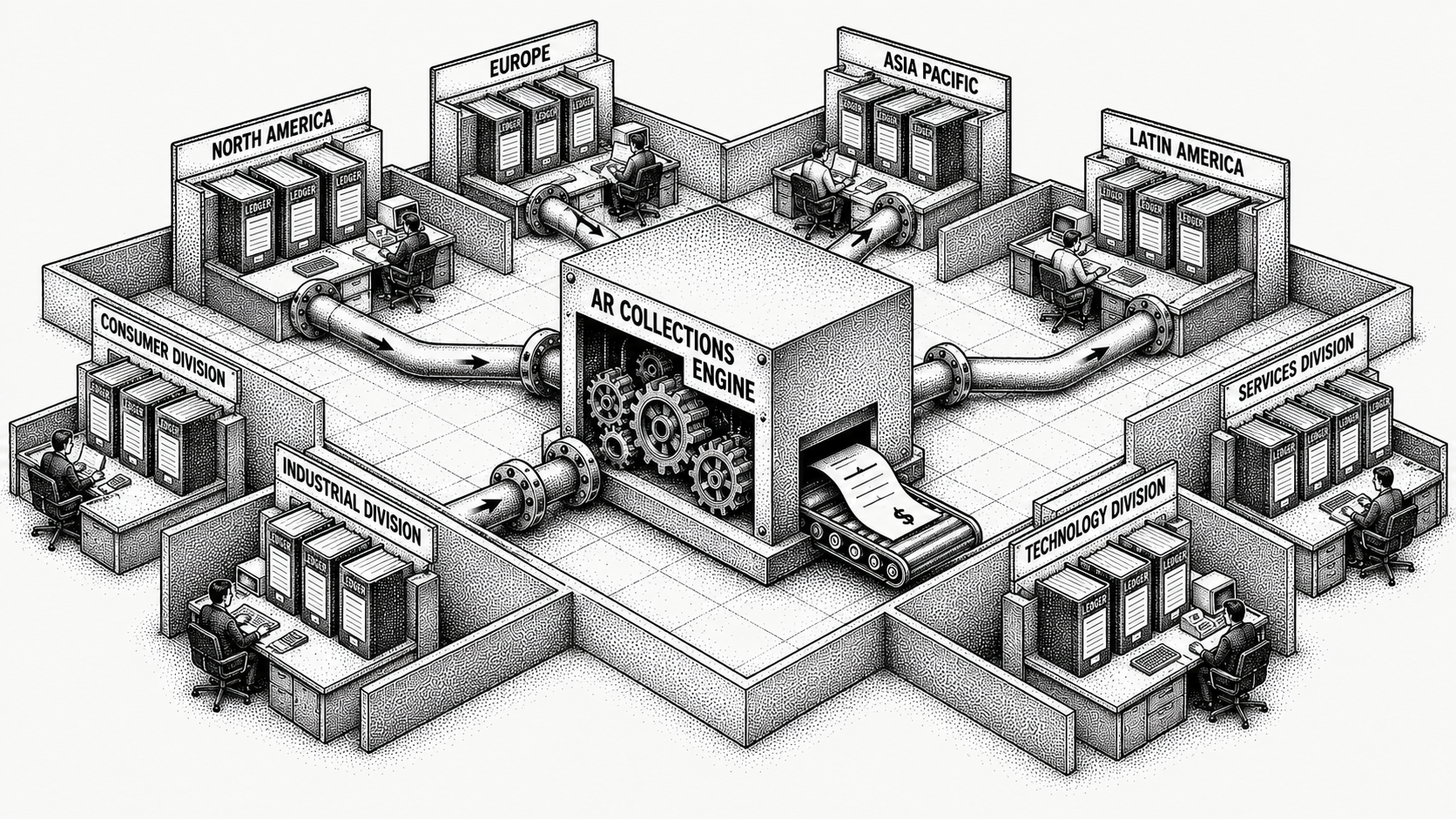
The best enterprise AR automation delivers the scale, security, and control of a traditional collections suite without the six to nine month rollout or the large team needed to run one. For an enterprise finance organization, that means SOC 2 Type II compliant data handling, an auditable record of every action, rules you can set by segment, and cash application that holds up at high volume, all on top of the ERP you already run and live in less than one week. Monk is the AI-native invoice-to-cash platform built to that standard, and this guide covers what to evaluate and where it fits.
Why is enterprise AR different?
At enterprise scale, accounts receivable is a different problem than it is for a small team. Volume runs into the tens or hundreds of thousands of invoices. Customers pay through their own AP portals, each with its own rules. Approval chains are long, segments behave differently, and the finance organization is judged on a clean, board-ready DSO. On top of all of it sits a hard requirement for security, control, and a defensible audit trail.
The legacy answer to that complexity is a heavy collections suite that takes two to three quarters to implement and a dedicated AR team to operate. The cost is not only the license. It is the rollout, the headcount, and the lag before you see any return. The opportunity now is to get the same governance and scale from automation that goes live in days and runs with a lean team focused on exceptions rather than the queue.
What does enterprise AR look like without modern automation?
In a large finance organization without an AI-native layer, collections work is spread across a team of analysts who each own a portfolio. They pull from the aging report, send templated reminders, log into customer portals one at a time, and chase remittance details over email. The work is real, but it scales linearly: more revenue means more analysts, and DSO is only as good as the team's capacity in any given month.
Cash application is its own bottleneck. Remittances arrive in dozens of formats, often decoupled from the payment itself, and the rule-based matching inside most ERPs caps out well short of full coverage. Analysts reconcile the remainder by hand, which delays the moment an invoice is marked paid and clouds the real-time picture of cash. At enterprise volume, even a few points of unmatched cash represents a large unreconciled balance. Modern automation matters because it breaks the link between volume and headcount, holding DSO steady as the business grows.
What to look for in enterprise AR automation
Enterprise buyers should weigh five things that smaller tools rarely satisfy.
SOC 2 compliance and enterprise-grade data handling
Financial data demands a vendor that meets a recognized security standard. SOC 2 compliance, encryption, and clear data-handling controls are table stakes, not extras. Monk is SOC 2 Type II compliant.
White-box traceability
Every action the system takes should be inspectable, with a deterministic check before anything reaches a customer. You need to be able to answer exactly why a given message went out and to whom, on demand, when audit or a customer escalation calls for it.
Segment-level rules and playbooks
A strategic account and a long-tail account should not be chased the same way. The platform should let you define playbooks and cadences by segment, and change them without a consultant. Monk's intelligent collections ingest the context of each conversation and respond more effectively than dunning, adapting tone to a customer's history.
AP-portal submission and cash application at volume
Most enterprise delay lives inside customer AP portals, not in email. The tool should submit to portals like Coupa and Ariba automatically and apply incoming cash accurately, even when remittances arrive in formats an ERP cannot match on its own. Monk reaches an 80% automatic cash application match rate, rising to 95% once teams enable suggested rules.
A go-live measured in days
If the rollout is a project measured in quarters, you carry the cost long before you see the benefit. A modern AR automation platform sits on top of your ERP and is live in less than one week.
Legacy suite versus AI-native automation
The two approaches diverge on the factors that decide total cost and time to value.
| Factor | Legacy enterprise suite | AI-native automation (Monk) |
|---|---|---|
| Time to go live | Six to nine months | less than one week |
| Team to operate | Dedicated AR team | Lean team on exceptions |
| Auditability | Varies by module | White-box on every action |
| AP portal submission | Add-on or manual | Coupa, Ariba, and others automated |
| Cash application | Rule-based, often capped | AI matching, 95% match rate |
| Cost model | License plus implementation | No percentage of collections |
A worked example at enterprise volume
Consider a finance organization carrying 80,000 open invoices across strategic, mid-market, and long-tail segments. Under the manual model, analysts can give real attention to the strategic accounts and a fraction of the mid-market, while the long tail ages on autopilot and the consolidated DSO drifts. Cash application matches the clean remittances and leaves the rest for end-of-month reconciliation, so the real-time cash picture is always a few days stale.
With Monk running the same book, every segment gets a tailored cadence at once. Strategic accounts receive a measured, relationship-aware tone, the long tail gets consistent follow-up it never had, and an 80% automatic cash application match rate, rising to 95% once teams enable suggested rules keeps the aging report current as payments land. The 40% average reduction in DSO is not the result of working the team harder, it is the result of covering the full book and applying cash automatically, which is precisely the leverage mid-market and enterprise volume demands.
How does Monk fit enterprise teams?
Monk is an AI-native invoice-to-cash platform built to enterprise standard. It is SOC 2 Type II compliant, and its AR agent, Julia, runs intelligent collections that ingest the context of replies, submit to AP portals like Coupa and Ariba, and apply cash at volume with full auditability and segment-level control. It sits on top of your ERP, whether NetSuite, Salesforce, QuickBooks, HubSpot, or Stripe, rather than replacing it, and it goes live in less than one week.
Monk manages $2B+ in receivables for its customers, who see a 40% average reduction in DSO and resolve 90% of collections with zero human intervention. Intelligent collections run 24% more effectively than standard dunning, and the platform reaches an 80% automatic cash application match rate, rising to 95% once teams enable suggested rules, which at enterprise volume is the difference between a reconciled book and a large unmatched balance. Subject recovered substantial unbilled revenue and built an AR system of record across hundreds of school districts with Monk. There is no multi-quarter implementation and no need to grow the AR team, as the best accounts receivable automation software shows.
How do you roll Monk out across an enterprise?
Start with one segment or one business unit rather than the whole portfolio. Connect the ERP, let Monk run collections and cash application on that book, and measure the change in DSO against your current baseline. Because go-live takes less than one week, you can prove the result on real receivables inside a single reporting cycle, with white-box logs that satisfy audit from the first day, run as leanly as a small-business finance team.
From there, expansion is a matter of pointing Monk at additional segments, each inheriting the playbooks and controls you have already validated. The pilot does the convincing on real numbers, so by the time the rollout reaches the full book, finance leadership has seen the DSO movement and the audit trail firsthand.
Frequently asked questions
Is Monk enterprise-ready and SOC 2 Type II compliant?
Yes. Monk is SOC 2 Type II compliant and handles financial data to enterprise standard, with encryption and clear data-handling controls. Every action is logged for audit.
How fast is rollout versus a legacy suite?
Monk goes live in less than one week, versus the six to nine months enterprise AR suites typically require. You see DSO movement in the first reporting cycle rather than after a multi-quarter implementation.
Can we control rules by segment?
Yes. You set playbooks and cadences by segment, and Monk's intelligent collections adapt tone to each customer's history. White-box traceability covers every action the system takes.
Does it handle high volume and AP portals?
Yes. Monk runs collections, submits to AP portals like Coupa and Ariba automatically, and applies cash at scale with an 80% automatic match rate (up to 95% with suggested rules). It is built for tens or hundreds of thousands of invoices.
Do we need a large AR team to run it?
No. Monk automates the routine work so your team focuses on exceptions and strategy. That breaks the usual link between rising volume and rising headcount.
How do the alternatives compare?
Enterprise shortlists are usually a choice between depth of configuration and speed to value. Both are defensible, and the honest answer depends on whether you already have a credit department.
| Platform | What it is | Best fit |
|---|---|---|
| Monk | AI-native invoice-to-cash. An agent runs collections and cash application, and it submits into more than 600 corporate AP portals | Enterprises wanting AI-native receivables without a multi-quarter rollout |
| HighRadius | Enterprise order-to-cash suite with deep credit, collections and deductions modules | Organisations with a dedicated credit function and appetite for a longer implementation |
| BlackLine | Financial close and reconciliation platform with AR intelligence and cash application modules | Organisations already using BlackLine for close who want AR in the same environment |
| Esker | Document process automation with mature AR and AP coverage and a long ERP track record | Teams standardised on SAP, Oracle or Microsoft Dynamics |
| Serrala | Broad order-to-cash and treasury coverage for large finance organisations | Enterprises consolidating receivables and treasury together |
| Sidetrade | European order-to-cash platform with strong collections and payment-behaviour scoring | Mid to large enterprises wanting a specialist AR platform with AI depth |
Related reading: Implementing an AR Platform: A 30 Day Roadmap and Best AR Automation for Wholesale & Distribution in 2026.



.avif)