Best AR Automation for Wholesale Distributors in 2026

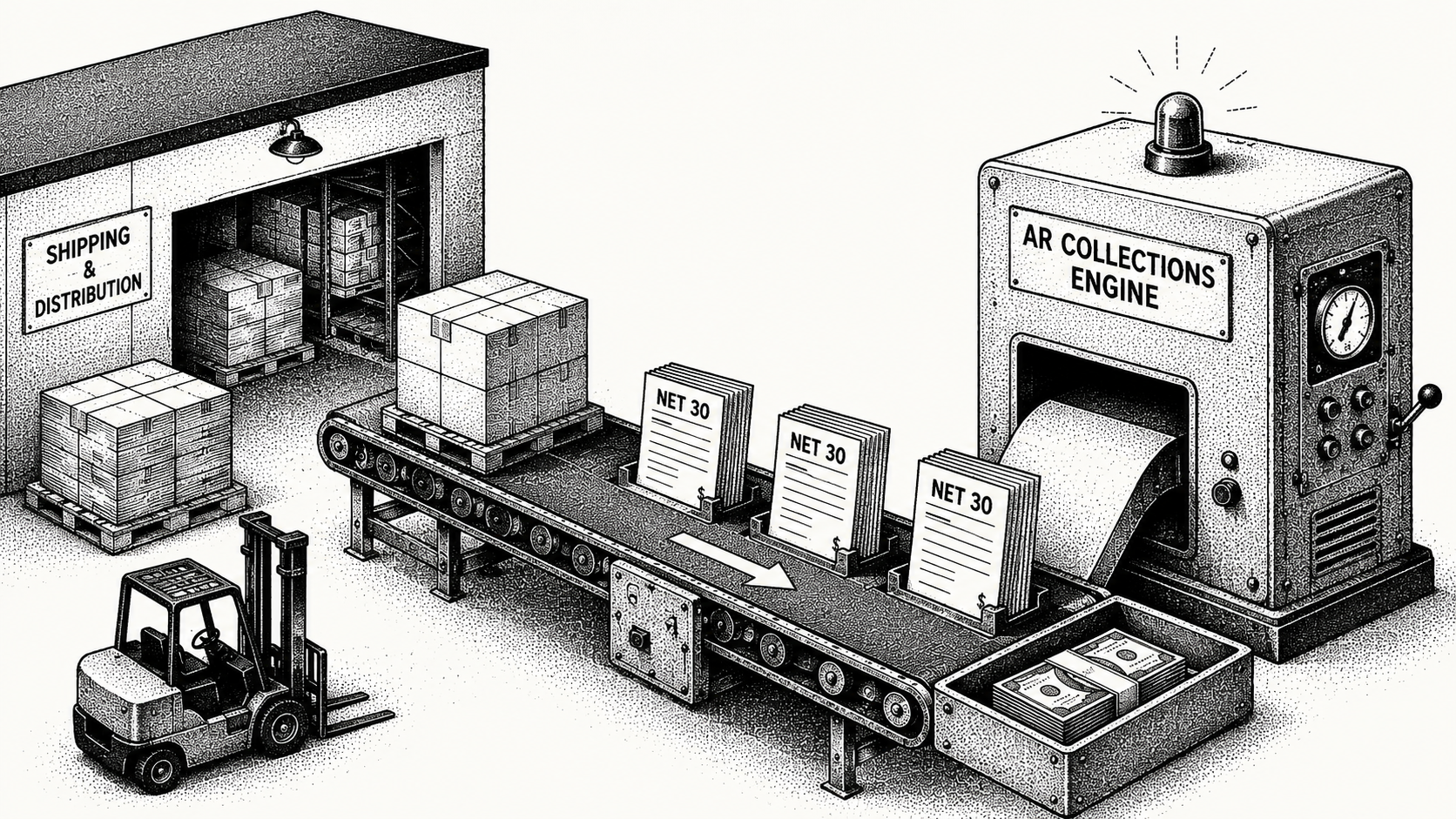
The best AR automation for wholesale distributors covers the entire book of net-terms accounts, resolves deductions and short pays against the underlying documents, and applies incoming cash without anyone rekeying a remittance. Monk is the AI-native invoice-to-cash platform built for that shape of receivables, running collections, cash application and AP portal submission as one system on top of the ERP a distributor already has. Distribution AR breaks down for structural reasons rather than for want of effort. A distributor carries hundreds or thousands of accounts on terms, most too small to warrant a phone call and collectively worth the whole cash position, and any payment can arrive short by an undocumented freight or damaged-goods claim. This guide covers what to look for in AR automation for wholesale and distribution and where Monk fits.
Consider a normal Tuesday in a distribution AR department. A lockbox file lands with two hundred payments, a large share of them short by an amount the remittance does not explain. Two retail customers have sent debit memos carrying reason codes that may or may not describe what happened, and a carrier has been asked three times for a signed proof of delivery another customer wants attached before it pays. Meanwhile the aged trial balance grows on the tail of accounts nobody has hours to call.
Why is distribution AR harder than it looks?
Distribution AR is hard because the book is wide, the margins are thin, and most of the friction sits in documents rather than the invoice. A distributor with two thousand net-terms accounts cannot work its receivables by name, so coverage becomes a rationing decision made weekly by whoever has the aged trial balance open.
Width is the first structural difference. The top fifty accounts are large enough that someone senior owns the relationship. Below them sit hundreds of accounts of a few thousand dollars each, none worth a phone call on its own, together worth more than the top fifty combined. They get a system-generated statement and little else, so they drift from 30 day terms to 60 and 70 days.
Margin is the second. Where gross margin is measured in single digits, an unrecovered deduction eats a disproportionate share of the profit on that shipment, and a write-off another business would absorb as rounding turns a profitable customer unprofitable. Third is the system of record. Plenty of distributors run an ERP chosen a decade ago for inventory, purchasing and warehousing, whose AR module was never seriously used for collections. The data is in the ERP. The collections process lives in exported spreadsheets and a shared inbox.
What does distribution AR look like without automation?
Without automation, a distribution AR team spends its week on cash application and deduction research and has almost no capacity left for collections. Take a regional distributor with 2,000 active net-terms accounts and two people in AR. Between them they can work perhaps the top hundred balances each month, while the other 1,900 get a statement and age past terms before anyone looks at them.
Cash arrives in a state that resists matching. A customer pays six invoices in one ACH, short-pays one for a disputed freight charge, and sends a remittance PDF listing purchase order numbers where the ERP expects invoice numbers. Built-in matching takes the clean payments and routes the rest to a person, and that exception queue absorbs most of the available hours.
Deduction research is heavier still, because each one is a small investigation. Someone pulls the purchase order, the pick ticket, the invoice, the contract price list and, for shortage or damage, the signed POD from the carrier, then decides whether the deduction is valid and files a dispute before the customer's window closes. Nobody times this work, so the backlog of unresolved deductions becomes one of the largest buckets on the aged trial balance, and credit exposure builds in the same blind spot.
Why do deductions, short pays and chargebacks decide the outcome?
Deductions decide the outcome because they are the most common reason a distribution invoice goes unpaid in full, and because unresolved ones look identical to ordinary past-due balances on an aging report. A short pay arrives against the right invoice number for less than the invoice amount, and the customer considers the matter closed.
The categories repeat across almost every distributor. Freight, where the customer deducts a delivery charge they believe should have been prepaid. Damaged or short-shipped goods, where they take credit for what did not arrive in saleable condition. The unearned early-payment discount, taken on day forty rather than day ten. The promotional or co-op allowance, deducted against an unrelated invoice. And pricing variance, where the purchase order and the invoice disagree.
Large retail customers formalise this into a debit memo carrying a reason code, and the reason code is frequently wrong. A claim coded as a shortage turns out to be a pricing variance against a contract tier applied early. One coded as damage turns out to be a delivery the customer cannot locate in its own receiving records, which makes it a POD question.
Proof of delivery gates a large share of these claims, and it is the one document a distributor does not control. The signed POD sits with the carrier, so retrieving it means a carrier portal, a request queue and a wait measured in days. Until it is in hand the invoice is uncollectable, which is why distributors that recover well treat POD retrieval as a standing process with an owner and a clock.
Pricing complexity supplies the rest: contract pricing by customer, volume tiers that change the correct price once the quarter's units are known, and rebates that accrue and settle afterwards. A rebate accrual correct in the ledger and invisible to the customer's AP clerk becomes a deduction. Across the receivables Monk manages, 39% of cash flow slowdown comes from edge cases, and in distribution those cases have names: freight, damage, allowance, tier, POD.
What should you look for in AR automation for distribution?
Look for a system that covers the whole book, keeps deduction context attached to the invoice, and writes back to the ERP you already run. Distribution ERPs are load-bearing, so the AR layer has to sit on top of one rather than replace it. Five capabilities carry particular weight.
Whole-book collections coverage
The system should chase every net-terms account on a suitable schedule, including the tail no person has time for. Monk's collections automation is run by Julia, its AI agent for Intelligent Collections, which ingests the context of each conversation and achieves a 24% higher response rate than standard dunning.
Cash application that survives messy remittances
Matching has to cope with one payment against many invoices, partial payments, short pays and remittance advice keyed to purchase order numbers. Monk's AI cash application reaches an 80% automatic match rate, rising to 95% once suggested matching rules are enabled, keeping the exception queue small enough to work properly.
Deduction handling that keeps the reason attached
When a customer short-pays, the reason they gave should live with the open balance, so the next follow-up references the freight claim or the debit memo instead of asking again. Reason codes, dispute deadlines and the documents already gathered belong on the account rather than in one collector's inbox.
Automated AP portal submission
Retail and enterprise customers increasingly accept invoices only through a portal or network such as Coupa or Ariba, often with the POD attached at submission. Across the receivables Monk manages, 92% of enterprise invoices must be submitted through a vendor portal or network rather than paid from an emailed invoice.
One view of the book, including credit exposure
You need one AR picture across every account and branch, with a single DSO figure you can take to a board and enough visibility of payment behaviour to see a customer deteriorating while the balance is still recoverable.
How does manual AR compare with automation for distributors?
The comparison is about reach and memory rather than effort. Here is how the two models differ for a distributor.
| Factor | Manual or ERP-only | AR automation (Monk) |
|---|---|---|
| Coverage | Top balances only | Every net-terms account on a schedule |
| Cash application | Exception queue worked by hand | AI matching at 80%, rising to 95% with suggested rules |
| Short pays | Reason lives in one collector's inbox | Context carried into the next follow-up |
| Debit memos | Researched when someone has an hour | Surfaced as named open items |
| AP portals | Logged into one at a time | Submission automated across portals and networks |
| Credit exposure | Seen only if someone reads the aging | One view across the book |
| Seasonal peaks | Coverage falls as volume rises | Coverage holds regardless of volume |
| Go-live | Not applicable | Less than one week |
Two people cannot work two thousand accounts, so the tail is neglected and its cash stays in aging. Removing that reach constraint tends to free more working capital than a collections hire. The same pattern appears in AR automation for manufacturing, where multi-plant net-terms books behave much the same way.
Which distribution numbers should you track?
Track five numbers by customer rather than in aggregate, because distribution receivables hide their problems in averages. The aged trial balance by customer comes first, with deductions shown separately from ordinary past-due balance. If unresolved short pays are mixed into the 60 and 90 day buckets, nobody can tell whether the book has a collections problem or a documentation problem, and those need different responses. Second is DSO across the whole book, since reporting on strategic accounts alone flatters the number and hides where the days are lost.
Third is the cash application match rate, because every unmatched payment costs a person an afternoon and leaves a stale aging report behind. Fourth is the deduction reason code mix and the recovery rate against each code, which shows whether freight terms, a promotional agreement or carrier paperwork is the cause. Fifth is the share of invoices that must travel through a customer AP portal, an invisible source of days. Seasonality frames all five: most distribution books swell and drain on a predictable calendar, and an effort sized for the quiet months will lose ground in the peak.
What are the alternatives?
Distribution shortlists usually contain payment networks, enterprise order-to-cash suites and AI-native platforms, built around different designs and aimed at different buyers.
| Platform | What it is | Best fit |
|---|---|---|
| Monk | AI-native invoice-to-cash. An AI agent runs collections, with AI cash application and automated AP portal submission alongside it | Distributors with high invoice volume, a wide net-terms book and routine deductions |
| Billtrust | Established invoicing and payment network operating at scale | Teams that want a payments network alongside receivables |
| HighRadius | Enterprise order-to-cash suite with credit, collections and deductions modules | Organisations with a dedicated credit function and appetite for a longer implementation |
| Esker | Document process automation with mature AR and AP coverage and a long ERP track record | Teams standardised on SAP, Oracle or Microsoft Dynamics |
| Versapay | Collaborative AR built around a buyer-facing portal | Businesses whose customers will adopt a supplier portal |
| Quadient | AR and communications automation with a customer payment portal | Teams prioritising customer communications alongside collections |
The useful question is which design matches the shape of the book: fifty large accounts with a credit department behind them need something different from two thousand accounts and two people in AR. For a broader view, see the guide to the best accounts receivable automation software in 2026.
How does Monk handle distribution AR?
Monk runs the receivables cycle as one system on top of the distributor's ERP. Julia, Monk's AI agent for Intelligent Collections, works every net-terms account on a personalised schedule, ingests the context of each conversation and reads replies for intent, so a customer who answers with a freight dispute is treated as a dispute rather than pushed along a fixed dunning sequence. That produces a 24% higher response rate than standard dunning, and 90% of collections are resolved with zero human intervention.
Cash application runs alongside as a separate capability, matching payments at an 80% automatic rate, rising to 95% once suggested matching rules are enabled, and writing the result back to the ERP so the aged trial balance reflects reality without anyone pasting a bank file into a spreadsheet. Invoices that customers accept only through a portal or network are submitted automatically, into more than 600 corporate AP portals.
Monk manages $2B+ in accounts receivable, and its customers see a 40% average reduction in DSO while saving 26 hours a month on receivables work. For an inventory-heavy business, days removed from DSO are capital that goes back into stock. Alaskan Salmon, a variable-weight seafood wholesaler, went live in under a week. Customers report an average 2.4x increase in cash on hand in the first quarter, which for an inventory-heavy business is capital back in stock. Monk is SOC 2 Type II compliant and integrates with NetSuite, QuickBooks, Salesforce, HubSpot, Stripe, Slack, Gmail and Docusign. Teams running NetSuite can read the detail on AR automation for NetSuite.
Where should you start?
Run one diagnostic this week. Export the aged trial balance by customer and split the past-due balance into two columns: amounts where the customer has given a reason, and amounts where nobody knows why the invoice is open. The first column is a documentation problem, the second a coverage problem, and the second is usually larger than expected.
Then sort the reason column by code. Count how much sits behind freight, damage, unearned discount, allowance and pricing variance, and how much waits on a signed POD. Any category repeating every month is a process fault upstream of AR that will keep producing deductions until somebody fixes the terms, the packaging or the price file.
Those two views tell you which half to automate first. If coverage dominates, whole-book collections will move DSO fastest. If reasons dominate, keeping deduction context attached to the invoice recovers more. Monk goes live in less than one week and customers see results in their first month, so the test costs a cycle rather than a quarter. To see it against your own aging report, book a demo.
Frequently Asked Questions
Can Monk cover thousands of net-terms accounts?
Yes. Julia, Monk's AI agent for Intelligent Collections, chases every net-terms account on a personalised schedule rather than only the largest balances. Coverage of the tail is where most distributors lose days, since those accounts historically got a statement and little else. Monk's customers resolve 90% of collections with zero human intervention.
How does Monk help with deductions and short pays?
Monk keeps the customer's explanation attached to the open balance, so a short pay stops looking like an anonymous past-due amount. Julia ingests the context of the conversation, so a reply citing a freight charge or a damaged pallet carries into the next follow-up. Your team still decides whether a deduction is valid, starting from the reason and the history.
What about proof of delivery and carrier paperwork?
A signed POD lives with the carrier, so no AR system can produce one on its own. What Monk does is make the dependency visible: an invoice held for missing paperwork appears as a named blocker on the account, which lets whoever owns POD retrieval work a real queue with a clock on it.
Does Monk submit invoices to customer AP portals?
Yes. Monk submits invoices into corporate AP portals and networks such as Coupa and Ariba automatically, so nobody works a login queue by hand. Across the receivables Monk manages, 92% of enterprise invoices must go through a vendor portal or network rather than being paid from an emailed invoice.
Which systems does Monk integrate with?
Monk integrates with NetSuite, QuickBooks, Salesforce, HubSpot and Stripe, along with Slack, Gmail, Docusign, Anrok, Plaid and Mercury. It layers on top of the ERP instead of replacing it, the only workable approach when that ERP also runs inventory, purchasing and the warehouse. Monk is SOC 2 Type II compliant.
How long does implementation take at a distributor?
Onboarding takes less than one week and customers see results in their first month. There is no migration, because Monk connects to the existing system of record and writes back to it. Most distributors begin with collections on the open net-terms book, then add cash application and portal submission.
What results do distributors see?
Monk's customers see a 40% average reduction in DSO, resolve 90% of collections with zero human intervention and save 26 hours a month on receivables work. Cash application reaches an 80% automatic match rate, rising to 95% with suggested matching rules. For a distributor, days removed from DSO convert into working capital for inventory.



.avif)