Best AR Automation for Manufacturers in 2026

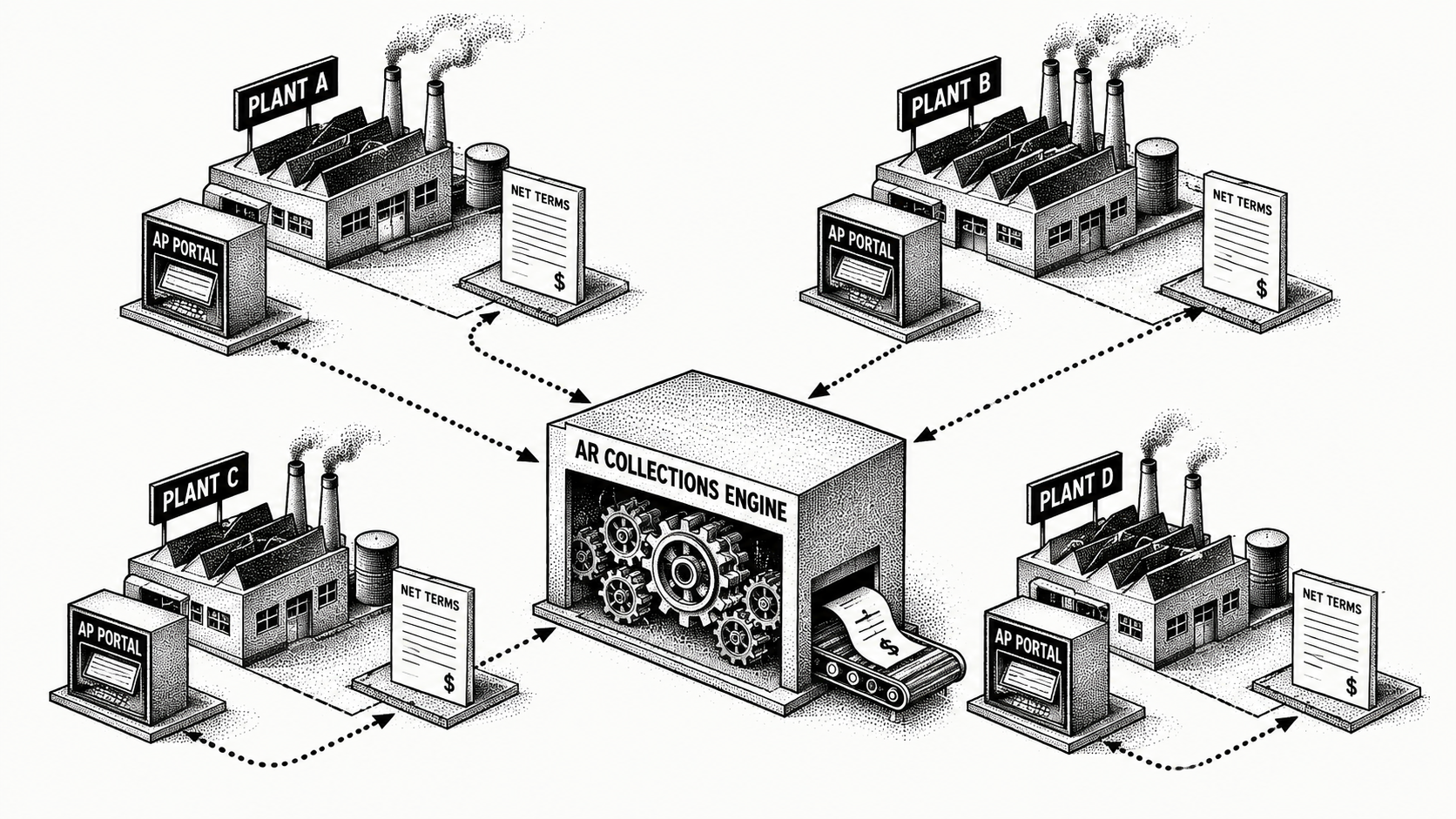
The best AR automation for manufacturers handles the receivable that a large customer controls rather than the one you issued. That means submitting through the AP portal the customer mandates, surviving a three way match against their purchase order and receipt, resolving the deductions and chargebacks that arrive as short payments with cryptic reason codes, and rolling multiple plants into one view of what is collectible. Monk does this as one invoice-to-cash system, running invoicing, AP portal submission, AI cash application, dispute handling at line level, and Intelligent Collections against the same customer record.
Manufacturers are unusual in how little control they have over their own cash cycle. Terms are dictated by the buyer, submission happens on the buyer's platform, payment is validated against the buyer's receiving records, and a meaningful share of every remittance is withheld under the buyer's compliance programme. A finance team of three can be reconciling against the procurement systems of forty companies, none of which they can change.
Why do deductions and chargebacks dominate manufacturing AR?
Because large buyers do not dispute invoices, they pay them short and send a code.
When you sell into retail, distribution or large OEM customers, the remittance advice routinely pays less than the invoice and cites a reason: a shortage on receipt, a pricing variance against the contract, a late or incomplete delivery under an on time in full programme, a damaged carton, an unearned discount taken anyway, a co-op advertising allowance, a returns authorisation, or a freight term applied differently than you applied it. Each is a separate claim, each has its own supporting evidence, and each has its own deadline for challenge.
The volume is the problem rather than the size. A single deduction is usually small enough that challenging it costs more than it recovers, which is precisely why deduction programmes work for the buyer. Across a year, on a book of business with several large accounts, the aggregate is substantial and a large share of it is invalid or duplicated. Manufacturers who research deductions systematically recover a meaningful fraction; manufacturers who do not write them off at period end and treat the loss as a cost of doing business with that customer.
What this asks of an AR system is specific. A short payment has to be applied to the invoice with the difference isolated against the line it relates to, coded to a deduction reason, assigned to an owner, and given a challenge deadline. Leaving the payment unapplied because it does not match, which is the default behaviour in most accounting systems, hides the entire problem inside an aging report that no longer means anything.
Why does the invoice fail the customer's three way match?
Because three systems have to agree, and only one of them is yours.
Large buyers pay against a match between their purchase order, their goods receipt and your invoice. If the unit price on your invoice differs from the price on their PO by any amount, the invoice is held. If you shipped 980 units against an order for 1,000 and invoiced for 980, but their receiving scanned 960, the invoice is held. If the PO line references a part number you have since superseded, the invoice is held. If the PO has been closed or the funds released against it have been exhausted, the invoice is held.
None of these are disputes in any ordinary sense. The buyer is not refusing to pay and often does not know the invoice is stuck. It sits in an exception queue inside their procure to pay system waiting for a buyer to look at it, and buyers look at exception queues when they have time.
The consequential detail is that a price variance is frequently correct on your side. Contract escalators, surcharges, index linked raw material adjustments and freight recovery all produce an invoice price that legitimately differs from a PO raised months earlier. Being right does not release the payment. Someone has to attach the contract clause and the calculation to the exception, and that person needs to know the exception exists, which they usually learn when the invoice ages past terms.
Why do on time in full penalties behave differently from other deductions?
Because they are assessed by rule against data you do not hold, and they compound.
On time in full programmes charge a supplier a percentage of the order value when a delivery misses a specified window or arrives incomplete. The measurement is taken from the buyer's receiving scan, not from your carrier's proof of delivery, and the two disagree more often than either party expects. A truck that arrived inside the appointment window but was unloaded the next morning can be recorded as late. A pallet counted short at receiving and later found on the dock can generate a shortage deduction that is never reversed unless you ask.
These charges are levied automatically, applied against the next remittance, and accompanied by a scorecard that determines your standing as a supplier. That second effect is why manufacturers under-challenge them. Contesting a charge feels like contesting the relationship, so teams absorb charges they could reverse with a carrier document.
The practical discipline is to treat every compliance charge as a claim with evidence and a deadline rather than as a scorecard outcome. Pull the carrier's proof of delivery and appointment record, compare it against the buyer's assessment, and challenge in the window. The recovery rate on well evidenced challenges is high, and the cases you cannot support are worth knowing about too, because they point at a real operational problem upstream.
What happens to cash when you run multiple plants on one customer?
Payments arrive at the group and nobody can tell which plant they belong to.
Manufacturers with several sites commonly invoice a national customer from more than one location, sometimes on separate ledgers and occasionally on separate ERP instances. The customer, reasonably, pays once. A single wire covering nineteen invoices raised by three plants arrives with a remittance file that references the customer's own document numbers rather than yours.
Two failures follow. Cash sits unapplied while someone works out the split, which means the aging report overstates what is outstanding and every collections conversation starts from a number the customer knows is wrong. And credit exposure becomes invisible, because each plant sees its own slice of a customer whose total balance and payment behaviour only exist when the slices are added together. Plants keep shipping to accounts that are stretching badly at group level.
Consolidating this is not a reporting exercise. It requires matching at the line level against a customer hierarchy, so that one payment can settle invoices raised by different entities and the resulting exposure is visible at both the plant and the parent. Without it, multi-site manufacturers run credit decisions on partial information.
Why do buyers insist on portal submission, and what does it cost you?
Because it moves the administrative burden onto the supplier, and it costs you the invoices that never arrive.
Most large industrial and retail buyers now require invoices through Coupa, SAP Ariba, SAP Business Network, Tungsten, Taulia or their own supplier platform, or through EDI 810 transactions with 820 remittance coming back. Each has its own required fields, its own attachment rules, its own tolerance for a PO reference that does not match exactly, and its own submission behaviour on failure.
The behaviour on failure is the expensive part. A portal rejection is frequently silent. The invoice does not enter the buyer's system, no exception is raised on their side, and your ERP shows the invoice as issued. It ages normally in your aging report while not existing anywhere in the buyer's. Teams discover it when they chase at sixty days and are told there is no record of the document.
The cost is also cumulative in labour. Submitting to forty portals, each with its own credentials, two factor requirements and field mappings, is a multi-day task every month that produces nothing except the ability to be paid. It is the clearest candidate for automation in the whole function, because it is high volume, entirely rule based, and the failure mode is invisible.
What are the alternatives?
The platforms below come up repeatedly when manufacturers evaluate this category. They are genuinely different products aimed at different buyers.
| Platform | What it is | Best fit |
|---|---|---|
| Monk | AI-native invoice-to-cash platform covering invoicing, AP portal submission, AI cash application, dispute and deduction handling at line level, and Intelligent Collections with a separate Voice Collections product | Manufacturers who want portal submission, short pay research and collections running on one customer record across multiple plants |
| Billtrust | Established order-to-cash suite spanning electronic invoice delivery, payments, credit, cash application and collections, with a mature business payments network | Mid-market and enterprise manufacturers who value breadth of invoice delivery channels and payment acceptance inside one suite |
| HighRadius | Enterprise order-to-cash and treasury software with deep cash application, deductions and collections modules and extensive configurability | Large manufacturing groups with a dedicated deductions team and appetite for an enterprise implementation |
| Esker | Cloud platform covering source-to-pay and order-to-cash with strong document process automation and electronic invoicing compliance across countries | Manufacturers operating across multiple countries who want document capture, AP and AR automation in one suite |
| Versapay | AR automation built around a shared portal where buyers and suppliers view invoices, raise questions and resolve them in the same place, with integrated payments and cash application | Teams whose main friction is back and forth with customers over invoice detail and who want that conversation in a collaborative portal |
| Quadient | AR and AP automation with collections workflow, aging dashboards and payment behaviour analytics, offered alongside a broader customer communications portfolio | Finance teams who want structured collections workflow and clear AR reporting without a heavy enterprise build |
Evaluate against your own worst month rather than a requirements matrix. Take a remittance that paid nineteen invoices short with four deduction codes, an invoice held for three weeks on a price variance you could justify in one email, and a submission that was rejected by a portal and noticed at sixty days. Make every vendor walk through those three artifacts. How a product behaves on your actual documents tells you far more than how it describes itself.
How does Monk handle this?
Monk treats the manufacturing receivable as a chain that runs from submission through short pay research to collection, and automates each link rather than automating the reminder at the end.
On submission, Monk gets the invoice into whatever portal the customer requires with the fields and attachments that portal demands, so a rejection surfaces immediately rather than at sixty days. An invoice that was not correctly lodged was never submitted, whatever your ERP shows, and closing that gap removes an entirely administrative category of loss.
On cash, AI cash application matches payments to invoices at an 80% automatic match rate, rising to 95% with suggested matching rules, and where a payment arrives short it isolates the difference against the specific invoice line rather than leaving the whole payment unapplied. In manufacturing that behaviour is the core of the product rather than a convenience, because the short payment with a deduction code is the standard remittance rather than the exception. Isolating the difference turns a write-off into a claim with an owner and a deadline. It matters more broadly because 39% of cash flow slowdown is caused by edge cases, and here the edge cases are a compliance charge, a pricing variance, a shortage claim, an unearned discount and one wire settling invoices from three plants.
On outreach, Julia, Monk's AI agent for Intelligent Collections, ingests the context of the conversation and responds to what the customer actually said rather than advancing a fixed dunning sequence. Julia reaches customers with a 24% higher response rate than standard dunning, and 90% of collections are resolved with zero human intervention. That distinction earns its keep when the reply is "this is sitting in an exception queue pending buyer approval", which is a status rather than a refusal and should not trigger another reminder. Voice Collections is a separate product that places and receives calls about overdue invoices from the same customer record, which is useful when a customer's AP team will pick up the phone but will not answer email.
The aggregate effect Monk sees across its customer base is a 40% average reduction in DSO and 26 hours a month saved on receivables work. Monk has $2B+ in accounts receivable under management, is SOC 2 Type II compliant, and integrates with QuickBooks, NetSuite, Salesforce, HubSpot and Stripe. Onboarding takes less than one week and customers see results in their first month, which counts for a lot in a business where the AR function is usually two or three people covering several plants.
Where should you start?
You do not need a platform decision to make progress this quarter. You need to know how much of your revenue is being retained by customers under deduction programmes, and most manufacturers cannot state the figure.
Take twelve months of remittances and total the difference between invoiced and paid, split by customer and by reason code. Then take a sample of each reason code and establish what proportion is valid. The output is two numbers that change how you run the function: total deductions as a percentage of revenue, and the recoverable share. Teams doing this for the first time regularly find the recoverable share is large enough to fund the work several times over.
Then check three structural things. Whether any invoice submitted to a customer portal in the last six months was rejected without anyone noticing for more than two weeks. Whether a single customer's balance and payment behaviour can be seen across all plants that invoice them. And whether every compliance charge in the last quarter was either challenged or consciously accepted, rather than absorbed by default.
When you compare vendors, bring the artifacts rather than the requirements document. If your problem is short payments with reason codes, invoices held on three way match exceptions, silent portal rejections and cash you cannot split across plants, that is the shape Monk is built for. See AR automation for manufacturing or book a demo and walk through a real remittance rather than a feature list.
Frequently Asked Questions
What is AR automation for manufacturers?
It is software that manages the receivable a large customer controls: submitting through their required AP portal, surviving their three way match, resolving the deductions and chargebacks that arrive as short payments, and consolidating cash and credit exposure across plants. Monk covers submission, cash application, line level dispute handling and Intelligent Collections in one invoice-to-cash system.
Why do manufacturers get so many short payments?
Because large buyers operate deduction programmes rather than raising disputes. Shortages, pricing variances, compliance charges, damage claims, unearned discounts, allowances and freight differences are deducted automatically from the remittance and cited by code. Individually each is small enough to ignore; in aggregate they are significant, and a meaningful share is invalid or duplicated.
What is a three way match and why does it hold my invoices?
It is the buyer's check that your invoice agrees with their purchase order and their goods receipt. Any difference in price, quantity or part reference sends the invoice to an exception queue rather than to payment, and nobody is notified. Price variances are frequently correct on the supplier side because of contract escalators or surcharges, but being right does not release the payment until the justification is attached to the exception.
Should we challenge on time in full and other compliance charges?
Where you have evidence, yes, and within the stated window. These charges are assessed from the buyer's receiving data rather than your carrier's records, and the two disagree often enough that well evidenced challenges succeed at a high rate. Charges you cannot support are still worth identifying, since they point at a real operational issue rather than a measurement error.
How should deductions be recorded in the ledger?
Apply the payment and isolate the difference against the specific invoice line with a reason code, an owner and a challenge deadline. The common alternative, leaving the whole payment unapplied because it does not balance, overstates the aging, makes every collections call start from a wrong number, and hides the deduction until someone writes it off at period end.
Can one customer be managed across multiple plants?
Only if invoices, payments and credit exposure resolve to a customer hierarchy rather than to a site ledger. National customers pay once for invoices raised by several plants, so without a hierarchy the cash is hard to apply and each site sees only part of the exposure. That is how plants keep shipping to accounts that are stretching badly at group level.
How long does it take to implement AR automation in a manufacturer?
With Monk, onboarding takes less than one week and customers see results in their first month. The realistic constraint is customer setup rather than software: identifying which buyers require which portal, with which credentials and field mappings. Manufacturers who start with their ten largest accounts by deduction volume tend to see value fastest.



.avif)