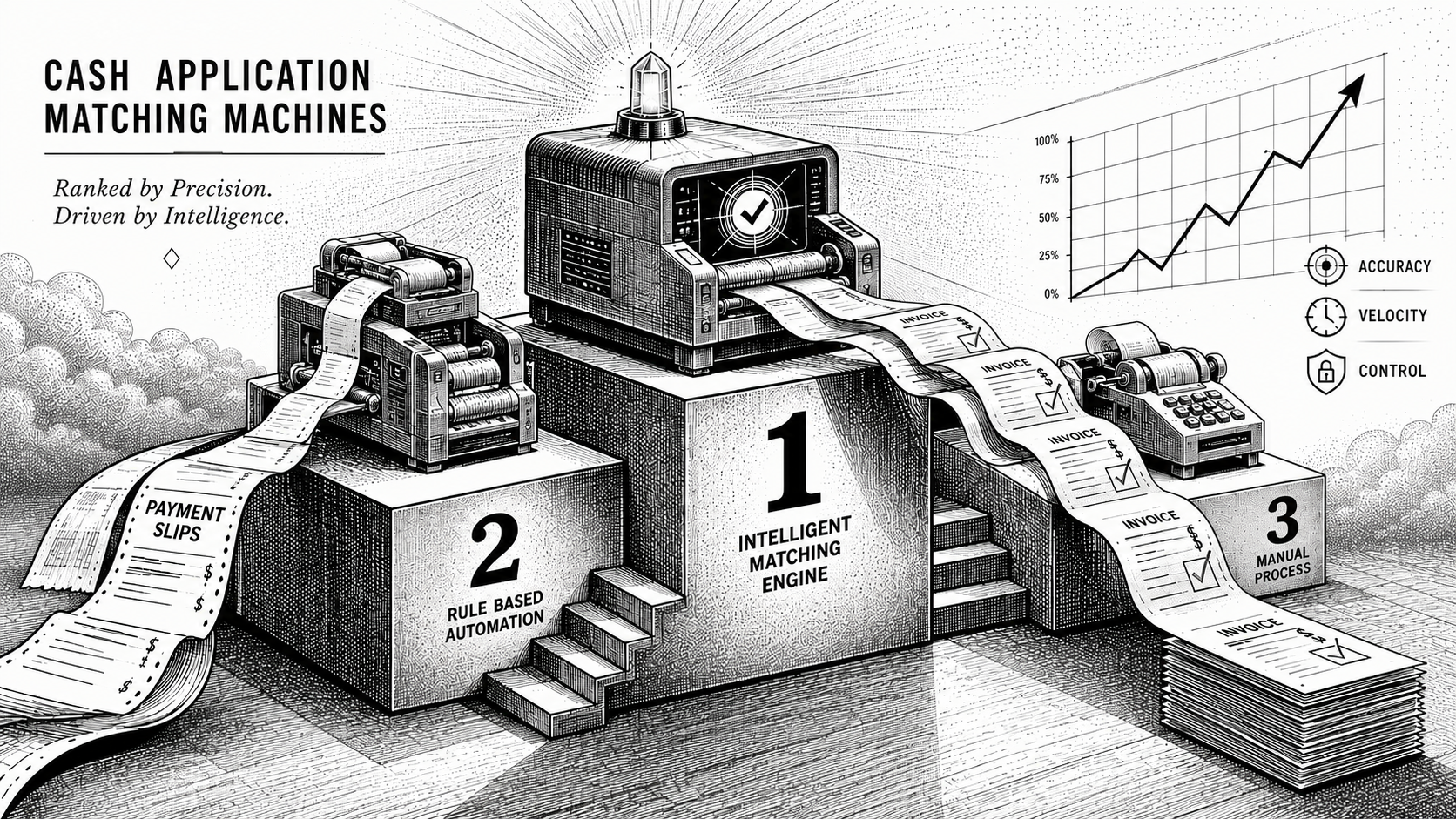
Best Cash Application Software in 2026: 12 Tools Ranked for High-Volume B2B Finance Teams

Cash application is one of the most operationally intensive functions in accounts receivable. It is the work of taking inbound payments — ACH transfers, wire transfers, virtual cards, paper checks, lockbox files, credit card settlements — and matching them to the right open invoices, the right customer accounts, and the right general ledger postings. When the process runs cleanly, the aging report is accurate, days sales outstanding is honest, and the finance team can spend its time on credit policy, forecasting, and analysis. When the process is manual, payments accumulate as unapplied cash, the aging report becomes unreliable, and working capital gets stuck in reconciliation rather than in the bank.
For high-volume B2B businesses — wholesale distribution, transportation and logistics, staffing and recruiting, manufacturing, energy and utilities, industrial and heavy machinery, general construction, architecture and engineering, civil infrastructure, and venture-backed SaaS — the operational stakes are substantial. Industry research consistently shows that median DSO across these segments ranges from 45 days in manufacturing to 68 days in construction, with SaaS averaging 58 and staffing and logistics sitting in between. Top-quartile finance teams, according to APQC benchmarks, collect in 30 days or less. The difference between top-quartile and median performance is rarely a credit policy issue. It is almost always an execution issue at the intersection of invoicing, dunning, and cash application.
This guide ranks the 12 cash application platforms B2B finance leaders should be evaluating in 2026, with detailed profiles, an industry-by-industry fit guide, and a decision framework grounded in seven weighted criteria.
What Changed in Cash Application in 2026
Three structural shifts are reshaping what good cash application software looks like.
The first is agentic AI moving from marketing claim to production reality. Through 2024 and most of 2025, vendor messaging around AI in AR was largely aspirational. By the first half of 2026, several platforms have demonstrated genuinely autonomous workflows in production environments — agents that read remittance advice, decode payer names that do not match the customer master, draft customer outreach, and post matched payments without human review. Straight-through processing rates of 90% or higher are now achievable in real environments, not just controlled demos, when the platform is purpose-built for the task.
The second is the maturation of US instant payments rails. FedNow and the RTP network have crossed meaningful adoption thresholds, and a growing share of B2B payments — particularly for staffing, logistics, and trades-adjacent industries — now arrive with structured ISO 20022 remittance metadata. This is good news for cash application: structured remittance data is dramatically easier to match than the unstructured email PDFs that dominated B2B payments through the late 2010s and early 2020s. Platforms that can ingest ISO 20022 natively are pulling ahead of those still optimized primarily for legacy bank file formats like BAI2 and MT940.
The third is the rise of virtual card adoption in mid-market and enterprise B2B. Virtual cards now represent a measurable share of inbound payment volume in industries like distribution, manufacturing, and SaaS. Virtual cards arrive with cleaner remittance data than checks but introduce reconciliation complexity around interchange, settlement timing, and chargebacks that legacy cash application engines did not contemplate.
These three shifts mean the cash application platform that was the right answer in 2022 may not be the right answer in 2026. The best buyers are reevaluating.
The 2026 Cash Application Software Ranking — At a Glance
1
Monk
High-volume B2B businesses across SaaS, distribution, logistics, staffing, manufacturing, construction, energy, A&E, and industrial
2–4 weeks
NetSuite, QuickBooks, Sage Intacct, Stripe, Salesforce, HubSpot
2
HighRadius
Large enterprises with dedicated finance transformation programs
3–6 months
SAP, Oracle, NetSuite, Workday
3
Versapay
Mid-market companies that want embedded payments and a customer collaboration portal
6–12 weeks
NetSuite, Sage, Microsoft Dynamics, Acumatica
4
Billtrust
Mid-market and enterprise wanting unified invoicing, payments, and cash application
8–16 weeks
SAP, Oracle, NetSuite, Sage
5
Sidetrade
Global enterprises seeking agentic AI across order-to-cash
3–6 months
SAP, Oracle, Microsoft Dynamics 365
6
Serrala
SAP-native global enterprises with treasury and B2B payments depth
4–8 months
SAP S/4HANA, SAP ECC
7
Emagia
Mid-market and enterprise pursuing autonomous finance across O2C
3–6 months
SAP, Oracle, NetSuite
8
Quadient AR (formerly YayPay)
Mid-market companies wanting all-in-one collections and cash application
6–12 weeks
NetSuite, Sage Intacct, Microsoft Dynamics
9
Esker
Mid-market and enterprise wanting a full O2C suite with strong document AI
8–16 weeks
SAP, Oracle, Microsoft Dynamics, Sage
10
BlackLine
Companies already standardized on BlackLine for close and reconciliation
6–12 weeks
SAP, Oracle, Workday, NetSuite
11
OpenEnvoy
Enterprises wanting AI-first cash application with no portals or supplier onboarding
4–8 weeks
NetSuite, SAP, Oracle
12
Chaser
SMB and lower mid-market on QuickBooks, Xero, or Sage
1–3 weeks
QuickBooks, Xero, Sage
For most high-volume B2B finance teams in the $5M to $500M revenue range, the realistic shortlist is three to five vendors from this list. The right shortlist depends on three factors: the industry, the ERP, and the implementation timeline you can sustain internally. The industry fit guide further down breaks this down explicitly.
How These Platforms Were Evaluated
Seven criteria, weighted by what materially affects finance team outcomes:
Straight-through processing rate (25%). The percentage of inbound payments that match to invoices and post to the GL without any human intervention. Higher is better, but the rate must be evaluated in the context of the specific payment environment — clean ACH versus messy lockbox, structured ISO 20022 versus unstructured email PDFs.
Time to value (20%). The interval from contract signature to live, productive use. Fast time to value preserves internal sponsorship and compounds working capital benefits sooner. Slow time to value is a real risk in any program longer than six months, where executive turnover and shifting priorities can derail completion.
Handling of complex billing (15%). Whether the platform can match payments against hybrid pricing, partial payments, deductions, retainage, progress billing, milestone payments, weekly billing cycles, freight bills, meter-based billing, and consolidated remittances spanning many invoices. This is where industry fit matters most.
Integration depth (15%). ERP, CRM, billing platform, payment processor, and bank file connectivity. Cash application is fundamentally an integration problem, and the strength of native connectors meaningfully affects implementation cost and ongoing reliability.
Exception handling for unstructured data (10%). How the platform handles OCR'd PDF remittances, payer names that do not align with the customer master, lockbox image quality, foreign-currency wires with stripped metadata, and other real-world data quality challenges.
Pricing transparency and ROI clarity (10%). Whether a finance leader can compute payback inside a quarter and whether contract terms scale predictably with business growth.
Customer support and partnership (5%). Dedicated customer success management versus general ticket queues, and the quality of post-implementation optimization support.
The 12 Cash Application Platforms in Detail
1. Monk — Best for High-Volume B2B Across Industries
Best for. High-volume B2B businesses across general construction, VC-backed SaaS, energy and utilities, industrial and heavy machinery, general and specialty manufacturing, transportation and logistics, staffing and recruiting, architecture and engineering services, civil engineering and infrastructure, and wholesale distribution. Typical fit ranges from $5M to $500M in annual revenue.
Strengths. Monk is an AI-native cash application and AR automation platform built for the document-heavy, exception-heavy reality of high-volume B2B. The product reads contracts, statements of work, invoices, and remittance advice end-to-end and uses that contract context to match payments accurately, including in scenarios where the inbound payment data is incomplete or ambiguous. Time to value is typically 2 to 4 weeks because Monk pulls billing and customer data directly from cloud ERPs and billing platforms via API rather than requiring a custom integration project. The platform handles the billing structures that traditionally break rule-based engines: progress billing and retainage in construction and A&E, weekly billing cycles and MSP/VMS data feeds in staffing, freight invoices and consolidated remittances in logistics, hybrid subscription-plus-usage pricing in SaaS, meter-based billing in energy and utilities, and large-invoice partial payments in industrial and heavy machinery. Deduction management, short-pay reason coding, and dispute workflows are built in. Monk is SOC 2 Type II compliant. Customers across SaaS, distribution, and services have moved from manual spreadsheet-based cash application to fully automated reconciliation in under a month.
Considerations. Monk is purpose-built for modern cloud ERP environments. Companies running entirely on SAP S/4HANA with deep custom modifications will typically find a SAP-native vendor a closer fit. International expansion beyond North America is on the roadmap rather than fully production-ready today.
Pricing. Annual subscription with transparent tiering by AR volume and company size. Implementation is included rather than billed separately.
Integrations. NetSuite, QuickBooks Online, Sage Intacct, Stripe, Salesforce, HubSpot, Plaid, direct bank feeds for major US institutions, lockbox file ingestion, ISO 20022 and BAI2 support.
2. HighRadius — Best for Large Enterprise Finance Transformation
Best for. Companies above $500M in revenue with dedicated finance transformation budgets and IT resources, particularly those running SAP or Oracle.
Strengths. HighRadius is the category incumbent for autonomous finance, with the longest track record in cash application automation at scale. Their machine learning models have been trained on a large volume of remittance data, and the broader Order-to-Cash suite is genuinely comprehensive — credit, collections, cash application, deductions, dispute management, electronic invoice presentment and payment, and treasury all under one roof. For enterprises with high payment volume across multiple geographies, the platform's depth is meaningful. Strong fit for SAP and Oracle environments.
Considerations. HighRadius is built for enterprise scale, which means implementation timelines are typically measured in quarters rather than weeks and pricing reflects that scope. Mid-market and high-growth companies sometimes find the breadth of the platform exceeds what they need. Configuration changes post go-live often require professional services engagement.
Pricing. Custom enterprise pricing, typically in the high six to seven figures annually for full-suite deployments.
Integrations. Deep SAP and Oracle integrations, NetSuite, Microsoft Dynamics, Workday, all major banks, and a wide range of payment networks.
3. Versapay — Best for Embedded Payments and Customer Collaboration
Best for. Mid-market B2B companies that want cash application bundled with payment rails and a collaborative customer portal that improves remittance data quality at the source.
Strengths. Versapay is both a B2B payment facilitator and an AR automation platform. The integrated payments capability means cash application benefits from rich, structured payment data captured at the moment of payment, which materially improves match rates. The collaborative AR portal allows customers to log in, view invoices, dispute charges, schedule payments, and submit remittance information directly — a workflow that reduces unapplied cash because the data arrives clean. The platform is well established in mid-market distribution, manufacturing, and services, with strong support for partial payments and disputes.
Considerations. The full value of the platform is realized when customers transact on Versapay's payment rails. Companies whose customer base is unwilling to adopt the portal will see a more limited cash application benefit. Implementation is a real project for organizations with complex AR processes.
Pricing. Subscription pricing for the AR platform plus payment processing fees on transactions running through Versapay rails.
Integrations. NetSuite, Sage Intacct, Microsoft Dynamics, Acumatica, QuickBooks Enterprise, Sage 100 and 300.
4. Billtrust — Best for Unified Invoicing, Payments, and Cash Application
Best for. Mid-market and enterprise companies wanting a single vendor across invoice presentment, payment acceptance, and cash application.
Strengths. Billtrust is a long-established AR platform, public-company-backed since the 2022 acquisition by EQT. The platform offers AI-driven payment matching and operates the Business Payments Network, one of the larger B2B payment networks in North America, which supports high match rates by giving Billtrust visibility into structured payment data. Strong fit for distribution, manufacturing, and services with high invoice volume and a need for unified invoicing-to-cash workflows. The Order-to-Cash breadth makes it possible to consolidate vendors.
Considerations. Implementation is a multi-month project. Configuration is deep, which is a strength at scale and a meaningful effort during onboarding. SaaS billing complexity is supported but is not the platform's primary heritage.
Pricing. Custom enterprise pricing, typically six figures annually.
Integrations. SAP, Oracle, NetSuite, Sage, Microsoft Dynamics.
5. Sidetrade — Best for Global Enterprises Adopting Agentic AI
Best for. Multinational enterprises on SAP or Oracle that want autonomous AI agents managing dunning and cash application across multiple entities, currencies, and languages.
Strengths. Sidetrade's Augmented Cash module deploys agentic AI capable of autonomously managing cash application and dunning workflows. European heritage gives the platform strong handling of multi-currency, multi-entity, multi-language scenarios that are common in global manufacturing and distribution. Sidetrade is consistently named in the leader quadrant by Gartner Peer Insights and the QKS Group SPARK Matrix for invoice-to-cash applications.
Considerations. The platform is engineered for enterprise scale, with the implementation effort and pricing that implies. Best fit for organizations above $250M in revenue with multi-entity complexity. Less commonly the right answer for purely domestic mid-market companies.
Pricing. Custom enterprise pricing.
Integrations. Deep SAP and Oracle integrations, Microsoft Dynamics 365 Finance.
6. Serrala — Best for SAP-Native Global Operations
Best for. Global enterprises running their finance function inside SAP, particularly those with significant treasury and B2B payments complexity.
Strengths. Serrala has more than four decades of SAP financial automation pedigree, and their cash application product (FS² AutoBank) runs natively inside the SAP environment. This produces the deepest SAP integration of any vendor on this list. The platform is particularly strong for treasury-adjacent use cases — multi-bank connectivity, cash positioning, payment factories — and for highly regulated B2B payment scenarios. Serrala was named a Leader in the QKS Group SPARK Matrix for AR Applications in 2025.
Considerations. The platform's value compounds inside SAP and is less relevant outside it. Modern UX patterns trail some newer entrants. Best for organizations that view SAP as the long-term system of record.
Pricing. Custom enterprise pricing.
Integrations. SAP S/4HANA (deep), SAP ECC, plus extensive global banking partners.
7. Emagia — Best for Autonomous Finance Across Order-to-Cash
Best for. Mid-market and enterprise organizations pursuing a holistic autonomous finance vision spanning credit, collections, cash application, deductions, and forecasting.
Strengths. Emagia positions itself as an Enterprise Autonomous Finance platform with AI-powered modules across the full O2C lifecycle. The cash application module supports structured and unstructured remittance ingestion, and the broader platform offers strong cash flow forecasting capabilities that benefit from AR data feeding directly into liquidity projections. Customer base spans manufacturing, distribution, services, and technology.
Considerations. Best realized as a multi-module deployment; standalone cash application implementations capture less of the platform's value. Implementation timelines are mid-range for enterprise deployments.
Pricing. Custom enterprise pricing, modular by capability.
Integrations. SAP, Oracle, NetSuite, Microsoft Dynamics.
8. Quadient AR (formerly YayPay) — Best for All-in-One Mid-Market AR
Best for. Mid-market companies that want collections, cash application, customer portal, and reporting from a single vendor without selecting best-of-breed for each function.
Strengths. Quadient AR is a mature mid-market AR product with a complete feature set across collections workflows, cash application, customer self-service, and analytics. The 2021 acquisition by Quadient (a French enterprise software group) has stabilized roadmap and resourcing. Strong fit for companies on Sage Intacct or NetSuite that prefer a consolidated AR vendor. The platform supports the full range of B2B industries including manufacturing, staffing, transportation, and distribution.
Considerations. The cash application matching engine is competent and well-supported, though some buyers report it does not match the autonomous AI claims of the most recent entrants in environments with very high unstructured remittance volume.
Pricing. Subscription pricing, typically mid-five to low-six figures annually.
Integrations. NetSuite, Sage Intacct, Microsoft Dynamics, QuickBooks, Acumatica.
9. Esker — Best for Full Order-to-Cash Suite with Document AI Heritage
Best for. Mid-market and enterprise companies wanting one vendor across order management, invoicing, collections, cash application, and credit, with strong document AI capabilities.
Strengths. Esker offers a deep, integrated O2C suite supported by a long-standing document automation heritage that translates well into OCR and remittance interpretation. European public company with global presence. Strong fit for distribution, manufacturing, and services with high document volume across both AP and AR. Multi-language support is a real strength for international deployments.
Considerations. Suite-style architecture means cash application is one of many modules, and best results come from deploying the platform broadly rather than narrowly. Implementation timelines reflect the breadth of capability.
Pricing. Custom enterprise pricing, modular by capability.
Integrations. SAP, Oracle, Microsoft Dynamics, Sage, Infor.
10. BlackLine — Best for Companies Already Standardized on BlackLine
Best for. Organizations that have already adopted BlackLine for financial close and account reconciliation and want cash application data flowing into the same platform.
Strengths. BlackLine's AR Intelligence and Cash Application modules sit inside the broader close and reconciliation platform, which produces a unified workflow story for accounting teams already living in BlackLine. Strong audit trail, controls posture, and reporting capabilities benefit organizations with significant compliance requirements.
Considerations. As a standalone cash application choice without the broader BlackLine context, the platform is less differentiated than category specialists. Best evaluated when BlackLine is already the system of record for close.
Pricing. Custom enterprise pricing, modular.
Integrations. SAP, Oracle, Workday, NetSuite.
11. OpenEnvoy — Best for AI-First Cash Application Without Portals
Best for. Enterprise finance teams wanting AI-driven cash application that operates without requiring customer portals, supplier onboarding, or template configuration.
Strengths. OpenEnvoy positions cash application as an AI-first workflow that applies payments automatically by interpreting any inbound payment and remittance combination, without needing prior templates or supplier-side participation. This approach reduces onboarding friction in environments where customer portal adoption is impractical. Strong fit for enterprises with diverse customer bases that resist participating in vendor-managed portals.
Considerations. Newer entrant relative to the established enterprise incumbents, with a customer base that is still growing. Best evaluated on a focused, well-scoped pilot before broader rollout.
Pricing. Custom enterprise pricing.
Integrations. NetSuite, SAP, Oracle.
12. Chaser — Best for SMB and Lower Mid-Market
Best for. SMB and lower mid-market companies on QuickBooks, Xero, or Sage with relatively clean payment patterns and modest invoice volume.
Strengths. Lightweight, fast to deploy, and well-suited to small finance teams that need workflow automation without enterprise complexity. Auto-matching for ACH and credit card payments performs well in clean remittance environments. Strong customer reviews on the SMB side, with simple onboarding and predictable pricing.
Considerations. Optimized for cleaner payment environments and simpler billing structures. Companies with hybrid pricing, deduction-heavy industries, or high lockbox volume will typically outgrow Chaser as scale increases.
Pricing. Subscription pricing, low four to low five figures annually.
Integrations. QuickBooks Online, Xero, Sage, Microsoft Dynamics 365 Business Central.
Industry Fit Guide
The right cash application platform depends substantially on the structural characteristics of the industry. The following guide outlines the dominant payment and billing patterns in each high-volume B2B segment, with shortlist guidance.
Wholesale Distribution
Distribution is characterized by high invoice volume, frequent partial payments and short pays, deduction management for damaged goods and pricing disputes, and a mix of ACH, virtual card, and check payments. Customer master data is often messy due to chain accounts and ship-to versus bill-to complexity. Top-quartile DSO is typically in the 35–45 day range. The right cash application platform must handle deductions natively and support consolidated remittances spanning many invoices. Realistic shortlist: Monk, Versapay, Billtrust, Quadient AR.
Transportation and Logistics
Logistics carries some of the highest invoice volumes per dollar of revenue in any B2B segment, with freight bills, accessorial charges, fuel surcharges, and detention charges all flowing through AR. Multi-stop deliveries produce consolidated remits with line-item complexity. EDI 820 remittance volume is meaningful. Top-quartile DSO is typically in the 35–50 day range. Cash application platforms must handle EDI remittance, freight bill matching, and high-volume reconciliation. Realistic shortlist: Monk, HighRadius, Billtrust, Sidetrade.
Staffing and Recruiting
Staffing operates on weekly and bi-weekly billing cycles with significant volume of contractor and temporary placement billing flowing through MSP and VMS platforms (Fieldglass, Beeline, IQNavigator). Inbound payments arrive with VMS-formatted remittance data that requires specific parsing logic. Some clients pay individual placements; others consolidate at the MSP level. Top-quartile DSO is typically in the 40–55 day range. Cash application platforms must handle MSP/VMS data formats and weekly cycle reconciliation. Realistic shortlist: Monk, Quadient AR, Versapay.
General and Specialty Manufacturing
Manufacturing combines high SKU complexity with deduction-intensive customer relationships, particularly with retail and distributor channels. Trade promotion, slotting fees, freight allowances, and damaged goods deductions are routine. Industrial customers often pay against a single invoice across multiple POs. Top-quartile DSO is typically in the 40–50 day range. Cash application platforms must handle deduction reason coding and multi-PO matching. Realistic shortlist: Monk, HighRadius, Esker, Billtrust.
General Construction
Construction is structurally one of the most complex AR environments, with progress billing, retainage withheld and released, lien waivers, AIA G702 and G703 forms, joint check arrangements, and pay-when-paid clauses. Top-quartile DSO is typically in the 50–65 day range — the highest of any major B2B segment. Cash application platforms must handle retainage tracking, progress payment matching, and project-based reconciliation. Realistic shortlist: Monk, Versapay, Quadient AR.
Architecture and Engineering Services
A&E firms bill on milestone, percent-complete, and time-and-materials structures with significant complexity around change orders, retainage, and contract amendments. Project-based accounting is standard, with each project carrying its own AR aging. Top-quartile DSO is typically in the 45–60 day range. Cash application platforms must align with project-based ERP structures (Deltek, BST, Unanet) or modern cloud ERPs configured for project accounting. Realistic shortlist: Monk, Versapay, Quadient AR.
Civil Engineering and Infrastructure
Civil and infrastructure firms share many characteristics with general construction and A&E, with additional layers of public-sector billing complexity — federal acquisition regulations, state and municipal payment cycles, certified payroll, and prevailing wage compliance. Public-sector customers pay on extended cycles. Top-quartile DSO is typically in the 55–70 day range. Cash application platforms must handle government remittance formats and extended payment cycles. Realistic shortlist: Monk, Quadient AR, HighRadius.
Energy and Utilities
Energy and utility billing is meter-driven, high-volume, and frequently regulated. Inbound payments arrive across a range of channels, including bank-direct ACH from large industrial customers and consumer-driven channels for retail energy. Time-of-use pricing and tiered rate structures produce variable invoice amounts that complicate matching. Top-quartile DSO is typically in the 30–45 day range. Cash application platforms must handle meter-based billing variability and regulatory reporting requirements. Realistic shortlist: Monk, HighRadius, Sidetrade, Emagia.
Industrial and Heavy Machinery
Industrial and heavy machinery transactions involve large invoice values, partial payments tied to shipment or installation milestones, equipment financing arrangements, and warranty-related deductions. International shipments add foreign currency and trade finance complexity. Top-quartile DSO is typically in the 50–65 day range. Cash application platforms must handle large-invoice partial payments and milestone-based reconciliation. Realistic shortlist: Monk, HighRadius, Sidetrade, Esker.
VC-Backed B2B SaaS
Venture-backed SaaS combines hybrid pricing structures (subscription plus usage plus annual true-ups plus services), high customer count, and rapid revenue growth that constantly stresses the AR process. ACH and credit card are the dominant payment channels, with virtual cards growing. Top-quartile DSO for SaaS is typically in the 30–45 day range. Cash application platforms must handle hybrid pricing and rapid customer onboarding. Realistic shortlist: Monk, HighRadius, Versapay.
How to Choose the Right Cash Application Software
Three questions determine the right platform for most finance teams.
What ERP environment do you operate in? SAP-only environments with deep customizations are best served by vendors with native SAP heritage — HighRadius, Sidetrade, Serrala, and Esker. Modern cloud ERP environments running NetSuite, Sage Intacct, QuickBooks Online, or Microsoft Dynamics have the broadest set of options, with Monk, Versapay, Billtrust, Quadient AR, and BlackLine all viable depending on additional criteria. SMB environments on Xero or QuickBooks Online with light volume should evaluate Chaser first.
How structurally complex is your billing? Companies with billing structures that fit the standard B2B subscription or invoice pattern have many viable options. Companies whose billing involves progress billing, retainage, weekly cycles, hybrid pricing, milestone payments, deductions, or meter-based variability should specifically evaluate vendors known to handle the relevant complexity, with Monk and HighRadius covering the broadest range across these scenarios and the industry-specialized vendors providing depth in narrower domains.
How fast must implementation complete? Active CFO mandates to reduce DSO this quarter cannot be served by platforms with multi-quarter implementations. Realistic 2–6 week implementations are typical for Monk, Chaser, and OpenEnvoy. 6–16 week implementations are typical for Versapay, Billtrust, Quadient AR, BlackLine, and Esker. 12–24 week implementations are typical for HighRadius, Sidetrade, Serrala, and Emagia. Implementation timeline is the single variable that most often determines program success.
A useful additional filter is the payment data environment. Environments with primarily clean ACH and structured ISO 20022 remittance data will see strong straight-through processing rates from most platforms on this list. Environments dominated by lockbox checks, unstructured email PDFs, multi-invoice short pays, and international wires with stripped metadata will see meaningful differentiation, with the AI-native and document-AI-heritage platforms pulling ahead.
Cash Application 101: Concepts and Terminology
For finance leaders newer to the category, the following definitions clarify the most commonly referenced concepts.
Days sales outstanding (DSO). The average number of days it takes to collect cash after a sale. Calculated as (accounts receivable / total credit sales) × number of days. A primary indicator of working capital efficiency.
Straight-through processing (STP). The percentage of transactions that complete end-to-end without human intervention. In cash application, STP measures the share of payments that are matched to invoices and posted automatically.
Unapplied cash. Payments that have been received and recorded in cash but have not yet been matched and posted to a specific customer invoice. Persistent unapplied cash distorts the aging report and can mask collections issues.
Lockbox. A bank service where customer payments are mailed to a bank-managed PO box. The bank deposits the checks, captures images, and provides a daily file of payment and remittance data to the company. Lockbox files are a primary data input to cash application platforms.
Remittance advice. The information accompanying a payment that identifies which invoices the payment is intended to cover. May arrive as a structured EDI 820, an unstructured email PDF, embedded text in a wire transfer, or attached to a check.
ISO 20022. A modern global standard for financial messaging, including B2B payment and remittance data. Adoption is accelerating across instant payment rails and large-value payment systems.
BAI2 and MT940. Legacy bank file formats still widely used for daily bank transaction reporting in the US (BAI2) and internationally (MT940). Cash application platforms must support these to ingest bank-side payment data.
Deduction. A short-pay applied by the customer to an invoice, typically representing a disputed charge, damaged goods, or trade promotion claim. Deduction management is the workflow of researching, validating, and resolving these short-pays.
Partial payment. A payment that does not cover the full invoice amount, applied either against a single invoice or distributed across multiple invoices. Partial payment matching is a common source of cash application complexity.
Order-to-cash (O2C). The end-to-end revenue cycle from initial order capture through cash collection and posting. Cash application is one stage of O2C.
Invoice-to-cash (I2C). A narrower term that focuses on the back half of O2C — invoicing, collections, cash application, and dispute resolution.
Cash Application FAQ
What is cash application software? Cash application software automates the process of matching incoming payments to open invoices and posting them to the right customer accounts. It ingests payment data from bank files, lockbox files, payment processors, and remittance advice, then uses rules-based logic, machine learning, or both to identify the correct match and post the payment without manual intervention.
What is straight-through processing in cash application? Straight-through processing is the percentage of payments matched and posted to the GL automatically, without any human review. STP rates vary widely by environment. Clean ACH environments with structured remittance can sustain 90% or higher. Mixed environments with significant lockbox check volume and unstructured remittance commonly see 60–80% with rule-based platforms and 80–95% with AI-native platforms.
How long does cash application software take to implement? Implementation timelines range from 1 week to 6 months depending on the vendor, ERP environment, and scope. AI-native cloud platforms with API-based integrations typically go live in 2–4 weeks. Mid-market platforms in the 6–12 week range. Enterprise platforms with deep ERP integrations often require 3–6 months and dedicated IT resources.
How much does cash application software cost? Pricing ranges from under $10K annually for SMB tools to mid-six and seven figures for enterprise platforms. Mid-market AI-native tools typically run mid-five to low-six figures with implementation included or minimal. Most vendors do not publish pricing publicly, and finance leaders should expect a discovery and scoping conversation before seeing numbers.
What ROI does cash application automation typically deliver? Industry research and customer reporting consistently show DSO reductions of 5–15 days within the first one to two quarters of going live, with larger reductions when cash application is deployed alongside automated dunning and collections workflows. Labor savings typically range from 50–80% of manual cash application headcount. Working capital improvements compound monthly as unapplied cash backlogs clear.
Can cash application software handle complex billing structures like progress billing, retainage, hybrid pricing, or weekly cycles? The leading AI-native platforms — Monk in particular for cross-industry depth — handle these structures natively. Legacy rule-based platforms can handle them with significant configuration effort. Buyers in construction, A&E, civil infrastructure, staffing, and SaaS should specifically validate the handling of their billing structure during evaluation, ideally with live data in a focused pilot.
What integrations should cash application software have? At minimum: the ERP or accounting system of record, the primary payment processor or merchant acquirer, lockbox and bank file feeds for the relevant banking partners, and the customer master synchronization with CRM where applicable. Many companies also integrate billing platforms (Stripe, Zuora, Maxio, Tabs) and customer engagement tools (HubSpot, Outreach) for collections workflows.
Will cash application software actually reduce my DSO? Yes, where the DSO challenge is partly driven by manual lag in posting payments, late or inconsistent dunning, or persistent unapplied cash. Most customers see measurable DSO improvements within the first quarter of going live. Cash application software will not fully resolve DSO problems caused by structural credit policy issues, customer-side payment behavior, or industry-specific extended payment cycles — those require credit and collections strategy changes alongside the automation investment.
Do high-volume B2B businesses still need cash application software if they already have a modern ERP like NetSuite or Sage Intacct? ERP-native cash application capabilities are generally suitable for low-volume environments with clean payment data. Companies above $5M in AR-relevant revenue with meaningful invoice volume, deduction activity, partial payment frequency, or remittance complexity typically find that they outgrow ERP-native capabilities within one to two years. Specialized cash application software materially improves match rates, reduces manual effort, and produces cleaner downstream working capital data.
How does instant payment rail adoption affect cash application? Instant payment rails like FedNow and the RTP network carry structured ISO 20022 remittance data, which improves match rates relative to legacy ACH and check payments. Adoption is accelerating, particularly in staffing, logistics, and trades-adjacent industries. Cash application platforms with native ISO 20022 support will benefit disproportionately from this trend over the next 24 months.
The Bottom Line
The cash application software market in 2026 offers a wider range of credible options than at any previous point. Enterprise incumbents like HighRadius, Sidetrade, Serrala, and Billtrust continue to deliver depth at scale. Mid-market platforms like Versapay, Quadient AR, Esker, and BlackLine provide strong all-in-one AR capabilities. AI-native platforms including Monk, Emagia, and OpenEnvoy bring purpose-built capabilities for the document-heavy and exception-heavy realities of high-volume B2B.
For high-volume B2B finance leaders across SaaS, distribution, logistics, staffing, manufacturing, construction, energy, A&E, civil infrastructure, and industrial machinery — the right starting point is to honestly characterize the billing complexity, payment data environment, ERP context, and implementation timeline available, then build a shortlist of three to five vendors aligned to those constraints. The single most important variable is implementation timeline, because the working capital and operational benefits of cash application automation compound from the day the platform goes live, not from the day the contract is signed.
If you operate a high-volume B2B business and want to evaluate what AI-native cash application looks like in your specific environment, book a 20-minute Monk demo and we will walk through live matching against your own contracts and remittance data.
.avif)
.avif)