Revenue Automation Attacks DSO from Eight Angles, Not Just One


DSO is not a single problem. It is the aggregate output of at least eight distinct failure points in your revenue cycle, from how invoices get generated to how disputes get resolved. Most AR teams try to fix DSO by sending more reminder emails faster. Revenue automation, implemented correctly, addresses DSO at every point where cash flow leaks or stalls, which is why it can deliver a 40% average reduction in DSO rather than a marginal one.
Monk built its AI-native invoice-to-cash platform around this principle, operationalizing revenue recovery across the full lifecycle so the goal stays simple: turn revenue into cash faster. For the wider playbook, see Monk's guide on how to reduce DSO; here are the eight angles where automation directly moves the number.
Angle 1: How Does Faster Invoice Delivery Reduce DSO?
Every day between service delivery and invoice receipt is a day added to DSO that has nothing to do with your customer's willingness to pay. Manual invoicing adds delays from data entry, approval routing, and batch processing before the invoice even reaches the customer.
Revenue automation eliminates this gap by triggering invoice generation the moment the event occurs, with no queue and no waiting for someone to click send. If your DSO is 45 days and you lose 5 to delivery lag, automating delivery alone gets you to 40 without changing how you collect.
Angle 2: Why Does Invoice Accuracy Matter More Than Speed?
A fast invoice with the wrong amount, PO number, or contact creates a dispute, and disputes pause the payment clock entirely. Disputed invoices then sit in limbo for weeks while someone tracks down what went wrong and restarts approval on the customer side.
Revenue automation reduces errors by pulling data directly from source systems rather than relying on manual re-entry, so the disconnect between what was delivered and what was billed shrinks. Monk's contract-to-invoice processing reaches 90%+ accuracy, the difference between an invoice that gets paid on terms and one that triggers a multi-week dispute.
Angle 3: What Role Does Payment Flexibility Play in DSO?
Some customers pay slowly not because they are unwilling but because you have made it inconvenient. If your only option is a mailed check, you have built friction into the process, and every additional payment method removes a reason for delay.
Revenue automation integrates multiple payment channels and routes each customer to the method that matches their process rather than forcing everyone through one funnel. Monk connects payment processing to the rest of the revenue cycle so that when a payment is made it is automatically matched, reconciled, and reflected in the account status, closing a loop that stays open when payment acceptance and AR tracking live in separate systems.
Angle 4: How Does Intelligent Outreach Differ From Dunning?
Traditional dunning is a countdown timer with templates attached: invoice is 15 days old, send reminder A; 30 days old, send reminder B. This treats every customer identically, which is inefficient and damaging to relationships.
Intelligent outreach works differently. Monk's intelligent collections ingests the context of each conversation and responds more effectively than static dunning, with adaptive tone based on payment history. If a customer has already said payment is pending an internal approval, the system adjusts rather than firing off a generic notice. That context-awareness is why the AR agent, Julia, drives a 24% higher response rate than standard dunning and avoids the self-inflicted delays a poorly timed email can cause.
Angle 5: How Does Automated Cash Application Shave Days Off DSO?
Most teams undercount the gap between when a customer pays and when that payment is applied. With manual cash application that gap runs several days, during which your books show the invoice as unpaid even though the money is in your account, and your team may chase invoices that are already paid.
Monk's AI-native cash application matches incoming payments to open invoices at an 80% automatic match rate, rising to 95% with suggested rules in near real time. The reduction in DSO comes not from collecting faster but from recognizing collection faster, a distinction teams overlook when they focus only on outreach. For the mechanics, see what cash application is.
Angle 6: Why Does Dispute Resolution Speed Matter for DSO?
Disputed invoices are DSO black holes. The clock does not stop while you investigate; it runs to 60 or 90 days while emails go back and forth. Every disputed invoice that resolves two weeks faster is 14 fewer days of outstanding receivables.
Revenue automation attacks this with structured dispute workflows that have clear ownership, deadlines, and instant access to source documentation, so when a customer says a charge is wrong the system surfaces the relevant terms immediately. Because roughly 39% of cash-flow slowdowns come from predictable, recurring exceptions, catching those patterns is how Monk customers resolve 90% of collections with zero human intervention. For the full process, see Monk's complete guide to dispute resolution in AR.
Angle 7: How Does Portfolio Visibility Prevent DSO From Growing?
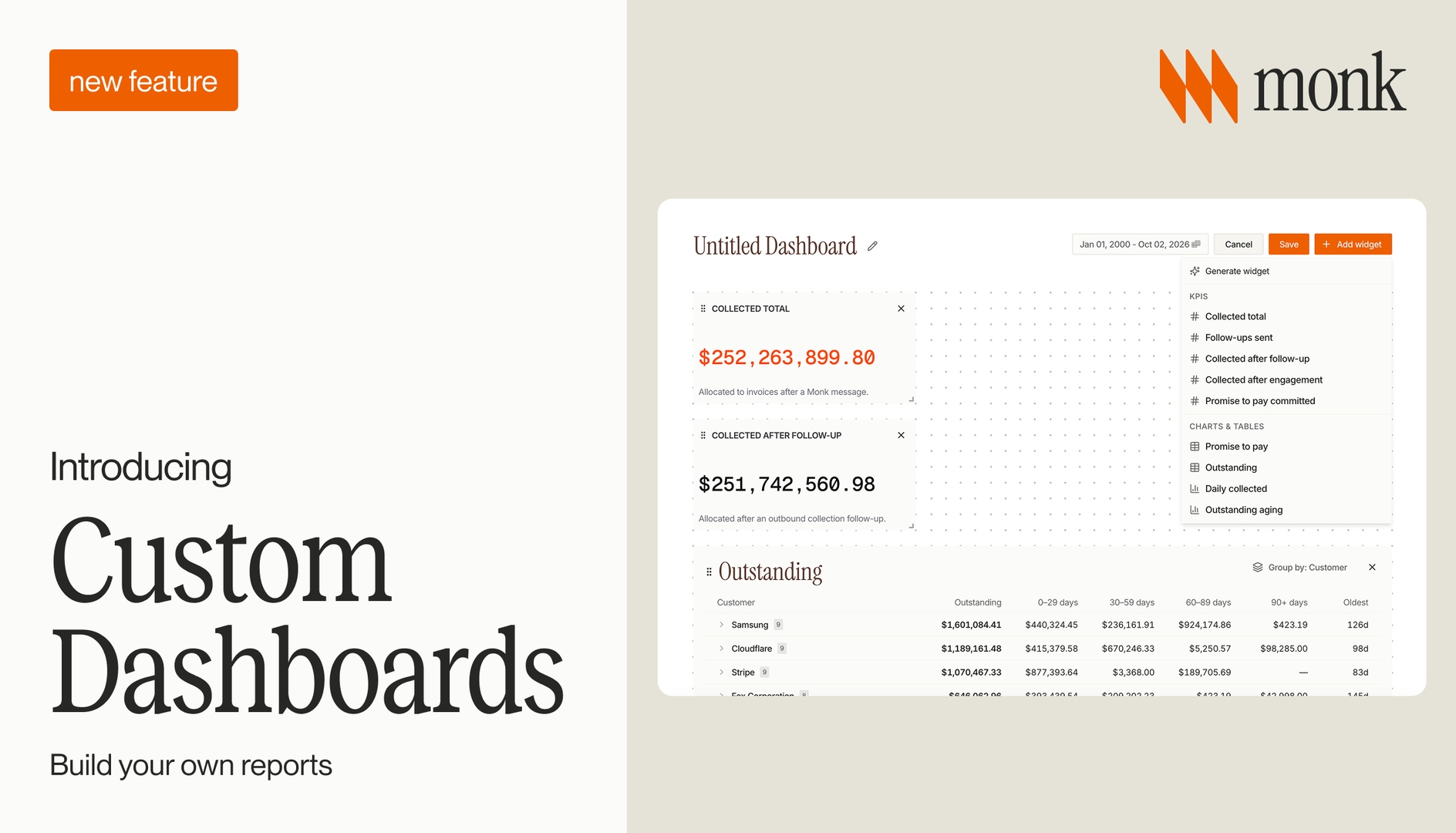
You cannot manage what you cannot see, and most AR teams operate from aging reports that are stale by the time they review them. Revenue automation provides real-time visibility into what is overdue and what is trending toward overdue, so when a reliable customer has invoices approaching terms with no payment activity you can intervene before they age past due. Monk gives AR teams this view to prioritize where impact is highest, the foundation of strong real-time AR reporting.
Angle 8: How Does Reporting and Forecasting Reduce DSO Over Time?
The first seven angles address the operational mechanics of DSO reduction. The eighth is strategic: using data from your automated revenue cycle to understand why DSO behaves as it does in your business, then making structural changes accordingly.
Revenue automation generates data manual processes do not capture: which customers pay late, which invoice types generate disputes, and which outreach produces the fastest response. This turns DSO management from reactive firefighting into proactive optimization, so instead of asking why DSO is up this quarter you can identify the accounts that shifted their payment timing and address it directly.
Why Attacking DSO From One Angle Does Not Work
Most AR automation projects deliver disappointing DSO results because they only address one or two of these angles. Automating dunning without fixing invoice accuracy just reminds people about invoices they will dispute anyway, and speeding cash application without improving outreach leaves the core collection problem untouched.
The compounding effect is what matters. When all eight angles work together, the DSO impact is multiplicative rather than additive. Monk brings the full revenue cycle under one system, going live in less than one week with no percentage of revenue taken on what is collected. To see the effect in practice, read the Profound case study. The table below summarizes all eight angles.
| Angle | How it reduces DSO |
|---|---|
| Faster invoice delivery | Triggers invoicing the moment the event occurs, removing delivery lag. |
| Invoice accuracy | Pulls data from source systems to prevent dispute-triggering errors. |
| Payment flexibility | Offers multiple channels routed to each customer, removing friction. |
| Intelligent outreach | Uses conversation context instead of static dunning, lifting response 24%. |
| Automated cash application | Matches payments at a 95% rate in near real time, ending recognition lag. |
| Dispute resolution speed | Structured workflows with source-document access resolve 90% with zero human intervention. |
| Portfolio visibility | Real-time views surface accounts trending overdue for early intervention. |
| Reporting and forecasting | Turns cycle data into proactive optimization so DSO does not creep back up. |
Frequently Asked Questions
What is DSO and why does it matter?
DSO, or days sales outstanding, measures the average number of days it takes to collect payment after an invoice is issued. It directly affects cash flow, working capital, and the operational capacity of your business.
How does revenue automation reduce DSO?
It addresses eight failure points at once: faster invoice delivery, more accurate billing, flexible payments, context-aware outreach, real-time cash application, structured dispute resolution, live portfolio visibility, and analytics. Because the stages reinforce one another, the impact is multiplicative rather than additive.
Can revenue automation reduce DSO if our customers just pay slowly?
Yes. Slow payment is often a symptom of friction in your process, not only customer behavior. Automating delivery, offering flexible payment options, and using context-aware outreach can shift payment timing even with historically slow payers.
How quickly does revenue automation impact DSO?
The fastest gains come from eliminating delivery delays and automating cash application, which can reduce reported DSO within the first 30 to 60 days. Deeper improvements from outreach and dispute resolution build over the following two to three quarters.
Does Monk address all eight DSO angles?
Yes. Monk covers the full revenue cycle from invoicing through collections and cash application, and its intelligent collections capability lifts response rates 24% over static dunning.
Ready to attack DSO from every angle and turn revenue into cash faster? Book a demo.



.avif)