Cash Flow Is the New Growth Metric

For about a decade, the number that mattered was growth. That is starting to change. Cash, not growth, is what tells you how healthy a company is.
A recent Deloitte study of US companies puts numbers behind this. Here is what those numbers say, and what they mean for a company that wants its growth to show up in the bank.
Growth is up. Cash isn't keeping pace.
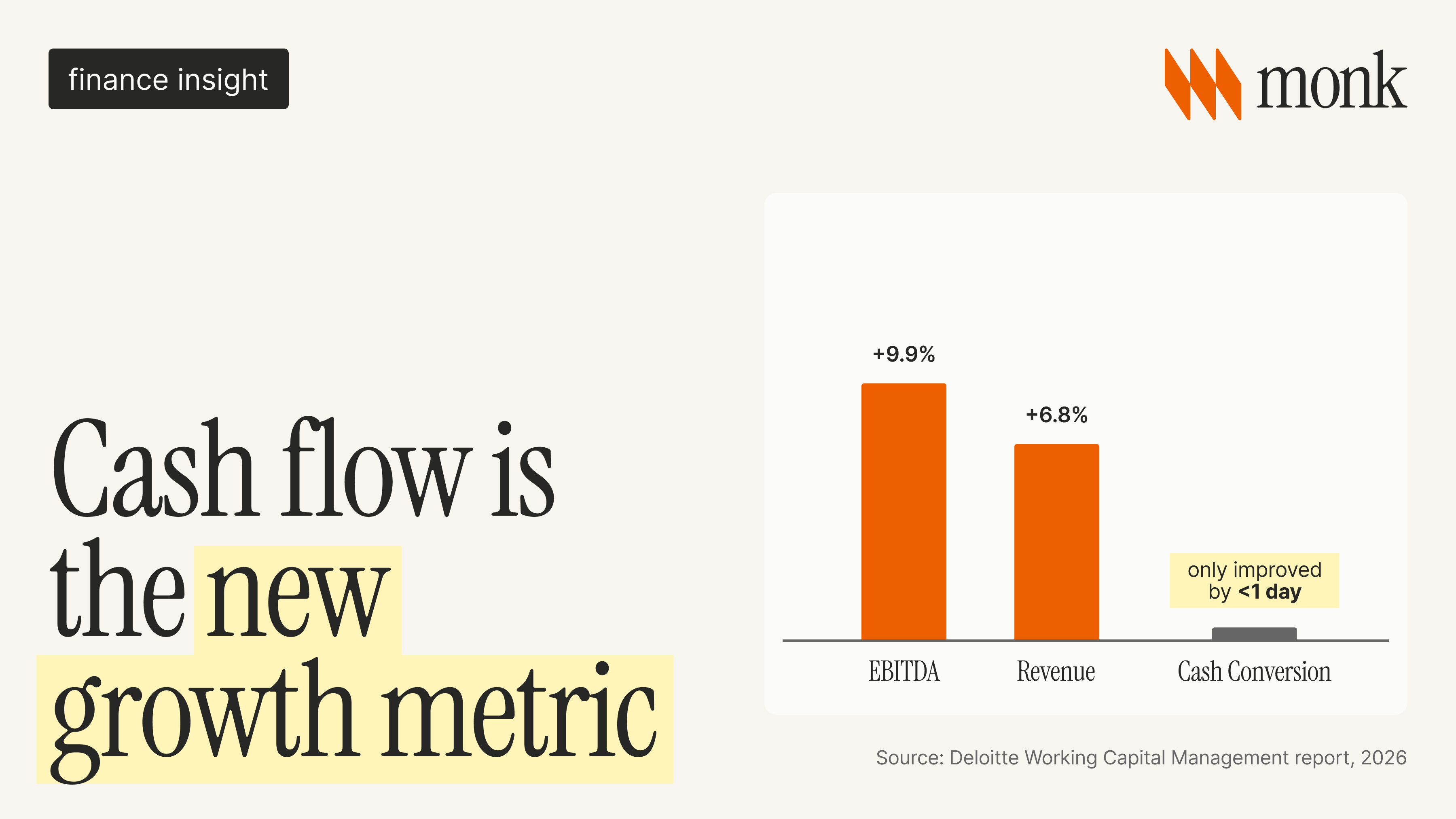
Deloitte looked at 2,313 public US companies. On the usual scoreboard the year looked good. Revenue was up 6.8%, EBITDA up 9.9%, free cash flow up 8.9%.
But the cash conversion cycle, how many days it takes to turn a dollar of activity into a dollar in the bank, barely moved. Inventory and payables improved. Receivables got worse. DSO, the average time customers take to pay, went up. In plain terms, customers paid slower and companies let them.
If you have run finance at a growing company, none of this is new. You can lean on suppliers and trim inventory with an email and a little friction. The third lever, the one that decides when revenue becomes cash, is the one hardly anyone wants to manage, because it means chasing your customers.
Why it matters more now that money is expensive
For years, slow collections were not a real problem. Money was cheap and credit was easy, so a company that grew faster than it collected could just raise or borrow to cover the gap. It never felt like a constraint.
That is not true anymore. Credit tightened through 2025, more companies went bankrupt, and defaults went up, mostly at smaller and more leveraged firms.
When money was cheap, being sloppy about cash did not cost a company much. But you can't raise or borrow your way out of slow collections anymore, so the cash has to come from the business itself, not from investors.
Receivables is the lever most teams underweight
Deloitte points to three levers for cash, receivables, inventory, and payables. These levers are not created equal, and it matters where you spend your time, especially if your business is growing and you have limited attention.
If you can only fix one, fix receivables.
Freeing up cash from inventory means holding less stock, so you run leaner and carry more risk.
Freeing up cash from payables means paying your suppliers later, which works until they notice and hand you worse terms next time.
Receivables is different. That is money you have already earned, for work you have already done, that you are now lending to your customer at zero interest.
It's easy to overlook the fact that every invoice you send on net-30 is a 30-day, no-interest loan to your customer. You may not think of it as lending, and they might not think of it as borrowing, and your books do not call it a loan. But that is what it is.
A company doing $20M in revenue at 60-day DSO is lending its customers about $3.3M at any given moment, for free.
Receivables is also the first lever to break, and it is structural. AR work grows with the number of invoices, but the team only grows with headcount. A follow-up process that worked for 20 accounts is not effective for 200.
Three numbers to find your cash gap
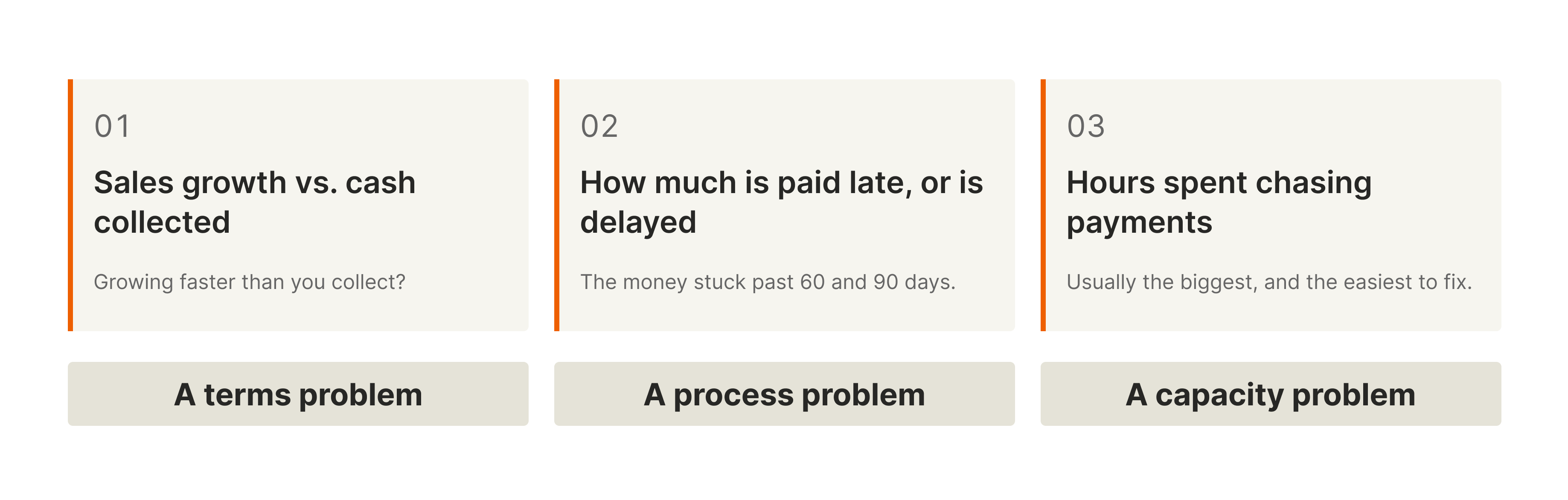
You can pull these numbers to find where the opportunity is to free up more cash.
Are you growing faster than you are getting paid? If your sales are going up, but the money is not landing in your account at the same pace, then you are covering that gap out of your own pocket.
How much cash is tied up in invoices customers haven't paid? Don't look at the average wait time, look instead at the invoices that are more than 60 or 90 days late.
How many hours a week does your team spend chasing payments by hand? Sending the reminder emails, making the calls, following up again.
Insight was never lacking. The bottleneck is AI that acts on insights, and moves hard metrics.
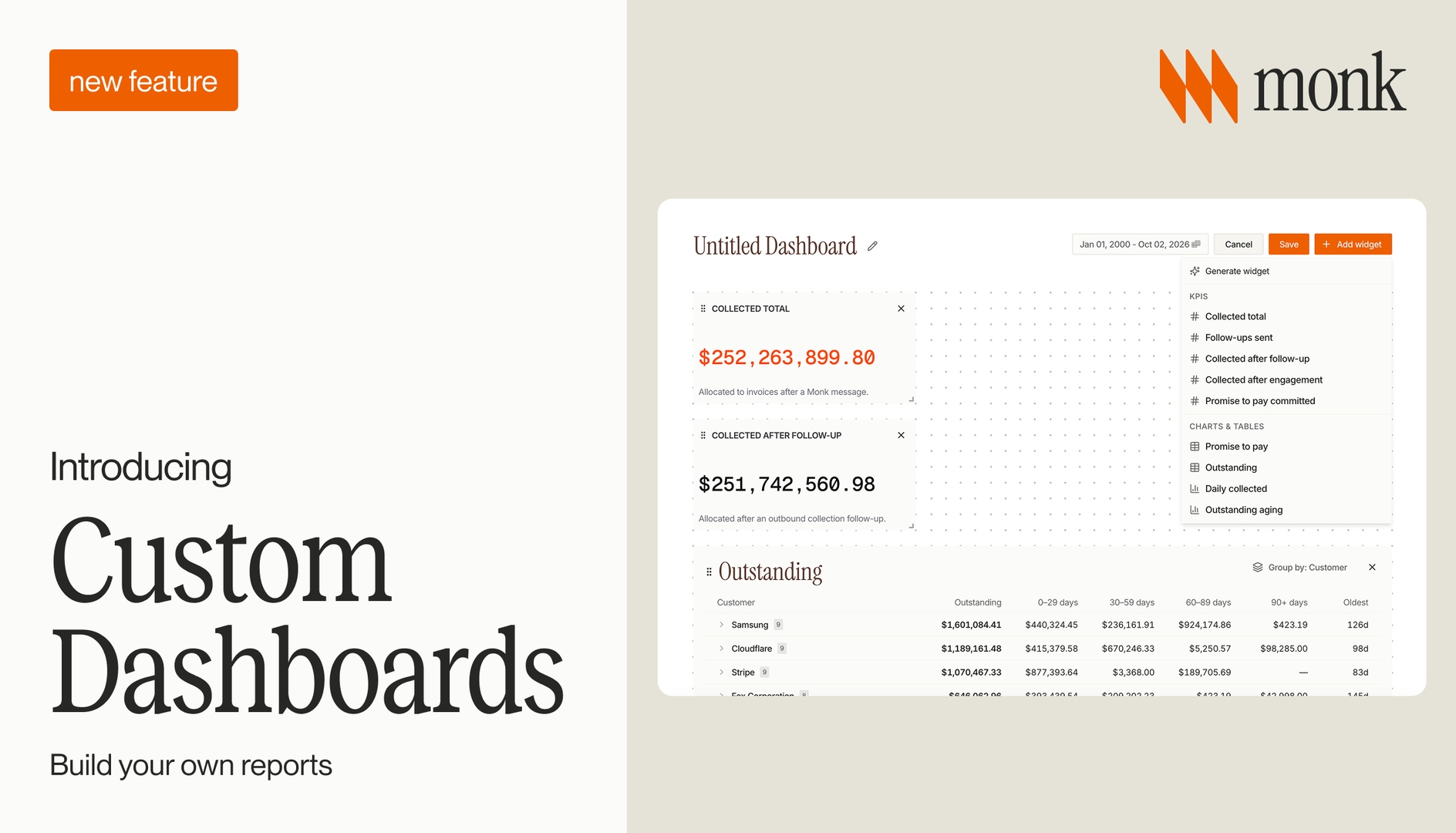
The last decade of finance software was mostly about insight-driven AI, but insights in finance have never been scarce. Teams have never been short on dashboards. They can watch DSO climb in real time, in color. What they have lacked is hands. A dashboard tells you collections are slipping, then waits for a person with a full calendar and 200 other accounts to do something about it.
An agent closes that gap. It sends the follow-up, applies the payment, flags the dispute, raises the odd case that needs a human, and does it again the next day.
Letting software act instead of advise takes trust. It only works if every action is logged, every decision can be undone, and a person stays in the loop on the calls that need judgment. Without that, you have just built a faster way to make mistakes. With it, your team gets the reach of software and keeps the control they had by hand. No good CFO hands a black box the keys to the company's cash, and none should.
Where to start
This is how we think about it at Monk. Collections, cash application, and forecasting run as one connected system. The agent handles the routine follow-up and matching, hands the genuinely unclear cases to a person, and learns from what they decide.
If you are growing fast and still collecting by hand, that gap is almost certainly there in your numbers, even if it has not shown up in a board deck yet. The good news is that receivables is the most fixable of the three levers, and the technology to automate it at scale already exists. This is not an 18-months-out thing.
For a decade, growth was the number that mattered. But revenue is not cash. The question now is whether your growth turns into cash.
Book a demo to find your cash gap and see how to close it.
Source: "Cash, Not Growth, Could Become the Test for Corporate America", by Anthony Jackson (principal), Justin Hughes (managing director), and Jeff Keene (senior vice president), all with Deloitte Transactions and Business Analytics LLP, via WSJ CFO Journal, June 2026.
Frequently Asked Questions
What does “cash flow is the new growth metric” mean?
It means company health is now judged by how fast revenue turns into cash, not by growth alone. When credit is expensive you can no longer raise or borrow to cover slow collections, so the cash has to come from the business itself.
What is DSO and why does it matter?
DSO, or days sales outstanding, is the average number of days customers take to pay. A rising DSO means you are effectively lending customers more money at zero interest, tying up cash you have already earned.
Which working capital lever is easiest to fix?
Receivables. Inventory means carrying more risk and leaning on payables strains supplier relationships, but receivables is money you have already earned for work already done. It is the most fixable of the three levers.
How much cash does slow collection tie up?
A company doing $20M in revenue at 60-day DSO is lending its customers about $3.3M at any given moment, for free. The higher your DSO, the larger that interest-free loan book.
What is agentic AR?
Agentic AR is software that acts on collections instead of just reporting on them. An AR agent sends follow-ups, applies payments, flags disputes, and escalates the cases that need a person, with every action logged and reversible.
Related guides: How to Know if Your AI Collections Agent Is Working.




.avif)