The 3 Core Workflows That Break in Legacy A/R (and How Monk Fixes Them)

Which Core Workflows Break in Legacy AR Systems?
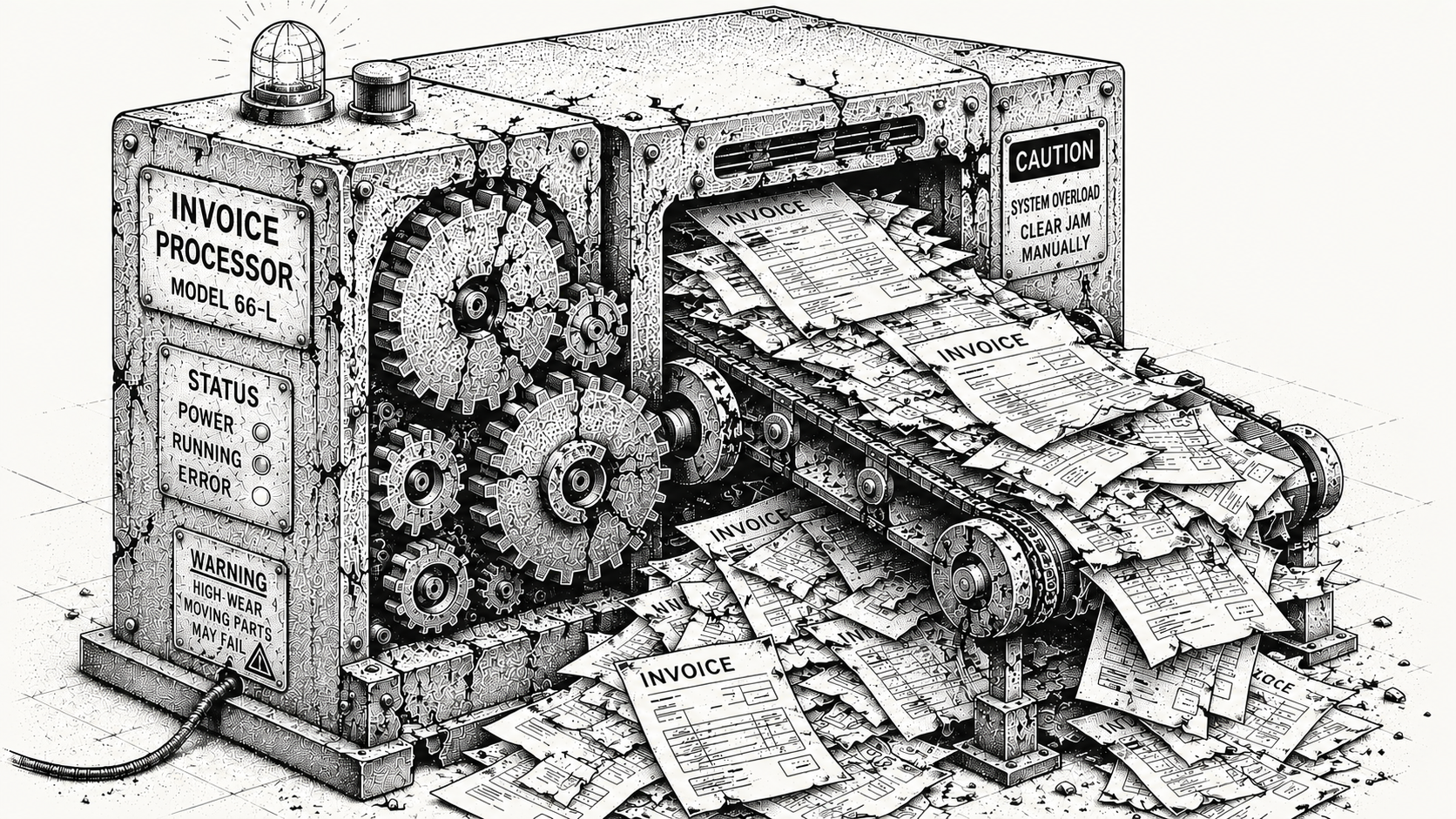
Three workflows break most often in legacy AR systems: collections and follow-up, payment reconciliation, and dispute identification and resolution. These are not edge cases, they are the primary drivers of high DSO and cash-flow risk, and they break because legacy tools were built for invoicing, not for getting paid. The fix is not more people or more policies, it is an AI-native invoice-to-cash platform that handles the unstructured, messy work these tools were never designed for.
Legacy AR software assumed a world of clean data, generous headcount, and predictable payment behavior. Today cash timing is critical, teams are lean, and most of the relevant information lives in freeform email and remittance, exactly where rules engines fail. This post breaks down the three broken workflows, why traditional tools cannot handle them, and how Monk replaces them. For the foundation, see Monk's overview of what accounts receivable automation is.
Why Does Collections and Follow-Up Break?
In legacy systems, collections reminders are static, impersonal, and timed to the due date rather than to risk, behavior, or context. There is no intelligence in escalation or prioritization, and incoming email replies go untracked while finance teams juggle Gmail, spreadsheets, and memory to manage outreach.
The real-world impact is that high-value customers get followed up too late or not at all, AP teams delay payment because no one followed up, and DSO balloons with no clear cause. Monk replaces this with an engine that drafts outreach by invoice risk tier and customer history, reads incoming replies to detect promises-to-pay, disputes, and delays, and auto-escalates when a promise is missed or an invoice ages past a threshold. Because Monk's intelligent collections ingests the context of each conversation rather than firing fixed reminders, it is 24% more effective than standard dunning and resolves 90% of collections with zero human intervention, looping a person in only when needed.
Why Does Payment Reconciliation Break?
In legacy systems, a Stripe or ACH payment lands but the invoice does not close automatically. Partial payments, remittances referencing the wrong invoice number, or multiple payments in one batch confuse the system, so finance teams fall back on manual CSV downloads, visual inspection, and memory, and the same problems recur every month.
The impact is revenue that stays unrecognized despite being collected, misapplied or unallocated payments that cause customer confusion, and reconciliation that drags into the next month and delays close. Monk replaces this with a matching engine that reads memos, POs, and PDF remittances and applies payments to the correct invoices even when the data is partial or incorrect, flagging genuine exceptions with probable matches rather than guessing. This is how Monk reaches an 80% automatic cash application match rate, rising to 95% once teams enable suggested rules, fully integrated with QuickBooks, NetSuite, Stripe, and your ERP, so almost nothing requires manual handling. The deeper point about why this is hard is covered in the companion piece on what LLMs can and cannot do in B2B payments, where reconciliation is the deterministic line that AI must respect.
Why Does Dispute Resolution Break?
In legacy systems, disputes hide in email threads and are often discovered only when a payment is late. There is no structured classification, so "dispute" might mean a duplicate invoice, a wrong PO, unclear terms, or a delivery failure, and with no routing logic the issue bounces between sales, ops, and finance while resolution tracking simply does not exist.
The result is invoices that stall indefinitely without a clear reason, internal finger-pointing, customers who perceive the company as disorganized or aggressive, and cash stuck in limbo. Monk reads invoice-related emails, flags dispute language like "this is incorrect" or "missing PO," auto-tags the dispute type, and routes it to the right owner with an SLA and a resolution timer. Crucially, it suppresses follow-up sequences until the dispute is cleared, so the company stops chasing money it has already agreed to investigate, which is exactly the kind of recurring exception that Monk's analysis links to 39% of cash-flow slowdowns.
What Does the Legacy Stack Cost?
Each broken workflow carries a distinct cost, and together they compound into slow cash and strained relationships. The table summarizes how each workflow breaks and the modern fix Monk applies.
| Workflow | How it breaks in legacy systems | The modern fix |
|---|---|---|
| Collections and follow-up | Static reminders timed to the due date, replies untracked across Gmail and Slack, no view of promises-to-pay | Context-aware outreach by risk tier and history, reply detection, and auto-escalation, 24% more effective than dunning |
| Payment reconciliation | Payments land but invoices stay open, partial payments and wrong references force manual matching | An AI matching engine reads memos and remittances to apply cash at an 80% automatic match rate, rising to 95% with suggested rules |
| Dispute resolution | Disputes hide in email, lack classification and routing, follow-up continues on disputed invoices | Auto-tagged and routed with an SLA, status tracked, and follow-up suppressed until cleared |
Notice the through-line: every failure is a place where unstructured information needed to be interpreted and a legacy rules engine could not do it. That is also where generative AI actually moves the needle in finance operations, because the gap is in comprehension, not effort. Bolting more reminders or more policies onto the old stack does not help.
There is also a hidden organizational cost that rarely appears on a dashboard. When collections, reconciliation, and disputes each live in a different tool, no single person can see the whole state of an account, so work gets duplicated, handoffs get dropped, and the team spends its energy reconciling the tools rather than the cash. Lean finance teams cannot afford that overhead, which is precisely why consolidation, not addition, is the right response to the great unbundling of finance.
How Does Monk Replace the Fragmented Stack?
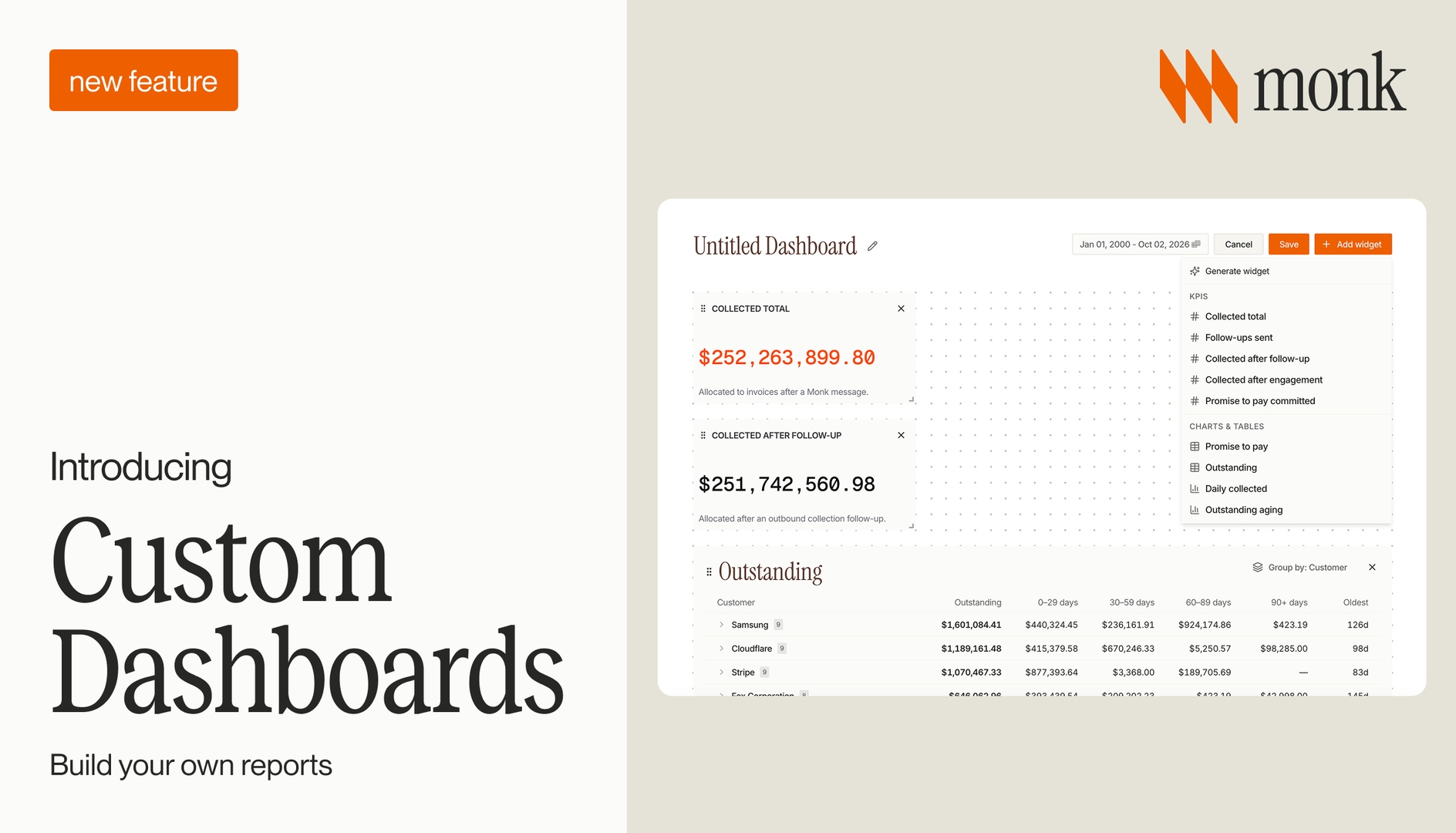
Monk consolidates fragmented AR work into a single platform rather than a patchwork of Gmail, spreadsheets, and disconnected tools. Collections, reconciliation, dispute tracking, and cash forecasting live in one place, with live dashboards instead of weekly spreadsheet builds, and everything is auditable and searchable.
The outcomes follow from the consolidation. Across roughly $2B+ in receivables under management, Monk customers see a 40% average reduction in DSO, a 2.4x average increase in cash on hand in the first quarter, and an average of 26 hours saved per month, with a typical go-live of less than one week, SOC 2 controls, and no percentage taken of revenue. Profound, after consolidating its AR onto Monk, grew its cash on hand 122% in the first month and cut its aging balance fivefold. Most AR software is built for invoicing; Monk is built for getting you paid, fixing the workflows that matter rather than the ones that look nice on a dashboard. To see the connected workflow, explore the Monk platform.
Frequently Asked Questions
Which AR workflows break most often in legacy systems?
Collections and follow-up, payment reconciliation, and dispute identification and resolution. These are the primary drivers of high DSO and cash-flow risk, yet legacy tools handle them with static reminders, manual matching, and untracked email threads.
Why do legacy collections tools fall short?
Their reminders are static and impersonal, timed to the due date rather than to risk or behavior. Email replies go untracked across Gmail and Slack, so finance teams lose visibility into promises-to-pay and which accounts need human intervention.
How does Monk fix payment reconciliation?
Monk uses a matching engine that reads memos, POs, and PDF remittances to apply payments to the correct invoices even when data is partial or incorrect, at an 80% automatic match rate, rising to 95% with suggested rules. Genuine exceptions are flagged with probable matches rather than guessing.
How does Monk handle disputes?
Monk reads invoice-related emails, flags dispute language, auto-tags the type, and routes it to the right owner with an SLA and resolution timer. It tracks status from open to resolved to paid and suppresses follow-up until the dispute is cleared.
Does Monk's matching engine improve itself automatically?
No. The matching engine applies deterministic rules with AI interpretation of unstructured remittance, and improvements come from human-reviewed configuration rather than the system tuning itself unsupervised. That keeps reconciliation auditable.
What makes Monk different from traditional AR software?
Most AR software is built for invoicing, while Monk is built for getting you paid. It consolidates collections, reconciliation, disputes, and cash forecasting into one AI-native invoice-to-cash platform instead of a fragmented stack of email and spreadsheets.
How fast can Monk go live?
Monk's typical go-live is less than one week because it connects to existing systems like QuickBooks, NetSuite, and Stripe rather than replacing them, with SOC 2 controls in place.
If you are still tracking promises-to-pay in your inbox, the workflows are the problem, not your team. Book a demo with Monk.
Related guides: Collections, Disputes, and Cash App: Why Every A/R Team Does This Manually, Why We Built Monk to Replace the Messy A/R Stack, How Generative AI Is Reinventing Accounts Receivable in 2026, AI-Native vs Traditional AR Automation: What Changed and How AI Rebundles the Winners and Leaves Legacy Vendors Behind.


.avif)