Designing a Finance Stack for Liquidity Efficiency in 2026

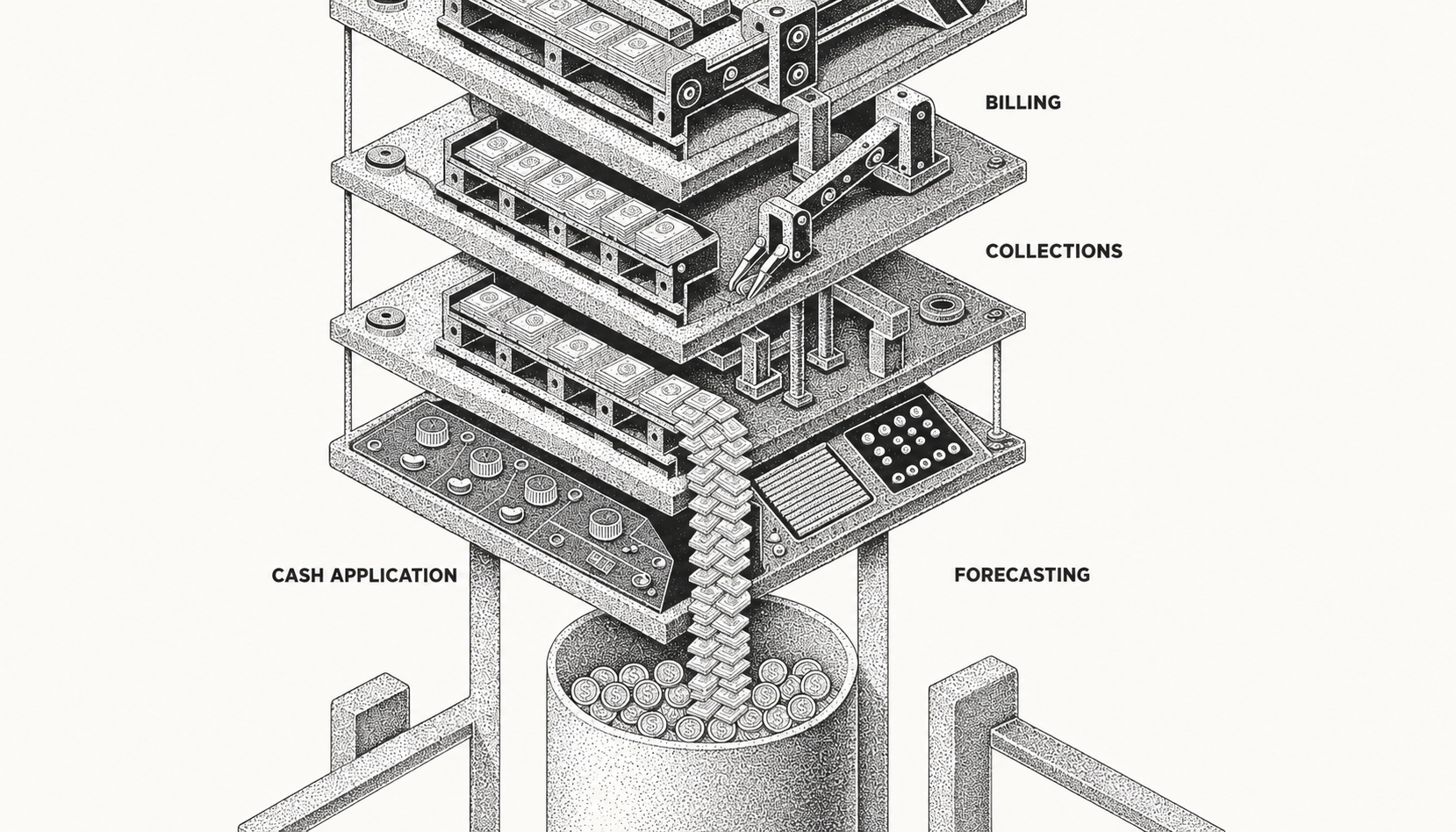
What Does a Liquidity-Efficient Finance Stack Look Like?
A liquidity-efficient finance stack is an end-to-end data and execution layer that actively pulls cash forward across the quote-to-cash cycle, rather than a patchwork of point tools bolted together to close the books. Liquidity efficiency itself is simply how quickly a business turns earned revenue into usable cash, and in a higher cost-of-capital environment it has become a board-level metric the modern CFO must own rather than a finance footnote. The structural difference is intent: most stacks were assembled to make debits match credits and pass audits, not to accelerate cash. Teams that re-architect around cash velocity, often on a invoice-to-cash platform like Monk, see a 40% average reduction in DSO. For the full context, start with Monk's overview of accounts receivable automation.
Why Are Most Finance Stacks Built for Compliance, Not Velocity?
Legacy systems were designed to produce accurate statements and survive an audit, which is a worthy goal but a fundamentally backward-looking one. That compliance-first design leaves finance reactive rather than strategic in predictable ways: invoices issue late because CRM and billing sync slowly, collections fall back on generic dunning, payments sit in unapplied cash for lack of clean metadata, and disputes live in inboxes rather than in a system anyone can query.
The unifying symptom is that cash gets stuck not because customers refuse to pay, but because the business cannot see where to unblock it. For most high-growth companies these are systemic problems rather than edge cases, and they compound as volume rises. A stack built only to report on cash will always discover liquidity gaps after they have already opened, which is precisely the wrong time to act.
What Are the Pillars of a Liquidity-Efficient Stack?
A stack designed for velocity rests on six pillars, each of which converts a reactive, manual step into an active one. The table maps each pillar to the job it does, and the throughline across all of them is treating collections and reconciliation as workflow problems rather than reminder problems.
| Pillar | What it does |
|---|---|
| Contract-aware billing | Generates invoices from contract terms, not manual re-entry |
| Dynamic collections | Resolves friction by context rather than a fixed reminder cadence |
| Real-time cash application | Matches payments to invoices as they arrive |
| Dispute management | Captures reason codes and time-to-resolution as structured data |
| Cash-integrated forecasting | Models actual cash arrival, not just recognized revenue |
| Cross-functional visibility | Sales and customer success see at-risk cash, not just finance |
Monk's intelligent collections ingests the context of each customer conversation, surfaces exceptions, and routes them with full context, which Monk reports is 24% more effective than standard dunning. Its AI-native cash application matches payments in real time at an 80% automatic match rate, rising to 95% with suggested rules, so the cash position stays accurate instead of drifting between reconciliations. The six pillars reinforce one another: clean contract-aware billing reduces the disputes that clog collections, and structured dispute data feeds a more accurate forecast.
How Should You Sequence the Build?
You do not implement all six pillars at once, and trying to is the most common way these projects stall. A practical sequence prioritizes the pillars that unblock the most trapped cash first, then layers on visibility and forecasting once the data underneath them is trustworthy.
| Phase | Pillars to stand up | Why first |
|---|---|---|
| Foundation | Contract-aware billing, real-time cash application | Clean, current data is the prerequisite for everything else |
| Acceleration | Dynamic collections, dispute management | Directly pulls trapped cash forward once data is clean |
| Intelligence | Cash-integrated forecasting, cross-functional visibility | Only trustworthy on top of clean data and live collections |
The reason for this order is that a forecast built on stale billing data or unapplied cash will be wrong no matter how sophisticated the model, so visibility and forecasting are earned last. Sequencing this way also produces visible wins early, since the foundation and acceleration phases are where the freed cash actually shows up. For the metric most worth optimizing across the whole build, Monk's argument on why reducing DSO is the highest-leverage move a finance team can make is the natural companion read.
What Metrics Track Liquidity Efficiency?
Classic DSO is a useful headline but too coarse to manage a stack by, because it blends fast and slow segments into one number. A liquidity-focused team instruments the cycle more granularly to see exactly where cash slows down.
The most actionable metrics are invoice-to-cash cycle time by deal type, cash forecast variance week over week, time-in-dispute per dollar, the unapplied cash ratio, and promise-to-pay conversion rate. Each maps directly to working capital and, more importantly, lets a team intervene before a liquidity gap widens rather than explaining it afterward. Tracked together, they turn liquidity from a quarterly surprise into a weekly operating metric.
The unapplied cash ratio deserves special attention, because it is the metric most teams never look at and the one that quietly distorts everything else. Cash that has arrived but has not been matched to an invoice inflates apparent receivables and understates real liquidity at the same time, so a team can be sitting on collected money while its dashboards say the opposite. Watching that ratio trend toward zero is one of the clearest signs that the real-time cash application pillar is actually working, and it is a fast early proof point when you are building the case for the rest of the stack.
How Does Monk Fit the Stack?
Monk connects billing, CRM, payments, support, and accounting into one full-cycle view of revenue-to-cash, replacing reactive manual AR with an orchestration layer that spans the whole quote-to-cash path. Because it integrates natively with Salesforce, NetSuite, QuickBooks, HubSpot, and Stripe, the cross-functional visibility pillar becomes practical rather than aspirational, and the data feeding the forecast comes from the systems of record rather than a spreadsheet export. You can see the connected design on the Monk platform.
The results are consistent across $2B+ in receivables under management: a 40% average reduction in DSO, a 2.4x average increase in cash on hand in the first quarter, and 26 hours saved per month, with 90% of collections resolved with zero human intervention and SOC 2 controls underneath. Profound grew its cash on hand 122% in the first month and cut its aging balance fivefold after re-architecting around cash velocity. Notably, Monk does this without taking a percentage of revenue, so the freed liquidity stays on your balance sheet. As Nico Serventi, Head of Finance at Subject, put it: "Monk gave us immediate visibility into unbilled revenue, tightened our collections process, and became a true AR system of record, without adding headcount."
Frequently Asked Questions
What is liquidity efficiency?
It is how quickly a business converts earned revenue into usable cash. It depends on how fast you get paid, how predictably you can forecast that cash, and how tightly the cash data is integrated with daily operations.
Why are most finance stacks bad at it?
They were built for compliance and closing the books, which is a backward-looking goal. That leaves finance reactive, with late invoices, generic dunning, unapplied cash, and disputes scattered across inboxes instead of a queryable system.
What are the core pillars of a liquidity-efficient stack?
The six pillars are contract-aware billing, dynamic collections, real-time cash application, dispute management, cash-integrated forecasting, and cross-functional visibility. Each converts a reactive manual step into an active one that pulls cash forward.
In what order should I build the stack?
Start with the foundation of contract-aware billing and real-time cash application, then add dynamic collections and dispute management, and finish with forecasting and cross-functional visibility. The later pillars are only trustworthy once the underlying data is clean and current.
How does Monk improve liquidity efficiency?
Monk orchestrates the full revenue-to-cash cycle in one system that connects billing, CRM, payments, and accounting. Customers cut DSO by 40% on average, save 26 hours per month, and resolve 90% of collections with zero human intervention, without Monk taking a percentage of revenue.
What should I measure?
Beyond DSO, track invoice-to-cash cycle time by deal type, cash forecast variance, time-in-dispute per dollar, the unapplied cash ratio, and promise-to-pay conversion rate. These let you intervene before a liquidity gap widens.
How fast can a team adopt this?
Monk goes live in less than one week because it connects to existing systems rather than replacing them. That means the freed cash from cleaner billing and faster collections starts showing up within the first quarter.
Ready to build for cash velocity? Explore Monk's automation or book a demo to map it against your own stack.
Related guides: How CFOs Are Rethinking Revenue-to-Cash in 2026.



.avif)