Email Deliverability for Collections: How to Make Sure Your Invoices Land in 2026

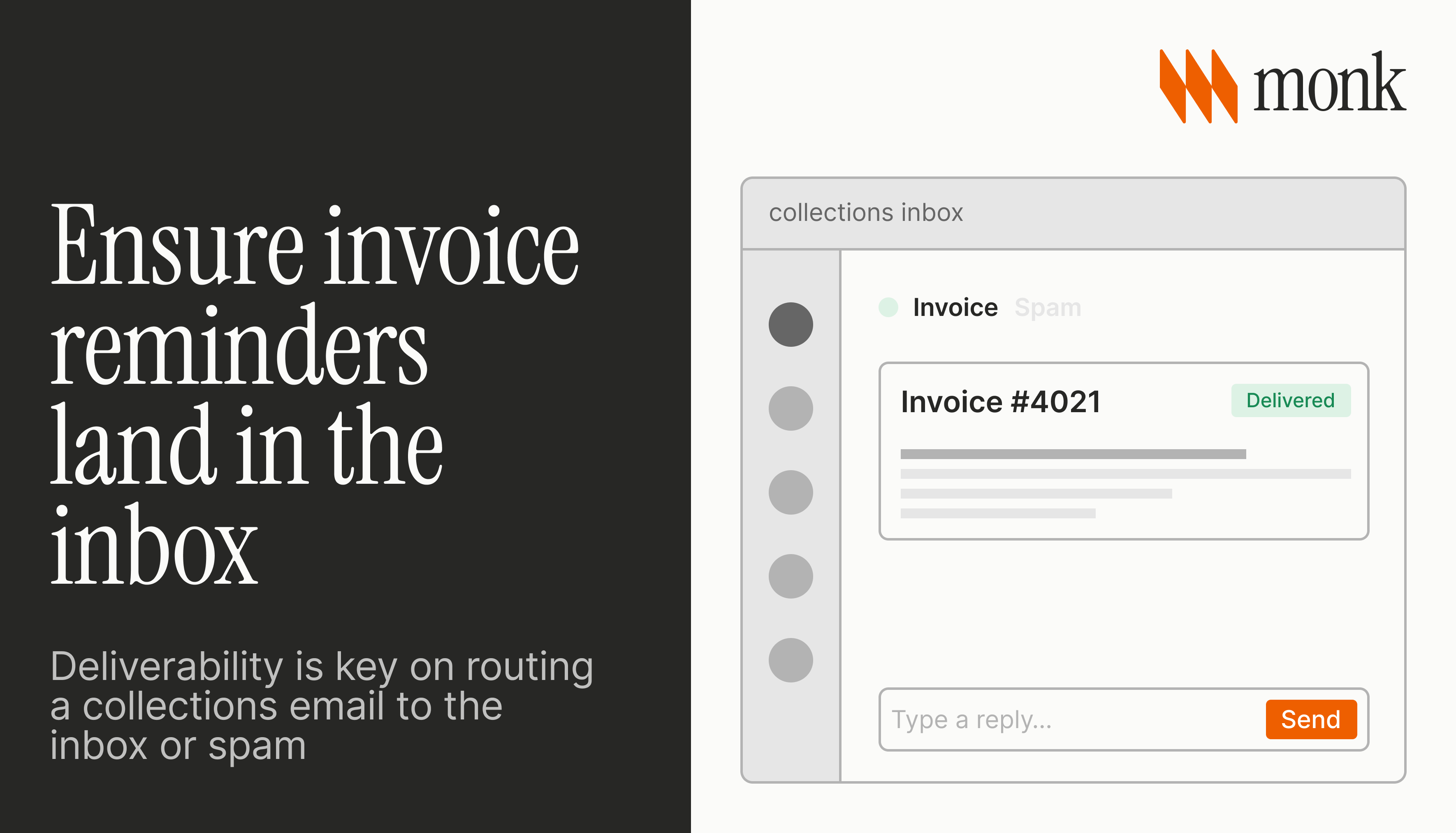
Collections email only works if it reaches the inbox. Deliverability is what decides whether your invoice reminder reaches the customer or drops into spam: how your sending domain is authenticated, your sender reputation, how human your sending looks, how you handle bounces, and whether you weigh the message down with tracking. Get those right and your reminder lands in front of the person who can pay it.
What is email deliverability, and why does it matter for collections?
Deliverability is the share of your emails that reach the inbox rather than the spam folder or a hard block. For marketing, a few messages lost to spam is a rounding error. For collections it is cash: an invoice reminder sitting in spam is an unpaid invoice, and your dashboard still says the email was sent. A collections email exists to reach the person who can pay, so deliverability decides whether a follow-up works or lands in spam.
Why do collections emails land in spam?
Mailbox providers score every message and decide where it goes. A collections email gets flagged when it looks like bulk marketing or comes from a sender they do not trust. The common causes:
- Missing or broken domain authentication (SPF, DKIM, DMARC).
- Bursty sending, where a large batch fired at once looks automated.
- Promotional or aggressive language and pushy subject lines.
- Tracking pixels, which providers read as a marketing signal.
- Repeated one-directional messages that never get a reply.
- High bounce rates from stale or wrong addresses.
Each one chips away at your sender reputation, and reputation is what providers use to place the next message.
How do you authenticate your sending domain?
Three DNS records prove to mailbox providers that the email is from you. Set all three.
| Record | What it does | Why it matters |
|---|---|---|
| SPF | Lists the servers allowed to send for your domain | Stops spammers spoofing your address |
| DKIM | Adds a cryptographic signature to each message | Proves the email was not tampered with in transit |
| DMARC | Tells providers what to do when SPF or DKIM fail | Protects your domain and builds sender reputation |
Without these, even a legitimate invoice reminder looks suspicious. With them, you are a known sender, which everything else depends on.
Why does sending cadence matter?
Because a human cadence reads as correspondence and a burst reads as a machine. Sending a thousand identical reminders in a minute is the fastest way to train a filter to distrust you. A good system spreads sends out, warms a new domain up gradually, respects a daily send limit, and stops after a set number of attempts when a message is clearly not landing. That restraint protects the reputation that gets the next email delivered.
Do tracking pixels hurt deliverability?
Yes. A tracking pixel is a hidden image that pings a server when the email loads, and mailbox providers treat it as a signal of bulk marketing rather than genuine correspondence. For collections that is a bad trade, because the pixel can push your message into spam, where the open you were trying to measure never happens. The open rate is unreliable anyway, since Outlook hides images by default and Gmail auto-loads them. We cover this in full in why Monk doesn't track email opens.
How should you handle bounces and wrong contacts?
A bounce is a dead end that also damages your reputation if you keep hitting it. When an address bounces, stop sending to it, find the right contact, and flag the account so a person can fix the record. A rising bounce rate is an early warning that your list has gone stale, and a clean list is one of the strongest signals you can send.
What should you measure instead of open rate?
The outcomes that tell you collections is working: reply rate and dollars collected. A reply is a person choosing to engage, and a payment is the result you want. Both are far more meaningful than a pixel load, and neither costs you deliverability to measure.
How does Monk protect your deliverability?
Monk is built to send like a person, because that is what lands. Julia, the email agent, writes each message for the specific account rather than firing a template, so the language and tone vary the way a person's messages do. She sends at a respectful, human cadence, honors send limits, and stops after a set number of attempts when an account is not responding. Monk does not add tracking pixels by default, flags high bounce rates so you can correct the contact, and signs messages so they read as human. That approach earns a 24% higher response than standard dunning and resolves 90% of collections without a person, on a SOC 2 Type II platform. See how it fits together in intelligent collections.
Our take
Deliverability is not a growth hack, it is the whole job. A collections email that lands in spam is the same as one you never sent, so we would rather send a clean, human message that reaches the customer than dress it up with tracking that works against it. Get the fundamentals right, authentication, cadence, a clean list, and the reminders reach the people who can pay them.
Frequently asked questions
What is email deliverability?
The share of emails that reach the inbox rather than spam or a block. For collections, poor deliverability means unpaid invoices, because a reminder in spam never gets read.
Why do my collections emails go to spam?
Usually missing domain authentication, bursty sends, promotional or aggressive language, tracking pixels, or a high bounce rate from a stale list.
What are SPF, DKIM, and DMARC?
Three DNS records that prove your email is from your domain. Together they authenticate you to mailbox providers and protect your sender reputation.
Do tracking pixels affect deliverability?
Yes. Providers read them as a marketing signal, which can push a message to spam. The open rate they produce is also unreliable, since Outlook and Gmail handle images differently.
How many collections emails can I send before it hurts?
There is no single number. What matters is a human cadence, a warmed-up domain, a sensible daily send limit, and stopping when messages are not landing.
How does Monk keep emails out of spam?
By writing unique, human messages, sending at a respectful cadence with send limits, avoiding tracking pixels, and flagging bounces, all on a SOC 2 Type II platform.
Want your invoice reminders to land? Book a demo.
Worth reading next: Why Monk Doesn't Track Email Opens, Collections Email Templates That Get Paid and How to Automate Collections Emails.




.avif)