Credit Intelligence: One AI Credit Score From Your AR and the Bureaus in 2026

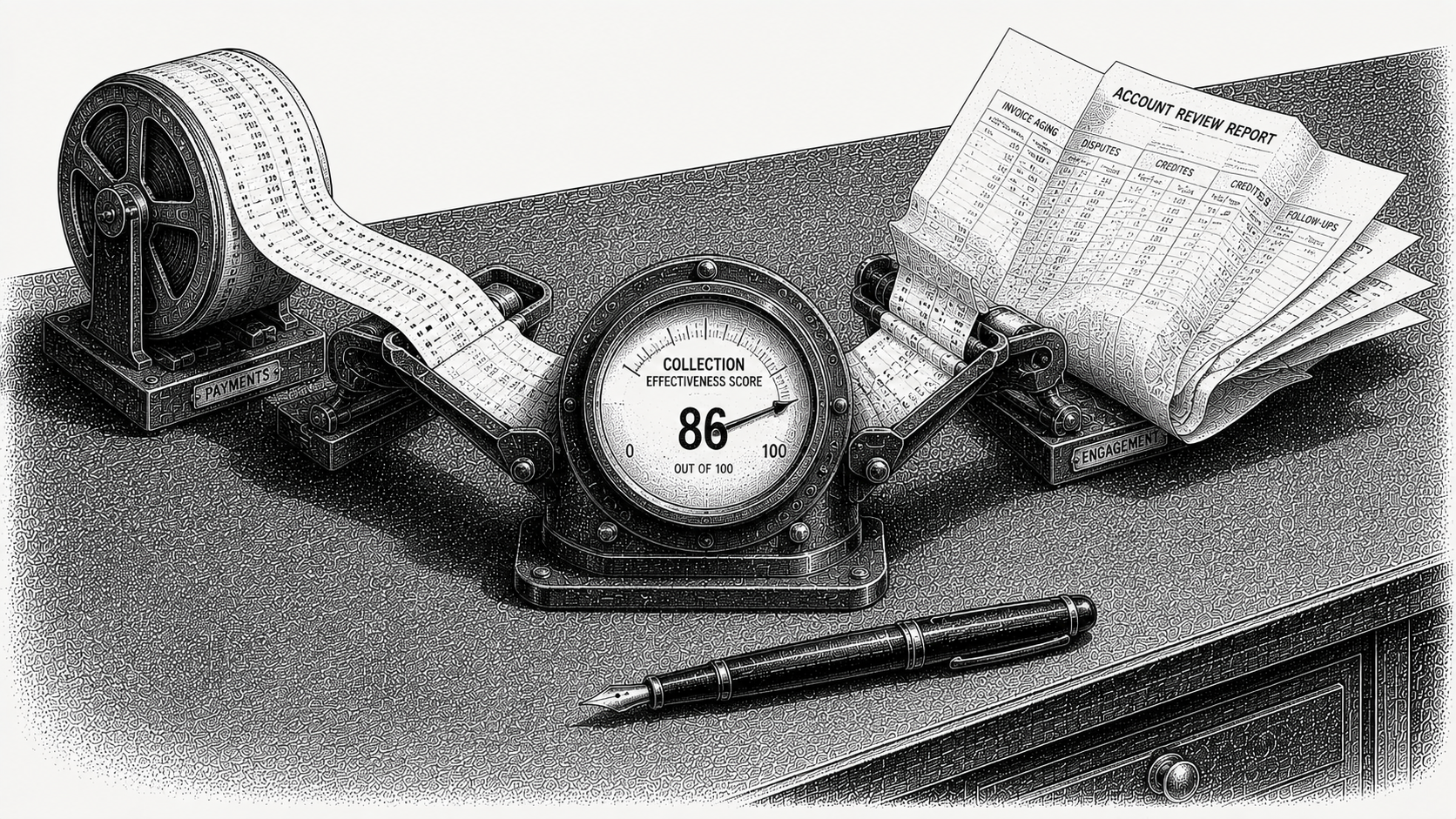
Credit intelligence is a single, continuously updated credit score built from two sources: the first-party payment behavior Monk already sees in your accounts receivable, and third-party bureau signals pulled in automatically. Monk combines the two into one Monk credit score and uses AI to suggest a credit decision with the evidence behind it, so you can set terms in seconds instead of on a gut check and last year's spreadsheet.
What is AI credit intelligence?
AI credit intelligence is a system that combines your company's internal accounts receivable payment data—days to pay, disputes, short-pays—with external credit bureau signals to generate a single, continuously updated credit score and AI-suggested credit decision.
Most teams extend Net 60 on a gut check and last year's data. Credit management software built around credit intelligence replaces that with a live score that reflects how a customer behaves. It reads the payment history in your own ledger, layers in outside credit signals, and produces a single number with the supporting detail attached. Because the score updates as customers pay, dispute, and renew, it reflects the account as it is today rather than how it looked at onboarding.
What signals go into the score?
Two kinds, and the combination is what makes the score reliable. First-party signals come from your relationship with the customer: how they pay you. Third-party signals come from the bureaus: how the market sees them. One is timely and specific, the other is broad and external, and together they cover what neither can alone.
First-party signals (from your AR):
- Days to pay
- Short-pay rates
- Disputes
- Collections behavior
Third-party signals (from bureaus):
- Business credit history
- Financial statements
- Bankruptcy and insolvency filings
| Signal type | Where it comes from | What it tells you |
|---|---|---|
| Payer intelligence (first-party) | Your AR, collections, and ERP and bank integrations | Days to pay, short-pay rates, disputes, collections behavior, updated continuously |
| Credit bureau data (third-party) | Industry-leading credit bureaus, pulled automatically | Business credit history, financial statements, bankruptcy and insolvency filings |
| AI suggestion | Both, combined by Monk | A credit report and a suggested decision, easy to read at a glance |
For a deeper look at how these signals translate into actionable insights, see our guide to the payment risk report.
How does the AI suggestion work?
Based on the decision in front of you, whether to extend terms, adjust a billing cycle, or approve a renewal, Monk wraps the first-party and third-party data into an AI suggestion you can read in seconds. It is not a black box. Every score carries the full supporting data, so you can drill into any factor and assess customer credit risk by seeing exactly why a customer scored high risk before you act. The AI agent suggests the credit limit, but a person makes the final decision. The suggestion gives you the answer and the evidence at the same time.
Why is your own payment data the strongest signal?
Because it is timely and it is specific to you. A bureau score reflects how a business pays the market in general and updates on a reporting cycle, so it can lag by weeks. How a customer pays you updates every time an invoice comes due. A customer can hold a solid bureau rating and still stretch you to 75 days, and your ledger sees that first. Monk flags risky B2B customers before you extend credit by surfacing payment-behavior patterns that bureaus cannot see, giving you an earlier warning than external scores. Monk already has this signal because it runs your collections, so the payment behavior behind every score is the same data your team uses to chase payment. For more on this, see payment behavior vs credit bureau scores.
What changes when credit scoring is continuous?
The old process was an annual spreadsheet review, terms set by what the sales team wanted, no early warning when an account started to slip, and renewals signed without anyone reading the payment history. Dynamic credit management through continuous scoring replaces each of those. Terms become data-backed for every customer, alerts fire when a risk profile shifts, and twelve months of AR behavior is surfaced before a renewal. And every term change, credit hold, billing extension, and renewal is logged with the data that informed it, so the whole process is audit-ready from day one.
Traditional credit scoring vs. AI credit intelligence:
- Update frequency: Periodic (monthly or quarterly) vs. continuous (every payment event)
- Data sources: Bureau-only vs. bureau plus your own payment history
- Decision speed: Hours of manual lookups vs. seconds with AI suggestion
- Early warning: Reactive, after external scores drop vs. proactive, from your own ledger first
How does it work?
Three steps, and the first-party data starts building the moment you connect.
- Connect. Link your ERP, and Monk begins building payer intelligence from your existing AR history.
- Enrich. Third-party credit signals layer in automatically, with no manual lookups and no stale bureau reports.
- Score and decide. Use the Monk score to set terms, extend credit, and flag renewals, while every decision is logged.
How does Monk credit intelligence fit the rest of the platform?
Because Monk runs collections and cash application on the same platform, the payment behavior behind each credit score is the same data that clears your invoices, so credit and collections stay consistent. Teams on Monk reduce DSO by 40% on average, and more than $2 billion in receivables runs on Monk today, including for Profound and ElevenLabs. Credit intelligence extends that from getting paid to deciding who to extend terms to in the first place. See it alongside the credit management workspace, and for the numbers behind a limit, see how to set customer credit limits.
Frequently Asked Questions
What is credit intelligence?
Credit intelligence is a single, continuously updated credit score built from your first-party AR payment behavior and third-party bureau signals, combined by AI into a report and a suggested decision.
What data does the Monk credit score use?
Monk uses first-party signals such as days to pay, short-pay rates, disputes, and collections behavior, plus third-party signals such as business credit history, financial statements, and bankruptcy filings.
How is this different from a credit bureau score?
A bureau score shows how a company pays the market and updates on a cycle. Monk adds how the customer pays you specifically, updated continuously, which is often the earliest warning of risk.
Can I see why a customer scored a certain way?
Yes. Every score carries the full supporting data, so you can drill into any factor and see exactly what drove it before you extend terms.
Is the credit decision automated?
Monk suggests a decision with the evidence behind it, and a person approves. Every term change, hold, and renewal is logged, so the process is audit-ready.
How fast can I make a credit decision?
In seconds, with every first-party and third-party signal in front of you, rather than an afternoon of manual lookups and tab-switching.
How do I get started?
Connect your ERP and Monk builds payer intelligence from your AR history, then enriches it with third-party signals automatically.



.avif)