AR Automation ROI: How to Build the Business Case

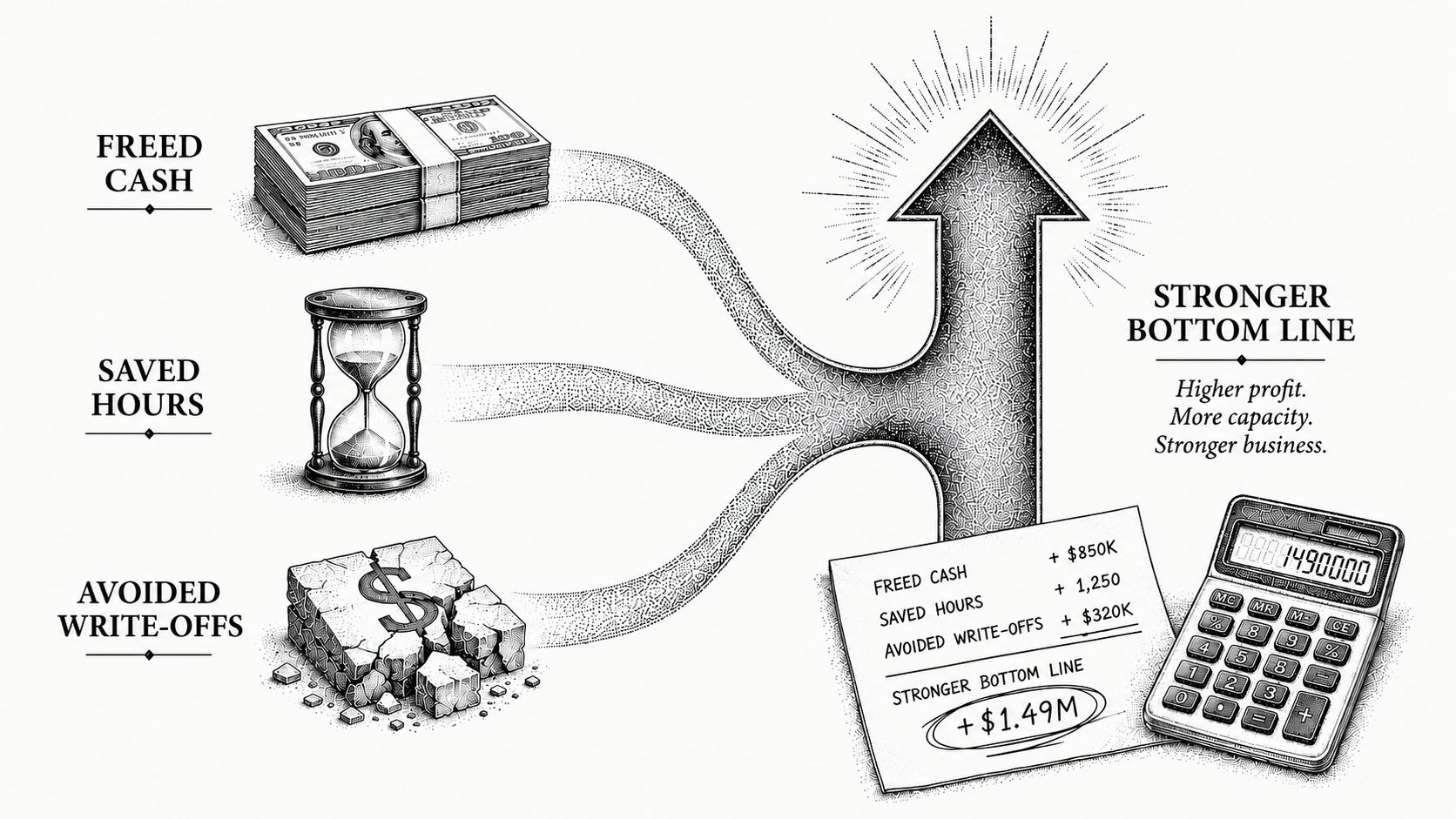
The ROI of accounts receivable automation is built from four numbers: what your current process costs in loaded hours, the cash released by a shorter DSO, the bad debt you stop writing off, and the hire you avoid making. Monk is an AI-native invoice-to-cash platform that runs invoicing, collections, AP portal submission and cash application as one system, and all four numbers can be estimated from data your finance team already holds. An afternoon with your ageing report, your payroll file and three years of write-offs gives you a figure you can defend in a finance review. This guide gives the method for each, a worked example you can follow line by line, what to ask a vendor about pricing and outcome claims, and what to measure in the first 90 days.
Most business cases stall in a predictable place. The champion knows the process is painful, the CFO asks what it costs today and what it returns, and neither question has a measured answer behind it. Few teams track the hours spent chasing an invoice, because those hours sit scattered across a controller, an AR coordinator and whoever holds the portal login. Every dollar figure below is hypothetical and labelled as such.
What is your current AR process costing you in hours?
It costs the loaded hourly cost of everyone who touches a receivable multiplied by the hours they spend, and most teams have never measured either half of that.
Measure hours rather than software spend. List the four activities that consume the time: follow-up and dunning, cash application and remittance matching, chasing documents such as W9s, PO numbers and banking details, and submitting invoices into customer AP portals. Ask everyone who touches them to keep a rough tally for one week. Price those hours at loaded cost, which is salary plus payroll taxes and benefits divided by roughly 2,080 hours a year.
Take a hypothetical B2B business at $40 million in revenue with 900 customers. Its AR coordinator spends 22 hours a week on follow-up, portal submission and document chasing, at an illustrative loaded rate of $45. Its controller spends 6 hours a week on cash application exceptions, at an illustrative $75. That is 22 hours for 52 weeks at $45, or $51,480, plus 6 hours for 52 weeks at $75, or $23,400. The current process costs about $75,000 a year in hours before anyone counts a licence.
Much of the time goes on edge cases rather than routine chasing, and 39% of cash flow slowdown is caused by edge cases. The hours also concentrate in the most expensive people, because awkward accounts get escalated to whoever can resolve them. Automating that work returns about 26 hours a month.
How much cash does a shorter DSO release?
Multiply your average daily receipts by the number of days you remove from DSO, and the product is the working capital the project puts back on your balance sheet.
Average daily receipts is twelve months of cash collected divided by 365, using collections rather than booked revenue. Then decide how many DSO days you could remove. Monk customers see a 40% average reduction in DSO, so applying that gives a defensible starting point. Build a second version at half that improvement, because a case that survives being halved gets approved.
Return to the hypothetical business, now carrying a DSO of 55 days. Daily receipts are roughly $110,000, which is $40 million divided by 365. A 40% reduction takes DSO from 55 days to 33, removing 22 days. Multiply 22 by $110,000 and the business frees about $2.4 million in working capital, cash pulled forward onto the balance sheet to deploy rather than financed through a line of credit. Every figure in that chain is illustrative.
This is usually the number that wins approval, because it is working capital rather than expense. You can convert it into a profit and loss number if you draw on a credit line: $2.4 million released at an illustrative borrowing cost of 10% avoids around $240,000 of interest a year. The arithmetic scales both ways: a $20 million business removing 12 days frees roughly $650,000, and a $4 million business removing 22 days frees roughly $240,000.
How much of your bad debt is avoidable?
Your own ledger will tell you what share of invoices ageing past 90 days ends up written off, and applying that rate to today's 90-plus bucket gives you the exposure this project is aimed at.
Pull three years of write-offs from the general ledger and express each year as a percentage of revenue. Then look at the ageing curve behind them: of the invoices that crossed 90 days, what proportion was collected? Most teams find a break past 90 days after which recovery rates drop sharply, and that break is the deadline the collections process works against. Invoices that age into bad debt are a full loss, since the cost of delivering that revenue was already incurred.
Keeping the same hypothetical business, suppose it writes off 0.6% of revenue, or $240,000 a year, and earlier follow-up recovers a third of that. The line in the model is $80,000 a year at full margin, and both inputs are illustrative assumptions. Label the judgement as a judgement, because a CFO will accept a conservative assumption that is marked as one.
One structural cause of ageing deserves its own line. Across the receivables Monk manages, 92% of enterprise invoices must be submitted through a vendor portal or network rather than paid from an emailed invoice. An invoice emailed but never submitted into the portal is not late in the customer's system; it does not exist there at all, and it ages toward write-off while each side believes the other is holding things up.
Does the business case depend on cutting headcount?
For most finance teams it does not, and the case reads as more credible when you say so directly: the saving is the hire you avoid while customer count grows, plus contractor spend you can stop.
Two phrasings come up repeatedly in conversations with finance leaders evaluating this category. One is "I'm trying to get rid of two overseas contractors and replace it with software". The other is "we're not backfilling for the controller". Each describes a team holding headcount flat while the customer base grows.
Model that as cost avoidance on its own line. If AR work already consumes one and a half people and the plan is to double customer count in eighteen months, the counterfactual is a second coordinator at loaded cost. Mark it as avoided rather than removed, and let the CFO decide how much credit to give it. Finance leaders discount headcount savings that depend on a redundancy nobody intends to carry out, while a clearly labelled avoided hire survives that scrutiny.
Capacity is what makes the avoided hire real. Monk resolves 90% of collections with zero human intervention, so the team's remaining time goes to accounts that need judgement. Contractor spend is easier still, because it is an invoice you can stop paying. Time a skilled analyst spends on reminders is time not spent on cash forecasting and credit decisions.
Why is pricing in this category not published, and what should you ask instead?
Vendors quote rather than publish because cost tracks variables that differ enormously between customers, so the productive question is what is metered and what the price does when that meter doubles.
Monk does not publish a price, and neither do most platforms in invoice-to-cash. Invoice volume, customer count, entities and ledgers to connect, AP portals in scope and the modules you switch on all move the number. A business with 4,000 small customers looks nothing like one with 50 enterprise accounts at identical revenue.
| Ask the vendor | Why to ask it |
|---|---|
| What is metered? | Volume, customer count, seats, entities and modules each behave differently as you grow. |
| What is the price at twice today's volume? | A per-invoice meter and a flat platform fee diverge at scale. |
| What is included at this tier? | Portal submission, cash application, voice collections and extra ledgers are sometimes extra. |
| Is there an implementation fee? | A one-off fee changes first-year payback even when the run rate looks fine. |
| What is the term and the renewal uplift? | An uncapped uplift is a different purchase from a capped one. |
| What happens if volume falls? | Seasonal businesses need to know whether the meter runs both ways. |
| How long does integration take? | Time to first value belongs inside the payback calculation. |
Hand the vendor your own volumes and ask them to price against those, which also makes quotes comparable. Our AR automation pricing guide covers the rest.
How do you judge a vendor's outcome claims, and how fast is payback?
Ask which customer profile each outcome number came from, then run payback on the profit and loss lines alone and treat the released cash as upside.
A DSO reduction achieved at a company with 50 enterprise customers does not transfer to a company with 4,000 small ones. Before carrying any published figure into your model, ask for the customer count, average invoice value, payment mix, share of invoices going through AP portals, starting DSO, and whether the number is an average or a best case. Then ask for the same metric from a customer that resembles you.
The illustrative case assembles into six hypothetical lines.
| Line in the model | Illustrative figure | Kind of number |
|---|---|---|
| Current process, measured in loaded hours | About $75,000 a year | Capacity released, cash only if a role changes |
| Working capital released by removing 22 days of DSO | About $2.4 million, once | Balance sheet |
| Interest avoided on that cash at an illustrative 10% | About $240,000 a year | Profit and loss |
| Bad debt avoided, a third of a $240,000 write-off rate | About $80,000 a year | Profit and loss |
| Coordinator hire avoided over twelve months | About $85,000 | Cost avoidance |
| Software | Quoted rather than published | Profit and loss |
Payback is the annual software cost divided by the annual benefit, multiplied by twelve for a figure in months. The strict version counts the two profit and loss lines only, $240,000 plus $80,000, or $320,000 a year in this illustration, and sets aside both the released cash and the avoided hire. A quote equal to a fifth of that benefit pays back in a little over two months.
A model showing payback inside a week has usually counted released working capital as though it were profit. Nine to twelve months on profit and loss lines alone is an ordinary result and still approves comfortably, since the working capital arrives first. Against a flat subscription, the freed cash alone typically covers the cost several times over, and for teams with meaningful AR volume payback lands within the first quarter.
How does Monk handle this?
Monk runs the whole invoice-to-cash cycle as one system, so the four numbers move together rather than one at a time.
Customers see a 40% average reduction in DSO and about 26 hours a month back to the team, with 90% of collections resolved with zero human intervention. Cash application matches 80% of payments automatically, rising to 95% once teams enable suggested matching rules. Julia, Monk's AI agent for Intelligent Collections, ingests the context of each conversation and earns a 24% higher response rate than standard dunning. Monk submits invoices into more than 600 corporate AP portals.
Onboarding takes less than one week and customers see results in their first month, with cash on hand up 37% on average in month one and rising to 2.4x over the first quarter. Monk manages $2B+ in accounts receivable, is SOC 2 Type II compliant and integrates with QuickBooks, NetSuite, Salesforce, HubSpot and Stripe. Published results include Elate cutting DSO in half, Rubie cutting total AR by 30% and Pump scaling from $1M to $25M ARR while automating 96% of collections. For teams growing customer count without adding AR headcount, Profound and Subject are the closer reads.
Where should you start?
Spend one week building the baseline, because both the business case and the proof that it worked depend on numbers captured before anything changed.
For three days, ask everyone who touches AR to log hours against four buckets: follow-up, cash application, document chasing and portal submission. On day four, pull the ageing report, three years of write-offs and twelve months of collections, then calculate daily receipts and current DSO with the formula you intend to keep. Write that formula down, since a DSO figure calculated one way in January and another in April proves nothing. On day five, build the four lines and mark each assumption with its source.
Agree the first 90 days measurement plan with your CFO before you sign anything. Six measures carry the proof: DSO calculated exactly as in your baseline, the percentage of cash applied without a human touch, hours logged against the same four buckets, the 90-plus bucket as a share of total AR, the count of invoices that needed a person, and the share of promises to pay kept. Take a reading at 30, 60 and 90 days. Results inside the first month are the normal pattern, so a flat reading at day 30 is a prompt to check configuration.
If you want the figures pressure-tested against comparable receivables before your finance review, book a demo and bring your ageing report.
Frequently Asked Questions
How do you calculate AR automation ROI?
Add four numbers and subtract the cost. The first is the loaded cost of the hours spent on follow-up, cash application, document chasing and portal submission. The second is the cash released by a shorter DSO, which is days removed multiplied by average daily receipts. The third is bad debt avoided, from your own write-off history. The fourth is the hire you avoid as customer count grows.
What is the biggest driver of ROI?
Usually the cash released by a shorter DSO, because it scales with both your revenue and the number of days you remove. For a business at $40 million in revenue, one day of DSO is worth roughly $110,000 in working capital, so a double-digit day reduction dominates every other line. It also tends to be approved fastest, since working capital arrives on the balance sheet.
How fast is payback?
For teams with meaningful AR volume, payback typically falls within the first quarter once the released cash is counted, helped by go-live in less than one week. On the stricter version, counting only profit and loss lines, nine to twelve months is an ordinary and approvable result. Run both versions and present both.
How much DSO can AR automation remove?
Monk customers see a 40% average reduction in DSO, so applying that to your current figure gives a reasonable estimate. Your own result depends on where the delay sits, since portal problems, missing documentation and disputes respond at different speeds. Build a second version at half the average improvement and check that the case still clears your hurdle rate.
How many hours does it save?
About 26 hours a month per team, taken from manual chasing, portal submission and reconciliation, and usually from your most capable people. Most finance leaders do not convert those hours into a redundancy. They use them to avoid the next AR hire, or to stop paying contractors covering the overflow.
Is the freed cash a one-time or ongoing benefit?
Both. Lowering DSO releases trapped capital once, and a structurally lower DSO keeps that cash available period after period. If you would otherwise draw on a credit line, price the released balance at your borrowing cost to turn a balance-sheet argument into an annual figure a CFO can sign off.
What does AR automation cost, and why is pricing not published?
Monk does not publish a price, and most platforms in this category quote instead, because cost tracks invoice volume, customer count, connected entities, portal coverage and modules. Ask what is metered, what the price becomes at twice your current volume, what is included at your tier, whether an implementation fee applies and what the renewal uplift is. Ask for the quote against your own volumes rather than a generic tier.
Related reading: How Much Does AR Automation Cost? A 2026 Pricing Guide, How to Reduce Bad Debt, How to Reduce DSO: 6 Proven Strategies to Collect Faster in 2026 and How to Select an AR Automation Platform: Complete Buyer's Guide for 2026.



.avif)