How AI Transforms Collections and AR Management in 2026

How Is AI Transforming Collections and AR in 2026?
AI is reshaping accounts receivable from a back-office billing function into a strategic lever for cash and customer experience. Instead of digitizing the same manual steps, AI changes who does the work: software handles the routine and escalates only the exceptions, so finance teams turn revenue into cash faster with less effort. With Monk, that means collections outreach 24% more effective than standard dunning, 90% of collections resolved with zero human intervention, a 40% average reduction in DSO, and an average of 26 hours saved per month.
This guide covers why AI-powered AR matters now, the four AI capabilities transforming the cycle, how leading teams deploy them, and how to measure the impact. For the foundational concepts, see Monk's guide to accounts receivable automation.
Why Does AI-Powered AR Matter Now?
Companies that offer net terms routinely see collection cycles stretch well past their stated terms, creating cash-flow gaps that constrain growth. Disconnected systems, manual payment matching, and generic outreach all compound the delay, and the larger the receivables book, the harder it is to keep up by hand.
The business case has become concrete rather than aspirational. Monk customers see a 40% average reduction in DSO and a 2.4x increase in cash on hand in the first quarter, while reclaiming an average of 26 hours per month, and one customer increased cash on hand by 122% in the first month. Because Monk charges a flat platform fee and never takes a percentage of the revenue it collects, those gains stay with the business.
The timing also reflects a genuine capability shift. Earlier AR software automated the easy 80% of work and dropped the hard 20% into a manual exception queue, which is why DSO stayed stubbornly high even after teams adopted it. AI-native systems read context well enough to handle much of that hard 20%, which is the part that actually moves cash. Across $2B+ in receivables under management, that is the change separating 2026 platforms from the dunning schedulers that came before.
What Are the Four AI Capabilities Transforming AR?
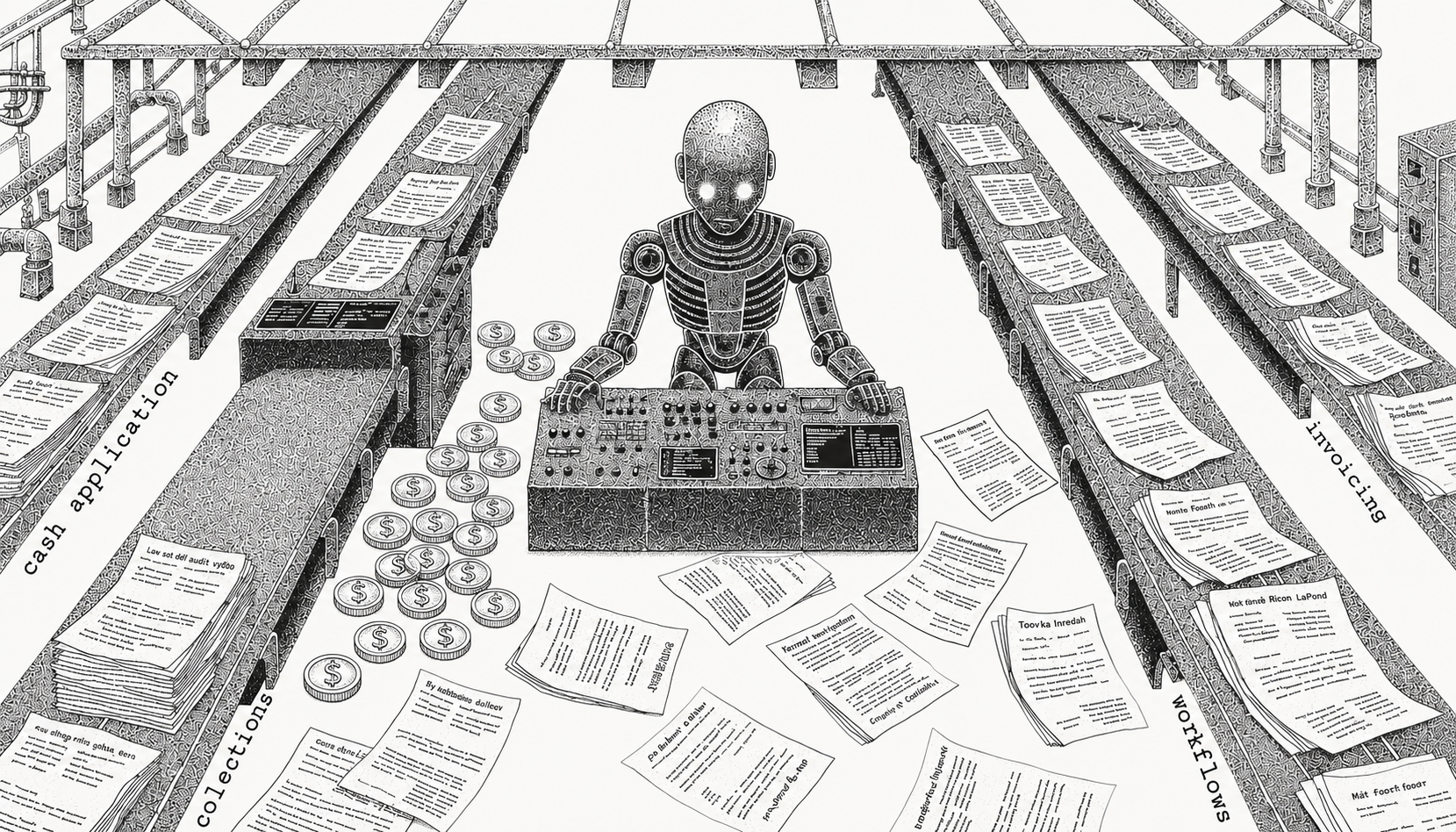
The shift shows up across four areas of the cycle, and each replaces a specific manual bottleneck with context-aware execution.
| Capability | What it replaces | What changes |
|---|---|---|
| Intelligent collections | Scheduled dunning blasts | Context-aware outreach, 24% more effective |
| Cash application | Manual payment matching | Auto-matches split and consolidated payments |
| Invoice automation | Manual invoice creation | Generates invoices from contract terms |
| Agentic workflows | Step-by-step human handoffs | Runs multi-step processes, escalates exceptions |
Collections is where a platform earns its return. Monk's intelligent collections and its AR agent, Julia, ingest signals across email replies, portal activity, and your CRM, then adapt outreach to each customer. When a customer says they will pay next week, it logs the promise, schedules follow-up after that date, and pauses other nudges. That context, not any self-learning, is why it is 24% more effective than standard dunning, and it keeps every action auditable.
Cash application handles the cases that break basic automation: payments split across accounts, consolidated payments across subsidiaries, and missing remittance detail, reaching an 80% automatic match rate, up to 95% with suggested rules. Invoice automation generates invoices from contract terms with multi-currency and complex line items, validating missing PO numbers before an invoice goes out, with processing accuracy above 90%. Agentic workflows then run multi-step processes such as portal setup, contact verification, and W-9 collection, escalating only when a genuine exception appears.
What ties the four together is that they share one source of truth. In older stacks, collections, cash application, and invoicing live in separate tools that do not talk to each other, so a payment applied in one system does not stop a reminder firing from another. When the four capabilities run on a single platform, applied cash, open balances, account context, and follow-up all stay in sync, which is what lets the system resolve the predictable, recurring exceptions that cause an estimated 39% of cash-flow slowdowns instead of escalating them. That integration is the difference between automation that adds work and automation that removes it.
What Stays Human in an AI-Native AR Process?
A common misconception is that AI-native AR removes the team. In practice it changes what the team spends time on. The roughly one in ten cases that require judgment, a contested charge, a sensitive enterprise relationship, an unusual payment arrangement, still route to a person, now with the full context attached so the decision is fast.
Monk also works the phone, placing outbound collection calls and answering inbound ones, with every call recorded and logged on the account. The result is a finance function where people handle exceptions and strategy while the system handles volume, and where the same data that runs execution also powers cash forecasting and a clearer view of risk. For a deeper look at where each model fits, see human-led vs AI-led collections.
How Are Leading Teams Deploying AI in AR?
The teams getting the most value do not flip a switch to full automation on day one. Monk lets them orchestrate their AI agents in stages: review the agent's drafted work, build trust as the results come in, then delegate the routine while keeping a hand on the exceptions.
That phased adoption is also what makes the change durable. Pump, which manages volume across more than 1,500 customers, freed its finance team of more than 40 hours a week with this approach, as detailed in the Pump case study. The work that used to consume the team, manual follow-up, portal submissions, and reconciliation, now runs largely on its own, with the team stepping in where their judgment matters.
A practical rollout usually starts narrow and widens as confidence grows. Many teams begin by letting the agent draft follow-ups for review, then move to letting it send routine outreach automatically once the tone and timing prove reliable, and finally hand off the recurring exceptions to documented playbooks. Each step is reversible and visible, so finance leaders never lose the audit trail. This is also where context-aware collections protect the customer relationship: because each message reflects the account's real history rather than a generic template, scaling up automation does not mean scaling up friction. The same comparison plays out in detail in dunning vs intelligent collections.
How Should You Measure AI Impact on AR?
Track a few metrics that show whether AI is actually delivering rather than just adding another tool. DSO and AR outstanding measure collection efficiency, where Monk customers see a 40% reduction. Auto-resolution rate measures how much runs without a person, and Monk resolves 90% of collections with zero human intervention.
Response rate shows whether outreach lands, and Monk's is 24% higher than standard dunning. Hours reclaimed quantifies freed capacity, an average of 26 per month. Speed to value matters too: Monk goes live in less than one week, so the payback window opens almost immediately rather than after a long rollout. For the wider field of tools, see the best AR automation software for 2026.
Frequently Asked Questions
What is AI-powered AR automation?
It uses AI and agentic systems to run the receivables cycle from invoicing through reconciliation, understanding context rather than just digitizing manual steps. Monk resolves 90% of collections with zero human intervention.
How much can AI reduce DSO?
Monk customers see a 40% average reduction in DSO. The exact figure depends on your starting DSO, invoice complexity, and customer mix, but the improvement typically appears within the first quarter.
What makes Monk's collections different?
Monk's intelligent collections ingest the context of each conversation to adapt tone per customer, which Monk reports is 24% more effective than standard dunning. The intelligence is in reading context accurately, not in self-tuning over time.
Does AI AR integrate with my existing systems?
Yes. Monk connects natively to Salesforce, QuickBooks, HubSpot, Stripe, NetSuite, and Anrok, plus Slack, Gmail, and Docusign, with bidirectional sync so your records stay the source of truth.
Does AI remove the need for a collections team?
No. It handles the routine volume and surfaces the roughly one in ten cases that need judgment, with full context attached, so the team focuses on exceptions and strategy rather than repetitive follow-up.
How fast can it go live?
Monk's typical go-live is less than one week, not months, so the return starts almost immediately and without taking a percentage of the revenue it collects.
Ready to turn revenue into cash with AI-native AR? Book a demo with Monk.
More on this: Intelligent Collections Software: A 2026 Guide, What Is Accounts Receivable Automation? [2026 Guide], Agentic vs Rules-Based Collections: What Changes in 2026 and Human-Led vs AI-Led Collections.



.avif)