Monk Platform Announces Real-Time Salesforce Integration

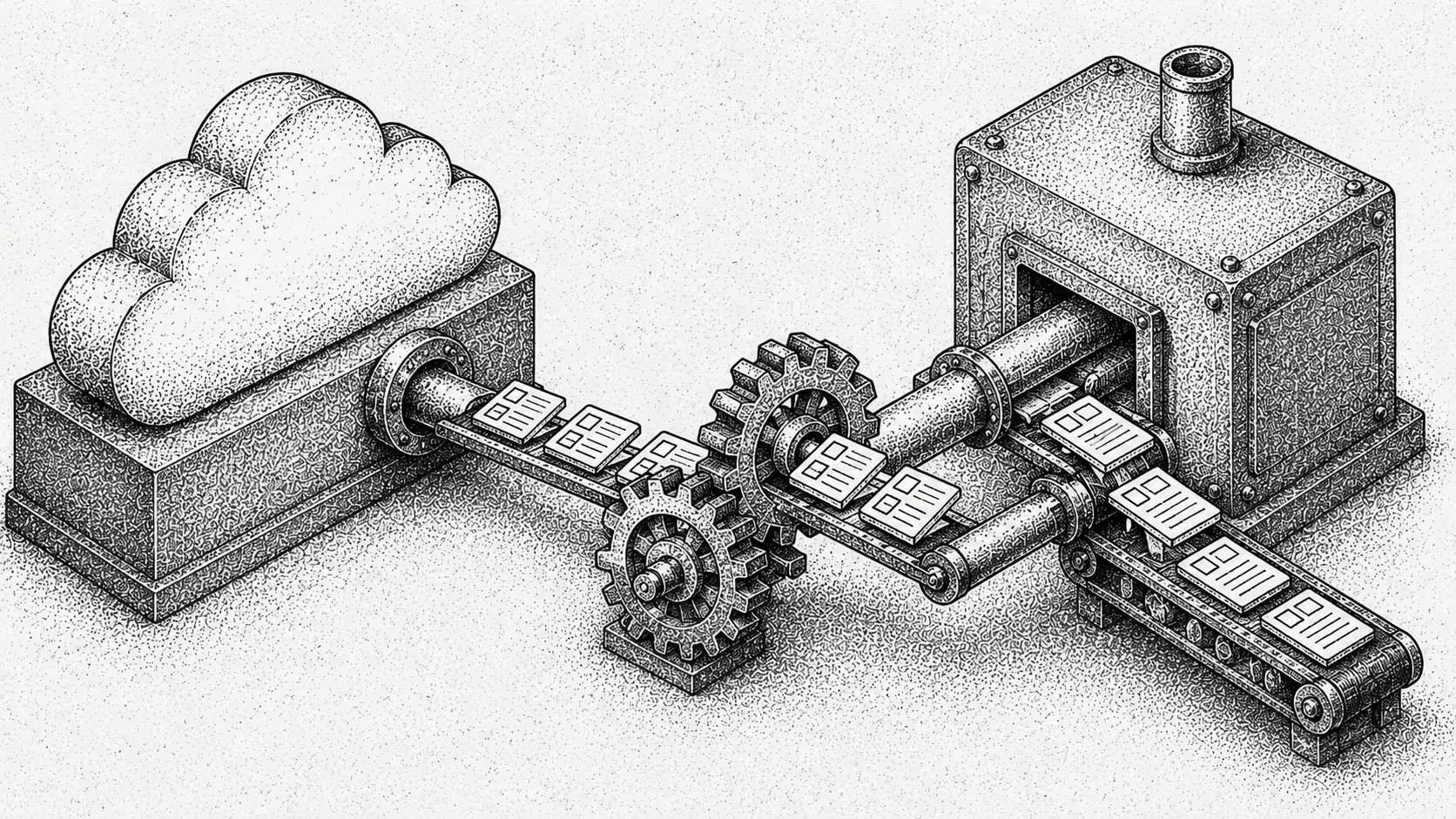
Today we are launching a native Salesforce integration that is built differently from standard billing connectors.
First, as with all Monk integrations - this is a native integration. Second, we deliver a significant amount of fidelity via real-time webhooks, full access to custom fields, and sandbox support. Third, we continue to leverage frontier models for contract extraction where we are able to infer deal types (amendments/renewals) and support any billing model, including usage based billing. Last, our team was able to build a proper historical backfill mechanism that allows you to quickly import all closed-won deals (not just net new).
The core point: closing a deal in Salesforce shouldn't require manual data entry into a billing system. Monk makes that handoff automatic, accurate, and auditable.
We are immensely proud of this integration and are excited for you to try it. Below are a few words from the team on why we set out on tis build and what's different in how we approached connecting to Salesforce.
Closing a Deal Shouldn't Start a New Job
A deal closes in Salesforce. Now someone has to pull the contract, read the terms, map everything to line items, set up billing schedules, and enter it all into your billing system. If the deal has usage-based components, that gets harder.
We've watched customers do this by hand. The reconciliation alone can take hours every month. Some had contracts with 50+ custom Salesforce fields covering start and end dates, per-SKU usage limits, billing periods, and renewal terms. Their old billing tools couldn't read any of it. They weren't managing billing. They were managing data entry.
Monk fixes that.
A Package Inside Salesforce, Not a Connector Around It
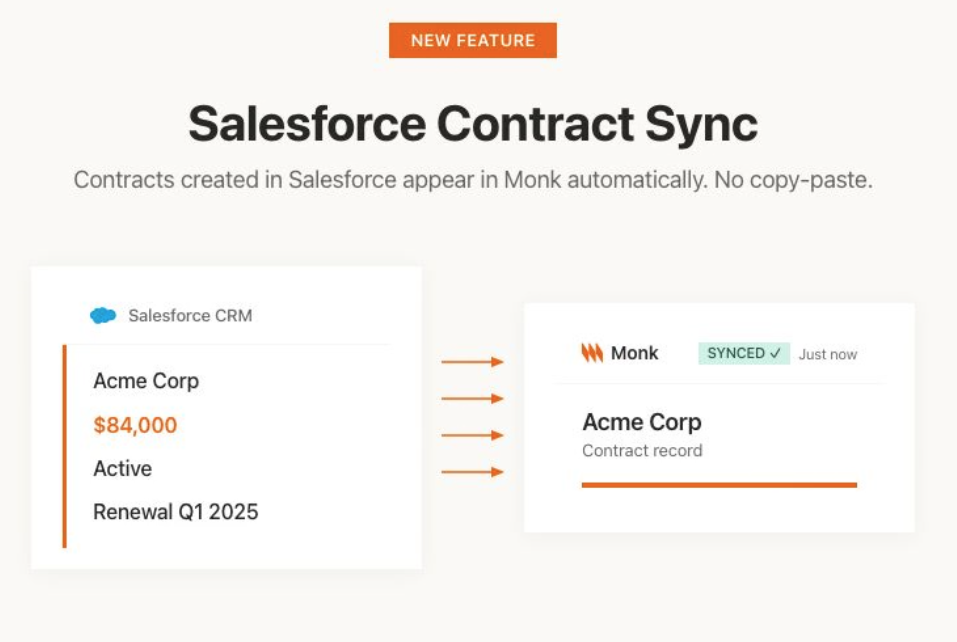
Monk installs into your Salesforce org as a native managed package. It's not a third-party connection polling your CRM every few hours. It lives inside Salesforce.
That means webhooks fire the moment an opportunity changes stage. You configure it from your Salesforce Lightning interface. The integration can read your full data model: standard fields, custom fields, attached files, related objects. Sandbox mode is built in, so you can test against your real schema before going live.
This matters because a slow or lossy sync doesn't just cause delays. It causes wrong invoices.
What Happens When a Deal Closes
When an opportunity moves to Closed Won, Monk fires a webhook and routes the deal through our AI extraction pipeline. The AI reads everything on the opportunity: all standard fields, all custom fields, any attached contract documents. It uses that to figure out the deal type (new contract, amendment, or renewal), pull out the pricing structure, and map line items to the right billing schedule.
Then it surfaces a draft for your team to review before anything goes out.
We don't auto-bill. A human looks at the draft and approves it. Customers have told us this is the right approach for complex deals. You want the AI to do the heavy lifting on extraction. You still want eyes on it before it touches a customer.
| Step | What happens |
|---|---|
| Closed-won webhook | When an opportunity moves to Closed Won, Monk fires a webhook from inside Salesforce |
| AI extraction of terms | The AI reads all standard fields, custom fields, and attached contracts to pull out the pricing structure |
| Deal-type inference | Monk infers whether the deal is a new contract, amendment, or renewal and maps line items to the right billing schedule |
| Human-reviewable billing draft | Monk surfaces a draft for your team to review and approve before anything goes out |
Usage-Based Billing Is the Hard Part
Most billing tools can read a flat-fee contract from Salesforce well enough. Usage-based billing is a different problem.
Think about contracts with per-SKU usage limits (service hours, contact caps, API calls), limits that change between contract periods, and credit allocations at different conversion rates. The actual usage data lives somewhere else, like Snowflake or an events pipeline. Reconciling all of that against the contract terms is where the manual work builds up.
Monk handles both sides. The integration pulls in the contract structure from Salesforce, including usage limits, credit allocations, and deal-specific pricing. It connects that to our metering engine, which tracks the actual usage. When a customer goes over their limit, Monk triggers the right response based on their contract: an overage invoice, a sales flag, or a usage cutoff.
Competitors lost deals because they couldn't handle usage-based billing alongside traditional contracts. We built it because our customers needed it.
You Don't Have to Start from Zero
Going live with Monk doesn't mean only new deals get imported. The integration includes a backfill flow for historical Salesforce opportunities. Existing customers come in without manual data entry. You can audit and fix any records where Salesforce data was incomplete.
What this Salesforce/Monk Integration Means for Customers
The Salesforce integration is the starting point for everything else Monk does. A deal closes, the contract gets extracted, billing gets set up, invoices go out, collections start. Every step depends on that first handoff being accurate.
That's why we built it the way we did: a native package, real-time webhooks, AI that reads your actual Salesforce schema, and a human review step that keeps your team in control without making them do the work.
Next Steps
If your team is spending time manually translating closed deals into billing data, we'd like to show you how Monk handles it. We have a team of ex-Salesforce experts who will work with you on your setup. This is especially relevant if you have custom fields.
Frequently Asked Questions
How does Monk's Salesforce integration work?
Monk installs as a native managed package inside your Salesforce org. When an opportunity moves to Closed Won, a webhook fires and routes the deal through Monk's AI extraction pipeline, which reads standard fields, custom fields, and attached contracts, then surfaces a billing draft for human review.
Does Monk support usage-based billing from Salesforce?
Yes. Monk pulls in contract structure from Salesforce, including per-SKU usage limits, credit allocations, and deal-specific pricing, then connects it to a metering engine that tracks actual usage and triggers overage invoices, sales flags, or usage cutoffs based on the contract.
Does Monk automatically bill customers when a deal closes?
No. Monk does not auto-bill. The AI does the heavy lifting on extraction and creates a draft, but a human reviews and approves it before anything goes out to a customer.
Can Monk import historical Salesforce deals, not just new ones?
Yes. The integration includes a backfill flow for historical Salesforce opportunities, so existing closed-won deals come in without manual data entry and records with incomplete Salesforce data can be audited and fixed.
Is the Salesforce integration native or a third-party connector?
It is native. Monk installs into your Salesforce org as a managed package rather than a third-party connection polling your CRM, so it can read your full data model and webhooks fire the moment an opportunity changes stage. Sandbox mode is built in for testing.
You can book a demo here. If you're already a customer and want to turn on the Salesforce integration, reach out to your account manager or email us at team@monk.com and we'll get you set up.
Adjacent to this: Monk Deepens Native Integration with HubSpot, Reinventing Invoice-to-Cash with AI-Native Architecture and AR Automation for Usage-Based Billing SaaS.



.avif)