The Month-End Close Process: A 2026 Guide for Finance Leaders

What Is the Month-End Close Process?
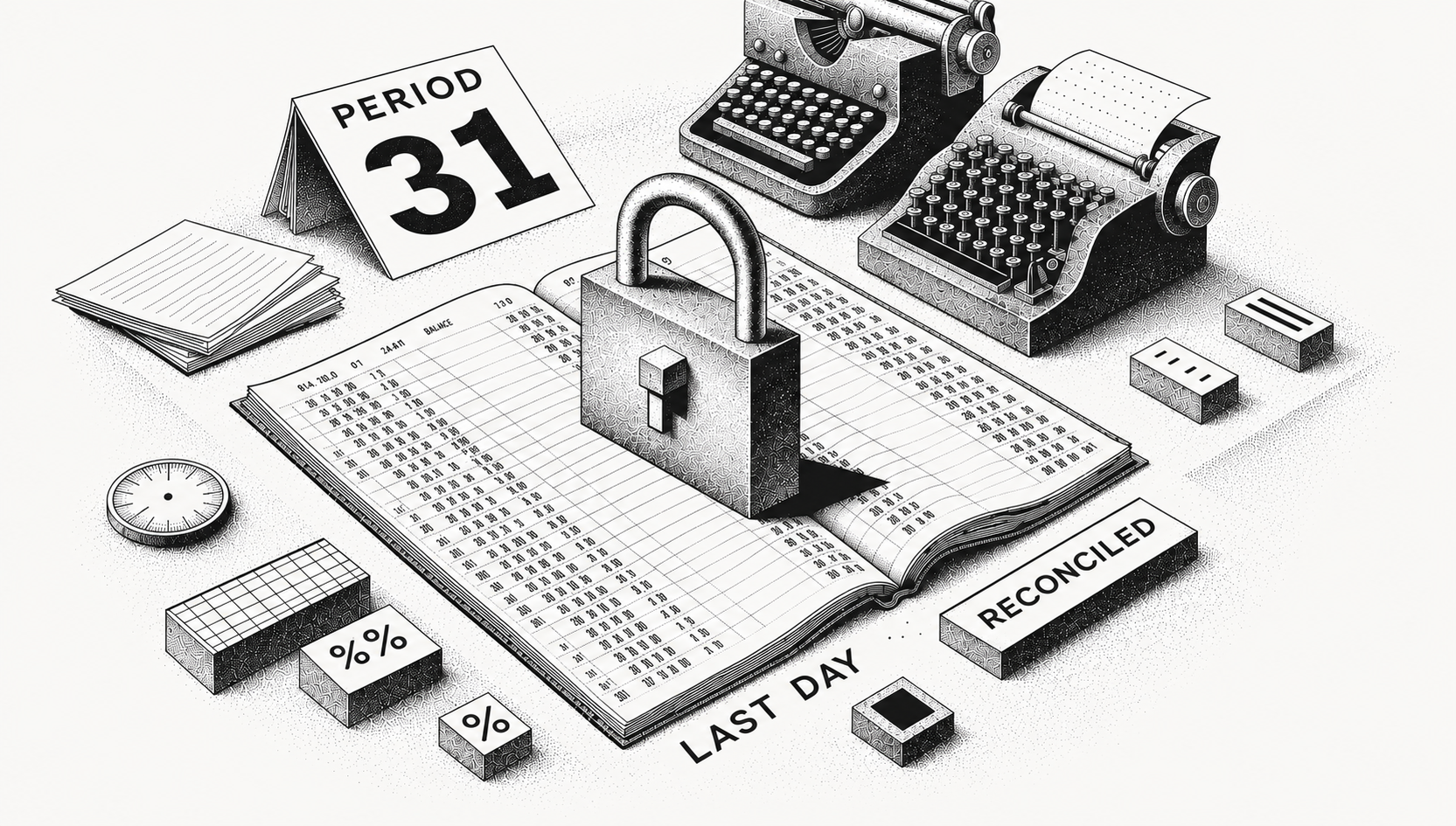
The month-end close is the process of finalizing a completed month's financial records by recording every transaction that belongs to it, reconciling accounts for accuracy, and locking the period so it cannot be quietly changed later. For a high-growth company, an efficient close is the difference between having timely numbers to steer by and spending the first two weeks of every month reconciling the last one while the current one slips away. Without a true period lock, historical financials are always in flux and a single backdated invoice can rewrite last quarter's revenue. The upstream accounts receivable breakdowns that complicate the close are mapped out in Monk's complete AR automation guide.
Why Does the Close Break at Scale?
The close rarely fails because a team is careless; it fails because the volume and complexity of receivables outgrow the manual habits that used to work. A process built to reconcile 50 invoices a month buckles when that number becomes 500, more payment terms appear, and three new tools enter the stack that do not talk to each other.
| Failure mode | What it looks like in practice |
|---|---|
| Volume outpaces manual work | A close cadence that held at $2M ARR quietly slips at $10M |
| AR grows more complex | More terms, billing cycles, and exceptions to reconcile each month |
| Integration gaps multiply | Invoicing, ERP, and payment systems require manual export and import |
| No audit trail | Numbers shift between drafts and no one can explain why |
Notice that three of the four trace back to receivables. When invoice status, payment matching, and collections live in disconnected spreadsheets, the AR portion of the close becomes a manual scramble that absorbs the team's first week. This is the same dynamic we examine in our look at how tool sprawl and siloed data drain cash flow velocity, and it is why accounts receivable automation is so often the highest-leverage fix for a slow close, even though the close itself is broader than AR.
Consider a concrete example. A Series B SaaS company closing the books on $8M in ARR was spending nine days on its close, and seven of them went to AR. The controller's team was manually exporting payment data from Stripe, matching it against invoices in a spreadsheet, then re-keying the results into NetSuite. Every unmatched payment, short payment, or duplicate triggered an email thread that took days to resolve. The accounting itself was sound; the bottleneck was that the receivables data feeding the close was never current, so the team rebuilt it from scratch every month. That pattern, where the close is slow because the AR ledger is stale, is the single most common reason a growing finance team blows past its target close window, and it is the same stale data that makes AR forecasts go wrong.
What Does a Strong Close Process Look Like?
The best close processes share a handful of traits, and each one removes a category of last-minute surprises. Set clear cutoffs so everyone agrees what belongs in the month and applies the accrual or cash basis consistently. Automate reconciliation by importing bank feeds and updating invoice status without manual entry, surfacing only the genuine exceptions for human review. Enforce period locks so reopening a closed month takes deliberate effort. And maintain real-time AR visibility so you know what is outstanding on any given day rather than discovering it on day eight of the close.
A Practical Close Framework for High-Growth Teams
A close that does not slip needs a sequence, not just a checklist. The four-phase framework below keeps work front-loaded so the back half of the close is review rather than data gathering.
| Phase | Window | Focus |
|---|---|---|
| Pre-close prep | Last 3 business days of the month | Confirm cutoffs, clear pending exceptions, chase open AR |
| Capture and accrue | Days 1 to 2 | Record all transactions, post accruals, lock invoicing |
| Reconcile | Days 2 to 4 | Match payments, reconcile bank and AR, resolve flags |
| Review and lock | Days 4 to 5 | Validate statements, lock the period, archive the audit trail |
The leverage point is pre-close prep. The slowest closes are the ones that walk into day one carrying a backlog of unresolved receivables. Pulling that work forward is exactly what receivables automation makes possible, because chasing and matching happen continuously instead of in a monthly burst. When you walk into the close with payments already applied and exceptions already worked, the reconcile phase shrinks from days to hours.
It also helps to separate the two distinct types of close work so you can attack them differently. Mechanical work, such as posting payments, matching remittances, and reconciling bank lines, is repetitive and rules-driven, which makes it a strong candidate for automation. Judgment work, such as deciding how to treat an ambiguous accrual or whether a disputed invoice should be reserved, genuinely needs a person. A clean automation layer handles the mechanical layer continuously, freeing the hours that should go to judgment work.
How Does AR Automation Accelerate the Close?
This is where purpose-built tooling earns its place. Monk automates the full invoice-to-cash process and connects to the systems you already invoice and collect in, so the AR portion of the close becomes reviewing data rather than gathering it. When a customer pays, the invoice updates automatically; when a payment is late, intelligent collections ingests the context of each conversation and follows up more effectively than standard dunning, without anyone on the team writing the email. Because Monk works natively with QuickBooks, NetSuite, Stripe, and Salesforce, there is no manual export-import cycle dragging the close into a second week. Pump built exactly this kind of real-time AR source of truth on Monk, automating more than 96% of its collections emails and reclaiming 40-plus hours a week as it scaled from $1M to $25M in ARR, as the Pump case study recounts.
The numbers behind this are consistent across Monk's customer base. Teams save an average of 26 hours per month, hit an 80% automatic cash application match rate, rising to 95% once teams enable suggested rules so payments reconcile against the right invoices automatically, and resolve 90% of collections with zero human intervention. With $2B+ in receivables under management on the platform, Monk also lets teams formally lock periods, capture starting and ending balances for AR and deferred revenue, and warn on any attempt to edit an invoice in a closed period, all backed by a SOC 2 audit trail. The result is a receivables ledger that is close-ready by default rather than a source of month-end firefighting. Teams that want the broader playbook can start with Monk's view on why reducing DSO is the highest-leverage move a finance team can make.
Frequently Asked Questions
What is month-end close in accounting?
It is the process of reviewing, reconciling, and finalizing all financial transactions for a completed month. That includes verifying revenues and expenses, reconciling balance sheet accounts, and producing accurate statements that leadership can act on.
How long should month-end close take?
For high-growth companies, an optimized and automated close runs in roughly five to ten business days. Manual processes often stretch to fifteen or twenty days, while best-in-class teams close in three to five.
What is the difference between month-end and year-end close?
Month-end close happens twelve times a year and feeds internal reporting. Year-end close happens once and layers in additional procedures for annual reporting, tax, and external audits, so it naturally takes longer.
Can you automate month-end close?
Not entirely, because judgment-based work like accrual decisions still needs a human. But large portions automate cleanly, including bank reconciliations, invoice status updates, payment matching, data integration, and report generation, which frees the team for the work that actually requires review.
What is a period lock and why does it matter?
A period lock is a control that prevents creating or modifying transactions in a closed period. It preserves historical accuracy, maintains a clean audit trail, and stops accidental backdating from rewriting numbers leadership has already reported.
How does AR automation help with the close?
It keeps invoice status real-time, matches payments automatically at an 80% automatic match rate, rising to 95% with suggested rules, removes the manual export-import between systems, and enforces period controls. Together those turn the AR portion of reconciliation into a quick validation instead of the first week of the month.
Does Monk run the close for me?
No. Monk does not perform the accounting close itself, but it accelerates the receivables and cash side that feeds it. By keeping invoice and payment data current, Monk makes the AR reconciliation that usually slows the close a fast, exception-only review.
Ready to tighten the AR side of your close? Explore the Monk platform or book a demo to see it against your own ledger.





.avif)