What Is Invoice-to-Cash? Definition, Process, and Why It Matters

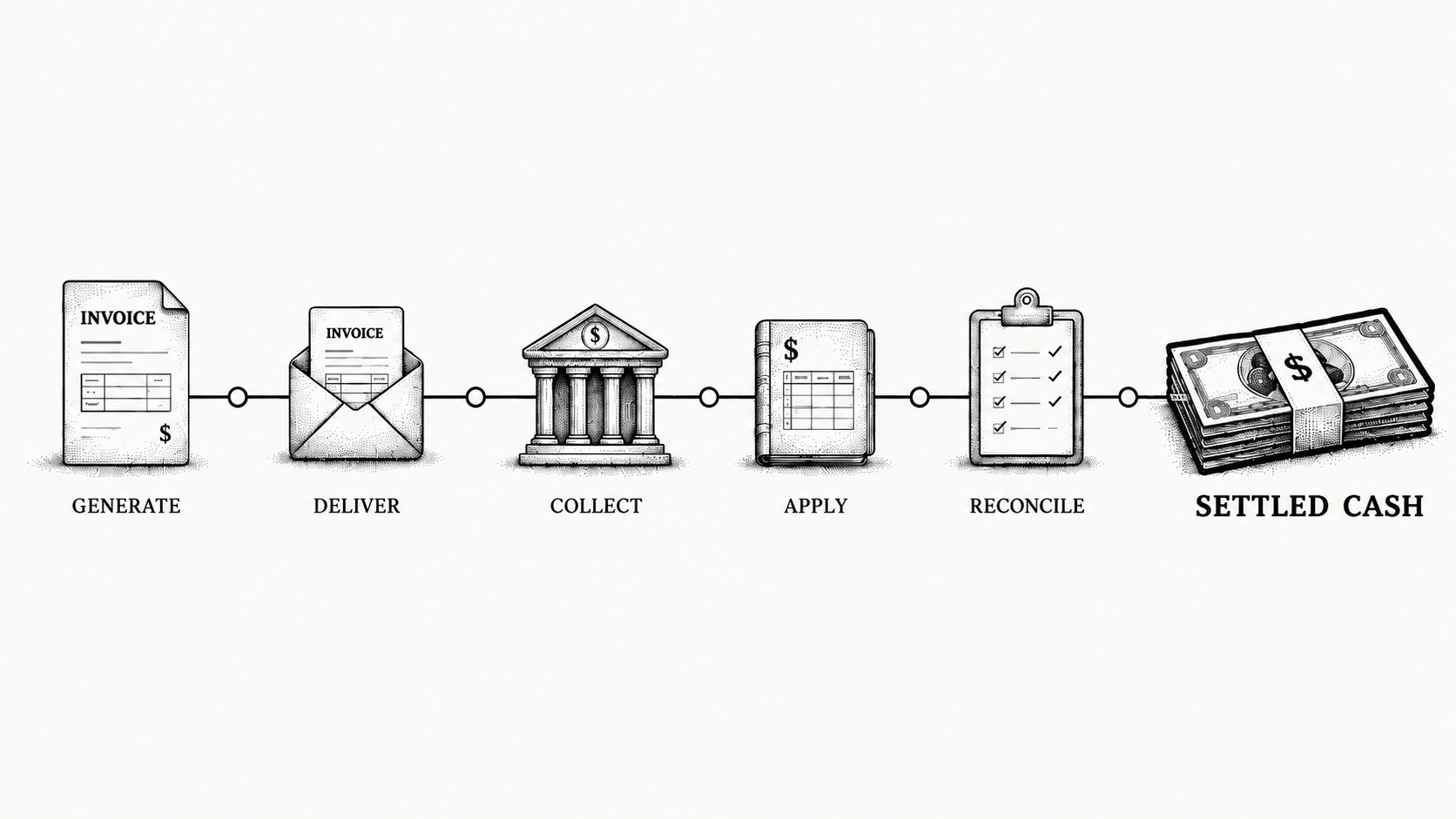
Invoice-to-cash is the end-to-end process of turning an issued invoice into collected, applied cash. It covers everything that happens after a sale is billed: generating the invoice, delivering it to the customer, following up to collect payment, applying that payment to the right open items, and reconciling and reporting the result. In short, invoice-to-cash is how finance teams move money from billed to banked.
The term is often shortened to I2C, and it sits at the heart of accounts receivable. It is also the lane where slow payments, manual follow-up, and unapplied cash quietly drain working capital. Monk is an AI-native invoice-to-cash platform, so this is the workflow we live in every day.
What Is the Invoice-to-Cash Process?
The invoice-to-cash process is usually described in five stages. Each stage hands off to the next, and a breakdown anywhere slows down the cash that follows it.
1. Invoice Generation
An accurate invoice is created from an order, contract, or usage record. It includes the amount due, line items, payment terms, and a due date. Errors here, such as a wrong amount or a missing PO number, are the most common reason invoices get disputed later.
2. Invoice Delivery
The invoice is sent to the customer through their preferred channel, whether that is email, a billing portal, or an accounts payable system. Delivery confirmation matters, because an invoice the customer never received cannot be paid on time.
3. Collections
Collections is the follow-up that moves an open invoice toward payment. It includes reminders before the due date, follow-up after it, dispute handling, and prioritizing the accounts most likely to slip. This is the most labor-intensive stage and the biggest driver of days sales outstanding (DSO).
4. Cash Application
When payment arrives, it has to be matched to the correct invoice or invoices and posted to the ledger. Cash application gets hard when remittance data is missing, payments are partial, or one wire covers many invoices. Accurate matching keeps the AR ledger clean and prevents teams from chasing money that has already been paid.
5. Reconciliation and Reporting
Finally, the AR sub-ledger is reconciled to the general ledger and to the bank, and the results feed reporting: DSO, aging, cash forecasts, and collector productivity. Clean reporting is what lets a team see whether the rest of the process is actually working.
How Is Invoice-to-Cash Different From Order-to-Cash and Contract-to-Cash?
These three terms overlap and are often used loosely, but they describe different scopes. Order-to-cash (O2C) is the broadest: it starts at the customer order and includes fulfillment and billing before AR even begins. Contract-to-cash starts earlier still, at the signed contract, and is common in subscription and usage-based businesses. Invoice-to-cash is the focused slice that begins the moment an invoice exists and ends when the cash is collected and applied.
| Dimension | Invoice-to-cash (I2C) | Order-to-cash (O2C) | Contract-to-cash |
|---|---|---|---|
| Starts at | Issued invoice | Customer order | Signed contract |
| Ends at | Cash collected and applied | Cash collected and applied | Cash collected and applied |
| Core focus | Collections, cash application, AR accuracy | Fulfillment plus billing plus AR | Pricing and entitlements plus billing plus AR |
| Typical owner | AR and collections teams | Sales ops, fulfillment, and finance | RevOps and finance |
The practical takeaway is that invoice-to-cash is the part of the cycle where finance has the most direct control over how fast cash actually arrives. That is why it functions as the anchor workflow rather than a sub-step of something broader, and why teams that fix it first tend to see the fastest DSO improvement relative to effort spent.
Why Does Invoice-to-Cash Matter?
Invoice-to-cash matters because it controls working capital. Every day an invoice sits unpaid is a day of cash tied up instead of funding the business. A slow or manual process shows up as high DSO, growing aging buckets, and finance teams spending their time chasing payments instead of analyzing them.
Done well, invoice-to-cash compresses the time between billing and banking. Teams using Monk have seen a 40% average DSO reduction, and customer-friendly outreach has driven a 24% higher response rate than traditional dunning. Strong cash application keeps the ledger trustworthy, because an 80% automatic cash application match rate, rising to 95% once teams enable suggested rules means far less manual matching and far fewer payments getting lost. Monk manages $2B+ in receivables and is SOC 2 Type II compliant.
What Breaks Invoice-to-Cash in a Manual Process?
Most invoice-to-cash problems are not dramatic. They are small handoff failures that compound across the five stages and quietly extend the time to get paid.
A wrong line item at generation becomes a dispute at collections. An invoice sent to the wrong contact at delivery becomes a missed due date. A wire with no remittance detail becomes hours of manual matching at cash application, and a messy sub-ledger becomes unreliable reporting at the end. Because each stage feeds the next, a single weak link drags down the entire cycle, which is why automating the connections between stages matters as much as automating any one of them.
How Do You Automate Invoice-to-Cash?
Automating invoice-to-cash means letting software handle the repetitive parts of each stage so people can focus on judgment calls. In practice, that work falls into three buckets.
- Automated, prioritized collections. Outreach is scheduled and sequenced by risk, and replies are handled in context rather than by generic dunning. With Monk, 90% of collections are resolved with zero human intervention.
- Intelligent cash application. Payments and remittances are matched automatically, even when one payment spans many invoices, holding an 80% automatic match rate (up to 95% with suggested rules).
- Continuous forecasting and reporting. DSO, aging, and expected cash update as the data changes, so finance is never working from a stale view.
The combined effect is real time back. Teams using Monk save about 26 hours per month on manual AR work, and go-live typically lands in less than one week rather than a multi-quarter rollout. Monk does this through products such as Cash Application, Cash Forecasting, and Intelligent Collections, coordinated by its AI agent Julia and configurable playbooks. Monk also does not take a percentage of your revenue.
Who Should Own Invoice-to-Cash?
Ownership usually splits across a few roles even on a small finance team. Billing or revenue operations owns invoice accuracy and delivery. Collections owns the follow-up and dispute resolution. Accounting owns cash application and reconciliation. When those roles work off the same live data instead of separate spreadsheets, handoffs stop being the place where invoices get lost, which is the single biggest practical gain of moving invoice-to-cash onto one connected platform.
How Monk Runs Invoice-to-Cash End to End
The advantage of an AI-native platform is that the five stages stop being separate tools and become one connected workflow. Monk treats invoice-to-cash as a single system rather than a chain of disconnected steps.
Julia coordinates outreach, applies cash as it arrives, and keeps forecasts current, while Monk's intelligent collections ingests the context of each customer conversation to follow up more effectively than standard dunning. Monk connects to the systems where billing and payment data already live, including Salesforce, QuickBooks, HubSpot, Stripe, NetSuite, and Anrok, so the ledger stays accurate without manual exports. The result is a shorter, cleaner path from billed to banked, run on the numbers above rather than on guesswork. For finance teams deciding where to automate first, invoice-to-cash is usually the highest-leverage lane, since it touches DSO, cash forecasting, and audit-readiness all at once.
Frequently Asked Questions
Common questions about the invoice-to-cash process and how to automate it.
What does invoice-to-cash mean?
Invoice-to-cash is the end-to-end process of converting an issued invoice into collected, applied cash. It spans invoice generation, delivery, collections, cash application, and reconciliation and reporting.
What are the stages of the invoice-to-cash process?
There are five core stages: invoice generation, invoice delivery, collections, cash application, and reconciliation and reporting. Each stage hands off to the next, so a delay in one slows everything downstream.
What is the difference between invoice-to-cash and order-to-cash?
Order-to-cash is broader and starts at the customer order, including fulfillment and billing. Invoice-to-cash is the focused slice that begins once an invoice exists and ends when the cash is collected and applied.
How does invoice-to-cash automation reduce DSO?
Automation prioritizes and times collections outreach, handles replies in context, and applies cash accurately. Teams using Monk have reduced DSO by 40% on average while saving about 26 hours per month.
Is invoice-to-cash the same as accounts receivable?
They are closely related. Accounts receivable is the balance owed to a company, while invoice-to-cash is the process that collects and applies it. Invoice-to-cash is how AR gets turned into cash.
How long does it take to automate invoice-to-cash with Monk?
Go-live with Monk typically lands in less than one week rather than a multi-quarter rollout. Once live, Monk coordinates collections, cash application, and forecasting as a single workflow, which is how teams reach an 80% automatic cash application match rate, rising to 95% once teams enable suggested rules and resolve 90% of collections with zero human intervention.
Adjacent to this: Automated Invoice Generation: A 2026 Guide.



.avif)