Introducing Cash Exceptions: A Clear Way to Manage Payment Mismatches

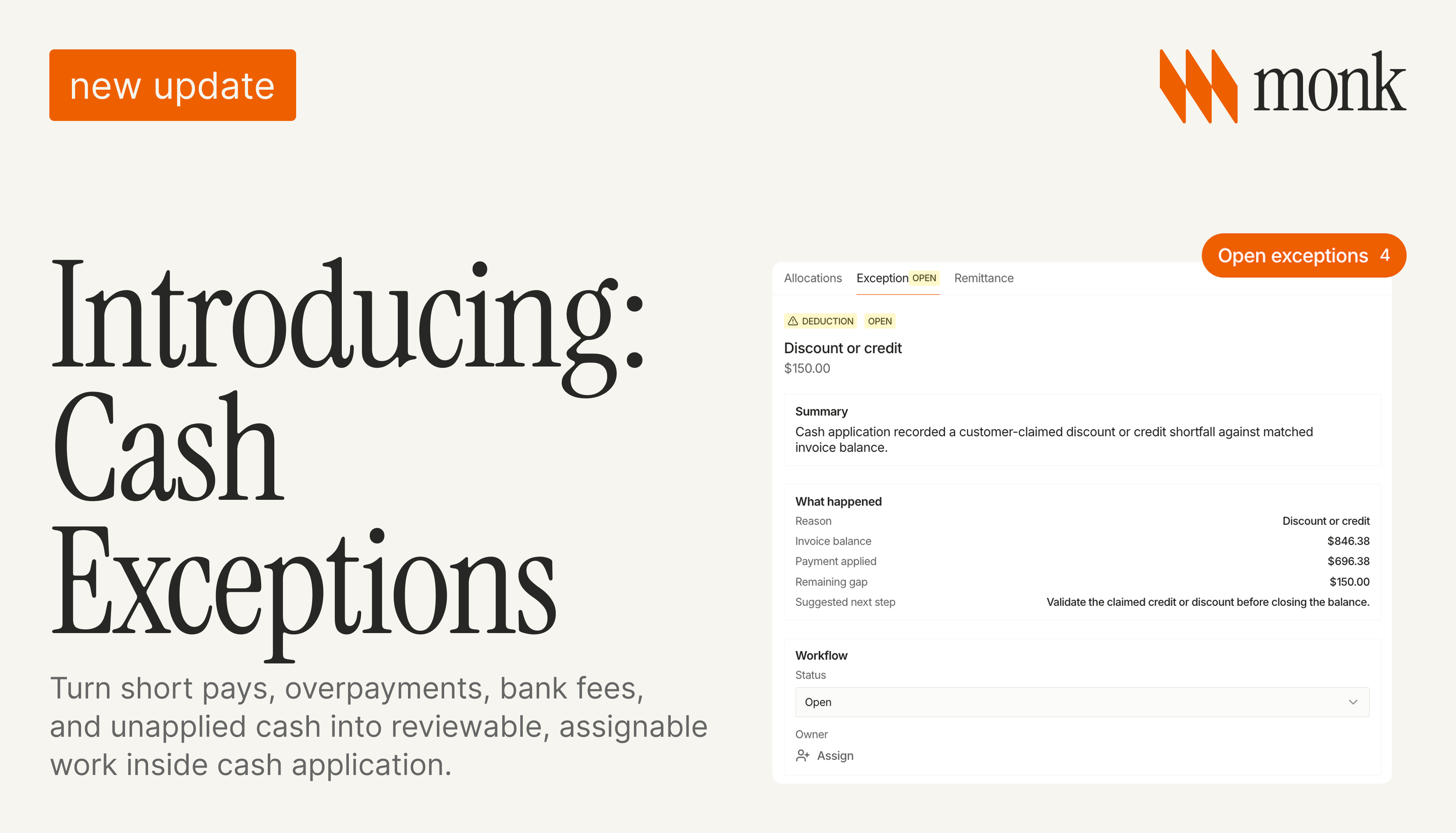
Cash application is easy when the payment matches the invoice exactly. The hard part is everything else: a customer short-pays by $500, a wire fee comes out of the transfer, an overpayment needs to become customer credit, or a payment lands with just enough context to be dangerous if you guess.
Those mismatches are where AR teams lose time. They sit in spreadsheets, Slack threads, aging notes, or someone's memory. The invoice stays open, the payment is only partly applied, and the reason why gets harder to reconstruct every week.
We're introducing cash exception management in Monk to make those mismatches reviewable, assignable, and auditable inside cash application.
What is a cash exception?
A cash exception is any payment variance that needs human review before the AR team can consider it fully handled. Examples include:
- a short payment against an invoice balance
- a claimed discount or credit
- a bank fee or FX shortfall
- an overpayment or unapplied cash balance
- a payment that may have been applied to the wrong invoice
- remittance that doesn't explain the payment clearly enough
A cash exception is not the same as a deduction. A deduction is usually intentional: the customer withheld money because they believe they were owed a credit, discount, adjustment, or concession. A cash exception is the wider bucket. It gives the team a place to track the gap first, then decide what it actually is.
Matching isn't the whole job
Most AR systems treat cash application as a matching problem: find the invoice, apply the payment, move on. But real finance teams need more than a match. They need to know what happened to the remaining balance, who owns the follow-up, what context was available at the time, and how the exception was resolved.
Cash exceptions give AR teams a clean workflow for that in Monk. When Monk detects a payment mismatch, the team can review it from the cash application drawer, see the affected transaction and invoice, assign an owner, add comments, update status, and keep an activity trail. So no payment gap goes unseen.
Built for control first
We're starting with review and workflow. Autonomous financial writebacks come later, once the rules are clear. Cash exceptions help teams understand and resolve mismatches. They don't automatically decide that an invoice should be written off, that a credit memo should be issued, or that an ERP should be updated without the right controls.
That's intentional. AR workflows touch cash, revenue, customer relationships, and accounting policy. The safest path is to make the work visible first, learn how teams resolve it, then add automation where the rules are clear.
Available by opt-in
Cash exception management is available as an opt-in feature for Monk customers. If your team deals with short pays, unapplied cash, overpayments, bank fees, or deduction-like workflows, we'd love to enable it for you and learn from your process.
Over the next few weeks we'll keep building on it: better reason classification, richer invoice and payment evidence, clearer resolution paths, and tighter connections between cash application, collections, and disputes.
How Do You Resolve a Cash Application Exception Step by Step?
The sequence below takes a payment mismatch from the moment it appears through to a resolved exception with an owner, a decision, and an audit trail.
- Measure the variance and check it against known patterns. Compare the cash received against the invoice balance and write down the exact difference, then test that figure against the usual causes: a wire or lockbox fee, an FX shortfall, or a standard discount percentage. A $35 gap on an international wire is almost always a bank fee, while a round $500 is a customer decision that needs an explanation.
- Classify the gap before you post anything. Decide whether you are looking at a short pay, a claimed discount or credit, a bank or FX fee, an overpayment, or cash applied to the wrong invoice. The classification decides who resolves it, so a wrong label sends the work to the wrong desk and the balance ages while it travels back.
- Apply the matched portion and hold the variance open. Post the cash that clearly belongs to identified invoices so those balances close on time, and keep the disputed or unexplained amount open against the specific invoice it relates to. Holding an entire payment hostage to one unexplained line delays cash you already have in the bank.
- Assign a named owner and a due date. Bank fees belong with treasury, claimed discounts with the account owner, and disputes with whoever can approve a credit. In Monk you do this from the cash application drawer: open the exception, review the affected transaction and invoice, assign the owner, and set the status.
- Keep the evidence and the decision on the exception itself. Attach the remittance, the customer email, and the reasoning behind the outcome as comments on the exception instead of leaving them in a spreadsheet or a Slack thread. That activity trail is what lets a colleague or an auditor reconstruct the decision months later.
- Close the loop in the ledger and with the customer. Issue the credit memo, write off the fee, or hand the remaining balance back to collections, then mark the exception resolved so the invoice shows its final position. Tell the customer what you concluded, because an unexplained residual balance produces the same short pay next quarter.
Frequently Asked Questions
What is a cash exception in AR?
Any payment variance that needs human review before it's fully handled, such as a short pay, an overpayment, a bank fee, unapplied cash, or a payment that may have hit the wrong invoice.
How is a cash exception different from a deduction?
A deduction is usually intentional, where a customer withholds money they believe they're owed. A cash exception is broader: it's the place to track any gap first, then decide what it is, including whether it's a deduction.
What can I do with a cash exception in Monk?
Review it from the cash application drawer, see the affected transaction and invoice, assign an owner, add comments, update status, and keep an activity trail.
Does Monk resolve cash exceptions automatically?
Not yet, and that's deliberate. Monk surfaces and organizes the work so a person can resolve it. Automation comes later, where the rules are clear.
Want tighter control over payment mismatches? Book a demo or talk to the Monk team about turning on cash exceptions.
Related reading: Put AR on autopilot and the new home for finance teams.
If this is the problem you are solving, these go deeper: The Hard Part of Cash Application Is User Intent.



.avif)