Collection Agency vs Collections Software: Which Recovers More?

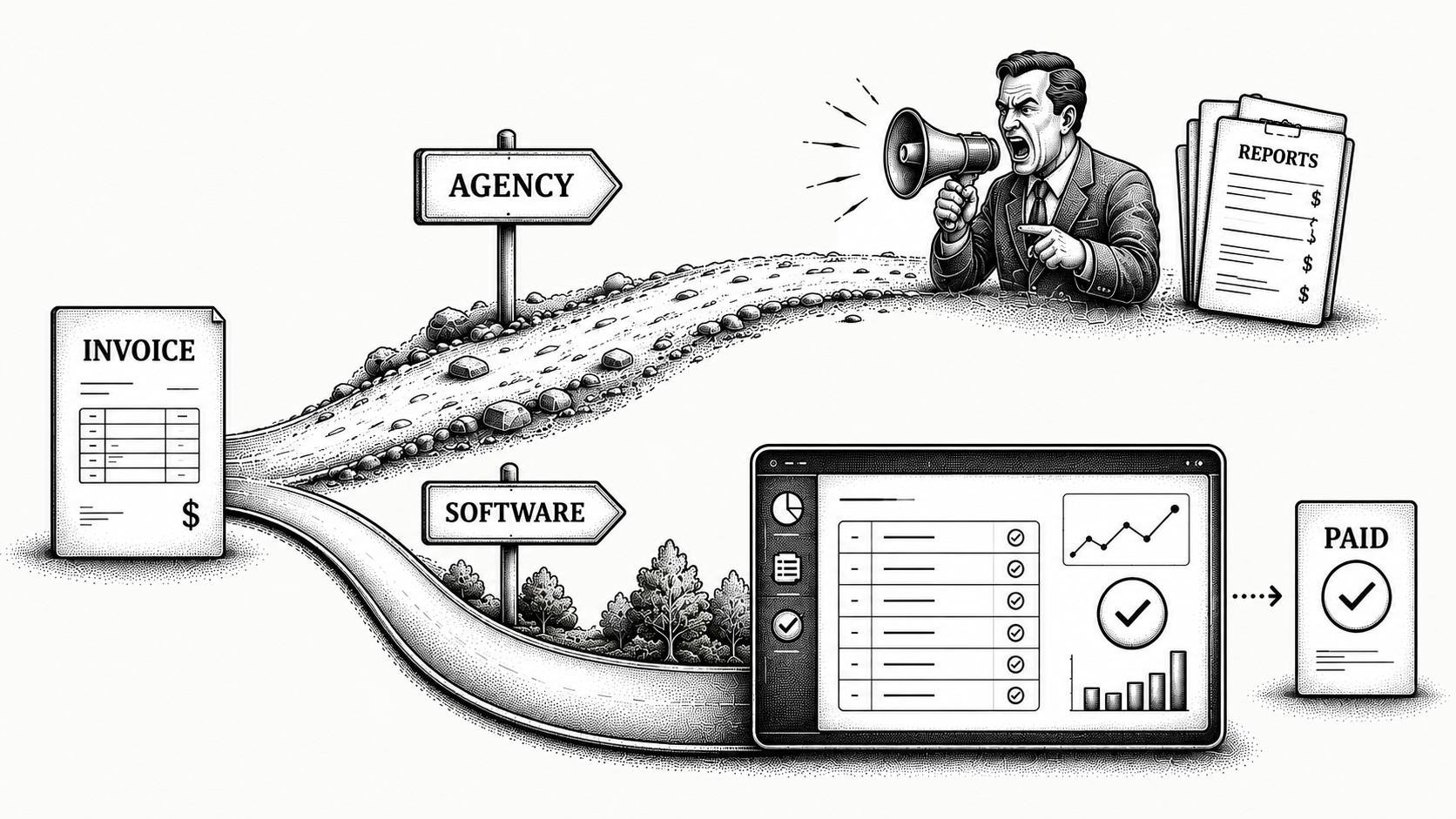
A collection agency recovers overdue debt for a steep contingency fee, often 25 to 50 percent of what it collects, and usually at the cost of the customer relationship. Collections software automates personalized follow-up earlier in the cycle, keeps the relationship in your hands, and costs a predictable fraction as much. For most B2B businesses the practical answer is software, because it keeps an account from ever reaching agency territory in the first place. This guide compares the two on cost, control, and customer relationships, and shows when each still makes sense.
Collection agency or collections software: what is the real choice?
When invoices go unpaid, most finance teams reach for one of two options: hand the debt to a collection agency, or put collections software to work. They sound similar but solve the problem at opposite ends of the cycle.
A collection agency is a cure you apply after an account is badly overdue, for a steep contingency fee and at the cost of the customer relationship. Collections software is prevention: it automates personalized follow-up from the moment an invoice is due, keeps the relationship in your hands, and costs a fraction as much. For most B2B businesses, the right software means an account rarely reaches agency territory in the first place.
How does a collection agency work, and what does it cost?
A collection agency takes over an overdue account and pursues payment on your behalf, usually once an invoice is 90 days or more past due. It typically charges a contingency fee, often 25 to 50 percent of whatever it recovers, so a recovered $20,000 invoice can cost you $5,000 to $10,000.
The agency contacts your customer directly, in its own name, with its own tactics. That can recover money you had written off, but it comes with real downsides: you hand over control of the conversation, the outreach can feel adversarial, and the customer relationship rarely survives intact. Agencies are built to extract payment from accounts you have largely given up on, not to keep good customers paying on time.
How does collections software work?
Collections software automates the follow-up that normally falls to a person on your finance team. The best tools start the day an invoice is due, not 90 days later, and send personalized, professional outreach in your company's name.
Good software also tracks replies, submits invoices to accounts payable portals, and escalates only when a human truly needs to step in. That keeps your team focused on the genuine exceptions rather than the entire queue.
Modern, AI-native tools go further. They ingest the context of each conversation and respond more effectively than dunning, so a customer who says they will pay Friday gets a different message than one raising a dispute. Because the outreach stays in your voice and starts early, the relationship is preserved and far more invoices get paid before they ever become a recovery problem. The cost is a predictable subscription, not a cut of every dollar.
Collection agency vs collections software, side by side
Seen together, the two approaches differ on almost every dimension that matters to a finance team, from timing and cost to who controls the customer conversation.
| Factor | Collection agency | Collections software |
|---|---|---|
| When it acts | After 90+ days overdue | From the day an invoice is due |
| Cost | 25 to 50 percent of recovered | Predictable subscription |
| Whose name | The agency's | Yours |
| Customer relationship | Usually damaged | Preserved |
| Control | Handed over | You keep it |
| Best for | Old, likely-uncollectible debt | Keeping current customers paying on time |
How do recovery rates compare?
Compared head to head, the two are not really competing for the same dollars. An agency recovers a share of old debt you had already discounted to near zero, minus its fee. Software recovers far more in aggregate because it acts while invoices are fresh and most collectible, when a simple nudge or a portal submission still gets them paid.
The practical implication is that the highest-return move is not choosing a better agency, it is shrinking the pool of invoices that ever reach an agency at all. Every invoice paid at day 20 is one that never becomes a day-120 recovery problem.
Think of it as two different jobs. An agency is good at salvaging a fraction of what is already lost, while software is good at making sure far less is ever lost. A team that leans on agencies is optimizing the smaller, harder pool of dollars, while a team that leans on software is protecting the much larger pool of invoices that are still easy to collect.
When does a collection agency still make sense?
Software is not the answer for every situation. If an invoice is genuinely old, the customer has gone silent or insolvent, and you have exhausted your own outreach, an agency or a collections attorney may be the only path to recovering anything.
The honest framing is that an agency is a last resort for accounts you have effectively written off. The goal of good collections software is to make that last resort rare, not to pretend it never has a place. A large balance you had given up on can be worth the fee, even after the relationship is gone.
Why most B2B teams are better off with software
The core difference is prevention versus cure. A collection agency is a cure for a problem that software prevents. Teams that automate collections early reduce the number of accounts that ever age into agency territory, keep their customer relationships intact, and stop paying a percentage of their own revenue to recover it.
Monk customers see a 40% average reduction in DSO and resolve 90% of collections with zero human intervention, which is exactly the outcome an agency cannot deliver: getting paid faster while keeping the customer. Over a year, that compounds into far more cash collected on time and far fewer accounts written off at all.
How Monk fits
Monk is an AI-native invoice-to-cash platform with an AR agent named Julia. Its intelligent collections ingest the context of each reply and tailor tone and timing per relationship, earning about 24% higher response rates than standard dunning. It submits invoices to accounts payable portals like Coupa and Ariba automatically and applies cash back to your ERP at an 80% automatic match rate, rising to 95% with suggested rules, all in your company's name and without the adversarial tactics or contingency fee of an agency.
Monk integrates with Salesforce, QuickBooks, NetSuite, HubSpot, and Stripe, is SOC 2 Type II compliant, goes live in less than one week, and does not take a percentage of your revenue. For a growing B2B business, that means most invoices get paid on time, and the few that would have gone to an agency get handled long before they get there.
Frequently asked questions
Is collections software cheaper than a collection agency?
Usually, yes. An agency charges a contingency fee of 25 to 50 percent of what it recovers, while software is a predictable subscription regardless of how much you collect. Software also prevents many invoices from aging far enough to need an agency at all.
Will using software hurt my customer relationships?
No. Good collections software sends professional, personalized outreach in your own name and adapts to each customer, which preserves the relationship. That is the opposite of a third-party agency contacting your customer with its own tactics.
When should I use a collection agency instead?
An agency makes sense as a last resort for old, likely-uncollectible debt, when the customer has gone silent or insolvent and you have exhausted your own outreach.
Can software recover invoices already 90 or more days overdue?
Yes, software can chase aged invoices, though recovery rates are highest when follow-up starts early. The bigger value of software is preventing invoices from reaching 90 days in the first place.
Does Monk replace a collection agency?
For most B2B businesses, Monk removes the need for one by automating collections early and keeping accounts current. An agency remains an option for debt you have already written off.
What is the difference between dunning and a collection agency?
Dunning is a fixed sequence of reminders you send yourself. A collection agency is a third party that pursues overdue debt for a fee. Monk's intelligent collections sit between them: automated like dunning, but context-aware and in your name, so accounts rarely need an agency.
Related guides: When to Use a Collection Agency (and When Not To), B2B Debt Collection: The Complete Guide and Debt Collection Software for Businesses: A 2026 Guide.



.avif)