When to Use a Collection Agency (and When Not To)

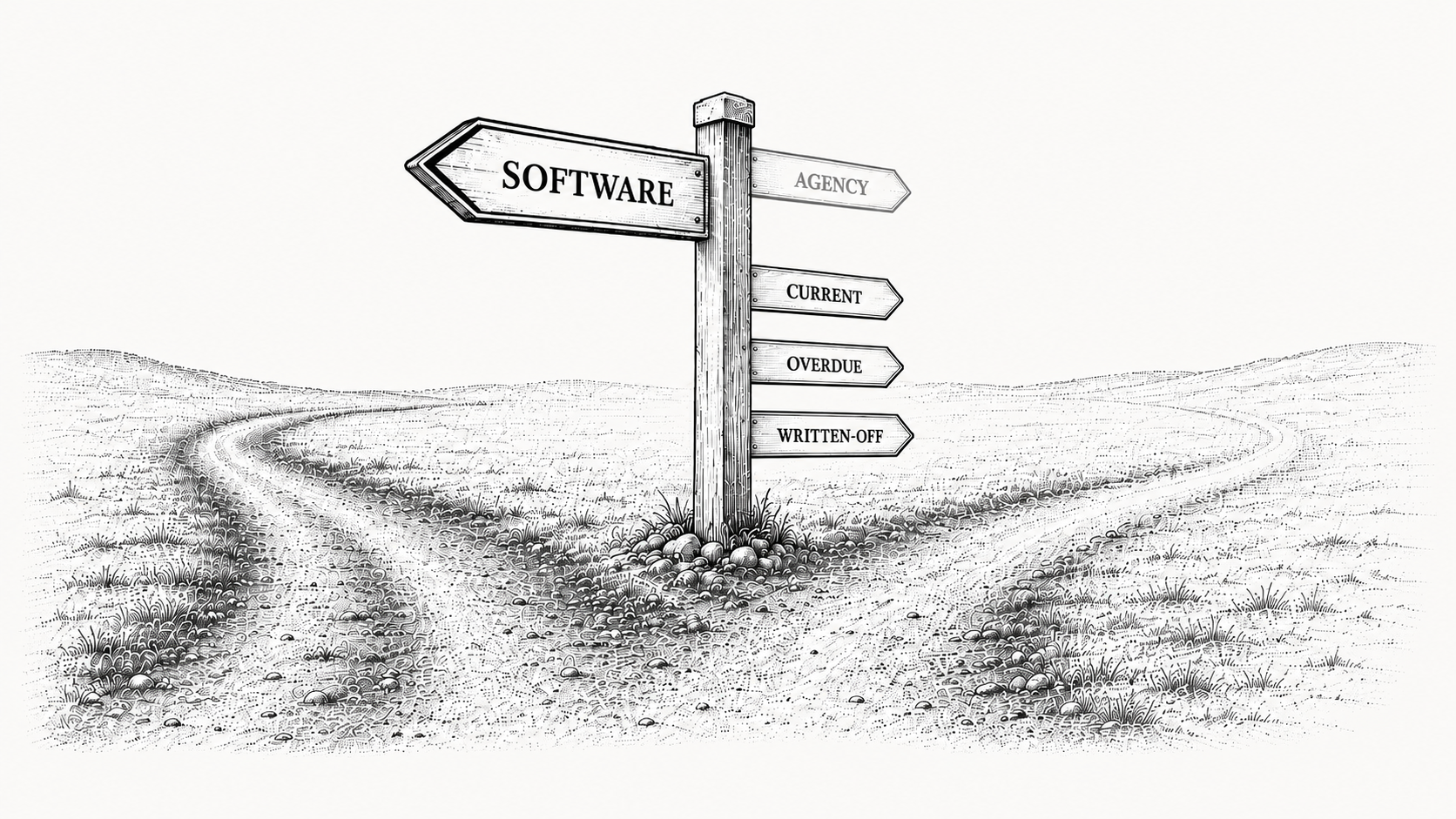
Use a collection agency as a last resort: when an invoice is badly overdue, the customer has stopped responding or is insolvent, your own outreach is exhausted, and the amount is large enough to justify the fee. For everything else, especially current accounts and customers you want to keep, collections software recovers more at far lower cost. This guide gives you a clear framework and the real costs of each path so you can decide with confidence.
When should you use a collection agency?
An agency really earns its place only at the very end of the road. By the time it makes sense, you have already tried consistent, professional outreach, the customer has gone quiet or cannot pay, and you have effectively written the debt off internally.
The deciding factor is usually the trade you are willing to make. An agency can recover money you had given up on, but it does so at a steep fee and at the cost of the relationship, which is only worth it when there is no relationship left to protect.
It is worth being honest about what an agency is and is not. It is a recovery tool for debt you have effectively lost, not a faster way to collect from customers who are simply slow to pay. Treating it as the latter trades a valuable, ongoing account for a one-time partial payment, which is rarely a good deal for a growing business.
What are the signs it is time for an agency?
A few clear signals indicate that an account has moved past what your own team should reasonably keep working. When several of these are true at the same time, escalation starts to make sense.
- The invoice is 90 to 120 days or more past due with no progress.
- The customer has gone silent after repeated, professional outreach.
- The customer is insolvent or out of business.
- You have effectively written the debt off internally.
- The balance is large enough that losing 25 to 50 percent of it to a fee still leaves a worthwhile recovery.
If none of these are true, the account almost certainly belongs in your own collections process, where it is cheaper to work and the relationship survives. Escalating a recoverable account too early simply hands away margin you did not need to give up, and it risks a customer you could have kept.
What does a collection agency cost?
Agencies charge a contingency fee, often 25 to 50 percent of what they recover, so the math only works on balances large enough to justify giving up half. Beyond the fee, you hand over control of the conversation, and the agency contacts your customer in its own name with its own tactics.
That is an acceptable trade for debt you have already given up on, and a poor one for an account you still want. The real cost is not just the fee; it is the renewal and the referral you forfeit when a third party takes over the relationship.
It helps to run the numbers before escalating. On a $30,000 invoice you had written off, a 40% fee still returns $18,000 you would not otherwise have seen, which is a clear win. On a $3,000 invoice from a customer you hoped to renew, the same fee plus the lost relationship rarely pencils out.
When is software the better call?
For current and recently overdue accounts, and any relationship you want to preserve, collections software is the stronger choice. It works early, in your name, for a predictable cost, and keeps most accounts from ever reaching agency territory.
The cost structure alone tends to settle the question. An agency takes a cut of every dollar it recovers, while software is a flat subscription regardless of how much you collect. As your receivables grow, a percentage fee scales against you, while a predictable subscription does not.
This is the larger point: most agency referrals are preventable. Consistent, early follow-up collects the invoice while it is still fresh, so the agency question never comes up. Monk customers see a 40% average reduction in DSO and resolve 90% of collections with zero human intervention, which is exactly the outcome that keeps accounts out of an agency's hands.
A simple framework for deciding
Match the action to the state of the account, and the right path is usually obvious.
| Account state | Best action |
|---|---|
| Current or recently due | Automated collections software |
| Overdue, customer responsive | Software with escalation playbooks |
| Badly overdue, unresponsive or insolvent | Collection agency or attorney |
The pattern is that an agency sits at the far end of the spectrum, reserved for debt you have effectively lost. Everything earlier in the cycle is better served by software, which is both cheaper and kinder to the relationship.
The strategic goal is to keep accounts on the left side of that table. Every invoice you collect while it is still current is one that never reaches the unresponsive or insolvent stage, which is why early automation does more for your recovery rate than any agency relationship can.
What should you do before escalating?
Before any account goes to an agency, work the basics that resolve most overdue invoices. Confirm why the invoice is actually unpaid, since the cause is often a dispute, a missing purchase order, or an invoice stuck in an accounts payable portal like Coupa or Ariba rather than a refusal to pay.
Then follow up professionally and persistently in your own name, and offer a payment plan for strained balances. Most accounts clear at this stage, and the few that do not are the genuine candidates for escalation. Skipping these steps means paying an agency for work you could have done yourself at a fraction of the cost.
Documenting each step also matters. A clear record of when you reached out, what the customer said, and how you tried to resolve the balance gives an agency or attorney what they need if escalation does become necessary. Just as importantly, it shows you exactly where the process broke down, so you can prevent the next account from reaching the same point.
How does Monk fit?
Monk is an AI-native invoice-to-cash platform whose AR agent, Julia, automates collections early so accounts rarely reach the point of needing an agency. Its intelligent collections ingest the context of each conversation and respond more effectively than dunning, adapting tone to each customer's history, submitting invoices to accounts payable portals, and applying cash back to your ERP, all while keeping the relationship in your hands.
Because that work happens in your name from the day an invoice is due, Monk customers see a 40% average reduction in DSO, save about 26 hours a month, and resolve 90% of collections with zero human intervention. Monk integrates with Salesforce, QuickBooks, NetSuite, HubSpot, and Stripe, is SOC 2 Type II compliant, goes live in less than one week, and does not take a percentage of your revenue, so the agency question becomes rare rather than routine.
Frequently asked questions
When should a business use a collection agency?
As a last resort, for badly overdue invoices where the customer is unresponsive or insolvent and your own outreach is exhausted. The balance should also be large enough to justify the contingency fee.
How much does a collection agency charge?
Typically a contingency fee of 25 to 50 percent of whatever it recovers, so it only makes sense on larger balances you have effectively written off.
Is it better to use a collection agency or software?
Software is better for current accounts and ongoing relationships because it works early, in your name, for a predictable cost. An agency is for old debt you have written off.
Can a collection agency hurt customer relationships?
Yes. The agency contacts your customer in its own name with its own tactics, and the relationship rarely survives intact, which is why it is a last resort.
What should I do before sending an account to collections?
Confirm why the invoice is unpaid, follow up professionally, and offer a payment plan. Automated collections software handles most of this and prevents the need to escalate.
How does Monk reduce the need for an agency?
Monk automates personalized follow-up from the day an invoice is due, resolving 90% of collections with zero human intervention and cutting DSO by 40% on average. That keeps most accounts current and out of agency territory entirely.
Related guides: Collection Agency vs Collections Software: Which Recovers More?.



.avif)