Compliance-Built vs. Cash-Built Finance Stacks: Choosing the Right Engine for Growth

Introduction: Two Philosophies, One Balance Sheet
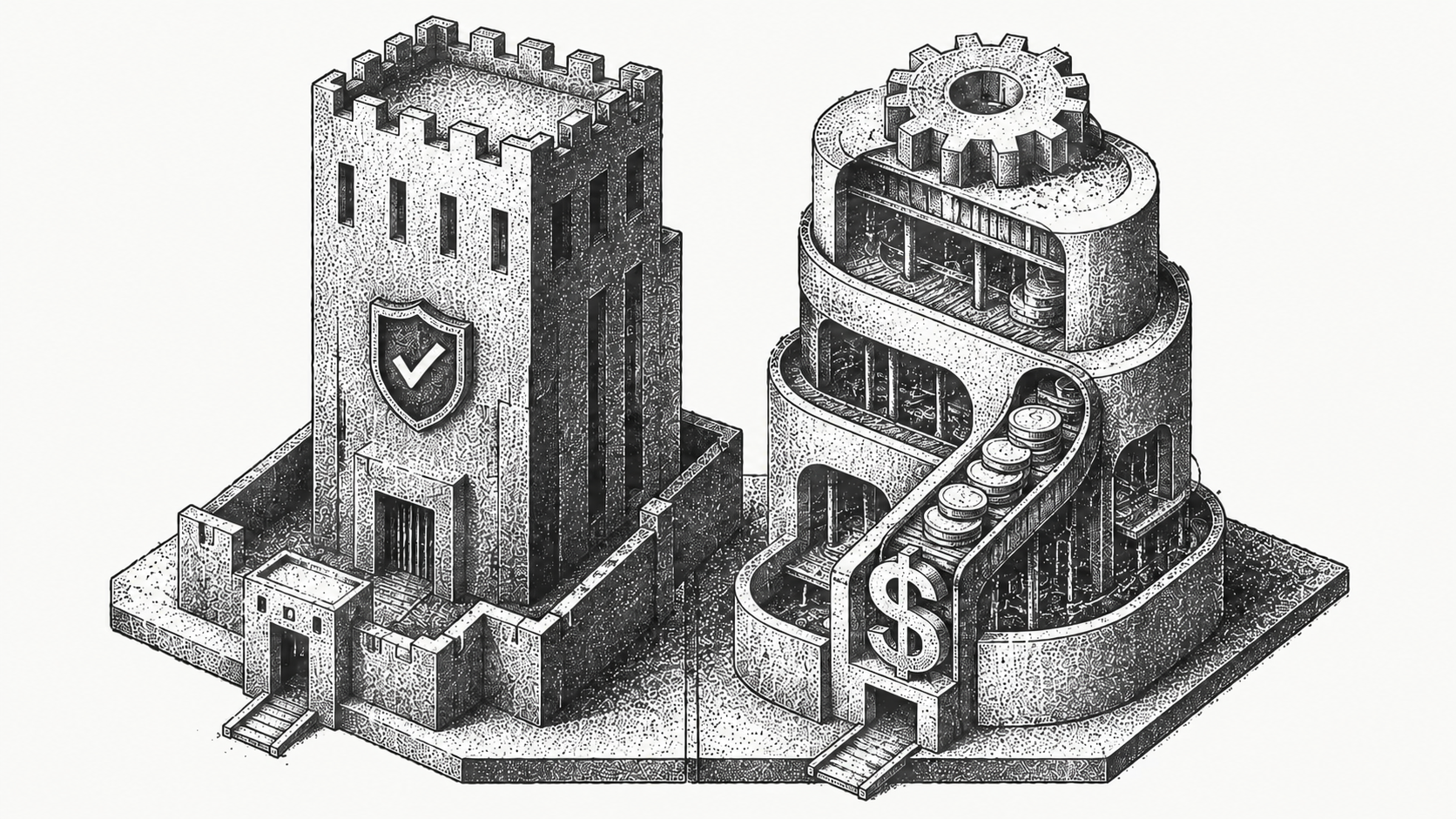
Every finance stack makes trade-offs. One lineage of tools was engineered to survive audits and enforce policy. The other lineage was born to accelerate liquidity and unlock working capital. Both promise control, yet they optimize for different outcomes. A compliance-built system worships the general ledger as final truth; anything that threatens reconciliation is blocked. A cash-built system worships velocity; data must flow, payments must clear, and edge cases must be solved in hours, not quarter-close crunch time. Most companies straddle both worlds without realizing the tension, layering subscription billing APIs on top of decades-old ERP modules that freeze whenever a buyer asks for net sixty terms. The result is a Frankenstein stack: safe enough to pass audit but too slow to fuel ambitious growth. Monk was built for the second lineage, applying modern accounts receivable automation to the cash-first side of this divide.
This essay explores the philosophical roots, technical architectures, and economic consequences of each approach. We draw on patterns from SaaS, manufacturing, and fintech to show how stack orientation shapes metrics like DSO, forecast accuracy, and burn multiple. We then offer a migration roadmap for leaders ready to pivot from compliance-only to cash-first, without sacrificing controls that keep regulators happy.
The Compliance-Built Paradigm: Order, Replication, and Period Close
Compliance-driven finance evolved when regulatory headwinds and on-premise software defined risk. Sarbanes-Oxley in 2002 forced public companies to prove that every transaction reconciled to the penny. The safest design was a monolithic ERP that replicated data slowly but deterministically. Each module, AR, AP, and GL, owned its own tables. Nightly batch jobs rolled sub-ledger totals into the general ledger. Custom workflows were discouraged; deviations threatened the audit trail.
In a compliance-built stack, change control is everything. New tax rules mean months of configuration, user acceptance testing, and external audit sign-off. Integrations are one-way or loosely coupled to avoid contaminating master data. Automation is rule-based, deterministic, and requires segregation of duties. When an invoice falls outside predefined tolerances, the workflow stops cold, forcing manual review. This design is excellent at preserving integrity during a long regulatory investigation, but it slows daily operations. Cash acceleration becomes an afterthought because the KPI scoreboard is dominated by on-time quarter closes and unqualified audit opinions.
The Cash-Built Philosophy: Flow, Context, and Real-Time Decisions
Cash-first architecture emerged alongside cloud-native startups that traded capital efficiency for speed. When runway is measured in months, not quarters, you cannot wait three days for an invoice to reach a portal. The guiding principle is simple: cash is oxygen. Systems must route data from contract signature to cleared funds in a continuous stream. Instead of nightly batches, event buses capture every state change and update a central graph store in milliseconds. Integrations are first-class citizens, versioned and owned by the same engineers who build product releases. Compliance controls still exist, but they live as policy layers in code-reviewed pipelines rather than rigid modules.
Autonomous agents, implemented as LLM-powered microservices, negotiate disputes, propose payment plans, and chase partial remittances. Because agents operate on a unified data substrate, they maintain context across contract clauses, invoice schedules, and prior communications. Human finance operators supervise edge cases and adjust policies; they do not re-enter data. The stack is optimized for cash-flow velocity: days from signature to bank settlement. Auditability follows because every event, agent action, and human override is logged with cryptographic trace IDs. This is precisely the model Monk delivers through its invoice-to-cash platform, where the AR agent Julia operates on a single graph of contracts, invoices, and conversations.
Architectural Showdown
For readers who want the contrast at a glance, the table below summarizes how the two orientations differ across the dimensions that matter.
| Dimension | Compliance-built | Cash-built |
|---|---|---|
| Optimizes for | Audit readiness and policy enforcement | Cash velocity and working capital |
| Data store | Relational ERP sub-ledgers rolled into the GL | Event-sourced graph updated in real time |
| Process cadence | Batch jobs oriented around period close | Streaming events and continuous close |
| Exception handling | Queue for manual review | Agentic auto-resolution, then review |
| Integration strategy | Loose, often file-based | API-native and schema-flexible |
| Primary KPI | Audit readiness | Cash velocity |
Economic Impact: How Orientation Shows on the P&L
A compliance-built system may secure unqualified audits, but hidden costs pile up. Days sales outstanding hovers in the fifties while best-in-class peers drop well below thirty. Working capital lost in AR accruals forces higher revolver draws at elevated interest rates. Reconciliation teams expand to chase exceptions the ERP cannot parse. On the P&L these costs hide as SG&A bloating and interest expense, compressing EBITDA multiples.
Cash-built adopters report tangible gains. Companies that migrate from a legacy ERP to a cash-first platform with agentic collections routinely compress DSO and free working capital, while audit fees stay flat because automated lineage simplifies sample testing. Monk customers see a 40% average DSO reduction and 26 hours saved per month; Profound grew its cash on hand 122% in the first month and cut its aging balance fivefold after going cash-first. Investors reward faster cash conversion with lower burn multiples and stronger valuations.
Risk Management: The False Dichotomy
Critics argue that cash-built equals cowboy finance: fast but risky. The evidence suggests otherwise. Modern cash-first platforms implement granular permissions, dual approval thresholds, and immutable logs. LLM agents can be sandboxed under policy engines that prevent unauthorized credit notes or bank detail changes. Continuous controls monitoring flags anomalies faster than quarterly audits. In practice many compliance-driven stacks rely on manual workarounds that never hit audit trails, whereas cash-first systems automate checks consistently. Monk is SOC 2 Type II compliant, so speed does not come at the expense of assurance.
Regulators increasingly accept continuous assurance models. The PCAOB has issued guidance encouraging automated, real-time control environments when supported by evidence. A cash-built stack aligns with this trend, shifting compliance from after-the-fact validation to integrated daily governance.
Migration Roadmap: Blending Control with Velocity
A pivot does not have to be a risky big-bang cutover. The following phased roadmap blends control with velocity.
Phase 1: Mirror and Observe. Stream contract, invoice, and payment events into a graph alongside the ERP. Build read-only dashboards to compare numbers.
Phase 2: Agentify Exceptions. Deploy an autonomous agent on one AP portal like Coupa. Require human approval for concession thresholds. Measure the reduction in manual touches.
Phase 3: Continuous Reconciliation. Enable sub-ledger close daily instead of monthly. Adopt real-time bank feeds and auto-matching algorithms. Stakeholders watch cash probability curves update hourly.
Phase 4: Policy as Code. Encode credit limits, tone guidelines, and escalation paths in version-controlled repositories. Security teams review pull requests like any production change.
Phase 5: Retire Legacy Batch Jobs. Once discrepancies approach zero, freeze ERP sub-modules for read-only archival. The streaming graph becomes the primary ledger.
Culture Shift: From Ticking Boxes to Fueling Growth
The biggest challenge of the shift is psychological. Controllers steeped in compliance may fear losing the safety blanket of manual sign-offs. CFOs can ease the transition by reframing velocity gains as risk mitigation: more cash extends runway and cushions shocks. Training programs should elevate finance analysts into data stewards who supervise agents and monitor dashboards.
Some organizations pilot the new stack in a subsidiary or new product line to build proof points. Over time the narrative evolves from "Will audits suffer?" to "How did we ever live without instant visibility?" Teams that have made the leap share hard-won lessons in our write-up on handling AR for fast-growing B2B SaaS businesses.
Looking Ahead: Convergence Rather Than Conflict
Ultimately the debate between compliance-built and cash-built finance stacks is a false one. The future converges: robust controls enforced continuously by code, paired with streaming data that fuels liquidity. The winning designs borrow discipline from legacy ERPs and agility from cloud architectures. CFOs who make the pivot today secure a twofold advantage: lower cost of capital through faster cash conversion, and regulator trust through transparent logs.
As interest rates fluctuate and AI transforms customer expectations, slow stacks become strategic liabilities as AI rebundles the winners. Finance leaders cannot afford month-old data or batch-driven exceptions. They need systems that guarantee integrity and deliver speed. Choosing a cash-built orientation does not abandon compliance; it embeds it in every event, making the ledger both accurate and alive. The same tension shows up at the document layer, which is why navigating buyer requirements like those in our playbook for Ariba, Coupa, and SAP Business Network matters for any cash-first team.
The question, then, is not whether to upgrade but how soon. Those who hesitate risk watching competitors use their reclaimed cash to capture market share. Those who act position finance as a growth engine rather than a cost center, rewriting the narrative for the decade ahead.
Frequently asked questions
What is the difference between a compliance-built and a cash-built finance stack?
A compliance-built stack is engineered to survive audits and enforce policy, treating the general ledger as final truth and optimizing for period close and audit readiness. A cash-built stack is engineered for liquidity and speed, treating data flow and cash velocity as the primary goal while embedding controls as code.
Does a cash-built finance stack sacrifice compliance?
No. Modern cash-first platforms implement granular permissions, dual approval thresholds, and immutable logs, with agents sandboxed under policy engines. Continuous controls monitoring flags anomalies faster than quarterly audits, aligning with regulator interest in real-time, automated control environments.
What KPI does each finance stack optimize for?
A compliance-built stack optimizes for audit readiness, on-time quarter closes, and unqualified audit opinions. A cash-built stack optimizes for cash velocity, measured as the number of days from invoice to cleared funds, while keeping auditability intact through logged events and overrides.
How do you migrate from a compliance-built to a cash-built stack?
A phased roadmap works best: mirror and observe events alongside the ERP, agentify exceptions with human approval thresholds, enable continuous reconciliation, encode policy as version-controlled code, and finally retire legacy batch jobs once discrepancies approach zero.
How does Monk fit a cash-built finance stack?
Monk is an AI-native invoice-to-cash and cash projection platform. It automates collections, matches payments to invoices, and forecasts cash on real-time customer behavior, supporting a cash-first architecture where controls are enforced continuously rather than only at period close.
More on this: CFO Playbook: Preparing Finance for the AI-Native Era.




.avif)