DSO Is Dead: The New Cash KPI Finance Teams Track in 2026


Is DSO Still the Right KPI for Finance Teams in 2026?
DSO is still worth tracking, but on its own it is no longer enough to run a finance team in 2026. Days sales outstanding is a lagging, backward-looking average: it tells you how long collection took last quarter, not which invoices are at risk now or when cash will actually arrive. The teams pulling ahead pair DSO with real-time, invoice-level cash visibility so they can act before an invoice ages rather than reporting on it after the fact.
In our experience working with finance teams managing receivables at scale, the "DSO is dead" framing is less about abandoning the metric and more about demoting it from a steering wheel to a rear-view mirror. This post explains where DSO falls short, the leading indicators worth tracking alongside it, and how a real-time, AI-driven invoice-to-cash system of record changes the picture. For the broader view of why DSO stays stubbornly high even after automation, see Monk's six proven strategies to reduce DSO.
Why Is DSO Alone No Longer Enough?
DSO has three structural blind spots that compound as a business grows. It is backward-looking, so it reflects what already happened rather than what is about to happen. It is an average, so it hides the difference between a customer who always pays late after a dispute and one who slipped once. And it is reactive, tied to end-of-month reporting cycles rather than daily action on live signals.
For fast-growing companies the distortion is worse. A handful of large invoices, a spike in contract value, or a lumpy billing month can swing the ratio, making receivables look like they are deteriorating when the underlying health is fine, or the reverse. A leader who manages to the number alone ends up chasing noise instead of the accounts that genuinely threaten cash.
There is also a behavioral cost. When DSO is the only scoreboard, teams optimize for month-end snapshots: a flurry of calls in the last week, aggressive cutoffs, and short-term pulls that strain customer relationships without fixing the upstream causes of late payment. Understanding what accounts receivable automation actually addresses helps reframe the goal from a prettier average to a healthier process.
A simple test exposes the gap. Ask your team to name, off the aging report, the five accounts most likely to slip this week and why. If the answer requires a manual pull and an hour of cross-referencing emails, the metric you manage by is not the metric that protects cash. The teams that win the cash game in 2026 can answer that question in seconds, because the signal lives in the workflow rather than in a month-end export.
What Should Finance Teams Track Instead?
The shift is from a single trailing average to a small set of leading, invoice-level indicators that tell you where cash is at risk today. The goal is to turn collections from a volume game into a precision operation, where attention flows to the accounts and exceptions that actually move the number.
In practice, the most useful complements to DSO are signals you can act on the same day you see them. Track the share of receivables tied to open disputes, the count of customers who have gone quiet after a touch, the percentage of invoices flowing through cleanly versus stalling on an exception, and a realistic expected-payment date per invoice rather than a blended average. Monk's own analysis points to a telling pattern here: roughly 39% of cash-flow slowdowns trace back to predictable, recurring exceptions rather than to customers who simply will not pay.
| Dimension | DSO alone | Real-time cash visibility |
|---|---|---|
| Timing | Backward-looking, monthly | Live, invoice-level |
| Granularity | Single blended average | Per invoice and per customer |
| Primary use | Month-end reporting | Intervene before aging |
| Risk view | Treats all accounts alike | Flags quiet or disputed accounts |
| Root cause | Obscured by the average | Recurring exceptions surfaced early |
How Does a Real-Time AR System Change Collections?
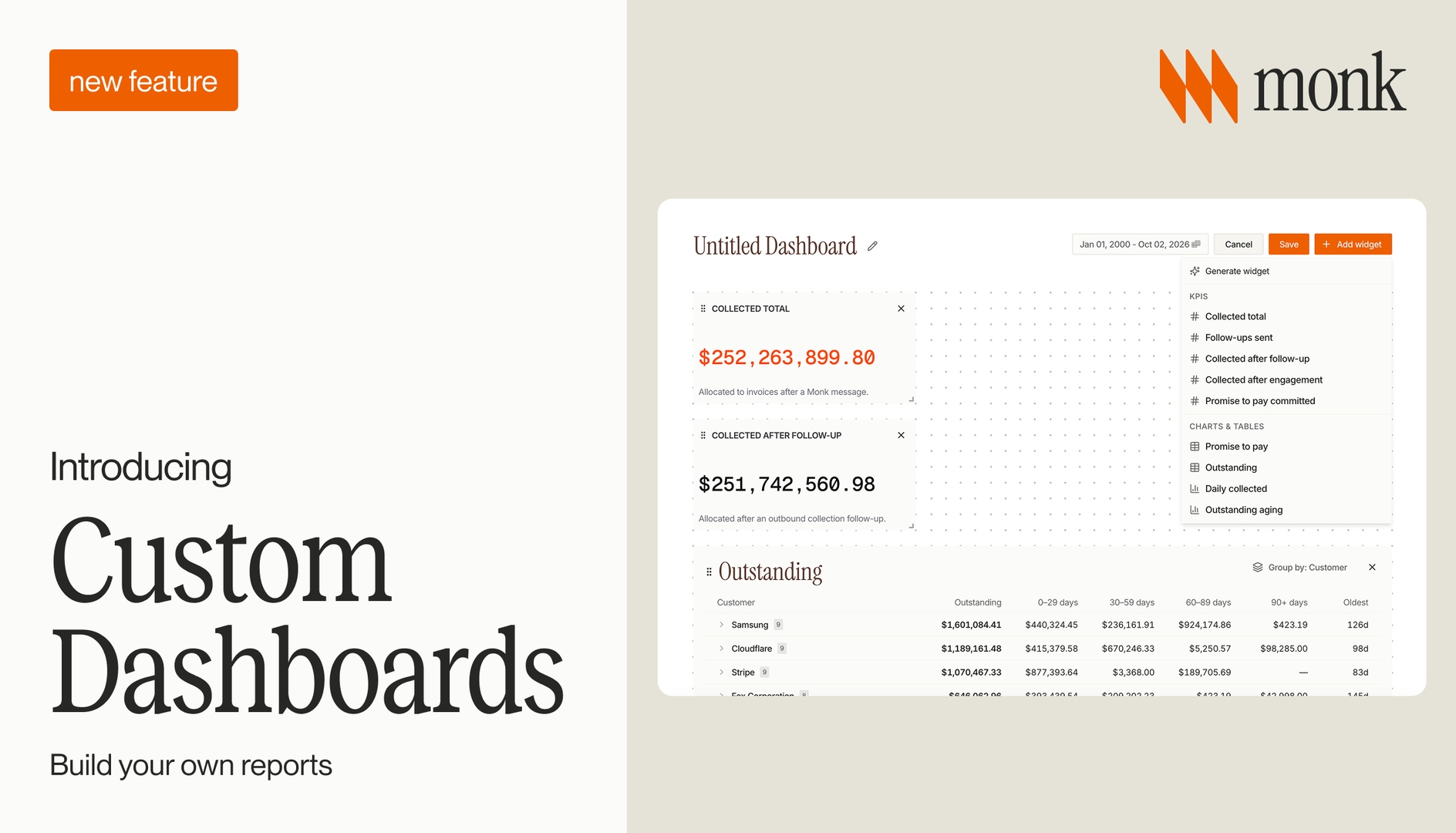
A real-time system of record acts on signals as they happen rather than waiting for an aging report to be assembled. Instead of a weekly manual pull from the ERP, the live layer continuously watches invoices, payments, and conversations and surfaces the next best action while it still matters.
This is where Monk's approach differs from the legacy dunning workflows that break in older AR systems. Monk's intelligent collections ingests the context of each customer conversation, adapts tone to that customer's history, and routes work through a smart queue, resolving routine items where it has high confidence and escalating the genuine exceptions to a person. Because that follow-up is contextual rather than a generic reminder cadence, monk.com reports a 24% higher response rate than standard dunning, and 90% of collections are resolved with zero human intervention.
Underneath that, the automation layer keeps cash application accurate, with an 80% automatic match rate (up to 95% with suggested rules), so the numbers on the live dashboard reflect reality rather than a lagging reconciliation. For the operational playbook behind these shifts, the team's guide on AR automation walks through how the workflow fits together end to end.
What Results Do Teams See After the Shift?
The payoff shows up as faster cash and reclaimed time, not just a cleaner report. Across the roughly $2B+ in receivables Monk manages, customers see a 40% average reduction in DSO, a 2.4x average increase in cash on hand in the first quarter, and an average of 26 hours saved per month, with a typical go-live of less than one week and SOC 2 controls in place. Siro cut its overdue AR by 45% while still growing revenue, and reclaimed more than 10 hours a week by managing to live signals instead of a month-end average.
As Nico Serventi, Head of Finance at Subject, put it: "Monk gave us immediate visibility into unbilled revenue, tightened our collections process, and became a true AR system of record, without adding headcount." That phrase, system of record, is the point: DSO becomes one line on a dashboard rather than the dashboard itself.
How to Make the Shift Without Disruption
You do not need to rip out your accounting system to move past DSO-only management. The practical path is to layer a real-time AR system of record on top of the ERP and CRM you already run, so live signals and automated follow-up sit alongside your existing books rather than replacing them.
A sensible sequence is to connect your source systems, let the platform establish a per-invoice baseline, then redefine your weekly review around leading indicators instead of the trailing average. Monk connects to the tools finance teams already use, including Salesforce, NetSuite, QuickBooks, HubSpot, Stripe, and Anrok, which is why the change tends to feel like an upgrade to visibility rather than a migration. To see how the pieces connect, browse Monk's integrations.
Frequently Asked Questions
Is DSO still a useful metric in 2026?
Yes, as a trend indicator over time. It is just not sufficient on its own, because it is a backward-looking average that cannot tell you which specific invoices are at risk right now or when cash will actually land.
What is the main problem with DSO?
It is both lagging and aggregated. It reflects collection that already happened and blends every account together, hiding the difference between a reliably late payer and a one-off slip.
What should replace or complement DSO?
Real-time, invoice-level cash visibility: which invoices are outstanding, which customers have gone quiet, where disputes are open, and a realistic expected-payment date per invoice rather than a single blended figure.
How does real-time AR visibility help cash flow?
It lets teams act before invoices age instead of reporting after the fact. Monk customers see a 40% average reduction in DSO and a 2.4x average increase in cash on hand in the first quarter.
Does this require replacing my accounting system?
No. A modern AR system of record integrates with your ERP and accounting software and acts as the live layer on top of it, so your books stay where they are.
What causes most cash-flow slowdowns?
According to Monk's analysis, roughly 39% of cash-flow slowdowns come from predictable, recurring exceptions rather than customers who refuse to pay. Surfacing those exceptions early is where real-time visibility pays off.
How fast can a team get live?
Monk's typical go-live is less than one week, because it layers onto existing systems rather than replacing them. That is why finance teams can shift their weekly review to leading indicators within the first week or two.
Ready to see your cash in real time instead of in hindsight? Book a demo with Monk.
Adjacent to this: Real-Time AR Reporting: What It Is and Why It Matters, 10 AR KPIs Every Finance Team Should Track in 2026 and Designing a Finance Stack for Liquidity Efficiency in 2026.



.avif)